

Common Object Request Broker Architecture

Encyclopedia
The Common Object Request Broker Architecture (CORBA) is a standard
defined by the Object Management Group
(OMG) that enables software components written in multiple computer languages
and running on multiple computers to work together (i.e., it supports multiple platforms).
More specifically, CORBA is a mechanism in software for normalizing the method-call semantics between application objects residing either in the same address space (application) or remote address space (same host, or remote host on a network). Version 1.0 was released in October 1991.
CORBA uses an interface definition language (IDL) to specify the interfaces which objects present to the outer world. CORBA then specifies a mapping from IDL to a specific implementation language like C++
or Java
. Standard mappings exist for Ada, C
, C++
, Lisp
, Ruby
, Smalltalk
, Java
, COBOL, PL/I and Python
. There are also non-standard mappings for Perl
, Visual Basic
, Erlang, and Tcl
implemented by object request broker
s (ORBs) written for those languages. Currently the OMG is working on a new IDL to C++11 language mapping, more details are available at ORBzone.org
The CORBA specification dictates there shall be an ORB through which an application would interact with other objects. In practice, the application simply initializes the ORB, and accesses an internal Object Adapter, which maintains things like reference counting, object (and reference) instantiation policies, and object lifetime policies. The Object Adapter is used to register instances of the generated code classes. Generated code classes are the result of compiling the user IDL code, which translates the high-level interface definition into an OS- and language-specific class base for use by the user application. This step is necessary in order to enforce CORBA semantics and provide a clean user process for interfacing with the CORBA infrastructure.
Some IDL mappings are more difficult to use than others. For example, due to the nature of Java, the IDL-Java mapping is rather straightforward and makes usage of CORBA very simple in a Java application. This is also true of the IDL to Python mapping. The C++ mapping is notoriously difficult; the mapping requires the programmer to learn complex and confusing datatypes that predate the C++ Standard Template Library
(STL). Currently work is being done to create a new C++0x language binding that will use Standard Template Library
(STL) heavily. Since the C language is not object-oriented, the IDL to C mapping requires a C programmer to manually emulate object-oriented features.
A language mapping requires the developer to create IDL code that represents the interfaces to his objects. Typically, a CORBA implementation comes with a tool called an IDL compiler which converts the user's IDL code into some language-specific generated code. A traditional compiler then compiles the generated code to create the linkable-object files for the application. This diagram illustrates how the generated code is used within the CORBA infrastructure:
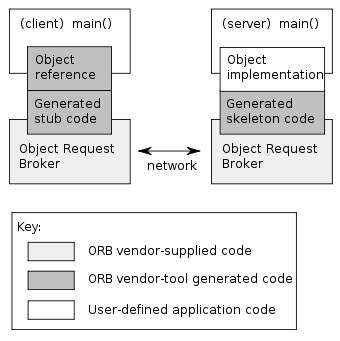 This figure illustrates the high-level paradigm for remote interprocess communications using CORBA. Issues not addressed here, yet accounted for in the CORBA specification, include data typing, exceptions, network protocols, communication timeouts, etc. For example: Normally the server side has the Portable Object Adapter
(POA) that redirects calls either to the local servants
or (to balance the load) to the other servers. Also, both server and client parts often have interceptors that are described below. Issues CORBA (and thus this figure) does not address, but that all distributed systems must address, include object lifetimes, redundancy/fail-over, naming semantics (beyond a simple name), memory management, dynamic load balancing, separation of model between display/data/control semantics, etc.
In addition to providing users with a language and a platform-neutral remote procedure call
(RPC) specification, CORBA defines commonly needed services such as transactions and security, events, time, and other domain-specific interface models.
OMG trademarks : CORBA, IIOP and OMG
are the registered marks of the Object Management Group and should be used with care. However, GIOP (General Inter-ORB Protocol) is not a registered OMG trademark. Hence in some cases it may be more appropriate just to say that the application uses or implements the GIOP-based architecture.
(URI) string, NameService lookup (similar to Domain Name System
(DNS)), or passed-in as a method parameter during a call.
Object references are lightweight objects matching the interface of the real object (remote or local). Method calls on the reference result in subsequent calls to the ORB and blocking on the thread while waiting for a reply, success or failure. The parameters, return data (if any), and exception data are marshaled internally by the ORB according to the local language and OS mapping.
define the concept of the OBV and Valuetypes. The code inside the methods of Valuetype objects is executed locally by default. If the OBV has been received from the remote side, the needed code must be either a priori known for both sides or dynamically downloaded from the sender. To make this possible, the record, defining OBV, contains the Code Base that is a space-separated list of URL
s from where this code should be downloaded. The OBV can also have the remote methods.
The OBVs may have fields that are transferred when the OBVs are transferred. These fields can be OBVs themselves, forming lists, trees or arbitrary graphs. The OBVs have a class hierarchy, including multiple inheritance and abstract classes.
The CCM has a component container, where software components can be deployed. The container offers a set of services that the components can use. These services include (but are not limited to) notification, authentication
, persistence
and transaction processing
. These are the most-used services any distributed system requires, and, by moving the implementation of these services from the software components to the component container, the complexity of the components is dramatically reduced.
It is useful for reusability.
to mediate the most important functions of the CORBA system. The CORBA standard defines the following types of interceptors:
The interceptors can attach the specific information to the messages being sent and IORs being created. This information can be later read by the corresponding interceptor on the remote side. Interceptors can also throw forwarding exceptions, redirecting request to another target.
s (ORBs) communicate. Standards associated with the protocol are maintained by the Object Management Group
(OMG). The GIOP architecture provides several concrete protocols, including:
Minor codes for the standard exceptions are prefaced by the VMCID assigned to OMG, defined as the unsigned long constant CORBA::OMGVMCID, which has the VMCID allocated to OMG occupying the high order 20 bits. The minor exception codes associated with the standard exceptions that are found in Table 3-13 on page 3-58 are or-ed with OMGVMCID to get the minor code value that is returned in the ex_body structure (see Section 3.17.1, “Standard Exception Definitions,” on page 3-52 and Section 3.17.2, “Standard Minor Exception Codes,” on page 3-58).
Within a vendor assigned space, the assignment of values to minor codes is left to the vendor. Vendors may request allocation of VMCIDs by sending email to tagrequest@omg.org. A list of currently assigned VMCIDs can be found on the OMG website at: http://www.omg.org/cgi-bin/doc?vendor-tags
The VMCID 0 and 0xfffff are reserved for experimental use. The VMCID OMGVMCID (Section 3.17.1, “Standard Exception Definitions,” on page 3-52) and 1 through 0xf are reserved for OMG use.
The Common Object Request Broker: Architecture and Specification (CORBA 2.3)
All CORBA products must support two OMG-defined URLs: "corbaloc:" and "corbaname:". The purpose of these is to provide a human readable and editable way to specify a location where an IOR can be obtained.
An example of corbaloc is shown below:
A CORBA product may optionally support the "http:", "ftp:" and "file:" formats. The semantics of these is that they provide details of how to download a stringified IOR (or, recursively, download another URL that will eventually provide a stringified IOR). Some ORBs do deliver additional formats which are proprietary for that ORB.
Language Independence
OS Independence
Freedom from Technologies
Strong Data Typing
High Tune-ability
Freedom From Data Transfer Details
Compression
Some of the failures were due to the implementations and the process by which CORBA was created as a standard, others reflect problems in the politics and business of implementing a software standard. These problems led to a significant decline in CORBA use and adoption in new projects and areas.
Implementation incompatibilities
Location transparency
Design and process deficiencies
Problems with implementations
Firewalls
Software engineering
Component-based software technologies
Language binding
Standardization
Standardization is the process of developing and implementing technical standards.The goals of standardization can be to help with independence of single suppliers , compatibility, interoperability, safety, repeatability, or quality....
defined by the Object Management Group
Object Management Group
Object Management Group is a consortium, originally aimed at setting standards for distributed object-oriented systems, and is now focused on modeling and model-based standards.- Overview :...
(OMG) that enables software components written in multiple computer languages
Programming language
A programming language is an artificial language designed to communicate instructions to a machine, particularly a computer. Programming languages can be used to create programs that control the behavior of a machine and/or to express algorithms precisely....
and running on multiple computers to work together (i.e., it supports multiple platforms).
Overview
CORBA enables separate pieces of software written in different languages and running on different computers to work with each other like a single application or set of services.More specifically, CORBA is a mechanism in software for normalizing the method-call semantics between application objects residing either in the same address space (application) or remote address space (same host, or remote host on a network). Version 1.0 was released in October 1991.
CORBA uses an interface definition language (IDL) to specify the interfaces which objects present to the outer world. CORBA then specifies a mapping from IDL to a specific implementation language like C++
C++
C++ is a statically typed, free-form, multi-paradigm, compiled, general-purpose programming language. It is regarded as an intermediate-level language, as it comprises a combination of both high-level and low-level language features. It was developed by Bjarne Stroustrup starting in 1979 at Bell...
or Java
Java (programming language)
Java is a programming language originally developed by James Gosling at Sun Microsystems and released in 1995 as a core component of Sun Microsystems' Java platform. The language derives much of its syntax from C and C++ but has a simpler object model and fewer low-level facilities...
. Standard mappings exist for Ada, C
C (programming language)
C is a general-purpose computer programming language developed between 1969 and 1973 by Dennis Ritchie at the Bell Telephone Laboratories for use with the Unix operating system....
, C++
C++
C++ is a statically typed, free-form, multi-paradigm, compiled, general-purpose programming language. It is regarded as an intermediate-level language, as it comprises a combination of both high-level and low-level language features. It was developed by Bjarne Stroustrup starting in 1979 at Bell...
, Lisp
Lisp programming language
Lisp is a family of computer programming languages with a long history and a distinctive, fully parenthesized syntax. Originally specified in 1958, Lisp is the second-oldest high-level programming language in widespread use today; only Fortran is older...
, Ruby
Ruby (programming language)
Ruby is a dynamic, reflective, general-purpose object-oriented programming language that combines syntax inspired by Perl with Smalltalk-like features. Ruby originated in Japan during the mid-1990s and was first developed and designed by Yukihiro "Matz" Matsumoto...
, Smalltalk
Smalltalk
Smalltalk is an object-oriented, dynamically typed, reflective programming language. Smalltalk was created as the language to underpin the "new world" of computing exemplified by "human–computer symbiosis." It was designed and created in part for educational use, more so for constructionist...
, Java
Java (programming language)
Java is a programming language originally developed by James Gosling at Sun Microsystems and released in 1995 as a core component of Sun Microsystems' Java platform. The language derives much of its syntax from C and C++ but has a simpler object model and fewer low-level facilities...
, COBOL, PL/I and Python
Python (programming language)
Python is a general-purpose, high-level programming language whose design philosophy emphasizes code readability. Python claims to "[combine] remarkable power with very clear syntax", and its standard library is large and comprehensive...
. There are also non-standard mappings for Perl
Perl
Perl is a high-level, general-purpose, interpreted, dynamic programming language. Perl was originally developed by Larry Wall in 1987 as a general-purpose Unix scripting language to make report processing easier. Since then, it has undergone many changes and revisions and become widely popular...
, Visual Basic
Visual Basic
Visual Basic is the third-generation event-driven programming language and integrated development environment from Microsoft for its COM programming model...
, Erlang, and Tcl
Tcl
Tcl is a scripting language created by John Ousterhout. Originally "born out of frustration", according to the author, with programmers devising their own languages intended to be embedded into applications, Tcl gained acceptance on its own...
implemented by object request broker
Object request broker
In distributed computing, an object request broker is a piece of middleware software that allows programmers to make program calls from one computer to another via a network...
s (ORBs) written for those languages. Currently the OMG is working on a new IDL to C++11 language mapping, more details are available at ORBzone.org
The CORBA specification dictates there shall be an ORB through which an application would interact with other objects. In practice, the application simply initializes the ORB, and accesses an internal Object Adapter, which maintains things like reference counting, object (and reference) instantiation policies, and object lifetime policies. The Object Adapter is used to register instances of the generated code classes. Generated code classes are the result of compiling the user IDL code, which translates the high-level interface definition into an OS- and language-specific class base for use by the user application. This step is necessary in order to enforce CORBA semantics and provide a clean user process for interfacing with the CORBA infrastructure.
Some IDL mappings are more difficult to use than others. For example, due to the nature of Java, the IDL-Java mapping is rather straightforward and makes usage of CORBA very simple in a Java application. This is also true of the IDL to Python mapping. The C++ mapping is notoriously difficult; the mapping requires the programmer to learn complex and confusing datatypes that predate the C++ Standard Template Library
Standard Template Library
The Standard Template Library is a C++ software library which later evolved into the C++ Standard Library. It provides four components called algorithms, containers, functors, and iterators. More specifically, the C++ Standard Library is based on the STL published by SGI. Both include some...
(STL). Currently work is being done to create a new C++0x language binding that will use Standard Template Library
Standard Template Library
The Standard Template Library is a C++ software library which later evolved into the C++ Standard Library. It provides four components called algorithms, containers, functors, and iterators. More specifically, the C++ Standard Library is based on the STL published by SGI. Both include some...
(STL) heavily. Since the C language is not object-oriented, the IDL to C mapping requires a C programmer to manually emulate object-oriented features.
A language mapping requires the developer to create IDL code that represents the interfaces to his objects. Typically, a CORBA implementation comes with a tool called an IDL compiler which converts the user's IDL code into some language-specific generated code. A traditional compiler then compiles the generated code to create the linkable-object files for the application. This diagram illustrates how the generated code is used within the CORBA infrastructure:
Portable Object Adapter
Portable Object Adapter - The CORBA object responsible for splitting the server side remote invocation handler into the remote Object and its Servant. The object is exposed for the remote invocations, while the servant contains the methods that are actually handling the requests...
(POA) that redirects calls either to the local servants
Servant (CORBA)
In CORBA, a Servant is the invocation target, containing methods for handling the remote method invocations. In the newer CORBA versions, the remote object on the server side is split into the Object and Servant...
or (to balance the load) to the other servers. Also, both server and client parts often have interceptors that are described below. Issues CORBA (and thus this figure) does not address, but that all distributed systems must address, include object lifetimes, redundancy/fail-over, naming semantics (beyond a simple name), memory management, dynamic load balancing, separation of model between display/data/control semantics, etc.
In addition to providing users with a language and a platform-neutral remote procedure call
Remote procedure call
In computer science, a remote procedure call is an inter-process communication that allows a computer program to cause a subroutine or procedure to execute in another address space without the programmer explicitly coding the details for this remote interaction...
(RPC) specification, CORBA defines commonly needed services such as transactions and security, events, time, and other domain-specific interface models.
OMG trademarks : CORBA, IIOP and OMG
Object Management Group
Object Management Group is a consortium, originally aimed at setting standards for distributed object-oriented systems, and is now focused on modeling and model-based standards.- Overview :...
are the registered marks of the Object Management Group and should be used with care. However, GIOP (General Inter-ORB Protocol) is not a registered OMG trademark. Hence in some cases it may be more appropriate just to say that the application uses or implements the GIOP-based architecture.
Objects By Reference
This reference is either acquired through a stringified Uniform Resource IdentifierUniform Resource Identifier
In computing, a uniform resource identifier is a string of characters used to identify a name or a resource on the Internet. Such identification enables interaction with representations of the resource over a network using specific protocols...
(URI) string, NameService lookup (similar to Domain Name System
Domain name system
The Domain Name System is a hierarchical distributed naming system for computers, services, or any resource connected to the Internet or a private network. It associates various information with domain names assigned to each of the participating entities...
(DNS)), or passed-in as a method parameter during a call.
Object references are lightweight objects matching the interface of the real object (remote or local). Method calls on the reference result in subsequent calls to the ORB and blocking on the thread while waiting for a reply, success or failure. The parameters, return data (if any), and exception data are marshaled internally by the ORB according to the local language and OS mapping.
Data By Value
The CORBA Interface Definition Language provides the language- and OS-neutral inter-object communication definition. CORBA Objects are passed by reference, while data (integers, doubles, structs, enums, etc.) are passed by value. The combination of Objects-by-reference and data-by-value provides the means to enforce strong data typing while compiling clients and servers, yet preserve the flexibility inherent in the CORBA problem-space.Objects By Value (OBV)
Apart from remote objects, the CORBA and RMI-IIOPRMI-IIOP
RMI-IIOP denotes the Java Remote Method Invocation interface over the Internet Inter-Orb Protocol , which delivers Common Object Request Broker Architecture distributed computing capabilities to the Java 2 platform...
define the concept of the OBV and Valuetypes. The code inside the methods of Valuetype objects is executed locally by default. If the OBV has been received from the remote side, the needed code must be either a priori known for both sides or dynamically downloaded from the sender. To make this possible, the record, defining OBV, contains the Code Base that is a space-separated list of URL
Uniform Resource Locator
In computing, a uniform resource locator or universal resource locator is a specific character string that constitutes a reference to an Internet resource....
s from where this code should be downloaded. The OBV can also have the remote methods.
The OBVs may have fields that are transferred when the OBVs are transferred. These fields can be OBVs themselves, forming lists, trees or arbitrary graphs. The OBVs have a class hierarchy, including multiple inheritance and abstract classes.
CORBA Component Model (CCM)
CORBA Component Model (CCM) is an addition to the family of CORBA definitions. It was introduced with CORBA 3 and it describes a standard application framework for CORBA components. Though not dependent on "language independent Enterprise Java Beans (EJB)", it is a more general form of EJB, providing four component types instead of the two that EJB defines. It provides an abstraction of entities that can provide and accept services through well-defined named interfaces called ports.The CCM has a component container, where software components can be deployed. The container offers a set of services that the components can use. These services include (but are not limited to) notification, authentication
Authentication
Authentication is the act of confirming the truth of an attribute of a datum or entity...
, persistence
Persistence (computer science)
Persistence in computer science refers to the characteristic of state that outlives the process that created it. Without this capability, state would only exist in RAM, and would be lost when this RAM loses power, such as a computer shutdown....
and transaction processing
Transaction processing
In computer science, transaction processing is information processing that is divided into individual, indivisible operations, called transactions. Each transaction must succeed or fail as a complete unit; it cannot remain in an intermediate state...
. These are the most-used services any distributed system requires, and, by moving the implementation of these services from the software components to the component container, the complexity of the components is dramatically reduced.
It is useful for reusability.
Portable interceptors
Portable interceptors are the "hooks", used by CORBA and RMI-IIOPRMI-IIOP
RMI-IIOP denotes the Java Remote Method Invocation interface over the Internet Inter-Orb Protocol , which delivers Common Object Request Broker Architecture distributed computing capabilities to the Java 2 platform...
to mediate the most important functions of the CORBA system. The CORBA standard defines the following types of interceptors:
- IORInteroperable Object ReferenceAn Interoperable Object Reference is a CORBA or RMI-IIOP reference that uniquely identified an object on a remote CORBA server.IORs can be transmitted in binary over TCP/IP via the General Inter-ORB Protocol , or serialized into a string of hexadecimal digits to facilitate transport by...
interceptors mediate the creation of the new references to the remote objects, presented by the current server. - Client interceptors usually mediate the remote method calls on the client (caller) side. If the object ServantServant (CORBA)In CORBA, a Servant is the invocation target, containing methods for handling the remote method invocations. In the newer CORBA versions, the remote object on the server side is split into the Object and Servant...
exists on the same server where the method is invoked, they also mediate the local calls. - Server interceptors mediate the handling of the remote method calls on the server (handler) side.
The interceptors can attach the specific information to the messages being sent and IORs being created. This information can be later read by the corresponding interceptor on the remote side. Interceptors can also throw forwarding exceptions, redirecting request to another target.
General InterORB Protocol (GIOP)
The GIOP is an abstract protocol by which Object request brokerObject request broker
In distributed computing, an object request broker is a piece of middleware software that allows programmers to make program calls from one computer to another via a network...
s (ORBs) communicate. Standards associated with the protocol are maintained by the Object Management Group
Object Management Group
Object Management Group is a consortium, originally aimed at setting standards for distributed object-oriented systems, and is now focused on modeling and model-based standards.- Overview :...
(OMG). The GIOP architecture provides several concrete protocols, including:
- Internet InterORB Protocol (IIOP) — The Internet Inter-Orb Protocol is an implementation of the GIOP for use over the InternetInternetThe Internet is a global system of interconnected computer networks that use the standard Internet protocol suite to serve billions of users worldwide...
, and provides a mapping between GIOP messages and the TCP/IPInternet protocol suiteThe Internet protocol suite is the set of communications protocols used for the Internet and other similar networks. It is commonly known as TCP/IP from its most important protocols: Transmission Control Protocol and Internet Protocol , which were the first networking protocols defined in this...
layer. - SSL InterORB Protocol (SSLIOP) — SSLIOP is IIOP over SSL, providing encryptionEncryptionIn cryptography, encryption is the process of transforming information using an algorithm to make it unreadable to anyone except those possessing special knowledge, usually referred to as a key. The result of the process is encrypted information...
and authenticationAuthenticationAuthentication is the act of confirming the truth of an attribute of a datum or entity...
. - HyperText InterORB Protocol (HTIOP) — HTIOP is IIOP over HTTP, providing transparent proxy bypassing.
VMCID (Vendor Minor Codeset ID)
Each standard CORBA exception includes a minor code to designate the subcategory of the exception. Minor exception codes are of type unsigned long and consist of a 20-bit “Vendor Minor Codeset ID” (VMCID), which occupies the high order 20 bits, and the minor code proper which occupies the low order 12 bits.Minor codes for the standard exceptions are prefaced by the VMCID assigned to OMG, defined as the unsigned long constant CORBA::OMGVMCID, which has the VMCID allocated to OMG occupying the high order 20 bits. The minor exception codes associated with the standard exceptions that are found in Table 3-13 on page 3-58 are or-ed with OMGVMCID to get the minor code value that is returned in the ex_body structure (see Section 3.17.1, “Standard Exception Definitions,” on page 3-52 and Section 3.17.2, “Standard Minor Exception Codes,” on page 3-58).
Within a vendor assigned space, the assignment of values to minor codes is left to the vendor. Vendors may request allocation of VMCIDs by sending email to tagrequest@omg.org. A list of currently assigned VMCIDs can be found on the OMG website at: http://www.omg.org/cgi-bin/doc?vendor-tags
The VMCID 0 and 0xfffff are reserved for experimental use. The VMCID OMGVMCID (Section 3.17.1, “Standard Exception Definitions,” on page 3-52) and 1 through 0xf are reserved for OMG use.
The Common Object Request Broker: Architecture and Specification (CORBA 2.3)
Corba Location (CorbaLoc)
Corba Location (CorbaLoc) refers to a stringified object reference for a CORBA object that looks similar to a URL.All CORBA products must support two OMG-defined URLs: "corbaloc:" and "corbaname:". The purpose of these is to provide a human readable and editable way to specify a location where an IOR can be obtained.
An example of corbaloc is shown below:
- corbaloc::160.45.110.41:38693/StandardNS/NameServer-POA/_root
A CORBA product may optionally support the "http:", "ftp:" and "file:" formats. The semantics of these is that they provide details of how to download a stringified IOR (or, recursively, download another URL that will eventually provide a stringified IOR). Some ORBs do deliver additional formats which are proprietary for that ORB.
Features
CORBA supports several features which it claims that no other single technology brings in one package. These benefits include language- and OS-independence, freedom from technology-linked implementations, strong data-typing, high level of tunability, and freedom from the details of distributed data transfers.Language Independence
- CORBA at the outset was designed to free engineers from the hang-ups and limitations of considering their designs based on a particular software language. Currently there are many languages supported by various CORBA providers, the most popular being Java and C++. There are also C-only, SmallTalk, Perl, Ada, Ruby, and Python implementations, just to mention a few.
OS Independence
- CORBA's design is meant to be OS-independent. CORBA is available in Java (OS-independent), as well as natively for Linux/Unix, Windows, Sun, Mac and others.
Freedom from Technologies
- One of the main implicit benefits is that CORBA provides a neutral playing field for engineers to be able to normalize the interfaces between various new and legacy systems. When integrating C, C++, Object Pascal, Java, Fortran, Python, and any other language or OS into a single cohesive system design model, CORBA provides the means to level the field and allow disparate teams to develop systems and unit tests that can later be joined together into a whole system. This does not rule out the need for basic system engineering decisions, such as threading, timing, object lifetime, etc. These issues are part of any system regardless of technology. CORBA allows system elements to be normalized into a single cohesive system model.
- For example, the design of a multitier architectureMultitier architectureIn software engineering, multi-tier architecture is a client–server architecture in which the presentation, the application processing, and the data management are logically separate processes. For example, an application that uses middleware to service data requests between a user and a database...
is made simple using Java ServletJava ServletA servlet is a Java programming language class used to extend the capabilities of servers that host applications accessed via a request-response programming model. Although servlets can respond to any type of request, they are commonly used to extend the applications hosted by Web servers...
s in the web server and various CORBA servers containing the business logic and wrapping the database accesses. This allows the implementations of the business logic to change, while the interface changes would need to be handled as in any other technology. For example, a database wrapped by a server can have its database schema change for the sake of improved disk usage or performance (or even whole-scale database vendor change), without affecting the external interfaces. At the same time, C++ legacy code can talk to C/Fortran legacy code and Java database code, and can provide data to a web interface.
Strong Data Typing
- CORBA provides flexible data typing, for example an "ANY" datatype. CORBA also enforces tightly coupled datatyping, reducing human errors. In a situation where Name-Value pairs are passed around, it is conceivable that a server provides a number where a string was expected. CORBA Interface Definition Language provides the mechanism to ensure that user-code conforms to method-names, return-, parameter-types, and exceptions.
High Tune-ability
- There are many implementations available (e.g. OmniORB (Open source C++ and Python implementation)) that have many options for tuning the threading and connection management features. Not all implementations provide the same features. This is up to the implementor.
Freedom From Data Transfer Details
- When handling low-level connection and threading, CORBA provides a high level of detail in error conditions. This is defined in the CORBA-defined standard exception set and the implementation-specific extended exception set. Through the exceptions, the application can determine if a call failed for reasons such as "Small problem, so try again", "The server is dead" or "The reference doesn't make sense." The general rule is: Not receiving an exception means that the method call completed successfully. This is a very powerful design feature.
Compression
- CORBA marshals its data in a binary form and supports compression. IONA, Remedy IT and TelefónicaTelefónicaTelefónica, S.A. is a Spanish broadband and telecommunications provider in Europe and Latin America. Operating globally, it is the third largest provider in the world...
have worked on an extension to the CORBA standard that delivers compression. This extension is called ZIOP and this is now a formal OMG standard.
Problems and criticism
While CORBA promised to deliver much in the way code was written and software constructed, it has been the subject of much criticism.Some of the failures were due to the implementations and the process by which CORBA was created as a standard, others reflect problems in the politics and business of implementing a software standard. These problems led to a significant decline in CORBA use and adoption in new projects and areas.
Implementation incompatibilities
- The initial specifications of CORBA defined only the IDL, not the on-the-wire format. This meant that source-code compatibility was the best that was available for several years.
Location transparency
- CORBA's notion of location transparency has been criticized; that is, that objects residing in the same address spaceAddress spaceIn computing, an address space defines a range of discrete addresses, each of which may correspond to a network host, peripheral device, disk sector, a memory cell or other logical or physical entity.- Overview :...
and accessible with a simple function call are treated the same as objects residing elsewhere (different processes on the same machine, or different machines). This notion is flawed if one requires all local accesses to be as complicated as the most complex remote scenario. However, CORBA does not place a restriction on the complexity of the calls. Many implementations provide for recursive thread/connection semantics. I.e. Obj A calls Obj B, which in turn calls Obj A back, before returning.
Design and process deficiencies
- The creation of the CORBA standard is also often cited for its process of design by committeeDesign by committeeDesign by committee is a term referring to a style of design and its resultant output when a group of entities comes together to produce something , particularly in the presence of poor leadership...
. There was no process to arbitrate between conflicting proposals or to decide on the hierarchy of problems to tackle. Thus the standard was created by taking a union of the features in all proposals with no regard to their coherence. This made the specification very complex, expensive to implement entirely and often ambiguous.
- A design committee composed largely of vendors of the standard implementation, created a disincentive to make a comprehensive standard. This was because standards and interoperability increased competition and eased customers' movement between alternative implementations. This led to much political fighting within the committee, and frequent releases of revisions of the CORBA standard that were impossible to use without proprietary extensions.
Problems with implementations
- Through its history, CORBA has been plagued by shortcomings in its implementations. Often there have been few implementations matching all of the critical elements of the specification, and existing implementations were incomplete or inadequate. As there were no requirements to provide a reference implementation, members were free to propose features which were never tested for usefulness or implementability. Implementations were further hindered by the general tendency of the standard to be verbose, and the common practice of compromising by adopting the sum of all submitted proposals, which often created APIs that were incoherent and difficult to use, even if the individual proposals were perfectly reasonable.
- Working implementations of CORBA have been very difficult to acquire in the past, but are now much easier to find. The SUN Java SDK comes with CORBA already. Some poorly designed implementations have been found to be complex, slow, incompatible and incomplete. Commercial versions can be very expensive. This changed significantly as commercial-, hobbyist-, and government-funded high quality free implementations became available.
Firewalls
- CORBA (more precisely, IIOP) uses raw TCP/IP connections in order to transmit data. However, if the client is behind a very restrictive firewall or transparent proxy server environment that only allows HTTP connections to the outside through port 80, communication may be impossible, unless the proxy server in question allows the HTTP CONNECTTunneling protocolComputer networks use a tunneling protocol when one network protocol encapsulates a different payload protocol...
method or SOCKSSOCKSSOCKS is an Internet protocol that routes network packets between a client and server through a proxy server. SOCKS5 additionally provides authentication so only authorized users may access a server...
connections as well. At one time, it was difficult even to force implementations to use a single standard port — they tended to pick multiple random ports instead. As of today, current ORBs do have these deficiencies. Due to such difficulties, some users have made increasing use of web services instead of CORBA. These communicate using XMLXMLExtensible Markup Language is a set of rules for encoding documents in machine-readable form. It is defined in the XML 1.0 Specification produced by the W3C, and several other related specifications, all gratis open standards....
/SOAPSOAPSOAP, originally defined as Simple Object Access Protocol, is a protocol specification for exchanging structured information in the implementation of Web Services in computer networks...
via port 80, which is normally left open or filtered through a HTTP proxy inside the organization, for web browsing via HTTP. Recent CORBA implementations, though, support SSL and can be easily configured to work on a single port. Most of the popular open source ORBS, such as TAO and JacORB also support bidirectional GIOP, which gives CORBA the advantage of being able to use callback communication rather than the polling approach characteristic of web service implementations. Also, more CORBA-friendly firewalls are now commercially available.
See also
CORBA- ServantServant (CORBA)In CORBA, a Servant is the invocation target, containing methods for handling the remote method invocations. In the newer CORBA versions, the remote object on the server side is split into the Object and Servant...
- Etherealization
- IncarnationIncarnation (CORBA)In the general context of CORBA objects and servants, incarnation is the act of associating a servant with a CORBA object so that it may service requests. In other words, incarnation provides a concrete servant form for the virtual CORBA object...
Software engineering
- Component-based software engineeringComponent-based software engineeringComponent-based software engineering is a branch of software engineering that emphasizes the separation of concerns in respect of the wide-ranging functionality available throughout a given software system...
- Distributed computingDistributed computingDistributed computing is a field of computer science that studies distributed systems. A distributed system consists of multiple autonomous computers that communicate through a computer network. The computers interact with each other in order to achieve a common goal...
- Portable objectPortable object (computing)In distributed programming, a portable object is an object which can be accessed through a normal method call while possibly residing in memory on another computer. It is portable in the sense that it moves from machine to machine, irrespective of operating system or computer architecture...
- Service-oriented architectureService-oriented architectureIn software engineering, a Service-Oriented Architecture is a set of principles and methodologies for designing and developing software in the form of interoperable services. These services are well-defined business functionalities that are built as software components that can be reused for...
(SOA) - Web serviceWeb serviceA Web service is a method of communication between two electronic devices over the web.The W3C defines a "Web service" as "a software system designed to support interoperable machine-to-machine interaction over a network". It has an interface described in a machine-processable format...
Component-based software technologies
- Freedesktop.orgFreedesktop.orgfreedesktop.org is a project to work on interoperability and shared base technology for free software desktop environments for the X Window System on Linux and other Unix-like operating systems. It was founded by Havoc Pennington from Red Hat in March 2000.The organisation focuses on the user....
D-BusD-BusIn computing, D-Bus is a simple inter-process communication open-source system for software applications to communicate with one another. Heavily influenced by KDE2–3's DCOP system, D-Bus has replaced DCOP in the KDE 4 release. An implementation of D-Bus supports most POSIX operating...
current open cross language cross platform Object Model - GNOMEGNOMEGNOME is a desktop environment and graphical user interface that runs on top of a computer operating system. It is composed entirely of free and open source software...
BonoboBonobo (computing)Bonobo is a component model for creating reusable software components and compound documents. It was created by the company Ximian for compound documents used in GNOME....
deprecated GNOME cross language Object Model - KDEKDEKDE is an international free software community producing an integrated set of cross-platform applications designed to run on Linux, FreeBSD, Microsoft Windows, Solaris and Mac OS X systems...
DCOPDCOPDCOP, which stands for Desktop COmmunication Protocol, is a light-weight interprocess and software componentry communication system. The main point of this system is to allow applications to interoperate, and to share complex tasks...
deprecated KDE interprocess and software componentry communication system - KDEKDEKDE is an international free software community producing an integrated set of cross-platform applications designed to run on Linux, FreeBSD, Microsoft Windows, Solaris and Mac OS X systems...
KPart KDE component framework - Component Object ModelComponent Object ModelComponent Object Model is a binary-interface standard for software componentry introduced by Microsoft in 1993. It is used to enable interprocess communication and dynamic object creation in a large range of programming languages...
(COM) Microsoft Windows only cross language Object Model - DCOMDistributed component object modelDistributed Component Object Model is a proprietary Microsoft technology for communication among software components distributed across networked computers. DCOM, which originally was called "Network OLE", extends Microsoft's COM, and provides the communication substrate under Microsoft's COM+...
Distributed COM, extension making COM able to work in networks - Common Language InfrastructureCommon Language InfrastructureThe Common Language Infrastructure is an open specification developed by Microsoft and standardized by ISO and ECMA that describes the executable code and runtime environment that form the core of the Microsoft .NET Framework and the free and open source implementations Mono and Portable.NET...
current .Net cross language cross platform Object Model - XPCOMXPCOMXPCOM is a cross-platform component model from Mozilla. It is similar to Microsoft COM and CORBA. It has multiple language bindings and IDL descriptions so programmers can plug their custom functionality into the framework and connect it with other components.-The model:XPCOM is one of the main...
Mozilla applications cross Platform Component Object Model - IBM System Object Model SOM and DSOM; component systems from IBM used in OS/2OS/2OS/2 is a computer operating system, initially created by Microsoft and IBM, then later developed by IBM exclusively. The name stands for "Operating System/2," because it was introduced as part of the same generation change release as IBM's "Personal System/2 " line of second-generation personal...
and AIX - Internet Communications EngineInternet Communications EngineThe Internet Communications Engine, or Ice, is an object-oriented middleware that provides object-oriented Remote Procedure Call, grid computing and Publish/subscribe functionality developed by ZeroC and dual-licensed under the GNU GPL and a proprietary license...
(ICE) - Java remote method invocationJava remote method invocationThe Java Remote Method Invocation Application Programming Interface , or Java RMI, is a Java application programming interface that performs the object-oriented equivalent of remote procedure calls ....
(Java RMI) - Java Platform, Enterprise EditionJava Platform, Enterprise EditionJava Platform, Enterprise Edition or Java EE is widely used platform for server programming in the Java programming language. The Java platform differs from the Java Standard Edition Platform in that it adds libraries which provide functionality to deploy fault-tolerant, distributed, multi-tier...
(Java EE) - Java Beans
- OpenAIROpenAIROpenAIR is a message routing and communication protocol for artificial intelligence systems that has been gaining in popularity in recent years . The protocol is managed by Mindmakers, and is described on their site in the following manner:...
- Remote procedure callRemote procedure callIn computer science, a remote procedure call is an inter-process communication that allows a computer program to cause a subroutine or procedure to execute in another address space without the programmer explicitly coding the details for this remote interaction...
(RPC) - Windows Communication FoundationWindows Communication FoundationThe Windows Communication Foundation , previously known as "Indigo", is an application programming interface in the .NET Framework for building connected, service-oriented applications.-The architectures:...
(WCF)
Language binding
- Language bindingLanguage bindingIn computing, a binding from a programming language to a library or OS service is an API providing that service in the language.Many software libraries are written in systems programming languages such as C or C++...
- Foreign function interfaceForeign function interfaceA foreign function interface is a mechanism by which a program written in one programming language can call routines or make use of services written in another. The term comes from the specification for Common Lisp, which explicitly refers to the language features for inter-language calls as...
- Calling conventionCalling conventionIn computer science, a calling convention is a scheme for how subroutines receive parameters from their caller and how they return a result; calling conventions can differ in:...
- Name manglingName manglingIn compiler construction, name mangling is a technique used to solve various problems caused by the need to resolve unique names for programming entities in many modern programming languages....
- Application programming interfaceApplication programming interfaceAn application programming interface is a source code based specification intended to be used as an interface by software components to communicate with each other...
- API - Application Binary InterfaceApplication binary interfaceIn computer software, an application binary interface describes the low-level interface between an application program and the operating system or another application.- Description :...
- ABI - Comparison of application virtual machinesComparison of Application Virtual MachinesThis article lists some software virtual machines that are typically used for allowing application bytecode to be portably run on many different computer architectures and operating systems. The application is usually run on the computer using an interpreter or just-in-time compilation...
- SWIGSWIGSWIG is an open source software tool used to connect computer programs or libraries written in C or C++ with scripting languages such as Lua, Perl, PHP, Python, R, Ruby, Tcl, and other languages like C#, Java, Modula-3, Objective Caml, Octave, and Scheme...
opensource automatic interfaces bindings generator from many languages to many languages