

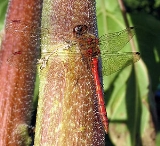
Common Darter

Encyclopedia
The Common Darter is a dragonfly
of the family Libellulidae
native to Eurasia
. It is one of the most common dragonflies in Europe
, occurring in a wide variety of water bodies, though with a preference for breeding in still water such as ponds and lakes. In the south of its range adults are on the wing all year round.
This small Dragonfly is seen in a wide variety of habitats, including lakes, ponds, canals and slow-flowing rivers. They are ambush predators, waiting on a prominent perch - such as a leaf or the top of a gate, until prey fly past, whereupon they will fly after it. They are territorial on breeding waters, often attempting to chase much bigger Dragonflies away such as Southern Hawker
s. This habit of repeatedly returning to a sunny spot allows you to easily predict where they are going to land, which is why it is one of the easiest dragonflies to photograph.
In suitable hunting areas away from water, however, they are not territorial: large numbers may assemble - groups of several hundred in a single field have been recorded - and lines of insects can be seen along the top of field gates.
Eggs are not laid, but broadcast from the air: the male holds the female in tandem and swings her down and forward over water at a height of around 40cm. At the furthest point of the arc the female releases some of her eggs to fall on the water.
named the Highland Darter used to be considered a separate species, Sympetrum nigrescens. It is found in Ireland, Scotland and Norway. It may be the same taxon as the Island Darter, formally S. nigrifemur
, both being a subspecies of S. striolatum.
Dragonfly
A dragonfly is a winged insect belonging to the order Odonata, the suborder Epiprocta or, in the strict sense, the infraorder Anisoptera . It is characterized by large multifaceted eyes, two pairs of strong transparent wings, and an elongated body...
of the family Libellulidae
Libellulidae
The skimmers or perchers and their relatives form the Libellulidae, the largest dragonfly family in the world. It is sometimes considered to contain the Corduliidae as the subfamily Corduliinae and the Macromiidae as the subfamily Macromiinae. Even if these are excluded , there still remains a...
native to Eurasia
Eurasia
Eurasia is a continent or supercontinent comprising the traditional continents of Europe and Asia ; covering about 52,990,000 km2 or about 10.6% of the Earth's surface located primarily in the eastern and northern hemispheres...
. It is one of the most common dragonflies in Europe
Europe
Europe is, by convention, one of the world's seven continents. Comprising the westernmost peninsula of Eurasia, Europe is generally 'divided' from Asia to its east by the watershed divides of the Ural and Caucasus Mountains, the Ural River, the Caspian and Black Seas, and the waterways connecting...
, occurring in a wide variety of water bodies, though with a preference for breeding in still water such as ponds and lakes. In the south of its range adults are on the wing all year round.
Appearance
Sympetrum species are not easy to tell apart and in most areas more than one Sympetrum species will occur. Females and Teneral individuals have light yellow thorax and abdomen. Males turn red as they mature. Females darken with age, becoming a dark chocolate brown, and sometimes develop a blue colouration to the bottom of the abdomen. The wings also develop a brown tinge with age. In all cases the legs have a cream or yellow stripe on a black background - this is a diagnostic feature of this species.Behaviour
Adults can be seen on the wing all year round in southern Europe but in northern regions they occur from June to November.This small Dragonfly is seen in a wide variety of habitats, including lakes, ponds, canals and slow-flowing rivers. They are ambush predators, waiting on a prominent perch - such as a leaf or the top of a gate, until prey fly past, whereupon they will fly after it. They are territorial on breeding waters, often attempting to chase much bigger Dragonflies away such as Southern Hawker
Southern Hawker
The Southern Hawker or Blue Darner is a long species of hawker dragonfly.It is large, with a long body. It has green markings on the black bodies, and the male also has blue spots on the abdomen....
s. This habit of repeatedly returning to a sunny spot allows you to easily predict where they are going to land, which is why it is one of the easiest dragonflies to photograph.
In suitable hunting areas away from water, however, they are not territorial: large numbers may assemble - groups of several hundred in a single field have been recorded - and lines of insects can be seen along the top of field gates.
Eggs are not laid, but broadcast from the air: the male holds the female in tandem and swings her down and forward over water at a height of around 40cm. At the furthest point of the arc the female releases some of her eggs to fall on the water.
Conservation status
This is one of the most abundant dragonflies in Europe, and populations show no evidence of decline.Highland Darter
A taxonTaxon
|thumb|270px|[[African elephants]] form a widely-accepted taxon, the [[genus]] LoxodontaA taxon is a group of organisms, which a taxonomist adjudges to be a unit. Usually a taxon is given a name and a rank, although neither is a requirement...
named the Highland Darter used to be considered a separate species, Sympetrum nigrescens. It is found in Ireland, Scotland and Norway. It may be the same taxon as the Island Darter, formally S. nigrifemur
Sympetrum nigrifemur
Sympetrum nigrifemur, the Island Darter, is a species of dragonfly in family Libellulidae. It is found in Portugal and Spain. Its natural habitats are rivers, intermittent rivers, intermittent freshwater marshes, and ponds....
, both being a subspecies of S. striolatum.