


Commandant of the Coast Guard

Encyclopedia
The Commandant of the United States Coast Guard is the highest ranking member of the United States Coast Guard
. The Commandant is normally the only four-star Admiral
in the Coast Guard and is appointed for a four-year term by the President of the United States
upon confirmation by the United States Senate
. The Commandant is assisted by a Vice Commandant
, two Assistant Commandants/Area Commanders and a Chief of Staff, all of whom are three-star Vice Admiral
s.
Unlike the chiefs of the other branches of the United States Armed Forces
, the Commandant of the Coast Guard is not a member of the Joint Chiefs of Staff
; he is, however, entitled to the same supplemental pay as the Joint Chiefs, per 37 U.S.C § 414(a)(5) ($4,000 per annum in 2009), and is accorded privilege of the floor under Senate Rule XXIII(1) as a de facto JCS member during Presidential addresses. Furthermore, in contrast to the Joint Chiefs who are not in the military's operational chain of command, the Commandant of the Coast Guard commands his service. He reports to the President, via the Secretary of Homeland Security
. Prior to the creation of the Department of Homeland Security
in 2003, the Commandant reported to the Secretary of Transportation
from 1966 to 2003. Until the creation of the Department of Transportation in 1966, the Commandant and the earlier counterparts had reported to the Secretary of the Treasury since 1790.
dates to a 1923 act that distributed the commissioned line and engineer officers of the Coast Guard in grades. Before 1923, the rank and title of the head of the Coast Guard was "captain-commandant." The rank "captain-commandant" originated in the Revenue Cutter Service
in 1908. The original holder of that rank was the Chief of the Revenue Cutter Service (also known as the Revenue Marine). The Coast Guard traces the lineage of Commandants back to Captain
Leonard G. Shepard
, chief of the Revenue Marine Bureau, even though he never officially received the title of Captain-Commandant. The Captain-Commandant position was created in 1908 when Captain Worth G. Ross
was the first to actually hold the position. Although he was retired, Captain Charles F. Shoemaker
was elevated to the rank of Captain-Commandant. Captain Shepard had already died and was not elevated to the rank.
In 1849 the Revenue Marine Bureau was dissolved, and the Revenue Marine fell under the control the Commissioner of Customs until the Revenue Marine Bureau was again established in 1869.
, the current Commandant.
United States Coast Guard
The United States Coast Guard is a branch of the United States Armed Forces and one of the seven U.S. uniformed services. The Coast Guard is a maritime, military, multi-mission service unique among the military branches for having a maritime law enforcement mission and a federal regulatory agency...
. The Commandant is normally the only four-star Admiral
Admiral (United States)
In the United States Navy, the United States Coast Guard and the United States Public Health Service Commissioned Corps, admiral is a four-star flag officer rank, with the pay grade of O-10. Admiral ranks above vice admiral and below Fleet Admiral in the Navy; the Coast Guard and the Public Health...
in the Coast Guard and is appointed for a four-year term by the President of the United States
President of the United States
The President of the United States of America is the head of state and head of government of the United States. The president leads the executive branch of the federal government and is the commander-in-chief of the United States Armed Forces....
upon confirmation by the United States Senate
United States Senate
The United States Senate is the upper house of the bicameral legislature of the United States, and together with the United States House of Representatives comprises the United States Congress. The composition and powers of the Senate are established in Article One of the U.S. Constitution. Each...
. The Commandant is assisted by a Vice Commandant
Vice Commandant of the United States Coast Guard
The Vice Commandant serves as the second-in-command of the United States Coast Guard.Since 1929, 27 officers have served as Vice Commandant, or, as the position was referred to before 1972, Assistant Commandant. The title of the position was changed effective October 2, 1972, pursuant to P.L....
, two Assistant Commandants/Area Commanders and a Chief of Staff, all of whom are three-star Vice Admiral
Vice admiral (United States)
In the United States Navy, the United States Coast Guard, the United States Public Health Service Commissioned Corps, the National Oceanic and Atmospheric Administration Commissioned Corps, and the United States Maritime Service, vice admiral is a three-star flag officer, with the pay grade of...
s.
Unlike the chiefs of the other branches of the United States Armed Forces
United States armed forces
The United States Armed Forces are the military forces of the United States. They consist of the Army, Navy, Marine Corps, Air Force, and Coast Guard.The United States has a strong tradition of civilian control of the military...
, the Commandant of the Coast Guard is not a member of the Joint Chiefs of Staff
Joint Chiefs of Staff
The Joint Chiefs of Staff is a body of senior uniformed leaders in the United States Department of Defense who advise the Secretary of Defense, the Homeland Security Council, the National Security Council and the President on military matters...
; he is, however, entitled to the same supplemental pay as the Joint Chiefs, per 37 U.S.C § 414(a)(5) ($4,000 per annum in 2009), and is accorded privilege of the floor under Senate Rule XXIII(1) as a de facto JCS member during Presidential addresses. Furthermore, in contrast to the Joint Chiefs who are not in the military's operational chain of command, the Commandant of the Coast Guard commands his service. He reports to the President, via the Secretary of Homeland Security
United States Secretary of Homeland Security
The United States Secretary of Homeland Security is the head of the United States Department of Homeland Security, the body concerned with protecting the American homeland and the safety of American citizens. The Secretary is a member of the President's Cabinet. The position was created by the...
. Prior to the creation of the Department of Homeland Security
United States Department of Homeland Security
The United States Department of Homeland Security is a cabinet department of the United States federal government, created in response to the September 11 attacks, and with the primary responsibilities of protecting the territory of the United States and protectorates from and responding to...
in 2003, the Commandant reported to the Secretary of Transportation
United States Secretary of Transportation
The United States Secretary of Transportation is the head of the United States Department of Transportation, a member of the President's Cabinet, and fourteenth in the Presidential line of succession. The post was created with the formation of the Department of Transportation on October 15, 1966,...
from 1966 to 2003. Until the creation of the Department of Transportation in 1966, the Commandant and the earlier counterparts had reported to the Secretary of the Treasury since 1790.
Evolution of the rank and title
The title of CommandantCommandant
Commandant is a senior title often given to the officer in charge of a large training establishment or academy. This usage is common in anglophone nations...
dates to a 1923 act that distributed the commissioned line and engineer officers of the Coast Guard in grades. Before 1923, the rank and title of the head of the Coast Guard was "captain-commandant." The rank "captain-commandant" originated in the Revenue Cutter Service
United States Revenue Cutter Service
The United States Revenue Cutter Service was established by Secretary of the Treasury Alexander Hamilton in 1790 as an armed maritime law enforcement service. Throughout its entire existence the Revenue Cutter Service operated under the authority of the United States Department of the Treasury...
in 1908. The original holder of that rank was the Chief of the Revenue Cutter Service (also known as the Revenue Marine). The Coast Guard traces the lineage of Commandants back to Captain
Captain (naval)
Captain is the name most often given in English-speaking navies to the rank corresponding to command of the largest ships. The NATO rank code is OF-5, equivalent to an army full colonel....
Leonard G. Shepard
Leonard G. Shepard
Leonard G. Shepard , was a captain in the United States Revenue Cutter Service and was appointed in 1889 by Secretary of the Treasury William Windom as the first military head of the service since 1869. His formal title was that of Chief of the Revenue Marine Division of the Department of the...
, chief of the Revenue Marine Bureau, even though he never officially received the title of Captain-Commandant. The Captain-Commandant position was created in 1908 when Captain Worth G. Ross
Worth G. Ross
Worth G. Ross was the first graduate of the School of Instruction of the Revenue Cutter Service, now known as the US Coast Guard Academy...
was the first to actually hold the position. Although he was retired, Captain Charles F. Shoemaker
Charles F. Shoemaker
Charles Frederick Shoemaker was a captain in the United States Revenue Cutter Service and was appointed in 1895 by Secretary of the Treasury John G. Carlisle to be Chief of the Revenue Marine Division of the Department of the Treasury...
was elevated to the rank of Captain-Commandant. Captain Shepard had already died and was not elevated to the rank.
Chiefs of the Revenue Marine Bureau
Chiefs exercised centralized control over the Revenue Marine Bureau.- Captain Alexander V. Fraser, USRM, 1843–1848
- Captain Richard Evans, USRM, 1848–1849
In 1849 the Revenue Marine Bureau was dissolved, and the Revenue Marine fell under the control the Commissioner of Customs until the Revenue Marine Bureau was again established in 1869.
- N. Broughton Devereux, 1869–1871
- Sumner I. Kimball, 1871–1878
- Ezra Clark, 1878–1885
- Peter Bonnett, 1885–1889
List of Commandants
There have been 24 Commandants of the Coast Guard since the office of Chief of the Revenue Marine Bureau was transferred to a military billet including Admiral Robert J. Papp, Jr.Robert J. Papp, Jr.
Robert J. Papp. Jr. is a United States Coast Guard admiral and the 24th and current Commandant of the U.S. Coast Guard. He leads the largest component of the United States Department of Homeland Security, with 42,000 active duty, 8,200 Reserve, 8,000 civilian, and 31,000...
, the current Commandant.
| # | Picture | Name | Rank | Start of tenure | End of tenure | Notes |
|---|---|---|---|---|---|---|
| 1 | Leonard G. Shepard Leonard G. Shepard Leonard G. Shepard , was a captain in the United States Revenue Cutter Service and was appointed in 1889 by Secretary of the Treasury William Windom as the first military head of the service since 1869. His formal title was that of Chief of the Revenue Marine Division of the Department of the... |
Captain Captain (naval) Captain is the name most often given in English-speaking navies to the rank corresponding to command of the largest ships. The NATO rank code is OF-5, equivalent to an army full colonel.... |
Shepard became the first military Chief of the "Revenue Marine Division" of the Treasury Department and is considered to be the first Commandant. | |||
| 2 | Charles F. Shoemaker | Captain Captain (naval) Captain is the name most often given in English-speaking navies to the rank corresponding to command of the largest ships. The NATO rank code is OF-5, equivalent to an army full colonel.... |
On May 8, 1908, Shoemaker was promoted to the rank of Captain-Commandant on the Retired List by Act of Congress. | |||
| 3 | 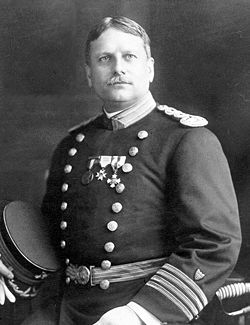 |
Worth G. Ross Worth G. Ross Worth G. Ross was the first graduate of the School of Instruction of the Revenue Cutter Service, now known as the US Coast Guard Academy... |
Captain-Commandant Captain (naval) Captain is the name most often given in English-speaking navies to the rank corresponding to command of the largest ships. The NATO rank code is OF-5, equivalent to an army full colonel.... |
Ross was instrumental in the establishment of what was to become the U.S. Coast Guard Academy in New London, Connecticut. | ||
| 4 |  |
Ellsworth P. Bertholf Ellsworth P. Bertholf Ellsworth Price Bertholf was a Congressional Gold Medal recipient who later served as the fourth Captain-Commandant of the United States Revenue Cutter Service and because of the change in the name of the agency, the fourth Commandant of the United States Coast Guard... |
Commodore Commodore (USN) Commodore was an early title and later a rank in the United States Navy and United States Coast Guard and a current honorary title in the U.S. Navy with an intricate history. Because the U.S. Congress was originally unwilling to authorize more than four ranks until 1862, considerable importance... |
Served during the merger of the U.S. Revenue Cutter Service with the U.S. Life-Saving Service to form the U.S. Coast Guard. Was the first Coast Guard officer the achieve flag rank.) | ||
| 5 | William E. Reynolds | Rear Admiral Rear Admiral Rear admiral is a naval commissioned officer rank above that of a commodore and captain, and below that of a vice admiral. It is generally regarded as the lowest of the "admiral" ranks, which are also sometimes referred to as "flag officers" or "flag ranks"... |
Reynolds was the first Coast Guard officer to be promoted to the rank of Rear Admiral. | |||
| 6 | Frederick C. Billard Frederick C. Billard Frederick C. Billard served as the sixth Commandant of the United States Coast Guard from 1924 until his death. He is the only Coast Guard Commandant to die in office.... |
Rear Admiral Rear Admiral Rear admiral is a naval commissioned officer rank above that of a commodore and captain, and below that of a vice admiral. It is generally regarded as the lowest of the "admiral" ranks, which are also sometimes referred to as "flag officers" or "flag ranks"... |
Billard was appointed to three consecutive terms as Commandant and died in office May 17, 1932, serving through the Prohibition Era and reorganization of the Academy. | |||
| 7 | Harry G. Hamlet Harry G. Hamlet Harry Gabriel Hamlet served as the seventh Commandant of the United States Coast Guard, from 1932 to 1936.-Early life and career:... |
Rear Admiral Rear Admiral Rear admiral is a naval commissioned officer rank above that of a commodore and captain, and below that of a vice admiral. It is generally regarded as the lowest of the "admiral" ranks, which are also sometimes referred to as "flag officers" or "flag ranks"... |
Hamlet persuaded Congress to dismiss efforts to merge the Coast Guard with the U.S. Navy. Continued serving after term as Commandant was over and eventually retired as a Vice Admiral by act of Congress. | |||
| 8 | 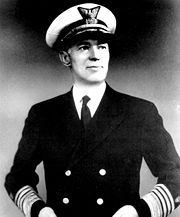 |
Russell R. Waesche Russell R. Waesche Russell Randolph Waesche, Sr. . Waesche served as the eighth Commandant of the United States Coast Guard from 1936 to 1946, overseeing the service during World War II. He also holds the distinction of being the longest serving Commandant, serving ten years in command of the United States Coast Guard... |
Admiral Admiral Admiral is the rank, or part of the name of the ranks, of the highest naval officers. It is usually considered a full admiral and above vice admiral and below admiral of the fleet . It is usually abbreviated to "Adm" or "ADM"... |
Longest serving Commandant, first Commandant to be promoted to Vice Admiral and Admiral. Commandant during World War II and helped the Coast Guard remain a separate distinct service while it was assigned to the U.S Navy. Oversaw the largest manpower buildup in Coast Guard history and was instrumental in the formation of the U.S. Coast Guard Auxiliary and the U.S. Coast Guard Reserve. | ||
| 9 |  |
Joseph F. Farley Joseph F. Farley Joseph Francis Farley served as the ninth Commandant of the United States Coast Guard from 1946 to 1949. He was also the first Coast Guard officer to be issued a service number and holds #1000 on the Coast Guard officer rolls.... |
Admiral Admiral Admiral is the rank, or part of the name of the ranks, of the highest naval officers. It is usually considered a full admiral and above vice admiral and below admiral of the fleet . It is usually abbreviated to "Adm" or "ADM"... |
Farley served during the difficult Post-World War II era when additional statutory responsibilities were being added to the Coast Guard's mission structure and personnel allowances were being reduced. | ||
| 10 | Merlin O'Neill Merlin O'Neill Merlin O'Neill served as the tenth Commandant of the United States Coast Guard from 1949 to 1954.He was born in Gallia County, Ohio on October 30, 1898. Following graduation from high school in Morgan City, Louisiana, he attended Western Kentucky State Normal School, and the Marion Military... |
Vice Admiral Vice Admiral Vice admiral is a senior naval rank of a three-star flag officer, which is equivalent to lieutenant general in the other uniformed services. A vice admiral is typically senior to a rear admiral and junior to an admiral... |
O'Neill directed the increase in port security activities required by the passage of the Magnuson Act Magnuson Act The Magnuson Act also known as the Chinese Exclusion Repeal Act of 1943 was immigration legislation proposed by U.S. Representative Warren G. Magnuson of Washington and signed into law on December 17, 1943 in the United States... and revitalized the Coast Guard Reserve program emphasizing it's defense mission during wartime. |
|||
| 11 | 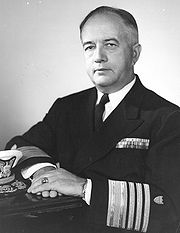 |
Alfred C. Richmond Alfred C. Richmond Alfred Carroll Richmond was a retired United States Coast Guard admiral who served as the 11th Commandant of the United States Coast Guard from 1954 to 1962, the second longest tenure of any U.S. Coast Guard Commandant.... |
Admiral Admiral Admiral is the rank, or part of the name of the ranks, of the highest naval officers. It is usually considered a full admiral and above vice admiral and below admiral of the fleet . It is usually abbreviated to "Adm" or "ADM"... |
Richmond served two full terms as Commandant and was the U.S. delegate to many international maritime conferences during his tenure. | ||
| 12 | 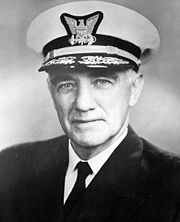 |
Edwin J. Roland Edwin J. Roland Edwin John Roland , served as the twelfth Commandant of the United States Coast Guard from 1962 to 1966.He was born in Buffalo, New York. Growing up in Buffalo, he attended Canisius High School and later Canisius College in the city. He graduated from the United States Coast Guard Academy in New... |
Admiral Admiral Admiral is the rank, or part of the name of the ranks, of the highest naval officers. It is usually considered a full admiral and above vice admiral and below admiral of the fleet . It is usually abbreviated to "Adm" or "ADM"... |
Roland oversaw the replacement of many World War II era cutters under fleet modernization programs during his tenure. He assisted the U.S. Navy with operations in Vietnam by supplying crews and cutters for Operation Market Time Operation Market Time Operation Market Time was the United States Navy’s effort to stop troops and supplies from flowing by sea from North Vietnam to South Vietnam during the Vietnam War... . |
||
| 13 | 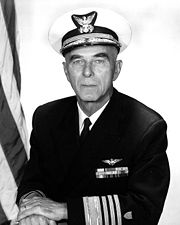 |
Willard J. Smith Willard J. Smith Willard John Smith served as the thirteenth Commandant of the United States Coast Guard from 1966 to 1970.... |
Admiral Admiral Admiral is the rank, or part of the name of the ranks, of the highest naval officers. It is usually considered a full admiral and above vice admiral and below admiral of the fleet . It is usually abbreviated to "Adm" or "ADM"... |
Smith was Commandant when the Coast Guard was transferred from the Department of the Treasury United States Department of the Treasury The Department of the Treasury is an executive department and the treasury of the United States federal government. It was established by an Act of Congress in 1789 to manage government revenue... to the newly formed Department of Transportation Department of Transportation The Department of Transportation is the most common name for a government agency in North America devoted to transportation. The largest is the United States Department of Transportation, which oversees interstate travel. All U.S. states, Canadian provinces, and many local agencies also have... . |
||
| 14 | 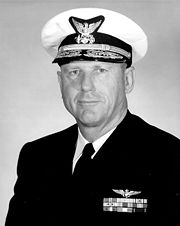 |
Chester R. Bender Chester R. Bender Chester R. Bender served as the fourteenth Commandant of the United States Coast Guard from 1970 to 1974. He also served as Superintendent of the Coast Guard Academy from 1965 to 1967.-Early life and education:... |
Admiral Admiral Admiral is the rank, or part of the name of the ranks, of the highest naval officers. It is usually considered a full admiral and above vice admiral and below admiral of the fleet . It is usually abbreviated to "Adm" or "ADM"... |
The Coast Guard undertook new statutory responsibilities in the areas of marine safety, environmental protection and law enforcement during his tenure, however Bender is best known for his changes in the dress uniform worn by Coast Guardsmen; sometimes referred to as "Bender's Blues". | ||
| 15 | Owen W. Siler Owen W. Siler Admiral Owen Wesley Siler served as the fifteenth Commandant of the United States Coast Guard from 1974 to 1978.Owen Siler was born in Seattle, Washington and raised in Santa Maria, California... |
Admiral Admiral Admiral is the rank, or part of the name of the ranks, of the highest naval officers. It is usually considered a full admiral and above vice admiral and below admiral of the fleet . It is usually abbreviated to "Adm" or "ADM"... |
Several changes in environmental duties occurred during Siler's tenure as well as a step-up in drug interdiction activities. Replacement of aging cutters was given budget priority. First women entered the Coast Guard Academy. | |||
| 16 | 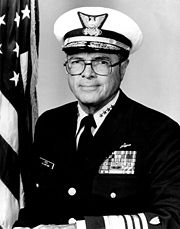 |
John B. Hayes John B. Hayes John Briggs Hayes was a retired United States Coast Guard admiral who served as the 16th Commandant of the United States Coast Guard from 1978 to 1982.... |
Admiral Admiral Admiral is the rank, or part of the name of the ranks, of the highest naval officers. It is usually considered a full admiral and above vice admiral and below admiral of the fleet . It is usually abbreviated to "Adm" or "ADM"... |
Hayes experienced severe budget problems during his tenure while fending off a move in Congress to transfer the Coast Guard to the Navy. Drug interdiction was increased and several high profile search and rescue cases occurred during his watch which helped keep the Coast Guard in the public eye. | ||
| 17 | 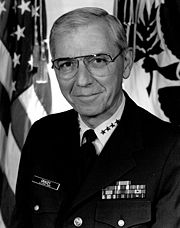 |
James S. Gracey James S. Gracey James Steele Gracey is a retired United States Coast Guard admiral who served as the 17th Commandant of the United States Coast Guard from 1982 to 1986.... |
Admiral Admiral Admiral is the rank, or part of the name of the ranks, of the highest naval officers. It is usually considered a full admiral and above vice admiral and below admiral of the fleet . It is usually abbreviated to "Adm" or "ADM"... |
Gracey faced tight budgets at the same time he was successful at replacing aging cutters. Increasing the Coast Guard's role in the defense of coastal waters was accomplished. | ||
| 18 | 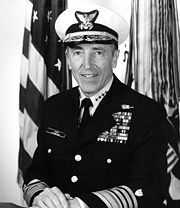 |
Paul A. Yost, Jr. Paul A. Yost, Jr. Paul Alexander Yost, Jr. is a retired United States Coast Guard admiral who served as the 18th Commandant of the United States Coast Guard from 1986 to 1990.-Early life and career:He is a native of St. Petersburg, Florida... |
Admiral Admiral Admiral is the rank, or part of the name of the ranks, of the highest naval officers. It is usually considered a full admiral and above vice admiral and below admiral of the fleet . It is usually abbreviated to "Adm" or "ADM"... |
Yost successfully maintained the service through difficult budget battles each year. In doing so, he also emphasized three 'primary mission areas": maritime law enforcement, maritime safety, and defense readiness. There was an increased emphasis on military/naval capabilities of the service. | ||
| 19 | 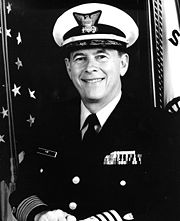 |
J. William Kime J. William Kime John William Kime was a United States Coast Guard admiral who served as the 19th Commandant of the United States Coast Guard from May 31, 1990 to June 1, 1994.-Early life and career:... |
Admiral Admiral Admiral is the rank, or part of the name of the ranks, of the highest naval officers. It is usually considered a full admiral and above vice admiral and below admiral of the fleet . It is usually abbreviated to "Adm" or "ADM"... |
|||
| 20 | 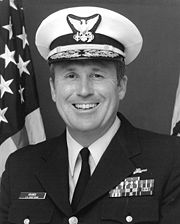 |
Robert E. Kramek Robert E. Kramek Robert Edward Kramek is a retired United States Coast Guard admiral who served as the 20th Commandant of the United States Coast Guard from 1994 to 1998... |
Admiral Admiral Admiral is the rank, or part of the name of the ranks, of the highest naval officers. It is usually considered a full admiral and above vice admiral and below admiral of the fleet . It is usually abbreviated to "Adm" or "ADM"... |
|||
| 21 | James Loy James Loy Admiral James Milton Loy served as Acting United States Secretary of Homeland Security in 2005 and United States Deputy Secretary of Homeland Security from December 4, 2003, to March 1, 2005... |
Admiral Admiral Admiral is the rank, or part of the name of the ranks, of the highest naval officers. It is usually considered a full admiral and above vice admiral and below admiral of the fleet . It is usually abbreviated to "Adm" or "ADM"... |
||||
| 22 | Thomas H. Collins Thomas H. Collins Thomas Hansen Collins is a retired United States Coast Guard 4 star admiral who served as the 22nd Commandant of the United States Coast Guard from 2002 to 2006.-Background:... |
Admiral Admiral Admiral is the rank, or part of the name of the ranks, of the highest naval officers. It is usually considered a full admiral and above vice admiral and below admiral of the fleet . It is usually abbreviated to "Adm" or "ADM"... |
||||
| 23 | 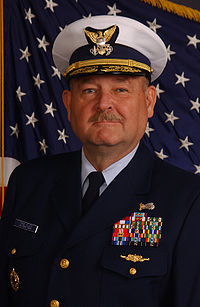 |
Thad W. Allen Thad W. Allen Thad William Allen is a retired United States Coast Guard admiral who served as the 23rd Commandant of the Coast Guard. Allen is best known for his widely-praised performance directing the federal response to Hurricanes Katrina and Rita in the Gulf Coast region from September 2005 to January 2006.... |
Admiral Admiral Admiral is the rank, or part of the name of the ranks, of the highest naval officers. It is usually considered a full admiral and above vice admiral and below admiral of the fleet . It is usually abbreviated to "Adm" or "ADM"... |
|||
| 24 | Robert J. Papp, Jr. Robert J. Papp, Jr. Robert J. Papp. Jr. is a United States Coast Guard admiral and the 24th and current Commandant of the U.S. Coast Guard. He leads the largest component of the United States Department of Homeland Security, with 42,000 active duty, 8,200 Reserve, 8,000 civilian, and 31,000... |
Admiral Admiral Admiral is the rank, or part of the name of the ranks, of the highest naval officers. It is usually considered a full admiral and above vice admiral and below admiral of the fleet . It is usually abbreviated to "Adm" or "ADM"... |
Incumbent Incumbent The incumbent, in politics, is the existing holder of a political office. This term is usually used in reference to elections, in which races can often be defined as being between an incumbent and non-incumbent. For example, in the 2004 United States presidential election, George W... |
|||