

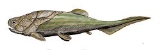
Coccosteus

Encyclopedia
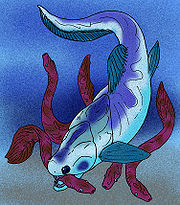
Like all other arthrodires
Arthrodira
Arthrodira is an order of extinct armoured jawed fishes of the Placodermi class that flourished in the Devonian period before their sudden extinction, surviving for about 50 million years and penetrating most marine ecological niches....
, Coccosteus had a joint between the armor of the body and skull
Skull
The skull is a bony structure in the head of many animals that supports the structures of the face and forms a cavity for the brain.The skull is composed of two parts: the cranium and the mandible. A skull without a mandible is only a cranium. Animals that have skulls are called craniates...
. In addition, it also had an internal joint between its neck vertebrae and the back of the skull, allowing for the mouth to be opened even wider. Along with the longer jaws, this allowed Coccosteus to feed on fairly large prey. The up-and-down movement of the skull also allowed for more water to be pumped through the gill
Gill
A gill is a respiratory organ found in many aquatic organisms that extracts dissolved oxygen from water, afterward excreting carbon dioxide. The gills of some species such as hermit crabs have adapted to allow respiration on land provided they are kept moist...
s. Possibly, the creature supplemented its diet with organic material filtered from mud using the gills. As with all other arthrodires, Coccosteus had bony dental plates embedded in its jaws, forming a beak. The beak was kept sharp by having the edges of the dental plates grind away at each other. Overall the creature looked similar to its gigantic cousin Dunkleosteus
Dunkleosteus
Dunkleosteus is a genus of prehistoric fish, one of the largest arthrodire placoderms ever to have lived, existing during the Late Devonian period, about 380-360 million years ago.This hunter, measuring up to and weighing , was a hypercarnivorous apex predator...
, save that its eyes were closer to the end of its snout than in its larger relative.