
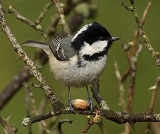
The
Coal Tit,
Periparus ater, is a
passerineA passerine is a bird of the order Passeriformes, which includes more than half of all bird species. Sometimes known as perching birds or, less accurately, as songbirds, the passerines form one of the most diverse terrestrial vertebrate orders:...
birdBirds are winged, bipedal, endothermic , vertebrate animals that lay eggs. There are around 10,000 living species, making them the most numerous tetrapod vertebrates. They inhabit ecosystems across the globe, from the Arctic to the Antarctic. Birds range in size from the Bee Hummingbird to the ...
in the
titThe tits, chickadees, and titmice constitute Paridae, a large family of small passerine birds which occur in the northern hemisphere and Africa...
familyIn biological classification, family is* a taxonomic rank. Other well-known ranks are life, domain, kingdom, phylum, class, order, genus, and species, with family fitting between order and genus...
Paridae. It is a widespread and common resident breeder throughout
temperateIn geography, temperate or tepid latitudes of the globe lie between the tropics and the polar circles. The changes in these regions between summer and winter are generally mild, rather than extreme hot or cold. But in continental areas, such as central North America the variations between summer...
to subtropical
EurasiaEurasia is a large landmass covering about 52,990,000 km
2 or about 10.6% of the Earth's surface...
and northern
AfricaAfrica is the world's second-largest and second most-populous continent, after Asia. At about 30.2 million km² including adjacent islands, it covers 6% of the Earth's total surface area and 20.4% of the total land area. With a billion people in 61 territories, it accounts for about 14.8% of the...
. The Spot-winged Tit (
P. melanolophus) is sometimes included in this
speciesIn biology, a species is:* a taxonomic rank or* a unit at that rank ....
; this may be correct, but more research is required.
Description and systematics
The Coal Tit is 10–11.5 cm in length, and has a distinctive large white nape spot on its black head. The head, throat and neck of the adult are glossy blue-black, setting off the off-white sides of the face (tinged grey to yellow depending on
subspeciesSubspecies in biological classification, is 1) a taxonomic rank subordinate to species, or 2) a taxonomic unit, a taxon in that rank...
) and the brilliant white nape; the white tips of the wing coverts appear as two wingbars. The underparts are whitish shading through buff to rufous on the flanks. The bill is black, the legs lead-coloured, and irides dark brown.
The young birds are duller than the adults, lacking gloss on the black head, and with the white of nape and cheeks tinged with yellow.
During the search for food, Coal Tit flocks keep contact with incessant short
dee or
see-see calls. The species' song – if "song" it can be called – is a strident
if-he, if-he, if-he, heard most frequently from January to June, but also in autumn. One variant of this song ends with a sharp
ichi. North African birds also have a
currr call similar to that of the
Crested TitThe Crested Tit, Lophophanes cristatus , is a passerine bird in the tit family Paridae. It is a widespread and common resident breeder in coniferous forests throughout central and northern Europe and in deciduous woodland in France and the Iberian peninsula...
(
Lophophanes cristatus) which is not found in Africa however.
Subspecies
A number of Coal Tit
subspeciesSubspecies in biological classification, is 1) a taxonomic rank subordinate to species, or 2) a taxonomic unit, a taxon in that rank...
are distinguished. The differences in coloration are quite pronounced in some of them, while their differences in size are more subtle. Coal Tits from
AsiaAsia is the world's largest and most populous continent, located in the eastern and northern hemispheres. It covers 8.6% of the earth's total surface area and with approximately 4 billion people, it hosts 60% of the world's current human population.Asia is traditionally defined as part of the...
follow
Bergmann's RuleIn zoology, Bergmann's rule is an ecogeographic rule that correlates latitude with body mass in animals. Broadly it asserts that within a species the body mass increases with latitude and colder climate, or that within closely related species that differ only in relation to size that one would...
, being larger in colder regions; those from further west, however, do not, as the birds from the uplands around the Mediterranean are larger than those from northern Europe. Across its range, tail length in relation to body length increases along a cline running from southwest to northeast.
The
BritishThe British are citizens of the United Kingdom, of the Isle of Man, one of the Channel Islands, or of one of the British overseas territories, and their descendants. In a historical context, the term refers to the ancient Britons, the indigenous inhabitants of Great Britain south of the...
race
P. a. britannicus has an olive hue to its brownish-grey back plumage, distinguishing it from the
continental EuropeContinental Europe, also referred to as mainland Europe or simply the Continent, is the continent of Europe, explicitly excluding European islands and, at times, peninsulas. Notably, in British and Irish English usage, the term means Europe excluding the United Kingdom, the Isle of Man, the Channel...
an nominate subspecies
P. a. ater and
P. a. abietum in which the back is bluish grey without a hint of green or brown. The Irish race
P. a. hibernicus is distinguished from
britannicus by the pale sulphur-yellow cheeks, breast and belly. It also has a paler rump (due to light fringes of the uppertail coverts) and a larger bill than its relatives from Britain and the Continent.
The
North AfricaNorth Africa or Northern Africa is the northernmost region of the African continent, linked by the Sahara to Sub-Saharan Africa.Geopolitically, the UN definition of Northern Africa includes the following seven countries or territories; Algeria, Egypt, Libya, Morocco, Sudan, Tunisia,Mauritania, and...
n race
P. a. ledouci has yellow underparts and cheeks, and the
CypriotCyprus , officially the Republic of Cyprus , is a Eurasian island country situated in the eastern Mediterranean, south of Turkey and west of Syria and Lebanon....
P. a. cypriotes has a buff tinge to its upperparts, and deep buff underparts.
AsiaAsia is the world's largest and most populous continent, located in the eastern and northern hemispheres. It covers 8.6% of the earth's total surface area and with approximately 4 billion people, it hosts 60% of the world's current human population.Asia is traditionally defined as part of the...
n subspecies are generally rather dusky brownish except for the black-and-white head; they include among others
P. a. michalowskii of the
CaucasusThe Caucasus or Caucas is a geopolitical region between at the border of Europe and Asia. It is home to the Caucasus Mountains, including Europe's highest mountain ....
,
P. a. phaeonotus of
IranIran , officially the Islamic Republic of Iran is a country in Western Asia. The name Iran has been in use natively since the Sassanid period and came into international use from 1935, before which the country was known internationally as Persia...
, or the Himalayan Coal Tit
P. a. aemodius of southwestern
ChinaChina is a cultural region, an ancient civilization, and, depending on perspective, a national or multinational entity extending over a large area in East Asia....
.
Taxonomy
This species was first described by
LinnaeusCarl Linnaeus was a Swedish botanist, physician, and zoologist, who laid the foundations for the modern scheme of binomial nomenclature...
in his 1758 edition of
Systema naturaeThe book Systema Naturae was one of the major works of the Swedish botanist, zoologist and physician Carolus Linnaeus. Its full title is Systema naturae per regna tria naturae, secundum classes, ordines, genera, species, cum characteribus, differentiis, synonymis, locis or translated: "System of...
. Linnaeus' primary reference was his earlier
Fauna Svecica, whose cumbersome pre-
binomialThe formal system of naming species is called binominal nomenclature , binary nomenclature , or the binomial classification system...
name
Parus capite nigro: vertice albo, dorso cinereo, pectore albo ("black-headed titmouse with white nape, ash-grey back, white breast") became the much simpler yet no less unequivocal
Parus ater. This name – meaning "dusky-black titmouse" – was simply adopted from older ornithological textbooks, ultimately going back to
Conrad GessnerKonrad Gessner was a Swiss naturalist and bibliographer. His five-volume Historiae animalium is considered the beginning of modern zoology, and the flowering plant genus Gesneria is named after him...
's 1555
Historiae animalium. Linnaeus' description was essentially the slightly rephrased species name from
Fauna Svecica:
P[arus] capite nigro, dorso cinereo, occipite pectoreque albo. – "a black-headed titmouse, with ash-grey back, and white back of the head and breast." He gave no type locality except "Europe", but his original description refers to the population inhabiting
SwedenSweden , officially the Kingdom of Sweden , is a Nordic country on the Scandinavian Peninsula in Northern Europe...
(which is consequently included in the nominate subspecies today).
Gessner also notes that the Coal Tit was known as
Kohlmeiß in German – the literal equivalent of its English name, though in its modern
orthographyThe orthography of a language specifies the correct way of using a specific writing system to write the language. Where more than one writing system is used for a language, for example for Kurdish, there can be more than one orthography. Orthography is derived from Greek ὀρθός orthós and γράφειν...
Kohlmeise it refers to the
Great TitThe Great Tit is a passerine bird in the tit family Paridae. It is a widespread and common species throughout Europe in any sort of woodland. It is resident, and most Great Tits do not migrate...
(
Parus major). That bird was in Gessner's day usually called
Spiegelmeiß ("multicolored titmouse"),
Brandtmeiß ("burnt titmouse") or
grosse Meiß ("great titmouse") in German.
Kölmeyß was attested for
P. major by William Turner, but Turner does not list
P. ater at all, while Gessner notes that his hunters always used
Kohlmeiß for the present species. However, this has since changed, and the modern German name of
P. ater is
Tannenmeise ("
firFirs are a genus of between 48-55 species of evergreen conifers in the family Pinaceae. All are trees, reaching heights of 10-80 m tall and trunk diameters of 0.5-4 m when mature...
titmouse"), after a typical
habitatThe term habitat has a number of meanings:* Habitat , a place where a species lives and grows** Human habitat, a place where humans live, work or play** Space habitat, a space station intended as a permanent settlement...
. This name is attested (as
Tannen-Maise) by Johann Leonhard Frisch in the early
18th centuryThe 18th century lasted from 1701 to 1800 in the Gregorian calendar, in accordance with the Anno Domini/Common Era numbering system.However, Western historians sometimes specifically define the 18th century otherwise for the purposes of their work...
already, who furthermore records that
P. ater was also called
Kleine Kohl-Maise ("small coal titmouse") whereas
Kohl-Maise referred unequivocally to
P. major. Frisch collected his data in the
BerlinBerlin is the capital city and one of sixteen states of Germany. With a population of 3.4 million within its city limits, Berlin is Germany's largest city. It is the second most populous city and the eighth most populous urban area in the European Union...
region, where the German dialect was
quite differentIn German linguistics, the Benrath line is the maken-machen isogloss: dialects north of the line have the original in maken , while those to the south have...
from that spoken by Gessner's
AlemannicAlemannic German is a group of dialects of the Upper German branch of the Germanic language family. It is spoken by approximately ten million people in six countries, including southern Germany, Switzerland, France, Austria, Liechtenstein, and Italy...
sources 200 years earlier, and heavily influenced by
Middle Low GermanMiddle Low German is a language that is the descendant of Old Saxon and is the ancestor of modern Low German. It served as the international lingua franca of the Hanseatic League...
– the language of the northern German sources of Turner. Regarding that,
Tanne is derived from the
Old SaxonOld Saxon, also known as Old Low German, is the earliest recorded form of Low German, documented from the 8th century until the 12th century, when it evolved into Middle Low German. It was spoken on the north-west coast of Germany and in Denmark by Saxon peoples...
danna, and thus had spread through the German
dialect continuumA dialect continuum is a range of dialects spoken across a large geographical area, differing only slightly between areas that are geographically close, and gradually decreasing in mutual intelligibility as the distances become greater. Dialects separated by great geographical distances may not be...
from north to south.
Most authorities still treat the Coal Tit in the
subgenusIn biology, a subgenus is a taxonomic rank directly below genus. See rank and rank .In zoology, a subgeneric name can be used independently or included in a species name, in parentheses, placed between the generic and specific name: e.g...
Periparus, but the
American Ornithologists' UnionThe American Ornithologists' Union is an ornithological organization in the USA. Unlike the National Audubon Society, its members are primarily professional ornithologists rather than amateur birders...
considers
Periparus a distinct
genusIn biology, a genus is a taxonomic unit used in the classification of living and fossil organisms. The term comes from Latin genus "descent, family, type, gender" , cognate with – genos, "race, stock, kin" ..In addition, genus is a taxonomic rank in the hierarchy In biology, a genus (plural:...
. This is supported by mtDNA
cytochrome bCytochrome b/b6 is the main subunit of transmembrane cytochrome bc1 and b6f complexes. In addition, it commonly refers to a region of mtDNA used for population genetics and phylogenetics.- Function :...
sequenceA DNA sequence or genetic sequence is a succession of letters representing the primary structure of a real or hypothetical DNA molecule or strand, with the capacity to carry information as described by the central dogma of molecular biology....
analysis;
Periparus seems to be closer to the
PoecilePoecile is a genus of bird in the tit family that is often lumped into the genus Parus. It has 13–15 species, which are scattered across North America, Europe and Asia; the North American species are the chickadees...
chickadees than to the Great Tit, for example. Thus, it belongs to the more advanced Paridae, in which the bright plumage of the more basal lineages is dulled down apomorphically.
In addition, the same data suggests that this species is paraphyletic in regard to the closely related and parapatric Spot-winged Tit (
P. melanolophus) from
South AsiaSouth Asia, also known as Southern Asia, is the southern region of the Asian continent, which comprises the sub-Himalayan countries and, for some authorities , also includes the adjoining countries on the west and the east...
, which looks like a slightly crested, darker version of
P. ater. Consequently, the Spot-winged Tit might have to be included in
P. ater, or some Coal Tits could be considered a distinct species. As occasional hybridization has been recorded between the two, mtDNA alone (which is inherited only from the mother) is insufficient to determine whether hybrid
gene flowIn population genetics, gene flow is the transfer of alleles of genes from one population to another.Migration into or out of a population may be responsible for a marked change in allele frequencies...
or another trivial cause (such as incomplete lineage sorting) obfuscates the actual relationships, or whether taxonomic rearrangement is indeed required. With the range of these titmice encircling the
HimalayasThe Himalaya Range or Himalayas for short , meaning "abode of snow", is a mountain range in Asia, separating the Indian subcontinent from the Tibetan Plateau...
, without further study it cannot even be excluded that they constitute a
ring speciesIn biology, a ring species is a connected series of neighboring populations that can interbreed with relatively closely related populations, but for which there exist at least two "end" populations in the series that are too distantly related to interbreed. Often such...
– with gene flow occurring in
NepalNepal , officially the Federal Democratic Republic of Nepal, is a landlocked country in South Asia and the world's youngest republic. It is bordered to the north by the People's Republic of China, and to the south, east, and west by the Republic of India...
but not in
AfghanistanThe Islamic Republic of Afghanistan is a landlocked country in south central Asia. It is variously described as being located within Central Asia, South Asia, or the Middle East...
–, as has been shown for other
passerineA passerine is a bird of the order Passeriformes, which includes more than half of all bird species. Sometimes known as perching birds or, less accurately, as songbirds, the passerines form one of the most diverse terrestrial vertebrate orders:...
s in the same region.
Ecology
It is typically a bird of
temperateIn geography, temperate or tepid latitudes of the globe lie between the tropics and the polar circles. The changes in these regions between summer and winter are generally mild, rather than extreme hot or cold. But in continental areas, such as central North America the variations between summer...
humid conifer
forestA forest is an area with a high density of trees. There are many definitions of a forest, based on the various criteria. These plant communities presently cover approximately 9.4% of the Earth's surface in many different regions and function as habitats for organisms, hydrologic flow modulators,...
, but apart from that shows little
habitatThe term habitat has a number of meanings:* Habitat , a place where a species lives and grows** Human habitat, a place where humans live, work or play** Space habitat, a space station intended as a permanent settlement...
specificity. In
BhutanThe Kingdom of Bhutan is a landlocked nation in South Asia, located at the eastern end of the Himalaya Mountains and is bordered to the south, east and west by the Republic of India and to the north by People's Republic of China. Bhutan is separated from the nearby state of Nepal to the west by...
for example Coal Tits are fairly common residents above the subtropical zone, at about 3,000-3,800 m
ASLThe term above mean sea level refers to the elevation or altitude of any object, relative to the average sea level datum. AMSL is used extensively in radio by engineers to determine the coverage area a station will be able to reach...
, and are found in forests dominated by Bhutan Fir (
Abies densa) as well as in those characterized by Himalayan Hemlock (
Tsuga dumosa) and
rhododendronRhododendron is a genus of flowering plants in the family Ericaceae. It is a large genus with over 1000 species and most have showy flower displays. It includes the plants known to gardeners as azaleas...
s.
The Coal Tit is an all-year resident throughout almost all range, making only local movements in response to particularly severe weather; only the
SiberiaSiberia , is the vast region constituting almost all of Northern Asia and for the most part currently serving as the massive central and eastern portion of the Russian Federation, having served in the same capacity previously for the USSR from its beginning, and the Russian Empire beginning in the...
n birds have a more regular
migrationBird migration is the regular seasonal journey undertaken by many species of birds. Bird movements include those made in response to changes in food availability, habitat or weather. These however are usually irregular or in only one direction and are termed variously as nomadism, invasions,...
. Very rarely, vagrants may cross longer distances; for example the nominate subspecies of
continental EuropeContinental Europe, also referred to as mainland Europe or simply the Continent, is the continent of Europe, explicitly excluding European islands and, at times, peninsulas. Notably, in British and Irish English usage, the term means Europe excluding the United Kingdom, the Isle of Man, the Channel...
was recorded in
IrelandIreland is the third-largest island in Europe and the twentieth-largest island in the world. It lies to the north-west of continental Europe and is surrounded by hundreds of islands and islets. To the east of Ireland, separated by the Irish Sea, is the island of Great Britain...
once in 1960 and once before that, but apparently not since then.
Coal Tits will form small flocks in winter with other tits. This species resembles other titmice in acrobatic skill and restless activity, though it more frequently pitches on a trunk, and in little hops resembles a
treecreeperThe treecreepers are a family, Certhiidae, of small passerine birds, widespread in wooded regions of the Northern Hemisphere and sub-Saharan Africa. The family contains ten species in two genera, Certhia and Salpornis...
(
Certhia). Its food is similar to that of the others; it is keen on beechmast, picks out the seeds from
firFirs are a genus of between 48-55 species of evergreen conifers in the family Pinaceae. All are trees, reaching heights of 10-80 m tall and trunk diameters of 0.5-4 m when mature...
(
Abies) and
larchLarches are conifers in the genus Larix, in the family Pinaceae. They are native to much of the cooler temperate northern hemisphere, on lowlands in the far north, and high on mountains further south. Larches are among the dominant plants in the immense boreal forests of Russia and Canada.They are...
(
Larix) cones, and joins
CarduelisThe genus Carduelisis a large group of birds in the finch family Fringillidae. It includes the greenfinches, redpolls, goldfinches, linnets, the twite, and the non-African siskins...
redpollThe Redpolls are a group of small passerine birds in the finch family Fringillidae which have characteristic red markings on their heads. They were formerly placed into the genus Acanthis together with the linnets and the twite, but their closest relatives are actually the crossbills, that are...
s and
siskin-Birds:Carduelis* Andean Siskin, Carduelis spinescens* Antillean Siskin, Carduelis dominicensis* Black Siskin, Carduelis atrata* Black-capped Siskin, Carduelis atriceps* Black-chinned Siskin, Carduelis barbata...
s in
alderAlder is the common name of a genus of flowering plants belonging to the birch family . The genus comprises about 30 species of monoecious trees and shrubs, few reaching large size, distributed throughout the North Temperate Zone and in the Americas also along the Andes southwards to...
s (
Alnus) and
birchBirch is the name of any tree of the genus Betula , in the family Betulaceae, closely related to the beech/oak family, Fagaceae.-Description:...
es (
Betula). It will also visit
gardenA garden is a planned space, usually outdoors, set aside for the display, cultivation, and enjoyment of plants and other forms of nature. The garden can incorporate both natural and man-made materials. The most common form is known as a residential garden. Western gardens are almost universally...
s to feed on a variety of foods put out, particularly
sunflower seedBotanically speaking, a sunflower seed is an achene. When dehulled, the edible remainder is called the sunflower kernel.For commercial purposes, sunflower seeds are usually classified by the pattern on their husks. If the husk is solid black, the seeds are called black oil sunflower seeds. The...
s.
A favourite nesting site is a hole in a rotting tree-stump, often low down, and the nest is deep within the hole; holes in the ground, burrows of
miceA mouse is a small mammal belonging to the order of rodents. The best known mouse species is the common house mouse . It is also a popular pet. The American white-footed mouse and the deer mouse also sometimes live in houses. In some places, certain kinds of field mice are also common...
or
rabbitRabbits are small mammals in the family Leporidae of the order Lagomorpha, found in several parts of the world. There are seven different genera in the family classified as rabbits, including the European rabbit , Cottontail rabbit , and the Amami rabbit...
s, chinks between the stones in walls, old nests of
PicaPica is the genus of three species of birds in the family Corvidae in both the New World and the old. They have long tails and have predominantly black and white markings. One species ranges widely from Europe through Asia, one occurs all over North America and the third is restricted to California...
magpies or other large birds, and
squirrelA squirrel is one of many small or medium-sized rodents in the family Sciuridae. In the English-speaking world, squirrel commonly refers to members of this family's genera Sciurus and Tamiasciurus, which are tree squirrels with large bushy tails, indigenous to Asia, the Americas and Europe....
dreys are also occupied. The materials, moss, hair and grass, are closely felted together, and rabbit fur or feathers added for lining. Seven to eleven red-spotted white
eggIn most birds and reptiles, an egg is the zygote, resulting from fertilization of the ovum. To enable incubation the egg is usually kept within a favourable temperature range as it nourishes and protects the growing embryo. When the embryo is adequately developed it breaks out of the egg in the...
s of the usual tit type are laid, usually in May; this species breeds usually once per year.
Being common and widespread, the Coal Tit is not considered a
threatened speciesThreatened species are any species which are vulnerable to extinction in the near future.World Conservation Union is the foremost authority on threatened species, and treats threatened species not as a single category, but as a group of three categories: vulnerable, endangered, and critically...
by the IUCN.
External links