
All Topics  
Chickenpox


   Email Print
   Bookmark   Link


Chickenpox


Chickenpox or chicken pox is a highly contagious illness caused by primary infection with varicella zoster virus
Varicella zoster virus

Varicella zoster virus is one of eight Herpesviridae known to infect humans . It commonly causes chicken-pox in children and both shingles and postherpetic neuralgia in adults....
 (VZV). It generally begins with a vesicular skin rash
Rash

A rash is a change of the skin which affects its color, appearance, or texture. A rash may be localized in one part of the body, or affect all the skin....
 appearing in two or three waves, mainly on the body and head rather than the hands and becoming itchy raw pockmarks, small open sores which heal mostly without scarring.

Chickenpox has a 10-21 day incubation period and is spread easily through coughs or sneezes of ill individuals, or through direct contact with secretions from the rash.


Discussion
Ask a question about 'Chickenpox'
Start a new discussion about 'Chickenpox'
Answer questions from other users
Full Discussion Forum


Recent Posts


Encyclopedia


Chickenpox or chicken pox is a highly contagious illness caused by primary infection with varicella zoster virus
Varicella zoster virus

Varicella zoster virus is one of eight Herpesviridae known to infect humans . It commonly causes chicken-pox in children and both shingles and postherpetic neuralgia in adults....
 (VZV). It generally begins with a vesicular skin rash
Rash

A rash is a change of the skin which affects its color, appearance, or texture. A rash may be localized in one part of the body, or affect all the skin....
 appearing in two or three waves, mainly on the body and head rather than the hands and becoming itchy raw pockmarks, small open sores which heal mostly without scarring.

Chickenpox has a 10-21 day incubation period and is spread easily through coughs or sneezes of ill individuals, or through direct contact with secretions from the rash. Following primary infection there is usually lifelong protective immunity from further episodes of chickenpox.

Chickenpox is rarely fatal, although it is generally more severe in adults than in children. Pregnant women and those with a suppressed immune system are at highest risk of serious complications. The most common late complication of chicken pox is shingles, caused by reactivation of the varicella zoster virus decades after the initial episode of chickenpox.

Signs and symptoms


Chickenpox is a highly infectious disease that spreads from person to person by direct contact or by air from an infected person's coughing or sneezing. Touching the fluid from a chickenpox blister
Blister

A blister is a small pocket of fluid within the upper layers of the skin, typically caused by forceful rubbing , burning, freezing, chemical exposure or infection....
 can also spread the disease. A person with chickenpox is infectious from one to five days before the rash appears. The contagious period continues until all blisters have formed scabs, which may take 5 to 10 days. It takes from 10 to 21 days after contact with an infected person for someone to develop chickenpox.

The chicken pox lesions (blisters) start as a two to four millimeter red papule
Papule

A papule is a circumscribed, solid elevation of skin with no visible fluid, varying in size from a pinhead to 1 cm.With regard to the quote "...varying in size from a pinhead to 1cm," depending on which text is referenced, some authors state the cutoff between a papule and a Plaque as 0.5cm, not 1cm, while ot...
 which develops an irregular outline (a rose petal). A thin-walled, clear vesicle (dew drop) develops on top of the area of redness. This "dew drop on a rose petal" lesion is very characteristic of chickenpox. After about 8 to 12 hours the fluid in the vesicle becomes cloudy and the vesicle breaks leaving a crust. The fluid is highly contagious, but once the lesion crusts over, it is not considered contagious. The crust usually falls off after seven days sometimes leaving a crater-like scar. Although one lesion goes through this complete cycle in about seven days, another hallmark of chickenpox is that new lesions crop up every day for several days. Therefore it may be a week before new lesions stop appearing and existing lesions crust over. Children should not be sent back to school until all lesions have crusted over.

It is not necessary to have contact with the infected person for the disease to spread. Infected persons can spread chickenpox before they know they have the disease, i.e. before any rash develops. They can infect others from about two days before the rash develops until all the sores have crusted over, usually four or five days after the rash starts.

Infection in pregnancy and neonates

For pregnant women, antibodies produced as a result of immunisation or previous infection are transferred via the placenta to the fetus. Women who are immune to chickenpox cannot become infected and do not need to be concerned about it for themselves or their infant during pregnancy.

Varicella infection in pregnant women can lead to viral
Viral

The term viral is used to describe anything related to virus.Viral may also mean:*See Virality,*Viral phenomenon, such as viral marketing and viral video....
 transmission
Transmission (medicine)

In medicine, transmission is the passing of a disease from an infected individual or group to a previously uninfected individual or group.The microorganisms that cause disease may be transmitted from one person to another by one or more of the following means:...
 via the placenta
Placenta

The placenta or afterbirth is a highly vascularized ephemeral organ present in Placentalia vertebrates that connects the developing fetal tissues to the uterine wall....
 and infection of the fetus
Fetus

A fetus is a developing mammal or other viviparous vertebrate, after the embryonic stage and before childbirth. The plural is fetuses, or sometimes feti....
. If infection occurs during the first 28 weeks of gestation, this can lead to fetal varicella syndrome (also known as congenital varicella syndrome). Effects on the fetus can range in severity from underdeveloped toes and fingers to severe anal and bladder malformation. Possible problems include:

  • Damage to brain: encephalitis
    Encephalitis

    Not to be confused with syphilis, although that can cause encephalitis as well.Encephalitis is an Acute inflammation of the brain.Encephalitis with meningitis is known as meningoencephalitis....
    , microcephaly
    Microcephaly

    Microcephaly is a neurodevelopmental disorder in which the circumference of the head is more than two standard deviations smaller than average for the person's age and sex....
    , hydrocephaly, aplasia
    Aplasia

    Aplasia is defective development resulting in the absence of all or part of an organ ....
     of brain
  • Damage to the eye (optic stalk
    Optic stalk

    The optic vesicles project toward the sides of the head, and the peripheral part of each expands to form a hollow bulb, while the proximal part remains narrow and constitutes the optic stalk....
    , optic cap, and lens vesicles), microphthalmia
    Microphthalmia

    Microphthalmia means small eyes....
    , cataracts, chorioretinitis
    Chorioretinitis

    File:Chorioretinitis ophthalmoscopy.ogvChorioretinitis is an inflammation of the choroid and retina of the eye. It is also known as choroid retinitis....
    , optic atrophy
    Optic atrophy

    Optic atrophy is the loss of some or most of the fibers of the optic nerve. In medicine, "atrophy" usually means "shrunken but capable of regrowth", so some argue that "optic atrophy" as a pathological term is somewhat misleading and use "optic neuropathy" instead....
  • Other neurological disorder: damage to cervical and lumbosacral spinal cord
    Spinal cord

    The spinal cord is a long, thin, tubular bundle of neuron and glia that extends from the brain. The brain and spinal cord together make up the central nervous system....
    , motor/sensory deficits, absent deep tendon reflex
    Tendon reflex

    Tendon reflex is a feedback mechanism that controls increasing muscle tension by causing muscle relaxation before tension force becomes so great it may damage the muscle....
    es, anisocoria/Horner's syndrome
    Horner's syndrome

    Horner's syndrome or Horner syndrome is a clinical syndrome caused by damage to the sympathetic nervous system. It is also known by the names Bernard-Horner syndrome or oculosympathetic palsy....
  • Damage to body: hypoplasia
    Hypoplasia

    Hypoplasia is underdevelopment or incomplete development of a tissue or organ. Although the term is not always used precisely, it properly refers to an inadequate or below-normal number of cells....
     of upper/lower extremities, anal and bladder sphincter
    Sphincter

    A sphincter is a structure, usually a circular muscle, that normally maintains constriction of a natural body passage or orifice and which relaxes as required by normal physiological functioning....
     dysfunction
  • Skin disorders: (cicatricial) skin lesions, hypopigmentation
    Hypopigmentation

    Hypopigmentation is the loss of skin color. It is caused by melanocyte depletion — a decrease in the amino acid tyrosine, which is used by melanocytes to make melanin....


Infection late in gestation or immediately following birth is referred to as neonatal varicella. Maternal infection is associated with premature delivery. The risk of the baby developing the disease is greatest following exposure to infection in the period 7 days prior to delivery and up to 7 days following the birth. The baby may also be exposed to the virus via infectious siblings or other contacts, but this is of less concern if the mother is immune. Newborns who develop symptoms are at a high risk of pneumonia and other serious complications of the disease.

Pathophysiology

Chickenpox is usually acquired by the inhalation of airborne respiratory droplets from an infected host. The highly contagious nature of VZV explains the epidemics of chickenpox that spread through schools as one child who is infected quickly spreads the virus to many classmates. High viral titers are found in the characteristic vesicles of chickenpox; thus, viral transmission may also occur through direct contact with these vesicles, although the risk is lower.

After initial inhalation of contaminated respiratory droplets, the virus infects the mucosae of the upper respiratory tract
Upper respiratory tract

The upper respiratory tract refers to the following parts of the respiratory system:* nose and paranasal sinuses* oral cavity * throat**pharynx...
. Viral proliferation occurs in regional lymph node
Lymph node

A Lymph node is an organ consisting of many types of cells, and is a part of the lymphatic system. Lymph nodes are found all through the body, and act as filters or traps for foreign particles....
s of the upper respiratory tract 2-4 days after initial infection and is followed by primary viremia on postinfection days 4-6. A second round of viral replication occurs in the body's internal organs, most notably the liver
Liver

The liver is a vital organ present in vertebrates and some other animals; it has a wide range of functions, a few of which are detoxification, protein synthesis, and production of biochemicals necessary for digestion....
 and the spleen
Spleen

The spleen is an organ found in all vertebrate animals. In humans, the spleen is located in the abdomen of the body, where it functions in the destruction of redundant red blood cells, and holds a reservoir of blood....
, followed by a secondary viremia
Viremia

Viremia is a medical condition where viruses enter the bloodstream and hence have access to the rest of the body. It is similar to bacteremia, a condition where bacteria enter the bloodstream....
 14-16 days postinfection. This secondary viremia is characterized by diffuse viral invasion of capillary
Capillary

Capillaries are the smallest of a body's blood vessels, measuring 5-10 micrometre in diameter, which connect arterioles and venules, and enable the interchange of water, oxygen, carbon dioxide, and many other nutrient and waste chemical substances between blood and surrounding tissue s....
 endothelial cells
Endothelium

The endothelium is the thin layer of cell that line the interior surface of blood vessels, forming an interface between circulating blood in the lumen and the rest of the vessel wall....
 and the epidermis
Epidermis (skin)

The epidermis is the outermost layer of the skin, composed of terminally differentiated stratified squamous epithelium, acting as the body's major barrier against an inhospitable environment....
. VZV infection of cells of the malpighian layer
Malpighian layer

The Malpighian layer of the skin is composed of both the stratum germinativum and stratum spinosum....
 produces both intercellular and intracellular edema
Edema

File:Oedema.jpgEdema or Oedema , formerly known as dropsy or hydropsy, is an abnormal accumulation of fluid beneath the skin, or in one or more cavities of the body....
, resulting in the characteristic vesicle.

Exposure to VZV in a healthy child initiates the production of host immunoglobulin G
Immunoglobulin G

Immunoglobulin G is a monomeric immunoglobulin, built of two Antibody#Heavy chain ? and two Antibody#Light chain. Each IgG has two antigen binding sites....
 (IgG), immunoglobulin M
Immunoglobulin M

Immunoglobulin M, or IgM for short, is a basic antibody that is present on B cells. It is the primary antibody against ABO blood group system and ABO blood group system antigens on red blood cells....
 (IgM), and immunoglobulin A
Immunoglobulin A

Immunoglobulin A is an antibody playing a critical role in mucosal immunity. More IgA is produced in mucosal linings than all other types of antibody combined; between 3 and 5g is secreted into the intestinal lumen each day.....
 (IgA) antibodies
Antibody

Antibodies are gamma globulin proteins that are found in blood or other bodily fluids of vertebrates, and are used by the immune system to identify and neutralize foreign objects, such as bacterium and viruses....
; IgG antibodies persist for life and confer immunity. Cell-mediated immune responses
Cell-mediated immunity

Cell-mediated immunity is an immune response that does not involve antibodies or complement system but rather involves the activation of macrophages, natural killer cells , antigen-specific cytotoxic T-lymphocytes, and the release of various cytokines in response to an antigen....
 are also important in limiting the scope and the duration of primary varicella infection. After primary infection, VZV is hypothesized to spread from mucosal and epidermal
Epidermis (skin)

The epidermis is the outermost layer of the skin, composed of terminally differentiated stratified squamous epithelium, acting as the body's major barrier against an inhospitable environment....
 lesions to local sensory nerves. VZV then remains latent in the dorsal ganglion
Dorsal root ganglion

In anatomy and neurology, the dorsal root ganglion is a nodule on a dorsal root that contains cell bodies of neurons in afferent nerve spinal nerves....
 cells of the sensory nerves. Reactivation of VZV results in the clinically distinct syndrome of herpes zoster (shingles).

Diagnosis

The diagnosis of varicella is primarily clinical. In a non-immunized individual with typical prodromal
Prodrome

In medicine, a prodrome is an early non-specific symptom indicating the start of a disease before specific symptoms occur. For example fever, malaise, headache and anorexia frequently occur in the prodrome of many infective disorders....
 symptoms associated with the appropriate appearing rash occurring in "crops", no further investigation would normally be undertaken.

If further investigation is undertaken, confirmation of the diagnosis can be sought through either examination of the fluid within the vesicles, or by testing blood for evidence of an acute immunologic response. Vesicle fluid can be examined with a Tsanck smear
Tzanck test

In dermatopathology, the Tzanck test, also Tzanck smear, is scraping of an ulcer base to look for Tzanck cell s. It is sometimes also called the Chickenpox skin test and the herpes skin test....
, or better with examination for direct fluorescent antibody
Direct fluorescent antibody

Direct fluorescent antibody is a laboratory test that uses antibody fluorescent tag with fluorescent dye to detect the presence of microorganisms....
. The fluid can also be "cultured", whereby attempts are made to grow the virus from a fluid sample. Blood tests can be used to identify a response to acute infection (IgM) or previous infection and subsequent immunity (IgG).

Prenatal diagnosis of fetal varicella infection can be performed using ultrasound
Ultrasound

Ultrasound is cyclic sound pressure with a frequency greater than the upper limit of human hearing . Although this limit varies from person to person, it is approximately 20 Hertz in healthy, young adults and thus, 20 kHz serves as a useful lower limit in describing ultrasound....
, though a delay of 5 weeks following primary maternal infection is advised. A PCR
Polymerase chain reaction

The polymerase chain reaction is a technique widely used in molecular biology. It derives its name from one of its key components, a DNA polymerase used to amplify a piece of DNA by in vitro enzyme DNA replication....
 (DNA) test of the mother's amniotic fluid
Amniotic fluid

Amniotic fluid or liquor amnii is the nourishing and protecting liquid contained by the amnion of a pregnant woman.Amnion grows and begins to fill, mainly with water, around two weeks after fertilization....
 can also be performed, though the risk of spontaneous abortion due to the amniocentesis
Amniocentesis

Amniocentesis , is a medicine procedure used in prenatal diagnosis of chromosomal abnormalities and fetal infections , in which a small amount of amniotic fluid, which contains fetal tissues, is extracted from the amnion or amniotic sac surrounding a developing fetus, and the fetal DNA is examined for genetic abnormalities....
 procedure is higher than the risk of the baby developing foetal varicella syndrome.

Prevention

A varicella vaccine
Varicella vaccine

The varicella vaccine protects against the disease commonly known as chickenpox....
 was first developed by Michiaki Takahashi in 1974 derived from the Oka strain. It has been available in the U.S. since 1995 to inoculate against the disease. Some countries require the varicella vaccination or an exemption before entering elementary school. Protection is not lifelong and further vaccination is necessary five years after the initial immunization.

In the United Kingdom
United Kingdom

The United Kingdom of Great Britain and Northern Ireland, commonly known as the United Kingdom , the UK or Britain,is a sovereign state located off the northwestern coast of continental Europe....
, varicella antibodies are measured in women with no history of the disease as part of routine prenatal care. By 2005 all National Health Service
National Health Service

The National Health Service is the name commonly used to refer to the four publicly funded healthcare systems of the United Kingdom, collectively or individually, although only the health service in England uses the name 'National Health Service' without further qualification....
 personnel had determined their immunity and been immunized if they were non-immune and have direct patient contact. Population-based immunization against varicella is not otherwise practiced in the UK. It is feared that there would be a greater number of cases of shingles in adults, until the vaccination was given to the entire population—because adults who have had chickenpox as a child are less likely to have shingles in later life if they have been exposed occasionally to the chickenpox virus (for example by their children). This is because the exposure acts as a booster vaccine.

Treatment

There is no evidence to support the effectiveness of topical application of calamine lotion, a topical barrier preparation containing zinc oxide in spite of its wide usage and excellent safety profile. It is important to maintain good hygiene and daily cleaning of skin with warm water to avoid secondary bacterial infection.

To relieve the symptoms of chicken pox, people commonly use anti-itching creams and lotions. These lotions are not to be used on the face or close to the eyes. An oatmeal bath also might help ease discomfort. .

Children

If oral aciclovir
Aciclovir

Aciclovir or acyclovir , chemical name acycloguanosine, is a guanosine nucleic acid analogues antiviral drug, marketed under trade names such as Cyclovir, Herpex, Acivir, Zovirax and Zovir ....
 is started within 24 hours of rash onset it decreases symptoms by one day but has no effect on complication rates. Use of acyclovir therefore is not currently recommended.

Adults

Infection
Infection

An infection is the detrimental colonization of a host organism by a foreign species. In an infection, the infecting organism seeks to utilize the host resources to multiply ....
 in otherwise healthy adults tends to be more severe and active; treatment with antiviral drugs (e.g. aciclovir
Aciclovir

Aciclovir or acyclovir , chemical name acycloguanosine, is a guanosine nucleic acid analogues antiviral drug, marketed under trade names such as Cyclovir, Herpex, Acivir, Zovirax and Zovir ....
) is generally advised, as long as it is started within 24-48 hours from rash onset. Patients of any age with depressed immune systems or extensive eczema are at risk of more severe disease and should also be treated with antiviral medication. In the U.S., 55 percent of chickenpox deaths are in the over-20 age group, even though they are a tiny fraction of the cases.

Special populations

If exposure to varicella in certain 'at risk' populations is confirmed (immunosuppressed individuals, pregnant seronegative women, neonates), anti-varicella zoster immunoglobulin may be given prior to onset of disease symptoms.

Prognosis

The duration of the visible blistering caused by varicella zoster virus varies in children usually from 4 to 7 days, and the appearance of new blisters begins to subside after the 5th day. Chickenpox infection is milder in young children, and symptomatic treatment, with sodium bicarbonate
Sodium bicarbonate

Sodium bicarbonate or sodium hydrogen carbonate is the chemical compound with the formula NaHCO3. Sodium bicarbonate is a white solid that is crystalline but often appears as a fine powder....
 baths or antihistamine
Antihistamine

An H1 antagonist is a histamine antagonist of the histamine H1 receptor that serves to reduce or eliminate effects mediated by histamine, an endogenous chemical mediator released during allergy....
 medication may ease itching. Paracetamol
Paracetamol

Paracetamol or acetaminophen is a widely used over-the-counter drug analgesic and antipyretic . It is commonly used for the relief of fever, headaches, and other minor aches and pains, and is a major ingredient in numerous common cold and Influenza remedies....
 (acetaminophen) is widely used to reduce fever. Aspirin
Aspirin

Aspirin , also known as acetylsalicylic acid , is a salicylate medication, often used as an analgesic to relieve minor aches and pains, as an antipyretic to reduce fever, and as an anti-inflammatory medication....
, or products containing aspirin, must not be given to children with chickenpox (or any fever-causing illness suspected of being of viral origin), as this risks causing the serious and potentially fatal Reye's Syndrome
Reye's syndrome

Reye's syndrome is a potentially fatal disease that causes numerous detrimental effects to many organs, especially the brain and liver. It is associated with aspirin consumption by children with viral diseases such as chickenpox....
.

In adults, the disease can be more severe, though the incidence is much less common. Infection in adults is associated with greater morbidity and mortality due to pneumonia
Pneumonia

Pneumonia is an Inflammation illness of the lung. Frequently, it is described as lung parenchyma/alveolus inflammation and abnormal alveolar filling with fluid ....
, hepatitis
Hepatitis

Hepatitis implies injury to the liver characterized by the presence of inflammatory cell s in the Tissue of the organ. The name is from ancient Greek hepar , the root being hepat- , meaning liver, and suffix -itis, meaning "inflammation" ....
, and encephalitis
Encephalitis

Not to be confused with syphilis, although that can cause encephalitis as well.Encephalitis is an Acute inflammation of the brain.Encephalitis with meningitis is known as meningoencephalitis....
. In particular, up to 10% of pregnant women with chickenpox develop pneumonia, the severity of which increases with onset later in gestation. In England and Wales, 75% of deaths due to chickenpox are in adults. Inflammation of the brain, or encephalitis
Encephalitis

Not to be confused with syphilis, although that can cause encephalitis as well.Encephalitis is an Acute inflammation of the brain.Encephalitis with meningitis is known as meningoencephalitis....
, can occur in immunocompromised individuals, although the risk is higher with herpes zoster
Herpes zoster

Herpes zoster , commonly known as shingles, is a viral disease characterized by a painful skin rash with blisters in a limited area on one side of the body, often in a stripe....
. Necrotizing fasciitis
Necrotizing fasciitis

Necrotizing fasciitis , commonly known as flesh-eating disease or flesh-eating bacteria, is a Rare disease infection of the deeper layers of skin and Subcutiss, easily spreading across the fascial plane within the subcutaneous tissue....
 is also a rare complication.

Secondary bacterial infection of skin lesions, manifesting as impetigo, cellulitis, and erysipelas, is the most common complication in healthy children. Disseminated primary varicella infection, usually seen in the immunocompromised or adult populations, may have high morbidity. Ninety percent of cases of varicella pneumonia occur in the adult population. Rarer complications of disseminated chickenpox also include myocarditis, hepatitis, and glomerulonephritis.

Hemorrhagic complications are more common in the immunocompromised or immunosuppressed populations, although healthy children and adults have been affected. Five major clinical syndromes have been described: febrile purpura, malignant chickenpox with purpura, postinfectious purpura, purpura fulminans, and anaphylactoid purpura. These syndromes have variable courses, with febrile purpura being the most benign of the syndromes and having an uncomplicated outcome. In contrast, malignant chickenpox with purpura is a grave clinical condition that has a mortality rate of greater than 70%. The etiology of these hemorrhagic chickenpox syndromes is not known.

Epidemiology

Primary varicella is an endemic
Endemic

Endemic, in a broad sense, can mean "belonging" or "native to", "characteristic of", or "prevalent in" a particular geography, race, field, area, or Natural environment; native to an area or scope....
 disease. Cases of varicella are seen throughout the year but more commonly in winter and early spring. This is unlike enteroviruses and lends some support to the view that, like measles and rubella
Rubella

Rubella, commonly known as German measles, is a disease caused by Rubella virus. The name is derived from the Latin, meaning little red....
, varicella is spread mainly by the respiratory route. In contrast, herpes zoster occurs sporadically and evenly throughout the year. Varicella is one of the classic diseases of childhood, with the highest prevalence in the 4–10 age group. Like rubella, it is uncommon in preschool children. Varicella is highly communicable, with an infection rate of 90% in close contacts. Most people become infected before adulthood but 10% of young adults remain susceptible. However, this pattern of infection is not universal, e.g. in rural India, varicella is predominantly a disease of adults, with the mean age of infection 23.4 years. It has been suggested that this could be due to interference by other respiratory viruses that children are exposed to.

Historically, varicella has been a disease predominantly affecting preschool and school-aged children. In adults the pock marks are darker and the scars more prominent than in children.

History

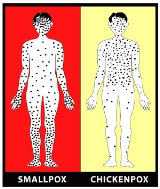
Chickenpox was first identified by the Persian physician, Muhammad ibn Zakariya ar-Razi (865–925), known to the West as "Rhazes", who clearly distinguished it from smallpox
Smallpox

Smallpox is an infectious disease unique to humans, caused by either of two virus variants, Variola major and Variola minor. The disease is also known by the Latin names Variola or Variola vera, which is a derivative of the Latin varius, meaning spotted, or varus, meaning "pimple"....
 and measles
Measles

Measles is a infection of the respiratory system caused by a virus, specifically a paramyxovirus of the genus Morbillivirus. Morbilliviruses, like other paramyxoviruses, are enveloped, single-stranded, negative-sense RNA viruses....
. Giovanni Filippo
Giovanni Filippo

Giovanni Filippo is believed to be first to describe Varicella, commonly known as chicken pox. He is also a major figure in the history of the science of human anatomy....
 (1510–1580) of Palermo
Palermo

Palermo is a historic city in southern Italy, the Capital of the autonomous region Sicily and the province of Palermo. The city is noted for its rich history, culture, architecture and gastronomy, playing an important role throughout much of its existence; it is over 2,700 years old....
 later provided a more detailed description of varicella (chickenpox). Subsequently in the 1600s, an English
United Kingdom

The United Kingdom of Great Britain and Northern Ireland, commonly known as the United Kingdom , the UK or Britain,is a sovereign state located off the northwestern coast of continental Europe....
 physician named Richard Morton
Richard Morton (physician)

Richard Morton was an English physician who was the first to state that Tubercle were always present in the tuberculosis disease of the lungs....
 described what he thought a mild form of smallpox
Smallpox

Smallpox is an infectious disease unique to humans, caused by either of two virus variants, Variola major and Variola minor. The disease is also known by the Latin names Variola or Variola vera, which is a derivative of the Latin varius, meaning spotted, or varus, meaning "pimple"....
 as "chicken pox". Later, in 1767, a physician named William Heberden
William Heberden

William Heberden , England physician, was born in London.At the end of 1724 he was sent to St John's College, Cambridge, where he obtained a fellowship, around 1730, became master of arts in 1732, and took the degree of Doctor of Medicine in 1739....
, also from England, was the first physician to clearly demonstrate that chickenpox was different from smallpox. However, it is believed the name chickenpox was commonly used in earlier centuries before doctors identified the disease.

There are many explanations offered for the origin of the name chickenpox:

  • Samuel Johnson
    Samuel Johnson

    Samuel Johnson was an English author. Beginning as a Grub Street journalist, he made lasting contributions to English literature as a poet, essayist, moralist, novelist, literary critic, biographer, editor and lexicographer....
     suggested that the disease was "less dangerous", thus a "chicken" version of the pox;
  • the specks that appear looked as though the skin was pecked by chickens;
  • the disease was named after chick pea
    Chickpea

    The chickpea is an edible legume of the family Fabaceae, subfamily Faboideae. Chickpeas are high in protein and one of the earliest cultivated vegetables....
    s, from a supposed similarity in size of the seed to the lesions;
  • the term reflects a corruption of the Old English word giccin, which meant itching.


As "pox" also means curse, in medieval times some believed it was a plague brought on to curse children by the use of black magic.

During the medieval era, oatmeal
Oatmeal

Oatmeal is a product of ground oat groats or a porridge made from this product . The term, 'oatmeal' can refer also to other products made from oat groats, such as steel-cut oats, crushed oats, and rolled oats....
 was discovered to soothe the sores, and oatmeal baths are today still commonly given to relieve itching.

See also

  • Pox party
    Pox party

    A pox party is a party held by parents for the purpose of infecting their children with childhood diseases, most commonly chicken pox, thus acquiring some immunity to the disease....


Further reading


External links