
All Topics  
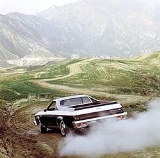
Chevrolet El Camino

 
Chevrolet El Camino

   Email Print
   Bookmark   Link


Chevrolet El Camino


The Chevrolet El Camino (Spanish translation: "The Road") was a coupe utility
Coupé utility

The coup? utility combines a two-door "coup?" cabin with an integral cargo bed behind the cabin?using a light-duty unibody automobile platform rather than a pickup truck's heavier duty body-on-frame construction....
 vehicle / muscle car
Muscle car

Muscle car is a term used to refer to a variety of high performance automobiles. At its most widely accepted the term refers to American 2-door rear wheel drive mid-size cars of the late 1960s and early 1970s equipped with large, powerful V8 engines and sold at an affordable price for street use and automobile racing, formally and informal...
 built by Chevrolet
Chevrolet

Chevrolet is a brand of automobile, produced by General Motors . It is the top selling GM marque, with "Chevrolet" or "Chevy" being at times synonymous with GM....
 in the United States
United States

The United States of America is a Federal government constitutional republic comprising U.S. state and a federal district. The country is situated mostly in central North America, where its Contiguous United States and Washington, D.C., the Capital districts and territories, lie between the Pacific Ocean and Atlantic Oceans, Borders of the U...
 from 1959 to 1960, with production resuming in 1964 and continuing through 1987. Produced in response to the success of the rival Ford Ranchero
Ford Ranchero

The Ford Ranchero was a coupe utility produced between 1957 and 1979 based on full-size, compact and intermediate automobiles by the Ford Motor Company for the North American market....
, it was based on corresponding Chevrolet car lines, though in North America, the vehicle is classified as a truck and titled as such. During 1978 through 1987, the El Camino was sold under four main models: The Super Sport, The Royal Knight, The Conquista, and the regular El Camino.


Discussion
Ask a question about 'Chevrolet El Camino'
Start a new discussion about 'Chevrolet El Camino'
Answer questions from other users
Full Discussion Forum


Encyclopedia


The Chevrolet El Camino (Spanish translation: "The Road") was a coupe utility
Coupé utility

The coup? utility combines a two-door "coup?" cabin with an integral cargo bed behind the cabin?using a light-duty unibody automobile platform rather than a pickup truck's heavier duty body-on-frame construction....
 vehicle / muscle car
Muscle car

Muscle car is a term used to refer to a variety of high performance automobiles. At its most widely accepted the term refers to American 2-door rear wheel drive mid-size cars of the late 1960s and early 1970s equipped with large, powerful V8 engines and sold at an affordable price for street use and automobile racing, formally and informal...
 built by Chevrolet
Chevrolet

Chevrolet is a brand of automobile, produced by General Motors . It is the top selling GM marque, with "Chevrolet" or "Chevy" being at times synonymous with GM....
 in the United States
United States

The United States of America is a Federal government constitutional republic comprising U.S. state and a federal district. The country is situated mostly in central North America, where its Contiguous United States and Washington, D.C., the Capital districts and territories, lie between the Pacific Ocean and Atlantic Oceans, Borders of the U...
 from 1959 to 1960, with production resuming in 1964 and continuing through 1987. Produced in response to the success of the rival Ford Ranchero
Ford Ranchero

The Ford Ranchero was a coupe utility produced between 1957 and 1979 based on full-size, compact and intermediate automobiles by the Ford Motor Company for the North American market....
, it was based on corresponding Chevrolet car lines, though in North America, the vehicle is classified as a truck and titled as such. During 1978 through 1987, the El Camino was sold under four main models: The Super Sport, The Royal Knight, The Conquista, and the regular El Camino. It also had a twin called the GMC Sprint and later the GMC Caballero
GMC Caballero

The GMC Caballero is a version of the Chevrolet El Camino coupe utility, built and sold by GMC Truck dealers mainly in the United States and Canada during the 1978-1987 model years....
 from 1978-1987. In Mexico
Mexico

The United Mexican States , commonly known as Mexico , is a federalism constitutionalism republic in North America. It is bordered on the north by the United States; on the south and west by the Pacific Ocean; on the southeast by Guatemala, Belize, and the Caribbean Sea; and on the east by the Gulf of Mexico....
, it was sometimes sold as the Chevrolet Conquistador.

First generation (1959-1960)


The first El Camino was produced for the 1959 model year (two years after the Ford Ranchero
Ford Ranchero

The Ford Ranchero was a coupe utility produced between 1957 and 1979 based on full-size, compact and intermediate automobiles by the Ford Motor Company for the North American market....
) and, like the Ranchero, was based on an existing and easily modified platform, namely the new-for-1959 Brookwood
Chevrolet Brookwood

Brookwood was a name used by Chevrolet on certain models in its station wagon offerings between 1958 and 1972....
 two-door station wagon and corresponding sedan delivery
Sedan delivery

Sorry, no overview for this topic
 variant; unlike those more pedestrian versions, the El Camino was available with any trim level and drivetrain option corresponding to the car line, including that of the Chevrolet Impala
Chevrolet Impala

The Chevrolet Impala is a Full-size car automobile built by General Motors for their Chevrolet division. Ed Cole, Chevrolet's chief engineer in the late 1950s, defined the Impala as a "prestige car within the reach of the average American citizen."...
. This was also the first year of the flamboyant "batwing" full-sized Chevrolet which sold in fewer numbers than more conservatively styled Fords. So too did the El Camino suffer in comparison to the Ranchero with 22,246 built the first year. The similar but less flamboyant 1960 model sold even worse at 14,163 units total at which point General Motors decided to discontinue the model. In total, 36,409 first generation El Caminos were produced.

Second generation (1964-1967)


Four years later, with the Ranchero still selling well, Chevrolet reincarnated the El Camino, based on the then-new Chevrolet Chevelle
Chevrolet Chevelle

The Chevrolet Chevelle is a mid-sized automobile from Chevrolet debuting in 1964. It was produced from 1964 through 1977 and was one of General Motors' most successful cars....
. That 1964 model was basically identical to the Chevelle forward of the B-pillars, but Chevrolet considered the vehicle a practical, utility model and the Chevelle's most powerful engines were not available. Initial engine offerings included six-cylinder engines of 194 and 230 cubic inches with horsepower ratings of 120 and 155, respectively. The standard V8 was a 283 cubic-inch Chevy small block with two-barrel carburetor and with optional engines including a 220-horsepower 283 with four-barrel carburetor and dual exhausts. Added to the El Camino's option list during the course of the 1964 model year were two versions of the 327 cubic-inch small block V8 rated at 250 and - the latter featuring a higher compression ratio of 10.5 to 1, larger four-barrel carburetor and dual exhausts.

1965 saw the availability of a higher performance version of the 327 engine rated at that was also available in Chevelles under option code L-79. Most other engines were carried over from 1964 including the 194 and 230 cubic-inch Turbo Thrift sixes, the 195-horsepower 283 cubic-inch Turbo-Fire V8 and 327 cubic-inch Turbo-Fire V8s of 250 and .

1966 brought added a V8 engine
V8 engine

A V8 engine is a V engine with eight cylinder s mounted on the crankcase in two banks of four cylinders, in most cases set at a right angle to each other but sometimes at a narrower angle, with all eight pistons driving a common crankshaft....
 to the lineup rated from 325 to . The 1965 327 would run low 15s in the 1/4 mile (at some 90 mph), while 1966 to 1969 models were easily into the mid- to upper-14s. New front end sheetmetal similar to Chevelles highlighted the '66 El Camino and a new instrument panel with horizontal sweep speedometer was featured. Inside, the standard version featured a bench seat interior and rubber floor mat from the lower-line Chevelle 300 series while the Custom used a more upscale interior from the Chevelle Malibu with plusher cloth-and-vinyl or all-vinyl bench seats and deep twist carpeting, or optional Strato bucket seats with console.

The El Camino followed the Chevelle's styling update for 1967, with a new grille, front bumper, and trim. Air shocks were introduced, allowing the driver to compensate for a load. The year 1967 also brought options of disc brakes, Turbo 400 3 speed transmission and the collapsable steering column for the first time. It was the pinnacle year for the 2nd generation El Camino. 2,565 El Camino Customs came with the 396 big block. That option came with the Powerglide, Turbo-Hydro 400 automatic, manual 3 speed or two choices of 4 speed manual Muncie transmissions. The 396 four speed equipped El Caminos were the most rare with less than 500 units sold. Other engines included the standard 230 Turbo-Thrift Six (140 horsepower) and 283 Turbo-Fire V8 (195 horsepower) or optional 327 Turbo-Fire V8s (275 and 325 horsepower).

Third generation (1968-1972)


1968 introduced a longer El Camino, based on the station wagon
Station wagon

A station wagon in American English, Australian English, Canadian English and New Zealand English usage and an estate car in British English usage, is a passenger automobile with a car body style similar to a sedan but with the roofline following the full, sometimes extended rear cargo area, i.e. ending with a more vertical door...
/4-door sedan wheelbase. A new, high performance Super Sport SS396 version was launched, alongside the Chevelle version. 1969 models were very similar, but 1970 saw the availability of a new SS396 which actually displaced (although all emblems read 396). Chevrolet's largest and most-powerful engine of the time was also put into a select few El Caminos. The LS6 454 in³ engine, rated at and of torque, gave the El Camino 1/4 mile times in the upper 13 second range at almost . 1969 also marked the first time that the legendary Chevrolet 350 V-8 was used in an El Camino.

The 1971 model saw reduced power and performance, along with the rest of Chevrolet's line, as lower-octane unleaded fuel was mandated, and emissions controls began to be felt. Single headlights replaced double for 1971, and the grille now came to a point. Little changed but still lower power outputs for 1972. Engine offerings for 1971-72 included the 250-6, small block V8s of 307 and 350 cubic inches; and big block V8s of 402 and 454 cubic-inch displacements. Horsepower ratings of those engines for 1971 ranged from 145 for the six to 365 for the 454 - all in gross figures. For 1972, horsepower measurements were switched to the "net" figures as installed in a vehicle with all accessories and emission controlles hooked up - this change brought the horsepower ratings for 1972 down to a range from for the six to 270 for the 454 V8.

A rebadged El Camino called the GMC Sprint debuted in 1971. It shared the same engine/transmission offerings as its Chevy counterpart.

The El Caminos of this period shared exterior and interior trims with the Chevelle Malibu including cloth and vinyl or all-vinyl bench seats and deep twist carpeting. All-vinyl Strato bucket seats and center console were optional.

Fourth generation (1973-1977)


For 1973, the El Camino was restyled again, matching changes to the Chevelle. It was the largest generation of El Camino, but thanks to lighter construction, it weighed less than the previous generation. A front-end restyle with quad stacked headlights was done in 1976, but otherwise it was the same truck until 1978.

Engine offerings during this period included a 250 cubic-inch inline six and a variety of V8s including the 305, 350 and 400 cubic-inch versions of the Chevy small-block V8, and the 454 Turbo-Jet big block V8 which was discontinued after 1975. Catalytic converters were added to all engines beginning with the 1975 model.

The El Camino was one of the few Chevrolet models to retain an "SS" or Super Sport version through this period as the Chevelle SS was dropped after 1973 and the Nova SS after 1976. The "SS" versions of the Impala, Monte Carlo and Camaro had already been dropped prior to that time.

There were two different trim levels of El Caminos during this period. The base model shared interior and exterior appointments with the Chevelle Malibu while the El Camino Classic (introduced for 1974) shared its trim with the more upscale Chevelle Malibu Classic including notchback bench seat with folding armrest in either cloth or vinyl trim, upgraded door panels and woodgrained instrument panel trim. Offered as an option were the swiveling Strato bucket seats also available in Chevelle Malibus and Lagunas, along with a center console. The "SS" was an option package rather than a distinct model.

In 1974, Chevrolet's sister division, Pontiac, reportedly took an El Camino body and grafted the urethane-nose front end from its Grand Am
Pontiac Grand Am

The Pontiac Grand Am was originally a mid-size car and later a compact car that was produced by the Pontiac division of General Motors. The Grand Am had two separate 3-year runs in the '70s: from 1973 to 1975 and again from 1978 to 1980....
 series and added the GA's instrument panel and Strato bucket seats with recliners and adjustable lumbar support along with Pontiac's Rally II wheels as a styling exercise for a possible Pontiac version of the El Camino. However, that concept never reached production as GMC was offering its own version of the El Camino called the Sprint and many (if not most) Pontiac dealers also sold GMC trucks through dualled dealerships.

Fifth generation (1978-1987)


A new, smaller El Camino was unveiled in 1978, with more sharp-edged styling and a slightly (one-inch) longer wheelbase. It included a single headlight design, until a later revision in 1982 that had a four headlight design. The El Camino now shared components with the Chevrolet Malibu
Chevrolet Malibu

The Chevrolet Malibu is a mid-size car produced in the United States by General Motors. It is marketed in the United States, Canada, Mexico and Middle East....
 (The Chevelle name had been dropped) and Chevrolet Monte Carlo
Chevrolet Monte Carlo

The Chevrolet Monte Carlo was an American-made automobile. Originally introduced by Chevrolet for the 1970 model year , it has gone through six generations as of 2007....
. V6 engine
V6 engine

A V6 engine is a V engine with six cylinder s mounted on the crankcase in two banks of three cylinders, usually set at either a right angle or an acute angle to each other, with all six pistons driving a common crankshaft....
s (based on the Buick
Buick V6 engine

The Buick V6, initially marketed as Fireball at its introduction in 1962, is a large V6 engine used by General Motors Corporation. The block is made of cast iron and all use two-valve-per-cylinder iron heads, actuated by pushrods....
 or Chevrolet 90-degree V6) were available for the first time, and from 1982 through 1984, Oldsmobile
Oldsmobile

Oldsmobile was a brand name of automobile produced for most of its existence by General Motors. It was founded by Ransom E. Olds in 1897. In its 107-year history, it produced 35.2 million cars, including at least 14 million built at its Lansing, Michigan factory....
-sourced diesel engine
Diesel engine

A diesel engine is an internal combustion engine which operates using the diesel cycle . Diesel engines have the highest thermal efficiency compared to any internal combustion or external combustion engine....
s. Most common engine found in El Caminos of this era was Chevy's 305 cubic-inch small block V8 rated at 150 or .

The 1984-87 El Camino SS shared the more aerodynamic front nose with the concurrent Monte Carlo SS, but did not get the Monte's higher-output 180-horsepower 305 V8.

After 1984, GM shifted El Camino production to Mexico
Mexico

The United Mexican States , commonly known as Mexico , is a federalism constitutionalism republic in North America. It is bordered on the north by the United States; on the south and west by the Pacific Ocean; on the southeast by Guatemala, Belize, and the Caribbean Sea; and on the east by the Gulf of Mexico....
 for three more years. Production ceased after the 1987 model year, as sales of the Chevrolet S-10 true pickup truck were outselling its passenger car counterpart.

1985 to 1987 El Caminos (and its twin, the GMC Caballero
GMC Caballero

The GMC Caballero is a version of the Chevrolet El Camino coupe utility, built and sold by GMC Truck dealers mainly in the United States and Canada during the 1978-1987 model years....
) were produced in Ramos Arizpe
Ramos Arizpe

Ramos Arizpe is a city and seat of the Ramos Arizpe in the Mexican state of Coahuila. Ramos Arizpe is located 11 km from the state capital of Saltillo....
, Mexico
Mexico

The United Mexican States , commonly known as Mexico , is a federalism constitutionalism republic in North America. It is bordered on the north by the United States; on the south and west by the Pacific Ocean; on the southeast by Guatemala, Belize, and the Caribbean Sea; and on the east by the Gulf of Mexico....
. Around 425 unsold 1987 El Caminos were sold as 1988 models.

The El Camino today

Many El Caminos are still used as daily drivers, and some are used in various racing venues. The 1980s version is the most common of any of that generation of body styles, though the late 60s command the highest prices and inspire the most replicas from Hot Wheels
Hot Wheels

Hot Wheels is a brand of die cast toy car, introduced by United States toymaker Mattel on September 7, 1968. It was the primary competitor of Johnny Lightning and Matchbox until 1996, when Mattel acquired rights to the Matchbox brand from Tyco Toys....
, Matchbox
Matchbox

Matchbox may refer to:* A box, usually thin wood or sometimes cardboard, which by design contains matches, similar to a matchbook* Matchbox , a well-known brand name of die-cast toys, originally sold in replica matchbox packaging....
 and Johnny Lightning
Johnny Lightning

Johnny Lightning is a brand of model cars originally produced by Topper Toys, similar to the hugely successful Mattel Hot Wheels die cast racing cars....
 which have produced few Ford Rancheros. The Discovery Channel
Discovery Channel

The Discovery Channel is an United States satellite and cable TV channel , founded by John Hendricks and distributed by Discovery Communications....
 program Monster Garage
Monster Garage

Monster Garage was a popular television show for the Discovery Channel hosted by Jesse G. James. Each episode was an hour in length and was conceived and produced by reality automotive show mastermind Thom Beers....
 once turned an El Camino into a Figure-8 racer (dubbed the "Hell-Camino"). The drift
Drifting (motorsport)

refers to a driving technique and to a motor sport where the driver intentionally oversteers, causing loss of traction in the rear wheels through turns, while preserving vehicle control and a high exit speed....
 team Bubba Drift uses a 1986 El Camino as the only drifting truck. It is unusual in that it uses an automatic transmission
Automatic transmission

An automatic transmission is an automobile gearbox that can change gear ratios automatically as the vehicle moves, freeing the driver from having to shift gears manual transmission....
 instead of a manual transmission
Manual transmission

A manual transmission is a type of Transmission used in automotive applications. It generally utilizes a driver-operated clutch operated by a pedal or lever, for regulating torque transfer from the engine to the transmission, and a gear-shift either operated by hand or by foot ....
.

On a production note, it has been constantly rumored for years now that GM may bring back the El Camino. During the 1995 model year, GM had a concept El Camino based on the full-size Caprice
Caprice

Caprice may refer to:...
 station wagon using the grille of a 1994-96 Impala SS
Chevrolet Impala

The Chevrolet Impala is a Full-size car automobile built by General Motors for their Chevrolet division. Ed Cole, Chevrolet's chief engineer in the late 1950s, defined the Impala as a "prestige car within the reach of the average American citizen."...
; this concept was destined for production but terminated due to GM's profitable SUV sales. GM
General Motors

General Motors Corporation , founded in 1908, is the world's second-largest automaker after Toyota, ranked by 2008 global unit sales. GM was the global sales leader for 77 consecutive calendar years from 1931 to 2008....
 already has a vehicle ready in Australia in the form of the Holden Ute
Holden Ute

The Holden Ute is a coupe utility built by Holden, the Australian subsidiary of General Motors since 2000. Before then, Holden had marketed their Holden Commodore-based utility models under the Holden Utility and Holden Commodore utility names, although the term ?Holden Ute? was also used in their official marketing literature....
, save for some minor changes necessary to make it available in the U.S. This may have been backtracked within the past couple of years, however, as the Subaru Baja
Subaru Baja

The Subaru Baja was a light-utility, all-wheel-drive, four passenger, four-door Crossover SUV manufactured from 2003-2006 by Subaru. The Baja combined the handling and passenger carrying characteristics of a car with the open-bed versatility, and to a lesser degree, load capacity of a pickup truck....
, the only "pickup car" recently available in the US, didn't sell well at all and was dropped after the 2006 model year. In addition, the Pontiac GTO
Pontiac GTO

The Pontiac GTO is an automobile built by Pontiac in the United States from 1964 to 1974, and by Holden in Australia from 2004 to 2006. It is often considered the first true muscle car....
 (which Holden
Holden

GM Holden Ltd is an Australian Automotive industry based in Port Melbourne, Victoria. The company was originally independent, but since 1931 has been a subsidiary of General Motors ....
 built and exported for Pontiac
Pontiac

Pontiac is a brand of automobiles, produced by General Motors Corporation that has been sold in the United States, Canada and Mexico since 1926....
 and was loosely related to the Holden Ute) didn't sell well either and was only programmed for three years ending in 2006 due to Holden upgrading the platform it was based on. A Chevrolet badged version, known as the Lumina Ute, is sold in South Africa. It has been recently rumored that the Holden Ute will be brought to the States first as a and then as the . After the debut of the Pontiac G8 Concept truck, GM had strongly considered putting it into production. However, due to the financial struggle of 2008 for GM, they axed the plans in early 2009.

See also

  • List of Chevrolet vehicles
    List of Chevrolet vehicles

    This is a list of vehicles made by Chevrolet.* Chevrolet 150 * Chevrolet 210 * Chevrolet 3100 1/2 Ton Trucks.* Chevrolet 3600 3/4 Ton Trucks.* Chevrolet 3800 One Ton Trucks....
  • Ute
    Pickup truck

    A pickup truck is a light motor vehicle with an open-top rear cargo area which is almost always separated from the cab to allow for chassis flex when carrying or pulling heavy loads....
  • Holden Ute
    Holden Ute

    The Holden Ute is a coupe utility built by Holden, the Australian subsidiary of General Motors since 2000. Before then, Holden had marketed their Holden Commodore-based utility models under the Holden Utility and Holden Commodore utility names, although the term ?Holden Ute? was also used in their official marketing literature....
  • Dodge Rampage
    Dodge Rampage

    The Dodge Rampage was a subcompact pickup truck based on Chrysler Corporation's Chrysler L platform. First released as a 1982 model, it was later joined by the similar Plymouth Scamp....
  • Pontiac G8 ST


External links