
All Topics  
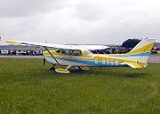
Cessna 172

 
Cessna 172

   Email Print
   Bookmark   Link


Cessna 172


The Cessna 172 Skyhawk is a four-seat, single-engine, high-wing fixed-wing aircraft
Fixed-wing aircraft

A fixed-wing aircraft is an aircraft capable of heavier-than-air flight whose Lift is generated not by wing motion relative to the aircraft, but by forward motion through the air....
.

More Cessna 172s have been built than any other aircraft
List of most produced aircraft

Aircraft with a production run greater than 5,000 aircraft. Numbers in list are based on numbers in each aircraft article....
. It is probably the most popular flight training
Flight training

Flight training is a course of study used when learning to aviator an aircraft. The overall purpose of primary and intermediate flight training is the acquisition and honing of basic airmanship skills....
 aircraft
Aircraft

An aircraft is a vehicle which is able to flight by being supported by the air, or in general, the atmosphere, of a planet. Examples include balloons, airplanes and helicopters....
 in the world.

ured by its longevity and popularity, the Cessna 172 is the most successful mass produced light aircraft in history.


Discussion
Ask a question about 'Cessna 172'
Start a new discussion about 'Cessna 172'
Answer questions from other users
Full Discussion Forum


Encyclopedia


Cessna
The Cessna 172 Skyhawk is a four-seat, single-engine, high-wing fixed-wing aircraft
Fixed-wing aircraft

A fixed-wing aircraft is an aircraft capable of heavier-than-air flight whose Lift is generated not by wing motion relative to the aircraft, but by forward motion through the air....
.

More Cessna 172s have been built than any other aircraft
List of most produced aircraft

Aircraft with a production run greater than 5,000 aircraft. Numbers in list are based on numbers in each aircraft article....
. It is probably the most popular flight training
Flight training

Flight training is a course of study used when learning to aviator an aircraft. The overall purpose of primary and intermediate flight training is the acquisition and honing of basic airmanship skills....
 aircraft
Aircraft

An aircraft is a vehicle which is able to flight by being supported by the air, or in general, the atmosphere, of a planet. Examples include balloons, airplanes and helicopters....
 in the world.

Design and development

Measured by its longevity and popularity, the Cessna 172 is the most successful mass produced light aircraft in history. The first production models were delivered in 1956 and they are still in production. As of 2008, more than 43,000 had been built. The Skyhawk's main competitors have been the Beechcraft Musketeer
Beechcraft Musketeer

The Beechcraft Musketeer line is a family of single-engine, low-wing, light aircraft that includes the Model 19 Musketeer Sport, the Model 23 Musketeer, Custom and Sundowner, the Model 23-24 Musketeer Super III the retractable gear Model 24-R Sierra and the military model CT-134 Musketeer....
 and Grumman AA-5 series
Grumman American AA-5

The United States Grumman American AA-5 series is a family of all-metal, 4-seat, light aircraft used for touring and training. The line includes the original American Aviation AA-5 Traveler, the Grumman American AA-5 Traveler, AA-5A Cheetah, and AA-5B Tiger, the Gulfstream American AA-5A Cheetah, and AA-5B Ti...
 (neither in production), the Piper Cherokee
Piper Cherokee

The Piper PA-28 Cherokee is a family of light aircraft designed for flight training, air taxi and personal use, built by Piper Aircraft.All members of the PA-28 family are all-metal, unpressurized, four-seat, single-engine piston engine airplanes with low-mounted wings and tricycle landing gear....
 and, more recently, the Diamond DA40
Diamond DA40

The Diamond DA40 Diamond Star is a four seat, single engine, Training aircraft and personal airplane constructed from composite materials....
.

The Cessna 172 started life as a tricycle landing gear variant of the taildragger Cessna 170
Cessna 170

The Cessna 170 is a light, single-engine, general aviation aircraft produced by the Cessna between 1948 and 1956....
, with a basic level of standard equipment. The first flight of the prototype was in November 1955. The 172 became an overnight sales success and over 1400 were built in 1956, its first full year of production.

Early 172s were similar in appearance to the 170, with the same straight aft fuselage and tall gear legs, although the 172 had a straight vertical tail while the 170 had a rounded fin and rudder. Later 172 versions incorporated revised landing gear and the sweptback tail which is still in use today.The final aesthetic development in the mid-1960s, was a lowered rear deck that allowed an aft window. Cessna advertised this added rear visibility as "Omni-Vision
Cessna

The Cessna Aircraft Company is an airplane manufacturing corporation headquartered in Wichita, Kansas, Kansas, USA. Their main products are general aviation aircraft....
" . This airframe configuration has remained almost unchanged since then, except for updates in avionics
Avionics

Avionics means "aviation electronics". It comprises Electronics systems for use on aircraft, artificial satellites and spacecraft, comprising communications, navigation and the display and management of multiple systems....
 and engines
Aircraft engine

An aircraft engine is a propulsion system for an aircraft. Aircraft engines are almost always either lightweight piston engines or gas turbines....
, including the Garmin G1000
Garmin G1000

The Garmin G1000 is an integrated flight instrument system manufactured by Garmin typically composed of two display units, one serving as a primary flight display, and one as a multi-function display....
 glass cockpit
Glass cockpit

A glass cockpit is an aircraft Cockpit that features electronic instrument Display device. Where a traditional cockpit relies on numerous mechanical gauges to display information, a glass cockpit utilizes several computer displays that can be adjusted to display flight information as needed....
 in 2005. Production had been halted in the mid-1980s, but was resumed in 1996 with the 160 hp (120 kW) Cessna 172R Skyhawk and was supplemented in 1998 by the 180 hp (135 kW) Cessna 172S Skyhawk SP.

Variants

Cessna172skyhawk1957model01
172 The basic 172 appeared in November 1955 as the 1956 model and remained in production until replaced by the 172A in early 1960. It was equipped with a Continental O-300
Continental O-300

The Teledyne Continental Motors O-300 and the C-145 are a family of air-cooled flat-6 piston engines for aircraft.First produced in 1947 in aviation, versions were still in production ....
  six-cylinder, air-cooled engine and had a maximum gross weight of . Introductory base price was USD$8995 and a total of 4195 were constructed over the five years.

172A The 1960 model 172A introduced a swept back tail and rudder, as well as float fittings. The price was USD$9450 and 1015 were built.

172B The 172B was introduced in late 1960 as the 1961 model and introduced a shorter undercarriage, engine mounts lengthened three inches (76 mm) , a reshaped cowling and a pointed propeller spinner. For the first time, the "Skyhawk" name was applied to an available deluxe option package. This added optional equipment included full exterior paint to replace the standard partial paint stripes and standard avionics. The gross weight was increased to .

172C The 1962 model was the 172C. It brought to the line an optional autopilot and a key starter to replace the previous pull-starter. The seats were redesigned to be six-way adjustable. A child seat was made optional to allow two children to be carried in the baggage area. The 1962 price was USD$9895. A total of 889 172C models were produced.

172D The 1963 172D model introduced the lower rear fuselage with wraparound Omni-Vision
Cessna

The Cessna Aircraft Company is an airplane manufacturing corporation headquartered in Wichita, Kansas, Kansas, USA. Their main products are general aviation aircraft....
 rear window and a one-piece windshield. New rudder and brake pedals were also added. 1146 172Ds were built.

1963 also saw the introduction of the 172D Powermatic. This was equipped with a Continental GO-300E
Continental O-300

The Teledyne Continental Motors O-300 and the C-145 are a family of air-cooled flat-6 piston engines for aircraft.First produced in 1947 in aviation, versions were still in production ....
 producing and a cruise speed faster than the standard 172D. In reality this was not a new model but was a Cessna 175
Cessna 175

The Cessna 175 Skylark is a four-seat, single-engine, high-wing airplane produced between 1958 in aviation and 1962 in aviation....
 Skylark that had been renamed for its last year of production. The Skylark had gained a reputation for poor engine reliability and the renaming of it as a 172 was a marketing attempt to regain sales through rebranding
Rebranding

Rebranding is the process by which a product or Service developed with one brand, company or product line affiliation is marketed or distributed with a different identity....
. The move was not a success and neither the 1963 Powermatic nor the Skylark were produced again after the 1963 model year.

172E
Cessna
The 172E was the 1964 model. The electrical fuses were replaced with circuit breakers. Gross weight was increased to where it would stay until the 172P. 1401 172Es were built that year as production continued to increase.

172F The 1965 model 172F introduced electrically-operated flaps to replace the previous lever-operated system. It was built in France by Reims Cessna as the F172 until 1971. These models formed the basis for the US Air Force's T-41A Mescalero primary trainer.

A total of 1436 172Fs were completed.

172G
Cessna
The 1966 model year 172G introduced a more pointed spinner and sold for USD$12,450 in its basic 172 version and USD$13,300 in the upgraded Skyhawk version. 1597 were built.

172H The 1967 model 172H was the last Continental O-300
Continental O-300

The Teledyne Continental Motors O-300 and the C-145 are a family of air-cooled flat-6 piston engines for aircraft.First produced in 1947 in aviation, versions were still in production ....
 powered model. It also introduced a shorter-stroke nose gear oleo to reduce drag and improve the appearance of the aircraft in flight. A new cowling was used, introducing shock-mounts that transmitted lower noise-levels to the cockpit and reduced cowl cracking. The electric stall warning horn was replaced by a pneumatic one.

The 1967 model 172H sold for USD$10,950 while the Skyhawk version was USD$12,750. 839 were built that year, representing the first year that production was less than the year before.

172I The 1968 model marked the beginning of the Lycoming powered 172s. The familiar 172 needed to be re-engined because Cessna had cancelled its contract with Continental for their venerable 0-300 6-cyl engine of .

The "I" model was introduced with a Lycoming O-320-E2D
Lycoming O-320

The Lycoming Engines O-320 is a large family of 92 different normally-aspirated, air-cooled, four-cylinder, direct-drive engines commonly used on light aircraft such as the Cessna 172 and Piper Cherokee....
 engine of , an increase of over the Continental powerplant. The increased power resulted in an increase in optimal cruise from TAS to TAS. There was no change in the sea level rate of climb at per minute.

The 172I also introduced the first standard "T" instrument arrangement. The 172I saw an increase in production to record levels with 1206 built.

172J The Cessna Company planned to drop the previous 172 configuration for the 1968 model year and replace it with a cantilever-wing/stabilator configuration that would be the 172J. However, as time for model introduction neared, those dealers who were aware of the change began applying pressure on the factory to continue the previous configuration. They felt the new model would be less usable as a trainer. Consequently, and at the last minute, the decision was made to continue the 172 in its original configuration. The planned 172J configuration would be introduced as a new model, the 177. The deluxe option would become the 177 Cardinal
Cessna 177

The Cessna 177 Cardinal is a light, high-wing general aviation aircraft that was intended to replace Cessna's Cessna 172. First announced in 1967 in aviation, it was produced from 1968 to 1978....
. The "J" designation was never publicly used.

172K The next model year was the 1969 "K" model. The 1969 172K had a redesigned vertical fin cap and reshaped rear windows. Optional long range wing fuel tanks were offered. The rear windows were slightly enlarged by . The 1969 model sold for USD$12,500 for the 172 and USD$13,995 for the Skyhawk, with 1170 made.

The 1970 model was still called the 172K but sported fiberglass, downward-shaped, conical wing tip
Wing tip

A wing tip is the part of the wing that is most distant from the fuselage of a fixed-wing aircraft.Because the wing tip shape influences the size and Drag of the wingtip vortices, tip design has produced a diversity of shapes, including:...
s. Fully articulated seats were offered as well. Production in 1970 was 759 units.

172L The 172L, sold during 1971 and 1972, replaced the main landing gear, which were originally flat spring steel with tapered, tubular steel gear legs. The new gear had a width that was increased by . The new tubular gear was lighter, but required aerodynamic fairings to maintain the same speed and climb performance as experienced with the flat steel design. The "L" also had a plastic fairing between the dorsal fin and vertical fin to introduce a greater family resemblance to the 182
Cessna 182

The Cessna 182, marketed under the name Skylane, is a four-seat, single-engine, light Fixed-wing aircraft. It has the option of adding two child seats, installed in the baggage area....
's vertical fin.

The 1971 model sold for USD$13,425 in the 172 version and USD$14,995 in the Skyhawk version. 827 172Ls were sold in 1971 and 984 in 1972.

172M
Gdqg
The 172M of 1973-76 gained a drooped wing leading edge for improved low speed handling. This was marketed as the "camber-lift" wing.

The 1974 172M was also the first to introduce the optional 'II' package which offered higher standard equipment, including a second nav/comm radio, an ADF and transponder
Transponder (aviation)

A transponder is an electronic device that produces a response when it receives a radio-frequency interrogation. In aviation, aircraft have transponders to assist in identifying them on radar and on other aircraft's Airborne Collision Avoidance Systems....
. The baggage compartment was increased in size and nose-mounted dual landing lights were available as an option.

The 1975 model 172M sold for USD$16,055 for the 172, USD$17,890 for the Skyhawk and USD$20,335 for the Skyhawk II. Total production of "M" models was 7306 over the four years it was manufactured.

In 1976, Cessna stopped marketing the aircraft as the 172 and began exclusively using the "Skyhawk" designation. This model year also saw a redesigned instrument panel to hold more avionics.

172N The Skyhawk N, or Skyhawk/100 as Cessna termed it, was introduced for the 1977 model year. The "100" designation indicated that it was powered by a Lycoming O-320-H2AD, engine designed to run on 100 octane fuel, whereas all previous engines used 80/87 fuel. Unfortunately, this engine proved troublesome and it was replaced by the similarly rated O-320-D2J to create the 1981 172P.

The 1977 "N" model 172 also introduced rudder trim as an option and standard "pre-selectable" flaps. The price was USD$22,300, with the Skyhawk/100 II selling for USD$29,950.

The 1978 model brought a 28-volt electrical system to replace the previous 14-volt system. Air conditioning was an option.

The 1979 model "N" increased the flap extension speed for the first 10 degrees to . Optional fuel cells increased the optional fuel to .

The "N" remained in production until 1980 when the 172P or Skyhawk P was introduced.

172O There was no "O" ("Oscar") model 172.

172P The 172P, or Skyhawk P, was introduced in 1981 to solve the reliability problems of the "N" engine. The Lycoming O-320-D2J
Lycoming O-320

The Lycoming Engines O-320 is a large family of 92 different normally-aspirated, air-cooled, four-cylinder, direct-drive engines commonly used on light aircraft such as the Cessna 172 and Piper Cherokee....
 was a great improvement.

The "P" model also saw the maximum flap deflection decreased from 40 degrees to 30 to allow a gross weight increase from to . A wet wing was optional, with a capacity of 62 US gallons of fuel.

The price of a new Skyhawk P was USD$33,950, with the Skyhawk P II costing USD$37,810 and the Nav/Pac equipped Skyhawk P II selling for USD$42,460.

In 1982, the "P" saw the landing lights moved from the nose to the wing to increase bulb life. The 1983 model added some minor sound-proofing improvements and thicker windows.

A second door latch pin was introduced in 1984.

Production of the "P" ended in 1985 and no more 172s were built for eleven years as legal liability rulings in the USA had pushed Cessna's insurance costs too high, resulting in dramatically increasing prices for new aircraft.

There were only 195 172s built in 1984, a rate of fewer than 4 per week.

172Q Cutlass The 172Q was introduced in 1983 and given the name Cutlass to create an affiliation with the 172RG, although it was actually a 172P with a Lycoming O-360-A4N
Lycoming O-360

The Lycoming Engines O-360 is a family of four-cylinder, direct-drive, horizontally opposed, air-cooled, piston aircraft engines. Engines in the O-360 series produce between 145 and 225 horsepower ....
 engine of . The aircraft had a gross weight of and an optimal cruise speed of compared to the "P"s cruise speed of on or less. It had a useful load that was about more that the Skyhawk P and a rate of climb that was actually per minute lower, due to the higher gross weight. Production ended after only three years when all 172 production stopped.

172R The Skyhawk R was introduced in 1996 and is powered by a derated Lycoming IO-360-L2A
Lycoming O-360

The Lycoming Engines O-360 is a family of four-cylinder, direct-drive, horizontally opposed, air-cooled, piston aircraft engines. Engines in the O-360 series produce between 145 and 225 horsepower ....
 producing a maximum of at just 2,400 rpm. This is the first Cessna 172 to have a factory fitted fuel-injected engine.

The 172R's maximum takeoff weight is . This model year introduced many improvements, including a new interior with soundproofing, an all new multi-level ventilation system, a standard four point intercom, contoured, energy absorbing, 26g front seats with vertical and reclining adjustments and inertia reel harnesses.

172S The Cessna 172S was introduced in 1998 and is powered by a Lycoming IO-360-L2A
Lycoming O-360

The Lycoming Engines O-360 is a family of four-cylinder, direct-drive, horizontally opposed, air-cooled, piston aircraft engines. Engines in the O-360 series produce between 145 and 225 horsepower ....
 producing . The maximum engine rpm was increased from 2,400 rpm to 2,700 rpm resulting in a increase over the "R" model. As a result, the maximum takeoff weight was increased to . This model is marketed under the name Skyhawk SP, although the Type Certiciation data sheet specifies it is a 172S.

The 172S is built primarily for the private owner-operator and is offered with the Garmin G1000
Garmin G1000

The Garmin G1000 is an integrated flight instrument system manufactured by Garmin typically composed of two display units, one serving as a primary flight display, and one as a multi-function display....
 avionics package as standard equipment and leather seats.

As of 2009, only the S model is in production.

Cessna 172RG Cutlass
Cessna
Cessna introduced a retractable-gear version of the 172 in 1980 and named it the Cutlass 172RG.

The Cutlass featured a variable pitch, constant speed propeller and more powerful Lycoming O-360-F1A6
Lycoming O-360

The Lycoming Engines O-360 is a family of four-cylinder, direct-drive, horizontally opposed, air-cooled, piston aircraft engines. Engines in the O-360 series produce between 145 and 225 horsepower ....
 engine of . The 172RG sold for about USD$19,000 more than the standard 172 of the same year and produced an optimal cruise speed of 140 knots (260 km/h), compared to for the contemporary version.

The 172RG did not find wide acceptance in the personal aircraft market, but was adopted by many flight schools as a complex aircraft trainer. Between 1980 and 1984 1177 RGs were built, with a small number following before production ceased in 1985.

While numbered and marketed as a 172, the 172RG was actually certified on the Cessna 175
Cessna 175

The Cessna 175 Skylark is a four-seat, single-engine, high-wing airplane produced between 1958 in aviation and 1962 in aviation....
 type certificate.

Reims FR172J and Cessna R172K Hawk XP

The FR172J Reims Rocket was produced by Reims Aviation
Reims Aviation

Reims Aviation is a France aircraft manufacturer located in the city of Reims currently producing the Reims-Cessna F406....
 in France from the late 60s to the mid 70s. It was powered by a Rolls-Royce built, fuel-injected, Continental IO-360D engine with a constant speed prop.

The Reims Rocket led to Cessna producing the R172K Hawk XP, a model available from 1977 to 1981 from both Wichita and Reims. This configuration featured a fuel injected, Continental IO-360K (later IO-360KB) derated to with a two bladed, constant speed propeller. The Hawk XP was capable of a cruise speed.

Owners claimed that the increased performance of the "XP" didn't compensate for its increased purchase price and the higher operating costs associated with the larger engine. The aircraft was well-accepted for use on floats, however, as the standard 172 is not a strong floatplane, even with only two people on board, while the XP's extra power improves water take-off performance dramatically.

While numbered and marketed as 172s, the R172J and R172K models are actually certified on the Cessna 175
Cessna 175

The Cessna 175 Skylark is a four-seat, single-engine, high-wing airplane produced between 1958 in aviation and 1962 in aviation....
 type certificate.

Future models

172TD On October 4, 2007 Cessna announced its plan to build a diesel-powered Cessna 172 model starting in mid-2008. The planned engine was to be a Thielert
Thielert

Thielert AG is a German engine development and manufacturing company. It is headquartered in Hamburg, with additional sites in Lichtenstein, Germany, Saxony and Altenburg, Thuringia....
 Centurion 2.0, liquid-cooled, two-litre displacement, dual overhead cam, four-cylinder, in-line, turbo-diesel with full authority digital engine control
FADEC

A FADEC is a system consisting of a digital computer, called an "electronic engine control" or "electronic control unit" , and its related accessories that control all aspects of aircraft engine performance....
. The engine produced and burns Jet-A
Jet fuel

Jet fuel is a type of aviation fuel designed for use in aircraft powered by Aircraft engine#Gas turbine engine configurations. It is clear to straw colored....
 fuel. The engines were to be installed at the Cessna Skyhawk factory in Independence, Kansas
Independence, Kansas

Independence is a city in and the county seat of Montgomery County, Kansas, Kansas, United States. The population was 9,846 at the 2000 United States Census....
 under an STC. The new model was designated the 172 Skyhawk TD, indicating "Turbo Diesel".

Cessna had taken special measures to ensure that the Skyhawk TD would be only fueled with Jet-A and not misfueled with avgas
Avgas

Avgas is a octane rating aviation fuel used to power many aircraft and racing cars. Avgas is a portmanteau for aviation gasoline, as distinguished from mogas , which is the everyday gasoline used in automobile....
. These included placards, key-shaped tank fillers that only accept jet fuel nozzles and a spring-loaded door activated with a jet-fuel nozzle. The aircraft was planned to be certified for Jet-A only and not automotive diesel.

The TD was to be equipped with only one engine control, referred to as a "power control", although it resembled the push-pull style throttle used in previous 172 models. The prototype has no carburetor heat or mixture control. The prototype is equipped with a constant speed MT propeller, but this is controlled automatically and there is no propeller rpm control.

The TD was designed to have the same gross weight as the "S" Skyhawk, , but at was intended to have less than the "S" model. Because it is turbonormalized
Turbocharger

A turbocharger, or turbo, is a gas compressor used for forced induction of an internal combustion engine. Like a supercharger, the purpose of a turbocharger is to increase the mass of air entering the engine to create more power....
 the prototype's engine produces full power at all altitudes and actually puts out more power than the "R" and "S" models above , where the normally aspirated powerplant's output drops off.

To account for the fact that Jet-A has a higher density than avgas Cessna planned to reduce the tank capacity on the TD to 44.6 US gallons, giving the aircraft a similar range to other models, due to the better efficiency of the diesel engine. The Thielert 2.0 is reported to burn 5.8 gal/hr at and 75% power. This compares to 8 gal/hr at the same power setting and altitude for the "R" model and 10 gal/hr for the "S" model Skyhawks.

Even with the reduced fuel tank capacity the full fuel payload of the TD will be compared to for the Cessna 172S and for the 172R.

Direct operating costs for the TD were forecast to be USD$96.39 per hour versus USD$101.81 for the higher powered "S" model. While the TD would burn less fuel per hour its engine replacement costs at 2400 hours, instead of overhaul, would almost make up for the difference, although these numbers will change as the price of fuel changes in future years.

In early 2008 certification had been planned for the summer of 2008 and Cessna had forecast delivering about 125 TDs before the end of 2008.

The TD was intended to sell for about USD$15,000 more than the top of the line "SP" Skyhawk and $35,000 more than the "R". Base price was initially advertised as USD$269,500 versus USD$254,500 for the "SP" or $234,500 for the "R".

Early orders for the TD were strong with most of the demand from flight schools and non-US operators.

In April 2008 the 172TD's engine manufacturer, Thielert
Thielert

Thielert AG is a German engine development and manufacturing company. It is headquartered in Hamburg, with additional sites in Lichtenstein, Germany, Saxony and Altenburg, Thuringia....
 filed for insolvency under German law, throwing the future of the aircraft into doubt.

On May 1, 2008 Cessna announced that they have cancelled all 2008 deliveries of the 172TD due to the insolvency of Thielert. The company stated: "At this point we have decided that we will not deliver 172TD aircraft during 2008, and we have informed our customers accordingly." Cessna has indicated, however, that they will proceed with the certification of the 172TD.

Cessna has indicated that they still wish to produce a diesel 172 as market demand is strong for this aircraft with over 100 orders.

Aircraft Type Clubs

The Cessna 172 is supported by a number of active aircraft type clubs, including The Cessna Pilots Association and The Cessna 172/182 Club.

Military operators

A variant of the 172, the T-41 Mescalero
T-41 Mescalero

The T-41 Mescalero is a military version of the popular Cessna 172 used by the United States Air Force and the United States Army as a Trainer ....
 is used as a trainer with the United States Air Force
United States Air Force

The United States Air Force is the aerial warfare branch of the Military of the United States and one of the uniformed services of the United States....
 and Army
United States Army

The United States Army is the branch of the United States Armed Forces responsible for Army operations. It is the largest and oldest established branch of the U.S....
. Because of its high-wing design, stability at low airspeeds, and relatively low stall speed, the 172 is an excellent platform for search and rescue operations, and is the primary platform for the Civil Air Patrol
Civil Air Patrol

The Civil Air Patrol is a United States Congress chartered, federally supported, Non-profit organization corporation that serves as the official Auxiliaries of the United States Air Force ....
's operations. In addition, the United States Border Patrol
United States Border Patrol

The United States Border Patrol is a federal police within U.S. Customs and Border Protection , a component of the Department of Homeland Security ....
 uses a fleet of 172s for aerial surveillance along the Mexican-American border.

The Irish Air Corps
Irish Air Corps

The Irish Air Corps provides the air defence function of Oglaigh na h?ireann , in support of the Irish Army and Irish Naval Service, together with such other roles as may be assigned by the Government ....
 uses the Reims version for aerial surveillance and monitoring of cash, prisoner & explosive escorts in addition to army co-operation and pilot training roles. The type is popular and successful in service despite some accidents. Air Corps examples are painted dark green and carry the service roundels. Most are not fitted with the distinctive wheel spats.

  • Bolivian Air Force
    Bolivian Air Force

    The Bolivian Air Force 'Fuerza A?rea Boliviana' or 'FAB' is part of the Military of Bolivia. It operates all Bolivian government owned aircraft....
     3 x 172K
  • Chilean Army
    Chilean Army

    The Chilean Army is the land arm of the Military of Chile. This 45,000-person army is organized into seven divisions, a special operations brigade and an air brigade....
     18 x R172K
  • Ecuadorian Air Force
    Ecuadorian Air Force

    The Ecuadorian Air Force is the Air arm of the Military of Ecuador....
     8 x 172F
  • Ecuadorian Army
    Ecuadorian Army

    The Ecuadorian Army is the branch of the Ecuadorian military in charge of the defense of the Ecuadorian State from any land-based threat.As such, the Army is one of the three branches that constitute the Ecuadorian Armed Forces , the other two being the Ecuadorian Air Force , and the Ecuadorian Navy ....
     1 x 172G
  • Guatemalan Air Force
    Guatemalan Air Force

    The Guatemalan Air Force is a small and antiquated air force. It has relied mostly on US aircraft types throughout its history, most of them by now obsolete in terms of what a modern air force should be....
     6 x 172K
  • Honduran Air Force 3
  • Iraqi Air Force
    Iraqi Air Force

    The Iraqi Air Force or IQAF is the Military of Iraq in Iraq responsible for the policing of international borders, surveillance of national assets and aerial warfare....
      12
  • Irish Air Corps
    Irish Air Corps

    The Irish Air Corps provides the air defence function of Oglaigh na h?ireann , in support of the Irish Army and Irish Naval Service, together with such other roles as may be assigned by the Government ....
     8 x FR172H, 1 x FR172K
  • Air Reconnaissance Unit 2
  • Malagasy Air Force
    Military of Madagascar

    The Military of Madagascar is made up of the People's Armed Forces and the National Gendarmerie. The IISS detailed the armed forces in 2007 as including an Army of 12,500+, a Navy of 500, and a 500-strong Air Force....
     4 x 172M
  • Pakistan Air Force
    Pakistan Air Force

    Pakistan Air Force is the aircraft branch of the Military of Pakistan and is responsible for defending Pakistani air-space from intrusions. It also provides air support for ground troops....
     4 x 172N
  • Philippine Army
    Philippine Army

    The Philippine Army is the ground arm of the Armed Forces of the Philippines . Its official name in Filipino language is Hukbong Katihan ng Pilipinas....
     -
  • Royal Saudi Air Force
    Royal Saudi Air Force

    The Royal Saudi Air Force , is the air force branch of Military of Saudi Arabia. After the Israeli Air Force the RSAF has the second largest air combat capability in the Middle East....
     8 x F172G, 4 x F172H, 4 x F172M


Notable flights

  • On December 4, 1958 Robert Timm and John Cook took off from McCarran Airfield, Las Vegas, NV in N9172B. Sixty four days, 22 hours, 19 minutes and 5 seconds later, they landed back at McCarran Airfield on February 4, 1959. The flight was part of a fund raising effort for the Damon Runyon
    Damon Runyon

    Damon Runyon was a newspaperman and writer.He was best known for his short stories celebrating the world of Broadway in New York City that grew out of the Prohibition in the United States era....
     Cancer Fund. Food and water were transferred by matching speeds with a chase car on a straight stretch of road in the desert, and hoisting the supplies aboard with a rope and bucket. Fuel was taken on by hoisting a hose from a fuel truck up to the aircraft, filling an auxiliary belly tank installed for the flight, pumping that fuel into the aircraft's regular tanks, and then filling the belly tank again. The drivers steered while a second person matched speeds with the aircraft with his foot on the vehicle's accelerator pedal.


Engine oil was added by means of a tube from the cabin that was fitted to pass through the firewall. Only the pilot's seat was installed. The remaining space was used for a pad on which the relief pilot slept. The right cabin door was replaced with an easy-opening, accordion-type door to allow supplies and fuel to be hoisted aboard. Early in the flight, the engine driven electric generator failed. A Champion wind driven generator (turned by a small propeller) was hoisted aboard, taped to the wing support strut, plugged into the cigarette lighter socket -- and served as the aircraft's source of electricity for the rest of the flight. The pilots decided to end the marathon-flight because, with nearly 1500 hours continuous running during the record-setting flight plus several hundred hours already on the engine beforehand (considerably in excess of its normal overhaul interval), the engine's power output had deteriorated to the point that they were barely able to climb away after refueling. The aircraft is on display in the passenger terminal at McCarran International Airport
McCarran International Airport

McCarran International Airport is the principal commercial airport serving Las Vegas, Nevada and Clark County, Nevada, United States. The airport is located five miles south of the central business district of Las Vegas, in the unincorporated area of Paradise, Nevada in Clark County....
. Photos and details of the record flight can be seen in a small museum on the upper level of the baggage claim area.


  • On February 13, 1964 Chicago Cubs
    Chicago Cubs

    The Chicago Cubs are a professional baseball franchise based in Chicago, Illinois. They are members and currently the two-time defending champions of the National League Central of Major League Baseball's National League....
     second baseman
    Second baseman

    Second base, or 2B, is the second of four stations on a baseball diamond which must be touched in succession by a base runner in order to score a run for that player's team....
     Ken Hubbs
    Ken Hubbs

    Kenneth Douglass Hubbs was an United States second baseman who played from to for the Chicago Cubs in the National League. He was killed in a plane crash near Provo, Utah prior to the 1964 in baseball....
     took off in a Cessna 172 with his close friend Dennis Doyle in Provo, Utah. They were in town to visit Doyle's wife and her parents. A minute into the flight, about five miles (8 km) south of Provo, the plane went down in poor weather in an ice covered part of Utah Lake.


  • On August 31, 1969, Rocky Marciano
    Rocky Marciano

    Rocky Marciano , born Rocco Francis Marchegiano, was the heavyweight champion of the world from 1952 to 1956. Marciano, with forty-three knockouts to his credit , remains the only heavyweight champion in boxing history to retire having won every fight in his professional career....
     was killed when the Cessna 172 he was a passenger in crashed on approach to an airfield outside Newton, Iowa.


  • On September 25, 1978, a Cessna 172 collided with Pacific Southwest Airlines Flight 182
    PSA Flight 182

    Pacific Southwest Airlines Flight 182, registration N533PS, was a Boeing 727 commercial airliner that collided over San Diego, California with a private Cessna 172 on September 25, 1978....
    , a Boeing 727
    Boeing 727

    The Boeing 727 is a mid-size, Narrow-body aircraft, trijet, T-tailed Commercial airliner jet airliner. The 727's fuselage has an outer diameter of ....
    . The two aircraft crashed over San Diego, California
    California

    California is a U.S. state on the West Coast of the United States of the United States, along the Pacific Ocean. It is bordered by Oregon to the north, Nevada to the east, Arizona to the southeast, and to the south the Mexico state of Baja California....
    . There were a total of 144 fatalities: 2 in the Cessna 172, 135 on the PSA Flight 182 and 7 on the ground. This accident is the subject of an upcoming documentary film.


  • In 1987, a rented Reims Cessna F172P was used by a German teenage pilot Mathias Rust
    Mathias Rust

    Mathias Rust is a Germany man known for his illegal landing near Red Square in Moscow in 1987. As an amateur aviator, he flew from Finland to Moscow, being tracked several times by soviet air defence and interceptors, which never received permission to shoot him down, and several times mistaken for a friendly aircraft, he landed on Vasilev...
     to fly an unauthorized flight from Helsinki-Malmi Airport
    Helsinki-Malmi Airport

    Helsinki-Malmi Airport is an airport in the city of Helsinki, Finland, located in the district of Malmi, some north-east from the city centre....
     through Soviet
    Soviet Union

    The Union of Soviet Socialist Republics was a Constitution of the Soviet Union socialist state that existed in Eurasia from 1922 to 1991.The name is a translation of the , romanization of Russian Soyuz Sovetskikh Sotsialisticheskikh Respublik, abbreviated ????, SSSR....
     airspace to land near the Red Square
    Red Square

    Red Square is the most famous city square in Moscow, and arguably one of the most famous in the world. The square separates the Moscow Kremlin, the former royal citadel and currently the official residence of the President of Russia, from a historic merchant quarter known as Kitay-gorod....
     in Moscow
    Moscow

    Moscow is the capital and the largest types of inhabited localities in Russia of the Russian Federation. It is also the largest European cities and metropolitan areas, with the Moscow metropolitan area ranking among the largest urban areas in the world....
    , all without being intercepted by Soviet air defense.


Incidents

On January 5, 2002 a high school student Charles J. Bishop
Charles J. Bishop

Charles J. Bishop was an United States teenager who committed suicide by crashing a Cessna 172 into the 28th floor of the Bank of America tower in Tampa, Florida on January 5, 2002....
 stole a Cessna 172 and crashed it into the side of the Bank of America Tower
Bank of America Tower

Bank of America Tower may refer to several buildings in the United States:*Bank of America Tower , New Mexico*Bank of America Tower , Florida...
 in downtown Tampa, Florida
Tampa, Florida

Tampa is a United States city in Hillsborough County, Florida, on the west coast of the state of Florida. It serves as the county seat for Hillsborough County....
, killing himself and no one else, but otherwise causing very little damage. See 2002 Tampa plane crash
2002 Tampa plane crash

The 2002 Tampa plane crash was an incident that occurred on Saturday, January 5, 2002. The incident occurred when high-school student of Eastlake High in Tarpon Springs, FL Charles Bishop , inspired by the September 11 attacks, stole a Cessna 172 and crashed it into the side of the Bank of America Tower in downtown Tampa, Florida....
 for more details.

Specifications (172R)


See also


External links