
|
|
|
|
Central Pacific Railroad
|
| |
|
| |
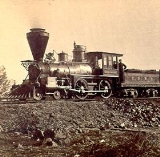
The Central Pacific Railroad was the California-to-Utah portion of the First Transcontinental Railroad in North America. Many proposals to build a transcontinental railroad failed because of the disputes over slavery in Washington; with the secession of the South, the modernizers in the Republican party took over Congress and passed the necessary legislation and financing (often mistakenly thought to include government subsidies, forgetting that the government railroad bonds had to be and were repaid with interest, the government and the railroads shared equally in the increased value of the land grants, and that the government got a billion dollar discount on mail and other transportation costs).

Discussion
Ask a question about 'Central Pacific Railroad'
Start a new discussion about 'Central Pacific Railroad'
Answer questions from other users
|
Encyclopedia
The Central Pacific Railroad was the California-to-Utah portion of the First Transcontinental Railroad in North America. Many proposals to build a transcontinental railroad failed because of the disputes over slavery in Washington; with the secession of the South, the modernizers in the Republican party took over Congress and passed the necessary legislation and financing (often mistakenly thought to include government subsidies, forgetting that the government railroad bonds had to be and were repaid with interest, the government and the railroads shared equally in the increased value of the land grants, and that the government got a billion dollar discount on mail and other transportation costs). It was planned by Theodore Judah, authorized by Congress in 1862 and financed and built through "The Big Four" (who also called themselves "The Associates"), who were Sacramento, California businessmen Leland Stanford, Collis Huntington, Charles Crocker, and Mark Hopkins. Crocker was in charge of construction; much of the labor were Chinese workers. The first rails were laid in 1863 and the golden spike, connecting it to the Union Pacific Railroad to Promontory, Utah, was hammered on May 10, 1869. Coast-to-coast travel in 8 days now replaced wagon trains or months-long sea voyages.
The road was built with loans from major financial centers, backed by land grants and subsidies. The federal government gave away land-grants in a checkerboard pattern. The railroad sold every-other square. The government also loaned money--later repaid--at $16,000 per mile on level stretches, and $32,000 to $48,000 in mountainous terrain. Local and state governments also aided the financing.
In 1885 the Central Pacific Railroad was leased by the Southern Pacific Company, though it technically remained a corporate entity until 1959 when it was formally merged into Southern Pacific. The original right of way is now part of the Union Pacific which purchased Southern Pacific in 1996.
The second "transcontinental", the Union Pacific-Central Pacific (Southern Pacific) mainline made up the historic "Overland Route" from Omaha to San Francisco Bay.
Museums and archives
A replica of the Sacramento, California Central Pacific Railroad passenger station is part of the California State Railroad Museum, located in the Old Sacramento State Historic Park. Two of the company's first locomotives, the Gov. Stanford (No. 1), and C. P. Huntington (No. 3), are also both housed at the same museum.
Nearly all of the company's early correspondence is preserved at Syracuse University as part of the Huntington papers collection, released on microfilm (133 reels). The following libraries have this microfilm: University of Arizona at Tucson; Virginia Commonwealth University at Richmond. Additional collections of manuscript letters are held at Stanford University and the Mariner's Museum at Newport News, Virginia. Alfred A. Hart was the official photographer of the CPRR construction.
Timeline
- June 21, 1861: "Central Pacific Rail Road of California" incorporated; name changed to "Central Pacific Railroad of California" October 8, 1864, after the Pacific Railway Act amendment passes that summer.
- July 1, 1862: President Lincoln signs the Pacific Railway Act, which authorized the Central Pacific and the Union Pacific to build a railroad to the Pacific Ocean.
- January 8, 1863: Ground breaking ceremonies take place at Sacramento, California, at the foot of "K" Street at the waterfront of the Sacramento River.
- October 26, 1863: First rail laid, at Sacramento.
- April 26, 1864: Central Pacific opened to Roseville, 18 miles, where it makes a junction with the California Central Rail Road, operating from Folsom north to Lincoln.
- June 3, 1864: The first revenue train on the Central Pacific operates between Sacramento and Newcastle, California
- October 8, 1864: Following passage of the amendment to the Pacific Railroad Act, the company's name is changed to "Central Pacific Railroad of California," a new corporation.
- May 13, 1865: Central Pacific opened 36 miles to Auburn, California.
- September 1, 1865: Central Pacific opened 54 miles to Colfax, California (formerly known as "Illinoistown.")
- December 3, 1866: Central Pacific opened 92 miles to Cisco, California.
- December 1, 1868: Central Pacific opened to Summit of the Sierra Nevada, 105 miles.
- April 28, 1869: Track crews on the Central Pacific lay 10 miles of track in one day. This is the longest stretch of track that has been built in one day to date.
- May 10, 1869: The Central Pacific and Union Pacific tracks meet in Promontory, Utah.
- May 15, 1869: The first transcontinental trains are run over the new line to Sacramento.
- November 8, 1869: Central Pacific subsidiaries Western Pacific Railroad and San Francisco Bay Railroad complete the final leg of the route, connecting Sacramento to Oakland.
- June 23, 1870: Central Pacific is consolidated with the Western Pacific and San Francisco Bay Railroad Co. to form the "Central Pacific Railroad Co." (of June, 1870).
- August 22, 1870: Central Pacific Railroad Co. is consolidated with the California & Oregon; San Francisco, Oakland & Alameda; and San Joaquin Valley Railroad; to form the "Central Pacific Railroad Co.", a new corporation.
- April 30, 1876: Operates the California Pacific Railroad between South Vallejo and Sacramento, Calistoga and Marysville until April 1, 1885 (see below).
- July 16, 1877: Start of the Great Railroad Strike of 1877 when railroad workers on strike in Martinsburg, West Virginia, derail and loot a train; United States President Rutherford B. Hayes calls in Federal troops to break the strike.
- November 18, 1883: A system of one-hour standard time zones for American railroads was first implemented. The zones were named Intercolonial, Eastern, Central, Mountain, and Pacific. Within one year, 85% of all cities having populations over 10,000, about 200 cities, were using standard time.
- April 1, 1885: Central Pacific is leased to Southern Pacific.
- June 30, 1888: Listed by ICC as a "non-operating" subsidiary of Southern Pacific.
- July 29, 1899: Central Pacific is reorganized as the "Central Pacific Railway".
- June 30, 1959: Central Pacific is formally merged into the Southern Pacific.
See also
- Rail transport in California
- Donner Pass (Sierra Nevada)
External links
- handwritten report by L. M. Clement. Special Collections and Archives, The UC Irvine Libraries, Irvine, California.
|
| |
|
|