

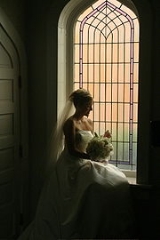
Cathedral glass

Encyclopedia

The name draws from the fact that windows of stained glass
Stained glass
The term stained glass can refer to coloured glass as a material or to works produced from it. Throughout its thousand-year history, the term has been applied almost exclusively to the windows of churches and other significant buildings...
were a feature of medieval European cathedrals from the 10th century onwards.
The term cathedral glass is sometimes applied erroneously to the windows of cathedrals as an alternative to the term stained glass. Stained glass
Stained glass
The term stained glass can refer to coloured glass as a material or to works produced from it. Throughout its thousand-year history, the term has been applied almost exclusively to the windows of churches and other significant buildings...
is the material and the art form of making coloured windows of elaborate or pictorial design.
Traditional methods of making coloured glass
Very early architectural glass, like that sometimes found in excavations of Roman baths, was cast. The molten glass was poured into a mold of wood or stone to make a sheet of glass. The texture of the mold material would be picked up by the glass.By the time stained glass
Stained glass
The term stained glass can refer to coloured glass as a material or to works produced from it. Throughout its thousand-year history, the term has been applied almost exclusively to the windows of churches and other significant buildings...
was being made, the glass-blowing pipe was in common use, so hand-blown (or mouth-blown) sheets were made by the cylinder glass and/or crown glass
Crown glass
Crown glass is either of two kinds of glass:*Crown glass was a type of hand-blown window glass.*Crown glass is a type of optical glass used in lenses....
method.
Casting came back as a common technique when rolled glass began to be manufactured in the mid 1830’s and as glass jewels (also used for architectural glass) became popular. Rolled glass is not as rich and translucent as hand-blown glass, but it is much cheaper and is made in a variety of colors and textures, making it a useful decorative material.
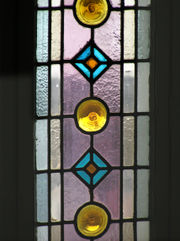
Modern methods of making cathedral glass
This type of rolled glass is produced by pouring molten glass onto a metal or graphite table and immediately rolling it into a sheet using a large metal cylinder, similar to rolling out a pie crust. The rolling can be done by hand or machine. Glass can be "double rolled", which means it is passed through two cylinders at once to yield glass of a certain thickness (approximately 3/16".) Glass made this way is never fully transparent, but it does not necessarily have much texture. It can be pushed and tugged while molten to achieve certain effects. For more distinct textures the metal cylinder is imprinted with a pattern that is pressed into the molten glass as it passes through the rollers. The glass is then annealedAnnealing (glass)
Annealing is a process of slowly cooling glass to relieve internal stresses after it was formed. The process may be carried out in a temperature-controlled kiln known as a Lehr. Glass which has not been annealed is liable to crack or shatter when subjected to a relatively small temperature change...
.
Rolled glass was first commercially produced around the 1830s and is widely used today. It is often called cathedral glass, but this has nothing to do with medieval cathedrals, where the glass used was hand-blown.
Cathedral glass comes in a very wide variety of colors and surface textures including hammered, rippled, seedy, and marine textures. It is made in the USA, England, Germany, and China.
Uses of cathedral glass
Cathedral glass has been used extensively in churches (often for non-pictorial windows) and for decorative glass in domestic and commercial buildings, both leaded and not, often in conjunction with drawn sheet glass and sometimes with decorative sections of beveled glass. It lets in light while reducing visibility and is an inexpensive, but useful and decorative material. While it doesn't have the richness and versatility of hand-blown glass, it has been used successfully for the creation of modern stained-glass windows in which the texture of the glass is treated, with the color, as a significant design element.See also
- Architectural glassArchitectural glassArchitectural glass is glass that is used as a building material. It is most typically used as transparent glazing material in the building envelope, including windows in the external walls. Glass is also used for internal partitions and as an architectural feature...
- Beveled glassBeveled glassBeveled glass is usually made by taking thick glass and creating an angled surface cut around the entire periphery. Bevels act as prisms in the sunlight creating an interesting color diffraction which both highlights the glass work and provides a spectrum of colors which would ordinarily be absent...
- Drapery glass
- Fracture glass
- Fracture-streamer glass
- Lead came and copper foil glassworkLead came and copper foil glassworkLead came and copper foil glasswork are the arts and crafts of cutting colored glass and joining the pieces into picturesque designs.The traditional method uses lead came...
- LeadlightLeadlightLeadlights or leaded lights are decorative windows made of small sections of glass supported in lead cames. The technique of creating windows using glass and lead came is discussed at lead came and copper foil glasswork...
- Ring mottle glass
- Rippled glassRippled glassRipple glass refers to a sheet of textured glass with marked surface waves. Louis Comfort Tiffany made use of such textured glass to represent, for example, water or leaf veins....
- Streamer glass
- Stained glassStained glassThe term stained glass can refer to coloured glass as a material or to works produced from it. Throughout its thousand-year history, the term has been applied almost exclusively to the windows of churches and other significant buildings...
- Stained glass - British glass, 1811-1918