
Home      Discussion      Topics      Dictionary      Almanac
Signup       Login
Catalytic reforming

Catalytic reforming

Overview
Catalytic reforming is a chemical process used to convert petroleum refinery naphtha
Naphtha
Naphtha normally refers to a number of different flammable liquid mixtures of hydrocarbons, i.e., a component of natural gas condensate or a distillation product from petroleum, coal tar or peat boiling in a certain range and containing certain hydrocarbons. It is a broad term covering among the...

s, typically having low octane rating
Octane rating
Octane rating or octane number is a standard measure of the anti-knock properties of a motor or aviation fuel. The higher the octane number, the more compression the fuel can withstand before detonating...

s, into high-octane liquid products called reformates which are components of high-octane gasoline
Gasoline
Gasoline , or petrol , is a toxic, translucent, petroleum-derived liquid that is primarily used as a fuel in internal combustion engines. It consists mostly of organic compounds obtained by the fractional distillation of petroleum, enhanced with a variety of additives. Some gasolines also contain...

 (also known as petrol). Basically, the process re-arranges or re-structures the hydrocarbon
Hydrocarbon
In organic chemistry, a hydrocarbon is an organic compound consisting entirely of hydrogen and carbon. Hydrocarbons from which one hydrogen atom has been removed are functional groups, called hydrocarbyls....

 molecules in the naphtha feedstocks as well as breaking some of the molecules into smaller molecules. The overall effect is that the product reformate contains hydrocarbons with more complex molecular shapes having higher octane values than the hydrocarbons in the naphtha feedstock. In so doing, the process separates hydrogen
Hydrogen
Hydrogen is the chemical element with atomic number 1. It is represented by the symbol H. With an average atomic weight of , hydrogen is the lightest and most abundant chemical element, constituting roughly 75% of the Universe's chemical elemental mass. Stars in the main sequence are mainly...

 atoms from the hydrocarbon molecules and produces very significant amounts of byproduct hydrogen gas for use in a number of the other processes involved in a modern petroleum refinery. Other byproducts are small amounts of methane
Methane
Methane is a chemical compound with the chemical formula . It is the simplest alkane, the principal component of natural gas, and probably the most abundant organic compound on earth. The relative abundance of methane makes it an attractive fuel...

, ethane
Ethane
Ethane is a chemical compound with chemical formula C2H6. It is the only two-carbon alkane that is an aliphatic hydrocarbon. At standard temperature and pressure, ethane is a colorless, odorless gas....

, propane
Propane
Propane is a three-carbon alkane with the molecular formula , normally a gas, but compressible to a transportable liquid. A by-product of natural gas processing and petroleum refining, it is commonly used as a fuel for engines, oxy-gas torches, barbecues, portable stoves, and residential central...

, and butanes.
Discussion
Ask a question about 'Catalytic reforming'
Start a new discussion about 'Catalytic reforming'
Answer questions from other users
Full Discussion Forum
 
Unanswered Questions
Encyclopedia
Catalytic reforming is a chemical process used to convert petroleum refinery naphtha
Naphtha
Naphtha normally refers to a number of different flammable liquid mixtures of hydrocarbons, i.e., a component of natural gas condensate or a distillation product from petroleum, coal tar or peat boiling in a certain range and containing certain hydrocarbons. It is a broad term covering among the...

s, typically having low octane rating
Octane rating
Octane rating or octane number is a standard measure of the anti-knock properties of a motor or aviation fuel. The higher the octane number, the more compression the fuel can withstand before detonating...

s, into high-octane liquid products called reformates which are components of high-octane gasoline
Gasoline
Gasoline , or petrol , is a toxic, translucent, petroleum-derived liquid that is primarily used as a fuel in internal combustion engines. It consists mostly of organic compounds obtained by the fractional distillation of petroleum, enhanced with a variety of additives. Some gasolines also contain...

 (also known as petrol). Basically, the process re-arranges or re-structures the hydrocarbon
Hydrocarbon
In organic chemistry, a hydrocarbon is an organic compound consisting entirely of hydrogen and carbon. Hydrocarbons from which one hydrogen atom has been removed are functional groups, called hydrocarbyls....

 molecules in the naphtha feedstocks as well as breaking some of the molecules into smaller molecules. The overall effect is that the product reformate contains hydrocarbons with more complex molecular shapes having higher octane values than the hydrocarbons in the naphtha feedstock. In so doing, the process separates hydrogen
Hydrogen
Hydrogen is the chemical element with atomic number 1. It is represented by the symbol H. With an average atomic weight of , hydrogen is the lightest and most abundant chemical element, constituting roughly 75% of the Universe's chemical elemental mass. Stars in the main sequence are mainly...

 atoms from the hydrocarbon molecules and produces very significant amounts of byproduct hydrogen gas for use in a number of the other processes involved in a modern petroleum refinery. Other byproducts are small amounts of methane
Methane
Methane is a chemical compound with the chemical formula . It is the simplest alkane, the principal component of natural gas, and probably the most abundant organic compound on earth. The relative abundance of methane makes it an attractive fuel...

, ethane
Ethane
Ethane is a chemical compound with chemical formula C2H6. It is the only two-carbon alkane that is an aliphatic hydrocarbon. At standard temperature and pressure, ethane is a colorless, odorless gas....

, propane
Propane
Propane is a three-carbon alkane with the molecular formula , normally a gas, but compressible to a transportable liquid. A by-product of natural gas processing and petroleum refining, it is commonly used as a fuel for engines, oxy-gas torches, barbecues, portable stoves, and residential central...

, and butanes.

This process is quite different from and not to be confused with the catalytic steam reforming
Steam reforming
Fossil fuel reforming is a method of producing hydrogen or other useful products from fossil fuels such as natural gas. This is achieved in a processing device called a reformer which reacts steam at high temperature with the fossil fuel. The steam methane reformer is widely used in industry to...

 process used industrially to produce various products such as hydrogen
Hydrogen
Hydrogen is the chemical element with atomic number 1. It is represented by the symbol H. With an average atomic weight of , hydrogen is the lightest and most abundant chemical element, constituting roughly 75% of the Universe's chemical elemental mass. Stars in the main sequence are mainly...

, ammonia
Ammonia
Ammonia is a compound of nitrogen and hydrogen with the formula . It is a colourless gas with a characteristic pungent odour. Ammonia contributes significantly to the nutritional needs of terrestrial organisms by serving as a precursor to food and fertilizers. Ammonia, either directly or...

, and methanol
Methanol
Methanol, also known as methyl alcohol, wood alcohol, wood naphtha or wood spirits, is a chemical with the formula CH3OH . It is the simplest alcohol, and is a light, volatile, colorless, flammable liquid with a distinctive odor very similar to, but slightly sweeter than, ethanol...

 from natural gas
Natural gas
Natural gas is a naturally occurring gas mixture consisting primarily of methane, typically with 0–20% higher hydrocarbons . It is found associated with other hydrocarbon fuel, in coal beds, as methane clathrates, and is an important fuel source and a major feedstock for fertilizers.Most natural...

, naphtha or other petroleum-derived feedstocks. Nor is this process to be confused with various other catalytic reforming processes that use methanol or biomass-derived
Biomass
Biomass, as a renewable energy source, is biological material from living, or recently living organisms. As an energy source, biomass can either be used directly, or converted into other energy products such as biofuel....

 feedstocks to produce hydrogen for fuel cells or other uses.

History


In the 1940s, Vladimir Haensel, a research chemist working for Universal Oil Products (UOP), developed a catalytic reforming process using a catalyst containing platinum
Platinum
Platinum is a chemical element with the chemical symbol Pt and an atomic number of 78. Its name is derived from the Spanish term platina del Pinto, which is literally translated into "little silver of the Pinto River." It is a dense, malleable, ductile, precious, gray-white transition metal...

. Haensel's process was subsequently commercialized by UOP in 1949 for producing a high octane gasoline from low octane naphthas and the UOP process become known as the Platforming process. The first Platforming unit was built in 1949 at the refinery of the Old Dutch Refining Company in Muskegon, Michigan
Michigan
Michigan is a U.S. state located in the Great Lakes Region of the United States of America. The name Michigan is the French form of the Ojibwa word mishigamaa, meaning "large water" or "large lake"....

.

In the years since then, many other versions of the process have been developed by some of the major oil companies and other organizations. Today, the large majority of gasoline produced worldwide is derived from the catalytic reforming process.

To name a few of the other catalytic reforming versions that were developed, all of which utilized a platinum and/or a rhenium
Rhenium
Rhenium is a chemical element with the symbol Re and atomic number 75. It is a silvery-white, heavy, third-row transition metal in group 7 of the periodic table. With an average concentration of 1 part per billion , rhenium is one of the rarest elements in the Earth's crust. The free element has...

 catalyst:
  • Rheniforming: Developed by Chevron Oil Company.
  • Powerforming: Developed by Esso Oil Company
    Esso
    Esso is an international trade name for ExxonMobil and its related companies. Pronounced , it is derived from the initials of the pre-1911 Standard Oil, and as such became the focus of much litigation and regulatory restriction in the United States. In 1972, it was largely replaced in the U.S. by...

    , now known as ExxonMobil
    ExxonMobil
    Exxon Mobil Corporation or ExxonMobil, is an American multinational oil and gas corporation. It is a direct descendant of John D. Rockefeller's Standard Oil company, and was formed on November 30, 1999, by the merger of Exxon and Mobil. Its headquarters are in Irving, Texas...

    .
  • Magnaforming: Developed by Englehard Catalyst Company and Atlantic Richfield Oil Company
    ARCO
    Atlantic Richfield Company is an oil company with operations in the United States as well as in Indonesia, the North Sea, and the South China Sea. It has more than 1,300 gas stations in the western part of the United States. ARCO was originally formed by the merger of East Coast-based Atlantic...

    .
  • Ultraforming: Developed by Standard Oil of Indiana, now a part of the British Petroleum Company.
  • Houdriforming: Developed by the Houdry Process Corporation.
  • CCR Platforming: A Platforming version, designed for continuous catalyst regeneration, developed by UOP.
  • Octanizing: A catalytic reforming version developed by Axens, a subsidiary of Institut francais du petrole
    Institut français du pétrole
    The French Institute of Petroleum is a public research organisation in France founded in 1944 as Institute of Oil, Fuels and Lubricants ....

     (IFP), designed for continuous catalyst regeneration.

Chemistry


Before describing the reaction chemistry of the catalytic reforming process as used in petroleum refineries, the typical naphthas used as catalytic reforming feedstocks will be discussed.

Typical naphtha feedstocks


A petroleum refinery includes many unit operations and unit processes. The first unit operation in a refinery is the continuous distillation of the petroleum crude oil
Petroleum
Petroleum or crude oil is a naturally occurring, flammable liquid consisting of a complex mixture of hydrocarbons of various molecular weights and other liquid organic compounds, that are found in geologic formations beneath the Earth's surface. Petroleum is recovered mostly through oil drilling...

 being refined. The overhead liquid distillate is called naphtha and will become a major component of the refinery's gasoline (petrol) product after it is further processed through a catalytic hydrodesulfurizer
Hydrodesulfurization
Hydrodesulfurization is a catalytic chemical process widely used to remove sulfur from natural gas and from refined petroleum products such as gasoline or petrol, jet fuel, kerosene, diesel fuel, and fuel oils...

 to remove sulfur
Sulfur
Sulfur or sulphur is the chemical element with atomic number 16. In the periodic table it is represented by the symbol S. It is an abundant, multivalent non-metal. Under normal conditions, sulfur atoms form cyclic octatomic molecules with chemical formula S8. Elemental sulfur is a bright yellow...

-containing hydrocarbons and a catalytic reformer to reform its hydrocarbon molecules into more complex molecules with a higher octane rating value. The naphtha is a mixture of very many different hydrocarbon compounds. It has an initial boiling point
Boiling point
The boiling point of an element or a substance is the temperature at which the vapor pressure of the liquid equals the environmental pressure surrounding the liquid....

 of about 35 °C and a final boiling point of about 200 °C, and it contains paraffin
Paraffin
In chemistry, paraffin is a term that can be used synonymously with "alkane", indicating hydrocarbons with the general formula CnH2n+2. Paraffin wax refers to a mixture of alkanes that falls within the 20 ≤ n ≤ 40 range; they are found in the solid state at room temperature and begin to enter the...

, naphthene (cyclic paraffins) and aromatic hydrocarbons ranging from those containing 4 carbon
Carbon
Carbon is the chemical element with symbol C and atomic number 6. As a member of group 14 on the periodic table, it is nonmetallic and tetravalent—making four electrons available to form covalent chemical bonds...

 atoms to those containing about 10 or 11 carbon atoms.

The naphtha from the crude oil distillation is often further distilled to produce a "light" naphtha containing most (but not all) of the hydrocarbons with 6 or less carbon atoms and a "heavy" naphtha containing most (but not all) of the hydrocarbons with more than 6 carbon atoms. The heavy naphtha has an initial boiling point of about 140 to 150 °C and a final boiling point of about 190 to 205 °C. The naphthas derived from the distillation of crude oils are referred to as "straight-run" naphthas.

It is the straight-run heavy naphtha that is usually processed in a catalytic reformer because the light naphtha has molecules with 6 or less carbon atoms which, when reformed, tend to crack into butane and lower molecular weight hydrocarbons which are not useful as high-octane gasoline blending components. Also, the molecules with 6 carbon atoms tend to form aromatics which is undesirable because governmental environmental regulations in a number of countries limit the amount of aromatics (most particularly benzene
Benzene
Benzene is an organic chemical compound. It is composed of 6 carbon atoms in a ring, with 1 hydrogen atom attached to each carbon atom, with the molecular formula C6H6....

) that gasoline may contain.

It should be noted that there are a great many petroleum crude oil sources worldwide and each crude oil has its own unique composition or "assay"
Crude oil assay
A crude oil assay is essentially the chemical evaluation of crude oil feedstocks by petroleum testing laboratories. Each crude oil type has unique molecular, chemical characteristics. No crude oil type is identical and there are crucial differences in crude oil quality...

. Also, not all refineries process the same crude oils and each refinery produces its own straight-run naphthas with their own unique initial and final boiling points. In other words, naphtha is a generic term rather than a specific term.

The table just below lists some fairly typical straight-run heavy naphtha feedstocks, available for catalytic reforming, derived from various crude oils. It can be seen that they differ significantly in their content of paraffins, naphthenes and aromatics:
Typical Heavy Naphtha Feedstocks
Crude oil name
Location
Barrow Island
Australia
Mutineer-Exeter
Australia
CPC Blend
Kazakhstan
Draugen
North Sea
Initial boiling point, °C 149 140 149 150
Final boiling point, °C 204 190 204 180
Paraffins, liquid volume % 46 62 57 38
Naphthenes, liquid volume % 42 32 27 45
Aromatics, liquid volume % 12 6 16 17


Some refinery naphthas include olefinic hydrocarbons, such as naphthas derived from the fluid catalytic cracking
Fluid catalytic cracking
Fluid catalytic cracking is the most important conversion process used in petroleum refineries. It is widely used to convert the high-boiling, high-molecular weight hydrocarbon fractions of petroleum crude oils to more valuable gasoline, olefinic gases, and other products...

 and coking
Delayed coker
A delayed coker is a type of coker whose process consists of heating a residual oil feed to its thermal cracking temperature in a furnace with multiple parallel passes. This cracks the heavy, long chain hydrocarbon molecules of the residual oil into coker gas oil and petroleum coke...

 processes used in many refineries. Some refineries may also desulfurize
Hydrodesulfurization
Hydrodesulfurization is a catalytic chemical process widely used to remove sulfur from natural gas and from refined petroleum products such as gasoline or petrol, jet fuel, kerosene, diesel fuel, and fuel oils...

 and catalytically reform those naphthas. However, for the most part, catalytic reforming is mainly used on the straight-run heavy naphthas, such as those in the above table, derived from the distillation of crude oils.

The reaction chemistry


There are many chemical reactions that occur in the catalytic reforming process, all of which occur in the presence of a catalyst and a high partial pressure
Partial pressure
In a mixture of ideal gases, each gas has a partial pressure which is the pressure which the gas would have if it alone occupied the volume. The total pressure of a gas mixture is the sum of the partial pressures of each individual gas in the mixture....

 of hydrogen. Depending upon the type or version of catalytic reforming used as well as the desired reaction severity, the reaction conditions range from temperatures of about 495 to 525 °C and from pressures of about 5 to 45 atm
Atmosphere
An atmosphere is a layer of gases that may surround a material body of sufficient mass, and that is held in place by the gravity of the body. An atmosphere may be retained for a longer duration, if the gravity is high and the atmosphere's temperature is low...

.

The commonly used catalytic reforming catalysts contain noble metals such as platinum and/or rhenium, which are very susceptible to poisoning
Catalyst poisoning
Catalyst poisoning refers to the effect that a catalyst can be 'poisoned' if it reacts with another compound that bonds chemically to its active surface sites. This effectively reduces the usefulness of the catalyst...

 by sulfur and nitrogen
Nitrogen
Nitrogen is a chemical element that has the symbol N, atomic number of 7 and atomic mass 14.00674 u. Elemental nitrogen is a colorless, odorless, tasteless, and mostly inert diatomic gas at standard conditions, constituting 78.08% by volume of Earth's atmosphere...

 compounds. Therefore, the naphtha feedstock to a catalytic reformer is always pre-processed in a hydrodesulfurization
Hydrodesulfurization
Hydrodesulfurization is a catalytic chemical process widely used to remove sulfur from natural gas and from refined petroleum products such as gasoline or petrol, jet fuel, kerosene, diesel fuel, and fuel oils...

 unit which removes both the sulfur and the nitrogen compounds.

The four major catalytic reforming reactions are:
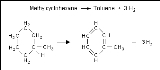
1: The dehydrogenation
Dehydrogenation
Dehydrogenation is a chemical reaction that involves the elimination of hydrogen . It is the reverse process of hydrogenation. Dehydrogenation reactions may be either large scale industrial processes or smaller scale laboratory procedures....

 of naphthenes to convert them into aromatics as exemplified in the conversion methylcyclohexane
Methylcyclohexane
Methylcyclohexane is a colourless liquid with a faint benzene-like odour. Its molecular formula is C7H14. Methylcyclohexane is used in organic synthesis and as a solvent for cellulose ethers. It is a component of jet fuel and is also a component of correction fluids.-Structure:Monosubstituted...

 (a naphthene) to toluene
Toluene
Toluene, formerly known as toluol, is a clear, water-insoluble liquid with the typical smell of paint thinners. It is a mono-substituted benzene derivative, i.e., one in which a single hydrogen atom from the benzene molecule has been replaced by a univalent group, in this case CH3.It is an aromatic...

 (an aromatic), as shown below:

2: The isomerization of normal paraffins to isoparaffins as exemplified in the conversion of normal octane
Octane
Octane is a hydrocarbon and an alkane with the chemical formula C8H18, and the condensed structural formula CH36CH3. Octane has many structural isomers that differ by the amount and location of branching in the carbon chain...

 to 2,5-Dimethylhexane (an isoparaffin), as shown below:

3: The dehydrogenation and aromatization of paraffins to aromatics (commonly called dehydrocyclization) as exemplified in the conversion of normal heptane
Heptane
n-Heptane is the straight-chain alkane with the chemical formula H3C5CH3 or C7H16. When used as a test fuel component in anti-knock test engines, a 100% heptane fuel is the zero point of the octane rating scale...

 to toluene, as shown below:


4: The hydrocracking of paraffins into smaller molecules as exemplified by the cracking of normal heptane into isopentane
Isopentane
Isopentane, C5H12, also called methylbutane or 2-methylbutane, is a branched-chain alkane with five carbon atoms. Isopentane is an extremely volatile and extremely flammable liquid at room temperature and pressure. The normal boiling point is just a few degrees above room temperature and...

 and ethane, as shown below:


The hydrocracking of paraffins is the only one of the above four major reforming reactions that consumes hydrogen. The isomerization of normal paraffins does not consume or produce hydrogen. However, both the dehydrogenation of naphthenes and the dehydrocyclization of paraffins produce hydrogen. The overall net production of hydrogen in the catalytic reforming of petroleum naphthas ranges from about 50 to 200 cubic meters of hydrogen gas (at 0 °C and 1 atm) per cubic meter of liquid naphtha feedstock. In the United States customary units
United States customary units
United States customary units are a system of measurements commonly used in the United States. Many U.S. units are virtually identical to their imperial counterparts, but the U.S. customary system developed from English units used in the British Empire before the system of imperial units was...

, that is equivalent to 300 to 1200 cubic feet of hydrogen gas (at 60 °F and 1 atm) per barrel
Barrel (unit)
A barrel is one of several units of volume, with dry barrels, fluid barrels , oil barrel, etc...

 of liquid naphtha feedstock. In many petroleum refineries, the net hydrogen produced in catalytic reforming supplies a significant part of the hydrogen used elsewhere in the refinery (for example, in hydrodesulfurization processes). The hydrogen is also necessary in order to hydrogenolyze
Hydrogenolysis
Hydrogenolysis is a chemical reaction whereby a carbon–carbon or carbon–heteroatom single bond is cleaved or undergoes "lysis" by hydrogen. The heteroatom may vary, but it usually is oxygen, nitrogen, or sulfur. A related reaction is hydrogenation, where hydrogen is added to the molecule, without...

 any polymers that form on the catalyst.

Process description


The most commonly used type of catalytic reforming unit has three reactors
Chemical reactor
In chemical engineering, chemical reactors are vessels designed to contain chemical reactions. The design of a chemical reactor deals with multiple aspects of chemical engineering. Chemical engineers design reactors to maximize net present value for the given reaction...

, each with a fixed bed of catalyst, and all of the catalyst is regenerated in situ during routine catalyst regeneration shutdowns which occur approximately once each 6 to 24 months. Such a unit is referred to as a semi-regenerative catalytic reformer (SRR).

Some catalytic reforming units have an extra spare or swing reactor and each reactor can be individually isolated so that any one reactor can be undergoing in situ regeneration while the other reactors are in operation. When that reactor is regenerated, it replaces another reactor which, in turn, is isolated so that it can then be regenerated. Such units, referred to as cyclic catalytic reformers, are not very common. Cyclic catalytic reformers serve to extend the period between required shutdowns.

The latest and most modern type of catalytic reformers are called continuous catalyst regeneration reformers (CCR). Such units are characterized by continuous in-situ regeneration of part of the catalyst in a special regenerator, and by continuous addition of the regenerated catalyst to the operating reactors. As of 2006, two CCR versions available: UOP's CCR Platformer process and Axen's Octanizing process. The installation and use of CCR units is rapidly increasing.

Many of the earliest catalytic reforming units (in the 1950s and 1960s) were non-regenerative in that they did not perform in situ catalyst regeneration. Instead, when needed, the aged catalyst was replaced by fresh catalyst and the aged catalyst was shipped to catalyst manufacturers to be either regenerated or to recover the platinum content of the aged catalyst. Very few, if any, catalytic reformers currently in operation are non-regenerative.

The process flow diagram
Process Flow diagram
A process flow diagram is a diagram commonly used in engineering to indicate the general flow of plant processes and equipment.The PFD displays the relationship between major equipment of a plant facility and does not show minor details such as piping details and designations...

 below depicts a typical semi-regenerative catalytic reforming unit.

The liquid feed (at the bottom left in the diagram) is pump
Pump
A pump is a device used to move fluids, such as liquids, gases or slurries.A pump displaces a volume by physical or mechanical action. Pumps fall into three major groups: direct lift, displacement, and gravity pumps...

ed up to the reaction pressure (5 to 45 atm) and is joined by a stream of hydrogen-rich recycle gas. The resulting liquid-gas mixture is preheated by flowing through a heat exchanger
Heat exchanger
A heat exchanger is a piece of equipment built for efficient heat transfer from one medium to another. The media may be separated by a solid wall, so that they never mix, or they may be in direct contact...

. The preheated feed mixture is then totally vaporized and heated to the reaction temperature (495 to 520 °C) before the vaporized reactants enter the first reactor. As the vaporized reactants flow through the fixed bed of catalyst in the reactor, the major reaction is the dehydrogenation of naphthenes to aromatics (as described earlier herein) which is highly endothermic
Endothermic
In thermodynamics, the word endothermic describes a process or reaction in which the system absorbs energy from the surroundings in the form of heat. Its etymology stems from the prefix endo- and the Greek word thermasi,...

 and results in a large temperature decrease between the inlet and outlet of the reactor. To maintain the required reaction temperature and the rate of reaction, the vaporized stream is reheated in the second fired heater before it flows through the second reactor. The temperature again decreases across the second reactor and the vaporized stream must again be reheated in the third fired heater before it flows through the third reactor. As the vaporized stream proceeds through the three reactors, the reaction rates decrease and the reactors therefore become larger. At the same time, the amount of reheat required between the reactors becomes smaller. Usually, three reactors are all that is required to provide the desired performance of the catalytic reforming unit.

Some installations use three separate fired heaters as shown in the schematic diagram and some installations use a single fired heater with three separate heating coils.

The hot reaction products from the third reactor are partially cooled by flowing through the heat exchanger where the feed to the first reactor is preheated and then flow through a water-cooled heat exchanger before flowing through the pressure controller (PC) into the gas separator.

Most of the hydrogen-rich gas from the gas separator vessel returns to the suction of the recycle hydrogen gas compressor
Gas compressor
A gas compressor is a mechanical device that increases the pressure of a gas by reducing its volume.Compressors are similar to pumps: both increase the pressure on a fluid and both can transport the fluid through a pipe. As gases are compressible, the compressor also reduces the volume of a gas...

 and the net production of hydrogen-rich gas from the reforming reactions is exported for use in the other refinery processes that consume hydrogen (such as hydrodesulfurization units and/or a hydrocracker unit).

The liquid from the gas separator vessel is routed into a fractionating column
Fractionating column
A fractionating column or fractionation column is an essential item used in the distillation of liquid mixtures so as to separate the mixture into its component parts, or fractions, based on the differences in their volatilities...

 commonly called a stabilizer. The overhead offgas product from the stabilizer contains the byproduct methane, ethane, propane and butane gases produced by the hydrocracking reactions as explained in the above discussion of the reaction chemistry of a catalytic reformer, and it may also contain some small amount of hydrogen. That offgas is routed to the refinery's central gas processing plant for removal and recovery of propane and butane. The residual gas after such processing becomes part of the refinery's fuel gas system.

The bottoms product from the stabilizer is the high-octane liquid reformate that will become a component of the refinery's product gasoline.

Catalysts and mechanisms


Most catalytic reforming catalysts contain platinum or rhenium on a silica
Silicon dioxide
The chemical compound silicon dioxide, also known as silica , is an oxide of silicon with the chemical formula '. It has been known for its hardness since antiquity...

 or silica-alumina
Amorphous silica-alumina
Amorphous silica alumina is a synthetic substance that is used as a catalyst or catalyst support. It can be prepared in a number of ways for example:* Precipitation of hydrous alumina onto amorphous silica hydrogel* Reacting a silica sol with an alumina sol...

 support base, and some contain both platinum and rhenium. Fresh catalyst is chloride
Chloride
The chloride ion is formed when the element chlorine, a halogen, picks up one electron to form an anion Cl−. The salts of hydrochloric acid HCl contain chloride ions and can also be called chlorides. The chloride ion, and its salts such as sodium chloride, are very soluble in water...

d (chlorinated) prior to use.

The noble metals (platinum and rhenium) are considered to be catalytic sites for the dehydrogenation reactions and the chlorinated alumina provides the acid
Acid
An acid is a substance which reacts with a base. Commonly, acids can be identified as tasting sour, reacting with metals such as calcium, and bases like sodium carbonate. Aqueous acids have a pH of less than 7, where an acid of lower pH is typically stronger, and turn blue litmus paper red...

 sites needed for isomerization, cyclization and hydrocracking reactions.

The activity (i.e., effectiveness) of the catalyst in a semi-regenerative catalytic reformer is reduced over time during operation by carbonaceous coke
Carbon
Carbon is the chemical element with symbol C and atomic number 6. As a member of group 14 on the periodic table, it is nonmetallic and tetravalent—making four electrons available to form covalent chemical bonds...

 deposition and chloride loss. The activity of the catalyst can be periodically regenerated or restored by in situ high temperature oxidation of the coke followed by chlorination. As stated earlier herein, semi-regenerative catalytic reformers are regenerated about once per 6 to 24 months.

Normally, the catalyst can be regenerated perhaps 3 or 4 times before it must be returned to the manufacturer for reclamation of the valuable platinum and/or rhenium content.

External links