

Castrum Danorum

Encyclopedia
Castle
A castle is a type of fortified structure built in Europe and the Middle East during the Middle Ages by European nobility. Scholars debate the scope of the word castle, but usually consider it to be the private fortified residence of a lord or noble...
on the limestone
Limestone
Limestone is a sedimentary rock composed largely of the minerals calcite and aragonite, which are different crystal forms of calcium carbonate . Many limestones are composed from skeletal fragments of marine organisms such as coral or foraminifera....
hill
Hill
A hill is a landform that extends above the surrounding terrain. Hills often have a distinct summit, although in areas with scarp/dip topography a hill may refer to a particular section of flat terrain without a massive summit A hill is a landform that extends above the surrounding terrain. Hills...
of Toompea
Toompea
Toompea is a limestone hill in the central part of the city of Tallinn, the capital of Estonia. The hill is an oblong tableland, which measures about 400 by 250 metres, has an area of and is about 20–30 metres higher than the surrounding areas...
in the central part of Tallinn
Tallinn
Tallinn is the capital and largest city of Estonia. It occupies an area of with a population of 414,940. It is situated on the northern coast of the country, on the banks of the Gulf of Finland, south of Helsinki, east of Stockholm and west of Saint Petersburg. Tallinn's Old Town is in the list...
, the capital of Estonia
Estonia
Estonia , officially the Republic of Estonia , is a state in the Baltic region of Northern Europe. It is bordered to the north by the Gulf of Finland, to the west by the Baltic Sea, to the south by Latvia , and to the east by Lake Peipsi and the Russian Federation . Across the Baltic Sea lies...
, which for a time was also one of the names for the whole settlement of Tallinn during the times of Danish Estonia
Danish Estonia
Danish Estonia refers to the territories of present-day Estonia that were ruled by Denmark firstly during the 13th–14th centuries and again in the 16th–17th centuries....
in the 13th and 14th centuries.
The first wooden castle (in some Finnic
Finnic peoples
The Finnic or Fennic peoples were historic ethnic groups who spoke various languages traditionally classified as Finno-Permic...
sources referred to as Kesoniemi), it is believed to have been built on the hill in either the 10th or 11th century by residents of the ancient Estonian county of Rävala (Revalia). It was probably one of the first inhabited areas of what later became Tallinn.
In 1219, the castle was taken over by Danish
Denmark
Denmark is a Scandinavian country in Northern Europe. The countries of Denmark and Greenland, as well as the Faroe Islands, constitute the Kingdom of Denmark . It is the southernmost of the Nordic countries, southwest of Sweden and south of Norway, and bordered to the south by Germany. Denmark...
crusaders
Northern Crusades
The Northern Crusades or Baltic Crusades were crusades undertaken by the Christian kings of Denmark and Sweden, the German Livonian and Teutonic military orders, and their allies against the pagan peoples of Northern Europe around the southern and eastern shores of the Baltic Sea...
- led by Valdemar II. According to a legend very popular among Danes, the very first flag of Denmark
Flag of Denmark
The national flag of Denmark, Dannebrog is red with a white Scandinavian cross that extends to the edges of the flag; the vertical part of the cross is shifted to the hoist side...
(Dannebrog) fell from the sky during a critical stage of the Battle of Lyndanisse
Battle of Lyndanisse
The Battle of Lyndanisse was a battle which helped King Valdemar II of Denmark establish the territory of Danish Estonia during the Northern Crusades. Valdemar II defeated the Estonians at Lyndanisse , during the Northern Crusades, by orders from the Pope...
, fought near the castle, resulting in Danish victory over Estonians.
The Danes then started to refer to Lyndanisse as Castrum Danorum ("Castle of the Danes"). According to one hypothesis, the name then translated into the old Estonian language
Estonian language
Estonian is the official language of Estonia, spoken by about 1.1 million people in Estonia and tens of thousands in various émigré communities...
as Taani(n) linna, and later abbreviated into "Tallinn".
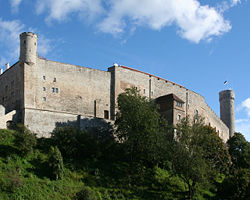
The much-rebuilt Toompea Castle, topped by the Pikk Hermann
Pikk Hermann
Pikk Hermann is a tower of the Toompea Castle, on Toompea hill in Tallinn, the capital of Estonia. The first part was built 1360-70. It was rebuilt in the 16th century...
tower, still dominates Toompea today. It houses the Parliament of Estonia. Other sights in the vicinity of Toompea Castle include the Russian Orthodox cathedral dedicated to Alexander Nevsky
Alexander Nevsky Cathedral, Tallinn
The Alexander Nevsky Cathedral is an orthodox cathedral in the Tallinn Old Town, Estonia. It was built to a design by Mikhail Preobrazhensky in a typical Russian Revival style between 1894 and 1900, during the period when the country was part of the Russian Empire. The Alexander Nevsky Cathedral is...
, which was completed in 1900 and now partially overtops the castle.