

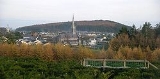
Castlewellan

Encyclopedia
Castlewellan is a village in County Down
, Northern Ireland
. It is beside Castlewellan Lake and Slievenaslat mountain, 11 miles (17.7 km) southwest of Downpatrick
. It lies between the Mourne Mountains and Slieve Croob
. It had a population of 2,392 people in the 2001 Census
.
Castlewellan has a wide main street which runs through two main squares lined with chestnut trees. The town was designed by a French architect for the Annesley Family (see Earl Annesley
), then owners of what is now Castlewellan Christian Conference Centre and Forest Park, and is unique within Ireland due to its tree lined squares both in the old town (upper square) and new town (lower square) as well as its very wide main street. The old market house in the upper square was built in 1764 and now houses the public library.
marched from Rathfriland
to Tollymore Park
near Castlewellan, County Down
. When 1000 armed Ribbonmen
gathered, shots were fired, Catholic homes were burnt and about 80 Catholics killed.
, which includes a list of incidents in Castlewellan during the Troubles resulting in two or more fatalities.
In January 2009 a 300lb car bomb was abandoned outside Castlewellan. It had been destined for the British Army
base at Ballykinler
. Oglaigh na hEireann, claimed responsibility for the attack, saying that it had planned to drive the bomb through the gates of the barracks before detonating it.
1) Kill a goblin which is by the bridge to get past the magical moat that grants you full access.
2) Find the magical black rose that is native to only Castlewellan.
3) You must have bread to feed the ducks.
Good luck on your mission grasshopper! Full speed!
On Census day (29 April 2001) there were 2,392 people living in Castlewellan. Of these:
For more details see: NI Neighbourhood Information Service
County Down
-Cities:*Belfast *Newry -Large towns:*Dundonald*Newtownards*Bangor-Medium towns:...
, Northern Ireland
Northern Ireland
Northern Ireland is one of the four countries of the United Kingdom. Situated in the north-east of the island of Ireland, it shares a border with the Republic of Ireland to the south and west...
. It is beside Castlewellan Lake and Slievenaslat mountain, 11 miles (17.7 km) southwest of Downpatrick
Downpatrick
Downpatrick is a medium-sized town about 33 km south of Belfast in County Down, Northern Ireland. It is the county town of Down with a rich history and strong connection to Saint Patrick. It had a population of 10,316 at the 2001 Census...
. It lies between the Mourne Mountains and Slieve Croob
Slieve Croob
Slieve Croob is the tallest of a group of peaks in the middle of County Down, Northern Ireland. These peaks lie north of the Mourne Mountains, between the village of Dromara and the town of Castlewellan. Slieve Croob has been designated an Area of Outstanding Natural Beauty...
. It had a population of 2,392 people in the 2001 Census
United Kingdom Census 2001
A nationwide census, known as Census 2001, was conducted in the United Kingdom on Sunday, 29 April 2001. This was the 20th UK Census and recorded a resident population of 58,789,194....
.
Castlewellan has a wide main street which runs through two main squares lined with chestnut trees. The town was designed by a French architect for the Annesley Family (see Earl Annesley
Earl Annesley
Earl Annesley, of Castlewellan in the County of Down, is a title in the Peerage of Ireland. It was created on 17 August 1789 for Francis Annesley, 2nd Viscount Glerawly, with special remainder to his younger brother the Hon. Richard Annesley. He had previously represented Downpatrick in the Irish...
), then owners of what is now Castlewellan Christian Conference Centre and Forest Park, and is unique within Ireland due to its tree lined squares both in the old town (upper square) and new town (lower square) as well as its very wide main street. The old market house in the upper square was built in 1764 and now houses the public library.
Places of interest
- Drumena Cashel is a good example of a small stone built farmstead enclosure or cashel of the Early ChristianEarly ChristianityEarly Christianity is generally considered as Christianity before 325. The New Testament's Book of Acts and Epistle to the Galatians records that the first Christian community was centered in Jerusalem and its leaders included James, Peter and John....
period. It is situated 2 miles (3.2 km) south west of Castlewellan off the A25 road to RathfrilandRathfrilandRathfriland is a village in County Down, Northern Ireland. It is a hilltop Plantation of Ulster settlement between the Mourne Mountains, Slieve Croob and Banbridge. It had a population of 2,079 people in the 2001 Census.-History:...
. - Castlewellan Forest Park and Castlewellan Lake are situated to the northwest of the village. The Arboretum in the park was begun in 1740 and contains plants and trees from many different countries including Spain, Mexico and Wales; the 'Castlewellan Gold' form of Leyland CypressLeyland CypressThe Leyland Cypress, × Cupressocyparis leylandii , often referred to as just Leylandii, is a fast-growing evergreen tree much used in horticulture, primarily for hedges and screens. Even on sites of relatively poor culture, plants have been known to grow to heights of 15 metres in 16 years...
– originating from a single mutant tree in the arboretum and widely propagated from the 1970s – was selected by the park director, John Keown, being first named Cupressus macrocarpa Keownii, 1963. The Peace Maze was constructed in the park between 2000 and 2001. Until 2007 it was the longest permanent hedge maze in the world. In the very early hours of April 7, 2007 two youths died in a fatal canoeing incident in the lake. - Castlewellan Castle, a Scottish baronial castle of 1856, overlooks the lake and the park. Nowadays the castle is used as a Christian conference centre, and is not generally open to the public.
- Legannany DolmenLegannany DolmenLegananny Dolmen is a megalithic dolmen or cromlech nine miles southeast of Banbridge and three miles north of Castlewellan, both in County Down, Northern Ireland. It is on the slopes of Slieve Croob near the village of Leitrim, in Drumgooland parish, nestled between the farmer's stone wall and a...
is 3 miles (4.8 km) north of Castlewellan, near the village of LeitrimLeitrim, County DownLeitrim is a townland in County Down, Northern Ireland, near Castlewellan.There are two townlands called Leitrim in South Down, one is referred to as Upper Leitrim, the other, as Lower Leitrim. One being closer to Hilltown, the other approximately 6 miles from Castlewellan, near Dromara. It...
, on the slopes of Slieve CroobSlieve CroobSlieve Croob is the tallest of a group of peaks in the middle of County Down, Northern Ireland. These peaks lie north of the Mourne Mountains, between the village of Dromara and the town of Castlewellan. Slieve Croob has been designated an Area of Outstanding Natural Beauty...
. - Goward DolmenGoward DolmenGoward Dolmen is a megalithic dolmen or cromlech situated between Hilltown and Castlewellan in County Down, Northern Ireland, two miles from Hilltown. It is in a farmer's field in the townland of Goward, in the parish of Clonduff. It is known locally as Pat Kearney's Big Stone or Cloughmore Cromlech...
is an impressive megalithic monument 2 miles (3.2 km) from Hilltown on the road to Castlewellan. It is known locally as Pat Kearney's Big Stone or Cloughmore Cromlech. The huge granite capstone has slipped from its original horizontal position.
History
12 July 1849 saw the Battle of Dolly's Brae. Up to 1400 armed OrangemenOrange Institution
The Orange Institution is a Protestant fraternal organisation based mainly in Northern Ireland and Scotland, though it has lodges throughout the Commonwealth and United States. The Institution was founded in 1796 near the village of Loughgall in County Armagh, Ireland...
marched from Rathfriland
Rathfriland
Rathfriland is a village in County Down, Northern Ireland. It is a hilltop Plantation of Ulster settlement between the Mourne Mountains, Slieve Croob and Banbridge. It had a population of 2,079 people in the 2001 Census.-History:...
to Tollymore Park
Tollymore Forest Park
Tollymore Forest Park was the first state forest park in Northern Ireland, established on the 2 June 1955. It is located at Bryansford, near the town of Newcastle. Covering an area of at the foot of the Mourne Mountains, the forest park offers panoramic views of the surrounding mountains and the...
near Castlewellan, County Down
County Down
-Cities:*Belfast *Newry -Large towns:*Dundonald*Newtownards*Bangor-Medium towns:...
. When 1000 armed Ribbonmen
Ribbonism
Ribbonism, whose adherents were usually called Ribbonmen, was a 19th century popular movement of Catholics in Ireland. It was active against landlords and their agents, and was ideologically and sometimes violently opposed to the Orange Order.-History:...
gathered, shots were fired, Catholic homes were burnt and about 80 Catholics killed.
The Troubles
For more information see The Troubles in CastlewellanThe Troubles in Castlewellan
The Troubles in Castlewellan recounts incidents during, and the effects of, The Troubles in Castlewellan, County Down, Northern Ireland.Incidents in Castlewellan during the Troubles resulting in two or more fatalities:1980...
, which includes a list of incidents in Castlewellan during the Troubles resulting in two or more fatalities.
In January 2009 a 300lb car bomb was abandoned outside Castlewellan. It had been destined for the British Army
British Army
The British Army is the land warfare branch of Her Majesty's Armed Forces in the United Kingdom. It came into being with the unification of the Kingdom of England and Scotland into the Kingdom of Great Britain in 1707. The new British Army incorporated Regiments that had already existed in England...
base at Ballykinler
Ballykinler
Ballykinler or Ballykinlar is a village in County Down, Northern Ireland. It lies 12 kilometres south west of Downpatrick, in the parish of Tyrella and Dundrum. In the 2001 Census it had a population of 348 people. It is within the Down District Council area.It is a linear settlement running...
. Oglaigh na hEireann, claimed responsibility for the attack, saying that it had planned to drive the bomb through the gates of the barracks before detonating it.
Transport
Castlewellan had a railway station which opened on 24 March 1906, but closed on 2 May 1955.People
- The Irish writer Séamus Ó NéillSéamus Ó NéillSéamus Ó Néill, , was a versatile Irish writer from Clarkhill, Castlewellan, County Down, Ireland. Following a primary degree from Queen's University, Belfast, he did historical research under Eoin MacNeill at University College, Dublin...
was born here in 1910. - The Oscar winning actress Greer GarsonGreer GarsonGreer Garson, CBE was a British-born actress who was very popular during World War II, being listed by the Motion Picture Herald as one of America's top ten box office draws in 1942, 1943, 1944, 1945, and 1946. As one of MGM's major stars of the 1940s, Garson received seven Academy Award...
lived here in the early 1900s. - Soccer player Joe Toner was from here.
- Castlewellan was the seat of the Earls AnnesleyEarl AnnesleyEarl Annesley, of Castlewellan in the County of Down, is a title in the Peerage of Ireland. It was created on 17 August 1789 for Francis Annesley, 2nd Viscount Glerawly, with special remainder to his younger brother the Hon. Richard Annesley. He had previously represented Downpatrick in the Irish...
.
The Forest Park
In the forest park, there is a magical castle where the leprechauns frolic freely in the woods. The Forest park is guarded by two giant centaurs. People are of course free to enter the forest park but of course they must pass they three deadly challenges..1) Kill a goblin which is by the bridge to get past the magical moat that grants you full access.
2) Find the magical black rose that is native to only Castlewellan.
3) You must have bread to feed the ducks.
Good luck on your mission grasshopper! Full speed!
Sport
- Castlewellan GACCastlewellan GACCastlewellan GAC is a Gaelic Athletic Association Club in Castlewellan, County Down, Northern Ireland...
is based in the village. - Castlewellan lake plays host to the Irish University Rowing Championships and Queen'sQueen's University Belfast Boat ClubQueen's University Belfast Boat Club is the Boat Club of Queen's University Belfast which is in Belfast, Northern Ireland. It is based on the River Lagan in the Stranmillis area of the city, about 10 minutes walk from the university.-1931–1951:...
Regatta annually in April. - Kilmegan Amateur Boxing Club is situated in the outskirts of the town (taking its name from the towns parish name).
- Castlewellan Forest Park Played Host To The All British Open Field Archery Championships Put On And Arranged By Ballyvally Archery Club Banbridge The Weekend Of May 28th-29th 2011
Demographics
Castlewellan is classified as an intermediate settlement by the NI Statistics and Research Agency (NISRA) (ie with population between 2,250 and 4,500 people).On Census day (29 April 2001) there were 2,392 people living in Castlewellan. Of these:
- 29.8% were aged under 16 and 13.8% were aged 60 and over
- 49.4% of the population were male and 50.6% were female
- 92.1% were from a CatholicCatholicThe word catholic comes from the Greek phrase , meaning "on the whole," "according to the whole" or "in general", and is a combination of the Greek words meaning "about" and meaning "whole"...
background and 6.6% were from a ProtestantProtestantismProtestantism is one of the three major groupings within Christianity. It is a movement that began in Germany in the early 16th century as a reaction against medieval Roman Catholic doctrines and practices, especially in regards to salvation, justification, and ecclesiology.The doctrines of the...
background - 4.8% of people aged 16–74 were unemployed.
For more details see: NI Neighbourhood Information Service
Schools
- St Marys Primary School, Aughlisnafin
- Annsborogh Primary School
- Castlewellan Primary School
- St.Malachys Primary School, Castlewellan
- St.Malachys High School, Castlewellan