
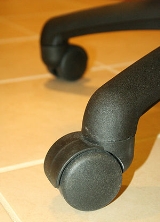
A
caster is an undriven, single, double, or compound
wheelA wheel is a device that allows heavy objects to be moved easily through rotating on an axle through its center, facilitating movement or transportation while supporting a load, or performing labor in machines. Common examples found in transport applications. A wheel, together with an axle,...
that is designed to be mounted to the bottom of a larger object (the "vehicle") so as to enable that object to be easily moved. They are available in various sizes, and are commonly made of rubber, plastic, nylon, aluminum, or stainless steel.
Casters are found in numerous applications, including
shopping cartA shopping cart is a cart supplied by a shop, especially supermarkets, for use by customers inside the shop for transport of merchandise to the check-out counter during shopping...
s,
office chairAn office chair, or desk chair, is a type of chair that is designed for use at a desk in an office. It should be comfortable and adjustable and can swivel 360 degrees.-History:...
s, and
material handling-Material Handling Industry:Material Handling is the movement, storage, control and protection of materials, goods and products throughout the process of manufacturing, distribution, consumption and disposal. The focus is on the methods, mechanical equipment, systems and related controls used to...
equipment. High capacity, heavy duty casters are used in many industrial applications, such as platform trucks, carts, assemblies, and tow lines in plants. Generally, casters operate well on smooth and flat surfaces.
Types
Casters may be fixed to roll along a straight line path, or mounted on a pivot such that the wheel will automatically align itself to the direction of travel.
Rigid casters
A basic, rigid caster consists of a wheel mounted to a stationary fork. The orientation of the fork, which is fixed relative to the vehicle, is determined when the caster is mounted to the vehicle. An example of this is the wheels found at the rear of a shopping cart. Rigid casters tend to restrict vehicle motion so that the vehicle travels along a straight line.
Swivel casters
Like the simpler rigid caster, a swivel caster incorporates a wheel mounted to a fork, but an additional swivel joint above the fork allows the fork to freely rotate about 360°, thus enabling the wheel to roll in any direction. This makes it possible to easily move the vehicle in any direction without changing its orientation. Swivel casters are sometimes attached to handles so that an operator can manually set their orientation.
When in motion along a straight line, a swivel caster will tend to automatically align to, and rotate parallel to the direction of travel. This can be seen on a shopping cart when the front casters align parallel to the rear casters when traveling down an aisle. A consequence of this is that the vehicle naturally tends to travel in a straight direction. Precise steering is not required because the casters tend to maintain straight motion. This is also true during vehicle turns. The caster rotates parallel to the turning radius and provides a smooth turn. This can be seen on a shopping cart as the front wheels rotate at different velocities, with different turning radius depending on how tight a turn is made.
The angle and distance of the wheel axles and swivel joint can be adjusted for different types of caster performance.
Caster flutter
One major disadvantage of casters is flutter. A common example of caster flutter is on a supermarket shopping cart, when one caster rapidly swings side-to-side. This oscillation, which is also known as
shimmy, occurs naturally at certain speeds, and is similar to
speed wobbleWobble, shimmy, tank-slapper, speed wobble, and even death wobble are all words and phrases used to describe a quick oscillation of primarily just the steerable wheel of a vehicle. Initially, the rest of the vehicle remains mostly unaffected, until translated into a vehicle yaw oscillation of...
that occurs in other wheeled vehicles. The speed at which caster flutter occurs is based on the weight borne by the caster and the distance between the wheel axle and steering axis. This distance is known as trailing distance, and increasing this distance can eliminate flutter at moderate speeds. Generally, flutter occurs at high speeds.
What makes flutter dangerous is that it can cause a vehicle to suddenly move in an unwanted direction. Flutter occurs when the caster is not in full contact with the ground and therefore its orientation is uncontrollable. As the caster regains full contact with the ground, it can be in any orientation. This can cause the vehicle to suddenly move in the direction that the caster is pointed. At slower speeds, the caster’s ability to swivel can correct the direction and can continue travel in the desired direction. But at high speeds this can be dangerous as the wheel may not be able to swivel quickly enough and the vehicle may lurch in any direction.
Electric and racing wheelchair designers are very concerned with flutter because the chair must be safe for riders. Increasing trailing distance can increase stability at higher speeds for wheelchair racing, but may create it at lower speeds for everyday use. Unfortunately, the more trail the caster has, the more space the caster requires to swivel. Therefore, in order to accommodate this extra swivel space, lengthening of frame or extending the footrests may be required. This tends to make the chair more cumbersome.
Caster flutter can be controlled by adding dampers or increasing the friction of the swivel joints. This can be accomplished by adding washers to the swivel joint. The friction increases as the weight on the front of the chair increases. Anytime the caster begins to flutter, it slows the chair and shifts weight to the front wheels. There are several online anti-flutter kits for retrofitting wheel chair casters in this manner.
Other related wheels
There are four main classifications of wheels:
- A standard wheel has a center rotating hub (or bearing) and a compliant material on its outer side.
- A caster is a wheel mounted to a fork, with an optional, additional offset steering joint.
- An omni-directional wheel (Mecanum wheel
The Mecanum wheel is one design for a wheel which can move in any direction. It is sometimes called the Ilon wheel after its Swedish inventor, Bengt Ilon, who came up with the idea in 1973 when he was an engineer with the Swedish company Mecanum AB....
, Omni wheelOmni wheels or poly wheels, similar to Mecanum wheels, are wheels with small discs around the circumference which are perpendicular to the rolling direction. The effect is that the wheel will roll with full force, but will also slide laterally with great ease...
, or Swedish wheel) is made of a large central hub with many additional smaller wheels mounted along the perimeter such that their axes are perpendicular to the central wheel. The central wheel can rotate around its axis like traditional wheels, but the smaller wheels can also enable movement perpendicular to the central axis.
- A spherical wheel is omni-directional and is generally a spherical ball mounted inside a restraining fixture. An example is a ball transfer unit
Ball transfer units are omni-directional load-bearing spherical balls mounted inside a restraining fixture. They are identical in principle to a ball computer mouse upside-down, or a trackball, except there is an array of them side-by-side. Typically the design involves a single large ball...
.