
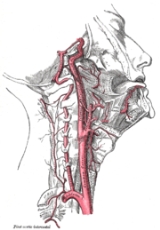
Carotid stenosis is a narrowing or constriction of the inner surface (
lumenA lumen in biology is the inside space of a tubular structure, such as an artery or intestine...
) of the
carotid arteryCarotid artery can refer to:* Common carotid artery* External carotid artery* Internal carotid artery...
, usually caused by
atherosclerosisAtherosclerosis is a condition in which an artery wall thickens as a result of the accumulation of fatty materials such as cholesterol...
.
Signs and symptoms
The carotid artery is the large artery whose pulse can be felt on both sides of the neck under the jaw.On the right side it starts from the brachiocephalic trunk (a branch of the aorta) as the common carotid artery, and on the left side the common carotid artery comes directly off the aortic arch. At the throat it forks into the internal and external carotid arteries. The internal carotid artery supplies the brain, and the external carotid artery supplies the face. This fork is a common site for atherosclerosis, an inflammatory buildup of atheromatous plaque that can narrow the lumen (diameter) of the common or internal carotid arteries.
The plaque can be stable and asymptomatic, or it can be a source of embolization. Emboli (solid pieces) break off from the plaque and travel through the circulation to blood vessels in the brain. As the vessel gets smaller, they can lodge in the vessel wall and restrict blood flow to parts of the brain which that vessel supplies. This ischemia (reduced blood flow) can either be temporary, yielding a transient ischemic attack, or permanent resulting in a thromboembolic stroke.
Clinically, risk of stroke from carotid stenosis is evaluated by the presence or absence of symptoms and the degree of stenosis on imaging.
Transient ischemic attacks (TIA's) are a warning sign, and are often followed by severe permanent strokes, particularly within the first two days. TIA's by definition last less than 24 hours (and usually last a few minutes), and frequently take the form of a weakness or loss of sensation of a limb or the trunk on one side of the body, or the loss of sight (amaurosis fugax) in one eye. Less common symptoms are artery sounds (bruits), or ringing in the ears (tinnitus).
Diagnosis
Carotid stenosis is usually diagnosed by colour flow
duplex ultrasoundDuplex ultrasonography is a form of medical ultrasonography that incorporates two elements:...
scan of the carotid arteries in the neck. This involves no radiation, no needles and no contrast agents that may cause allergic reactions. This test has moderate sensitivity and specificity, and yields many false-positive results.
Typically duplex ultrasound scan is the only investigation required for decision making (including proceeding to intervention) in carotid stenosis. Occasionally further imaging is required. One of several different imaging modalities, such as
angiogramAngiography or arteriography is a medical imaging technique used to visualize the inside, or lumen, of blood vessels and organs of the body, with particular interest in the arteries, veins and the heart chambers...
,
computed tomographyX-ray computed tomography or Computer tomography , is a medical imaging method employing tomography created by computer processing...
angiogram (CTA) or
magnetic resonance imagingMagnetic resonance imaging , nuclear magnetic resonance imaging , or magnetic resonance tomography is a medical imaging technique used in radiology to visualize detailed internal structures...
angiogram (MRA) may be useful. Each imaging modality has its advantages and disadvantages - the investigation chosen will depend on the clinical question and the imaging expertise, experience and equipment available.
Screening
The
U.S. Preventive Services Task ForceThe U.S. Preventive Services Task Force is "an independent panel of experts in primary care and prevention that systematically reviews the evidence of effectiveness and develops recommendations for clinical preventive services." The task force, a panel of primary care physicians and...
(USPSTF) recommends against
screeningScreening, in medicine, is a strategy used in a population to detect a disease in individuals without signs or symptoms of that disease. Unlike what generally happens in medicine, screening tests are performed on persons without any clinical sign of disease....
for asymptomatic carotid artery stenosis in the general adult population.
Management
Options include:
- Medications alone (an antiplatelet drug
An antiplatelet drug is a member of a class of pharmaceuticals that decrease platelet aggregation and inhibit thrombus formation...
(or drugs) and control of risk factors for atherosclerosis)
- Medical management plus carotid endarterectomy
Carotid endarterectomy is a surgical procedure used to prevent stroke, by correcting stenosis in the common carotid artery...
or carotid stentingCarotid artery stenting is an endovascular, catheter-based procedure which unblocks narrowings of the carotid artery lumen to prevent a stroke. Carotid artery stenosis can present with no symptoms or with symptoms such as transient ischemic attacks or cerebrovascular accidents...
The goal of treatment is to reduce the risk of stroke (cerebrovascular accident). Intervention (carotid endarterectomy or carotid stenting) can cause stroke, however where the risk of stroke from medical management alone is high, intervention may be beneficial. In selected, high-risk trial participants with asymptomatic severe carotid artery stenosis, carotid endarterectomy by selected surgeons reduces the 5-year absolute incidence of all strokes or perioperative death by approximately 5%. In excellent centers, carotid endarterectomy is associated with a 30-day stroke or mortality rate of about 3%; some areas have higher rates.
Clinical guidelines (such as those of National Institute for Clinical Excellence (NICE) ) recommend that all patients with carotid stenosis be given medication, usually anti-hypertensive drugs, anti-clotting drugs, anti-platelet drugs (such as aspirin), and especially statins (which were originally prescribed for their cholesterol-lowering effects but were also found to reduce inflammation and stabilize plaque).
NICE and other guidelines also recommend that patients with
symptomatic carotid stenosis be given
carotid endarterectomyCarotid endarterectomy is a surgical procedure used to prevent stroke, by correcting stenosis in the common carotid artery...
urgently, since the greatest risk of stroke is within days. Carotid endarterectomy reduces the risk of stroke or death from carotid emboli by about half.
For people with stenosis but no symptoms, the surgical recommendations are less clear and controversial. Such patients have a historical risk of stroke of about 1-2% per year. Carotid endarterectomy has a surgical risk of stroke or death of about 2-4% in the best institutions. Carotid endarterectomy reduced major stroke and death by about half, even after surgical death and stroke was taken into account. According to the Cochrane Collaboration the absolute benefit of surgery is small.
Surgery
Benefits of endarterectomy are greater than those of stenting. A 2010 study found benefits (reduced strokes) from carotid endarterectomy in those without symptoms who are under 75.