


Hohenzollern-Sigmaringen

Encyclopedia
Noble jurisdictions
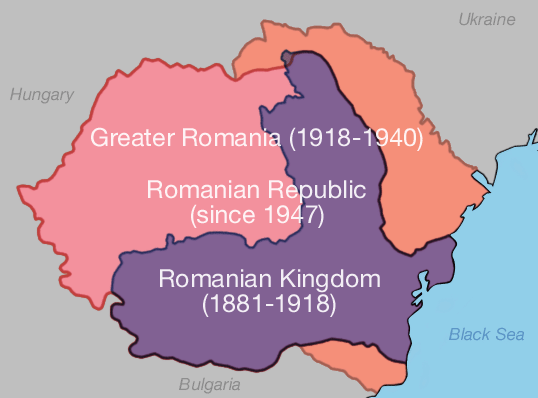
Carol I of Romania
Carol I , born Prince Karl of Hohenzollern-Sigmaringen was reigning prince and then King of Romania from 1866 to 1914. He was elected prince of Romania on 20 April 1866 following the overthrow of Alexandru Ioan Cuza by a palace coup...
, and descendants of his nephew Ferdinand ruled over the Kingdom of Romania
Kingdom of Romania
The Kingdom of Romania was the Romanian state based on a form of parliamentary monarchy between 13 March 1881 and 30 December 1947, specified by the first three Constitutions of Romania...
, as Karl Eitel did not have children. As monarch, the king of the Romanians was a sovereign
Sovereign
A sovereign is the supreme lawmaking authority within its jurisdiction.Sovereign may also refer to:*Monarch, the sovereign of a monarchy*Sovereign Bank, banking institution in the United States*Sovereign...
and head of state
Head of State
A head of state is the individual that serves as the chief public representative of a monarchy, republic, federation, commonwealth or other kind of state. His or her role generally includes legitimizing the state and exercising the political powers, functions, and duties granted to the head of...
.
The modern state of Romania
Romania
Romania is a country located at the crossroads of Central and Southeastern Europe, on the Lower Danube, within and outside the Carpathian arch, bordering on the Black Sea...
was formed by the merging of the principalities of Moldavia
Moldavia
Moldavia is a geographic and historical region and former principality in Eastern Europe, corresponding to the territory between the Eastern Carpathians and the Dniester river...
and Wallachia
Wallachia
Wallachia or Walachia is a historical and geographical region of Romania. It is situated north of the Danube and south of the Southern Carpathians...
in 1859 under the Moldavian domnitor
Domnitor
Domnitor was the official title of the ruler of the United Principalities of Wallachia and Moldavia between 1859 and 1866....
Alexandru Ioan Cuza. He was replaced by Karl Eitel of Hohenzollern-Sigmaringen in 1866, who became known as Prince Carol I of Romania.
During the Russo-Turkish War, Romania fought on the Russian side. In the 1878 Treaty of Berlin
Treaty of Berlin, 1878
The Treaty of Berlin was the final act of the Congress of Berlin , by which the United Kingdom, Austria-Hungary, France, Germany, Italy, Russia and the Ottoman Empire under Sultan Abdul Hamid II revised the Treaty of San Stefano signed on March 3 of the same year...
, Romania was subsequently recognized as an independent state by the Great Powers.
In return for ceding to Russian Empire
Russian Empire
The Russian Empire was a state that existed from 1721 until the Russian Revolution of 1917. It was the successor to the Tsardom of Russia and the predecessor of the Soviet Union...
the three southern districts of Bessarabia
Bessarabia
Bessarabia is a historical term for the geographic region in Eastern Europe bounded by the Dniester River on the east and the Prut River on the west....
that had been regained by Moldavia after the Crimean War
Crimean War
The Crimean War was a conflict fought between the Russian Empire and an alliance of the French Empire, the British Empire, the Ottoman Empire, and the Kingdom of Sardinia. The war was part of a long-running contest between the major European powers for influence over territories of the declining...
in 1852, Northern Dobruja
Dobruja
Dobruja is a historical region shared by Bulgaria and Romania, located between the lower Danube river and the Black Sea, including the Danube Delta, Romanian coast and the northernmost part of the Bulgarian coast...
was acquired.
In 1881, the principality
Principality
A principality is a monarchical feudatory or sovereign state, ruled or reigned over by a monarch with the title of prince or princess, or by a monarch with another title within the generic use of the term prince....
was raised to a kingdom
Monarchy
A monarchy is a form of government in which the office of head of state is usually held until death or abdication and is often hereditary and includes a royal house. In some cases, the monarch is elected...
and Prince Carol became King
Monarch
A monarch is the person who heads a monarchy. This is a form of government in which a state or polity is ruled or controlled by an individual who typically inherits the throne by birth and occasionally rules for life or until abdication...
Carol I. In 1947 the king was deposed and a people's republic proclaimed. In 1989 the communist regime fell and was succeeded by a democratic republic.
In 1918 Transylvania
Transylvania
Transylvania is a historical region in the central part of Romania. Bounded on the east and south by the Carpathian mountain range, historical Transylvania extended in the west to the Apuseni Mountains; however, the term sometimes encompasses not only Transylvania proper, but also the historical...
and Bessarabia
Bessarabia
Bessarabia is a historical term for the geographic region in Eastern Europe bounded by the Dniester River on the east and the Prut River on the west....
are incorporated. In 1918-19, confirmed by the Treaty of Versailles
Treaty of Versailles
The Treaty of Versailles was one of the peace treaties at the end of World War I. It ended the state of war between Germany and the Allied Powers. It was signed on 28 June 1919, exactly five years after the assassination of Archduke Franz Ferdinand. The other Central Powers on the German side of...
of 1919 and the Treaty of Trianon
Treaty of Trianon
The Treaty of Trianon was the peace agreement signed in 1920, at the end of World War I, between the Allies of World War I and Hungary . The treaty greatly redefined and reduced Hungary's borders. From its borders before World War I, it lost 72% of its territory, which was reduced from to...
of 1920, most of the Banat
Banat
The Banat is a geographical and historical region in Central Europe currently divided between three countries: the eastern part lies in western Romania , the western part in northeastern Serbia , and a small...
became part of Romania. Also Bukovina
Bukovina
Bukovina is a historical region on the northern slopes of the northeastern Carpathian Mountains and the adjoining plains.-Name:The name Bukovina came into official use in 1775 with the region's annexation from the Principality of Moldavia to the possessions of the Habsburg Monarchy, which became...
was incorporated in 1918.
On 10 May 2011, on a background of lawsuits in Germany brought against his family by his German relatives regarding the former name Hohenzollern-Veringen of his son in law, Radu, King Michael I of Romania
Michael I of Romania
Michael was the last King of Romania. He reigned from 20 July 1927 to 8 June 1930, and again from 6 September 1940 until 30 December 1947 when he was forced, by the Communist Party of Romania , to abdicate to the Soviet armies of occupation...
severed all of the dynastic and historical ties with the princely house of Hohenzollern-Sigmaringen, changed the name of his family to "of Romania", and gave up all princely titles conferred to him and to his family by the German Hohenzollerns.
Noble titles
The head of the royal house of Romania holds the title of:- King of the Romanians
The first degree descendants of the head of the royal house of Romania born within holy matrimony and in good standing hold the title of:
- Prince or Princess of Romania
During the reign of Carol II of Romania
Carol II of Romania
Carol II reigned as King of Romania from 8 June 1930 until 6 September 1940. Eldest son of Ferdinand, King of Romania, and his wife, Queen Marie, a daughter of Prince Alfred, Duke of Edinburgh, the second eldest son of Queen Victoria...
his son, Michael was styled "Măria Sa (M.S.) Marele Voievod de Alba Iulia" or the English translation "His Grace (H.G.) The Grand Voievod Of Alba Iulia". This was done because being a former King, Michael could not be styled again Crown Prince, so his father solved the problem with this agreement.
Styles
The Romanian original is: Majestatea Sa (M.S.) N.N., Regele Românilor (or Maiestatea Sa (M.S.) N.N., Regele României; both forms are accepted by the Romanian AcademyRomanian Academy
The Romanian Academy is a cultural forum founded in Bucharest, Romania, in 1866. It covers the scientific, artistic and literary domains. The academy has 181 acting members who are elected for life....
)
The English translation is: His Majesty (H.M.) N.N., King of the Romanians
Major coat of arms (Gesamtwappen)
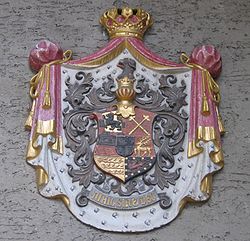
Coat of arms
A coat of arms is a unique heraldic design on a shield or escutcheon or on a surcoat or tabard used to cover and protect armour and to identify the wearer. Thus the term is often stated as "coat-armour", because it was anciently displayed on the front of a coat of cloth...
of the House of Hohenzollern-Sigmaringen is:
- Escutcheon: quarteringQuartering (heraldry)Quartering in heraldry is a method of joining several different coats of arms together in one shield by dividing the shield into equal parts and placing different coats of arms in each division....
of the shieldShieldA shield is a type of personal armor, meant to intercept attacks, either by stopping projectiles such as arrows or redirecting a hit from a sword, mace or battle axe to the side of the shield-bearer....
, parted per pale, twice parted per fess, with an inescutcheon- first sixth: Burgraviate of NurembergNurembergNuremberg[p] is a city in the German state of Bavaria, in the administrative region of Middle Franconia. Situated on the Pegnitz river and the Rhine–Main–Danube Canal, it is located about north of Munich and is Franconia's largest city. The population is 505,664...
(1214), on or (gold) a lion rampant sable (black) and a bordureBordureIn heraldry, a bordure is a band of contrasting tincture forming a border around the edge of a shield, traditionally one-sixth as wide as the shield itself...
of argentArgentIn heraldry, argent is the tincture of silver, and belongs to the class of light tinctures, called "metals". It is very frequently depicted as white and usually considered interchangeable with it...
(silverSilverSilver is a metallic chemical element with the chemical symbol Ag and atomic number 47. A soft, white, lustrous transition metal, it has the highest electrical conductivity of any element and the highest thermal conductivity of any metal...
) and gulesGulesIn heraldry, gules is the tincture with the colour red, and belongs to the class of dark tinctures called "colours". In engraving, it is sometimes depicted as a region of vertical lines or else marked with gu. as an abbreviation....
(redRedRed is any of a number of similar colors evoked by light consisting predominantly of the longest wavelengths of light discernible by the human eye, in the wavelength range of roughly 630–740 nm. Longer wavelengths than this are called infrared , and cannot be seen by the naked eye...
) - second sixth: Hereditary Chamberlain of the Holy Roman EmpireAulic CouncilThe Aulic Council was originally an executive-judicial council for the Holy Roman Empire....
(1504), on gules (red, two crossed scepters in orOr (heraldry)In heraldry, Or is the tincture of gold and, together with argent , belongs to the class of light tinctures called "metals". In engravings and line drawings, it may be represented using a field of evenly spaced dots...
(goldGoldGold is a chemical element with the symbol Au and an atomic number of 79. Gold is a dense, soft, shiny, malleable and ductile metal. Pure gold has a bright yellow color and luster traditionally considered attractive, which it maintains without oxidizing in air or water. Chemically, gold is a...
) (*) - third sixth: Lordship of Haigerloch and WehrsteinHaigerloch-Geography:-Geographical situation:Haigerloch lies at between 430 and 550 metres elevation in the valley of the Eyach, which forms two loops in a steep shelly limestone valley...
(1634), parted per fess gules (red) and argent (silver) - fourth sixth: Countship of SigmaringenSigmaringenSigmaringen is a town in southern Germany, in the state of Baden-Württemberg. Situated on the upper Danube, it is the capital of the Sigmaringen district....
(1535), on or (gold) a deerDeerDeer are the ruminant mammals forming the family Cervidae. Species in the Cervidae family include white-tailed deer, elk, moose, red deer, reindeer, fallow deer, roe deer and chital. Male deer of all species and female reindeer grow and shed new antlers each year...
gules (red)
- fifth sixth: Countship of VeringenVeringenstadtVeringenstadt is a town in the district of Sigmaringen, in Baden-Württemberg, Germany. It is situated 10 km north of Sigmaringen.- Municipality :...
(1535), on or (gold) three deerhorns horizontally with twice four, and once three antlerAntlerAntlers are the usually large, branching bony appendages on the heads of most deer species.-Etymology:Antler originally meant the lowest tine, the "brow tine"...
points gules (red)
- sixth sixth: County of Berg (1781), on argent (white) a lion rampantLionThe lion is one of the four big cats in the genus Panthera, and a member of the family Felidae. With some males exceeding 250 kg in weight, it is the second-largest living cat after the tiger...
gules (red) and a bordure of sable (black) with roundelRoundelA roundel in heraldry is a disc; the term is also commonly used to refer to a type of national insignia used on military aircraft, generally circular in shape and usually comprising concentric rings of different colours.-Heraldry:...
s or (gold)
- inescutcheon: Countship of ZollernZollernZollern, from 1218 Hohenzollern, was a county of the Holy Roman Empire. Its ruling dynasty was the House of Hohenzollern, a Swabian noble family first mentioned in 1061. They named their estates after Hohenzollern Castle at the Swabian Alb; its capital was Hechingen...
(1061), quarterly sable (black) and argent (silver)
- first sixth: Burgraviate of Nuremberg
- helm: or (gold) a helmet barred and affronté (sovereign), crowned with a coronetCoronetA coronet is a small crown consisting of ornaments fixed on a metal ring. Unlike a crown, a coronet never has arches.The word stems from the Old French coronete, a diminutive of coronne , itself from the Latin corona .Traditionally, such headgear is – as indicated by the German equivalent...
of a German prince (Fürstenkrone) - crestCrest (heraldry)A crest is a component of an heraldic display, so called because it stands on top of a helmet, as the crest of a jay stands on the bird's head....
: sable (black) and argent (white) a head and shoulders of a German houndHoundA hound is a type of dog that assists hunters by tracking or chasing the animal being hunted. It can be contrasted with the gun dog, which assists hunters by identifying the location of prey, and with the retriever, which recovers shot quarry...
(Deutsche Bracke) (1317) - wreathWreathA wreath is an assortment of flowers, leaves, fruits, twigs and/or various materials that is constructed to resemble a ring. They are used typically as Christmas decorations to symbolize the coming of Christ, also known as the Advent season in Christianity. They are also used as festive headdresses...
: sable (black) and argent (white) - mantlingMantlingIn heraldry, mantling or lambrequin is drapery tied to the helmet above the shield. It forms a backdrop for the shield. In paper heraldry it is a depiction of the protective cloth covering worn by knights from their helmets to stave off the elements, and, secondarily, to decrease the effects of...
: manteld sable (black), doubled argent (white) upon a crowned (Fürstenkrone) baldeqin gules (red), doubled ermineErmineErmine has several uses:* A common name for the stoat * The white fur and black tail end of this animal, which is historically worn by and associated with royalty and high officials... - mottoMottoA motto is a phrase meant to formally summarize the general motivation or intention of a social group or organization. A motto may be in any language, but Latin is the most used. The local language is usual in the mottoes of governments...
:- until the 19th century: Hie guet Zollere allwegeHouse of HohenzollernThe House of Hohenzollern is a noble family and royal dynasty of electors, kings and emperors of Prussia, Germany and Romania. It originated in the area around the town of Hechingen in Swabia during the 11th century. They took their name from their ancestral home, the Burg Hohenzollern castle near...
(We were always good Zollern) - from the 19th century onwards: NIHIL SINE DEONihil Sine Deothumb|right|The Royal Motto of [[Romania]] on the middle and great [[Coat of arms of Romania|coat of arms]]Nihil Sine Deo, Latin for "Nothing without God", is used as a motto by the German Hohenzollern-Sigmaringen royal family....
(Nothing without God)
- until the 19th century: Hie guet Zollere allwege
Family coat of arms (Gesamt- mit Hauswappen)
The combined coat of armsCoat of arms
A coat of arms is a unique heraldic design on a shield or escutcheon or on a surcoat or tabard used to cover and protect armour and to identify the wearer. Thus the term is often stated as "coat-armour", because it was anciently displayed on the front of a coat of cloth...
with inclusion of the House coat of arms of the House of Hohenzollern-Sigmaringen is:
- Escutcheon: quarteringQuartering (heraldry)Quartering in heraldry is a method of joining several different coats of arms together in one shield by dividing the shield into equal parts and placing different coats of arms in each division....
of the shieldShieldA shield is a type of personal armor, meant to intercept attacks, either by stopping projectiles such as arrows or redirecting a hit from a sword, mace or battle axe to the side of the shield-bearer....
, parted per pale, twice parted per fess, with an inescutcheon- first sixth: Burgraviate of NurembergNurembergNuremberg[p] is a city in the German state of Bavaria, in the administrative region of Middle Franconia. Situated on the Pegnitz river and the Rhine–Main–Danube Canal, it is located about north of Munich and is Franconia's largest city. The population is 505,664...
(1214), on or (gold) a lion rampant sable (black) and a bordureBordureIn heraldry, a bordure is a band of contrasting tincture forming a border around the edge of a shield, traditionally one-sixth as wide as the shield itself...
of argentArgentIn heraldry, argent is the tincture of silver, and belongs to the class of light tinctures, called "metals". It is very frequently depicted as white and usually considered interchangeable with it...
(silverSilverSilver is a metallic chemical element with the chemical symbol Ag and atomic number 47. A soft, white, lustrous transition metal, it has the highest electrical conductivity of any element and the highest thermal conductivity of any metal...
) and gulesGulesIn heraldry, gules is the tincture with the colour red, and belongs to the class of dark tinctures called "colours". In engraving, it is sometimes depicted as a region of vertical lines or else marked with gu. as an abbreviation....
(redRedRed is any of a number of similar colors evoked by light consisting predominantly of the longest wavelengths of light discernible by the human eye, in the wavelength range of roughly 630–740 nm. Longer wavelengths than this are called infrared , and cannot be seen by the naked eye...
) - second sixth: Hereditary Chamberlain of the Holy Roman Empire, on gules (red, two crossed scepters in orOr (heraldry)In heraldry, Or is the tincture of gold and, together with argent , belongs to the class of light tinctures called "metals". In engravings and line drawings, it may be represented using a field of evenly spaced dots...
(goldGoldGold is a chemical element with the symbol Au and an atomic number of 79. Gold is a dense, soft, shiny, malleable and ductile metal. Pure gold has a bright yellow color and luster traditionally considered attractive, which it maintains without oxidizing in air or water. Chemically, gold is a...
) (*) - third sixth: Lordship of Haigerloch and WehrsteinHaigerloch-Geography:-Geographical situation:Haigerloch lies at between 430 and 550 metres elevation in the valley of the Eyach, which forms two loops in a steep shelly limestone valley...
(1634), parted per fess gules (red) and argent (silver) - fourth sixth: Countship of SigmaringenSigmaringenSigmaringen is a town in southern Germany, in the state of Baden-Württemberg. Situated on the upper Danube, it is the capital of the Sigmaringen district....
(1535), on gules (red) a deerDeerDeer are the ruminant mammals forming the family Cervidae. Species in the Cervidae family include white-tailed deer, elk, moose, red deer, reindeer, fallow deer, roe deer and chital. Male deer of all species and female reindeer grow and shed new antlers each year...
or (gold) - fifth sixth: Countship of Veringen (1535), on or (gold) three dearhorns horizontally with twice four, and once three antlerAntlerAntlers are the usually large, branching bony appendages on the heads of most deer species.-Etymology:Antler originally meant the lowest tine, the "brow tine"...
points gules (red) - sixth sixth: County of Berg (1781), on argent (white) a lion rampant gules (red) and a bordure of sable (black) with roundelRoundelA roundel in heraldry is a disc; the term is also commonly used to refer to a type of national insignia used on military aircraft, generally circular in shape and usually comprising concentric rings of different colours.-Heraldry:...
s or (gold) - inescutcheon: Countship of ZollernZollernZollern, from 1218 Hohenzollern, was a county of the Holy Roman Empire. Its ruling dynasty was the House of Hohenzollern, a Swabian noble family first mentioned in 1061. They named their estates after Hohenzollern Castle at the Swabian Alb; its capital was Hechingen...
(1061), quarterly sable (black) and argent (silver)
- first sixth: Burgraviate of Nuremberg
- helm: seven particular helmets, equivalent to the seven particular coat of arms (Hohenzollern, Nuremberg, Sigmaringen, Veringen, Berg, Haigerloch and Wehrstein)
- crestCrest (heraldry)A crest is a component of an heraldic display, so called because it stands on top of a helmet, as the crest of a jay stands on the bird's head....
: seven particular crests, equivalent to the seven particular coat of arms (Hohenzollern, Nuremberg, Sigmaringen, Veringen, Berg, Haigerloch and Wehrstein) - wreathWreathA wreath is an assortment of flowers, leaves, fruits, twigs and/or various materials that is constructed to resemble a ring. They are used typically as Christmas decorations to symbolize the coming of Christ, also known as the Advent season in Christianity. They are also used as festive headdresses...
: sable (black) and argent (white) - mantlingMantlingIn heraldry, mantling or lambrequin is drapery tied to the helmet above the shield. It forms a backdrop for the shield. In paper heraldry it is a depiction of the protective cloth covering worn by knights from their helmets to stave off the elements, and, secondarily, to decrease the effects of...
: manteld sable (black), doubled argent (white) - supporter: two German hounds
- compartmentCompartmentIn heraldry, a compartment is a design placed under the shield, usually rocks, a grassy mount , or some sort of other landscape upon which the supporters are depicted as standing...
: grassGrassGrasses, or more technically graminoids, are monocotyledonous, usually herbaceous plants with narrow leaves growing from the base. They include the "true grasses", of the Poaceae family, as well as the sedges and the rushes . The true grasses include cereals, bamboo and the grasses of lawns ...
y
(*) Eitel Frederick II, count of Hohenzollern and Burgrave of Nuremberg became Hereditary Chamberlain of the Holy Roman Empire by appointment of Joachim I, elector and margrave of Brandenburg, Arch-Chamberlain of the Holy Roman Empire, and confirmed by Maximilian I, Holy Roman Emperor.
Romania
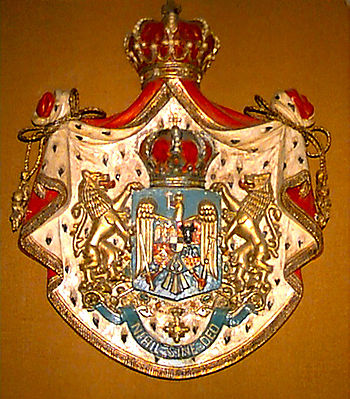
- an escutcheon of the combination of the territories of
 :
:
- WallachiaWallachiaWallachia or Walachia is a historical and geographical region of Romania. It is situated north of the Danube and south of the Southern Carpathians...

- MoldaviaMoldaviaMoldavia is a geographic and historical region and former principality in Eastern Europe, corresponding to the territory between the Eastern Carpathians and the Dniester river...

- Northern DobrujaNorthern DobrujaNorthern Dobruja is the part of Dobruja within the borders of Romania. It lies between the lower Danube river and the Black Sea, bordered in south by Bulgarian Southern Dobruja.-Geography:...

- TransylvaniaTransylvaniaTransylvania is a historical region in the central part of Romania. Bounded on the east and south by the Carpathian mountain range, historical Transylvania extended in the west to the Apuseni Mountains; however, the term sometimes encompasses not only Transylvania proper, but also the historical...
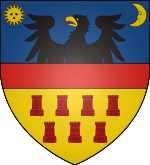
- BessarabiaBessarabiaBessarabia is a historical term for the geographic region in Eastern Europe bounded by the Dniester River on the east and the Prut River on the west....

- BanatBanatThe Banat is a geographical and historical region in Central Europe currently divided between three countries: the eastern part lies in western Romania , the western part in northeastern Serbia , and a small...

- OlteniaOlteniaOltenia is a historical province and geographical region of Romania, in western Wallachia. It is situated between the Danube, the Southern Carpathians and the Olt river ....

- BukovinaBukovinaBukovina is a historical region on the northern slopes of the northeastern Carpathian Mountains and the adjoining plains.-Name:The name Bukovina came into official use in 1775 with the region's annexation from the Principality of Moldavia to the possessions of the Habsburg Monarchy, which became...

- an inescutcheon of the House of HohenzollernHouse of HohenzollernThe House of Hohenzollern is a noble family and royal dynasty of electors, kings and emperors of Prussia, Germany and Romania. It originated in the area around the town of Hechingen in Swabia during the 11th century. They took their name from their ancestral home, the Burg Hohenzollern castle near...
(quarterly sable (black) and argent (silver)
- Wallachia
- helm: The Steel Crown of Romania
- mantlingMantlingIn heraldry, mantling or lambrequin is drapery tied to the helmet above the shield. It forms a backdrop for the shield. In paper heraldry it is a depiction of the protective cloth covering worn by knights from their helmets to stave off the elements, and, secondarily, to decrease the effects of...
: a crowned baldeqin gules (red), doubled ermineErmineErmine has several uses:* A common name for the stoat * The white fur and black tail end of this animal, which is historically worn by and associated with royalty and high officials... - mottoMottoA motto is a phrase meant to formally summarize the general motivation or intention of a social group or organization. A motto may be in any language, but Latin is the most used. The local language is usual in the mottoes of governments...
: NIHIL SINE DEONihil Sine Deothumb|right|The Royal Motto of [[Romania]] on the middle and great [[Coat of arms of Romania|coat of arms]]Nihil Sine Deo, Latin for "Nothing without God", is used as a motto by the German Hohenzollern-Sigmaringen royal family....
(Nothing without God) - supporter: two rampant lions
- compartmentCompartmentIn heraldry, a compartment is a design placed under the shield, usually rocks, a grassy mount , or some sort of other landscape upon which the supporters are depicted as standing...
: ground
Counts (Graf) of Hohenzollern (1576-1623)
- Karl II 1576–1606
- Johann 1606–1623
Princes (Fürst) of Hohenzollern-Sigmaringen (1623-1849)
- Johann 1623–1638
- Meinrad I 1638–1681
- Maximilian 1681–1689
- Meinrad II 1689–1715
- Joseph Franz Ernst 1715–1769
- Karl Friedrich 1769–1785
- Anton AloysAnton Aloys, Prince of Hohenzollern-SigmaringenAnton Aloys, Prince of Hohenzollern-Sigmaringen was Prince of Hohenzollern-Sigmaringen.He married Princess Amalie Zephyrine of Salm-Kyrburg in 1782 and was the father of Charles, Prince of Hohenzollern-Sigmaringen. He was the paternal great-grandfather of Prince Karl of Hohenzollern-Sigmaringen,...
1785–1831 - KarlCharles, Prince of Hohenzollern-SigmaringenCharles, Prince of Hohenzollern-Sigmaringen was Prince of Hohenzollern-Sigmaringen from 1831 to 1848.In 1833 Karl called a constitutional assembly together and created a constitutional charter that would be the law in his lands...
1831–1848 - Karl Anton 1848–1849
Claimants (1849-present)
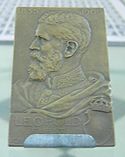
- Karl Anton 1849–1885 (became Prince (Fürst) of Hohenzollern on the death of the last Prince of Hohenzollern-Hechingen in 1869)
- Leopold, Prince of Hohenzollern 1885–1905
- William, Prince of Hohenzollern 1905–1927
- Friedrich, Prince of HohenzollernFriedrich, Prince of HohenzollernFrederick, Prince of Hohenzollern He was the eldest son of William, Prince of Hohenzollern and Princess Maria Teresa of Bourbon-Two Sicilies...
1927–1965 - Frederick William, Prince of HohenzollernFrederick William, Prince of HohenzollernFriedrich Wilhelm, Prince of Hohenzollern was the head of the Princely House of Hohenzollern-Sigmaringen.-Biography:Friedrich Wilhelm was born in Schloss Umkirch...
1965–2010 - Karl Friedrich, Prince of Hohenzollern 2010–present
- Alexander, Hereditary Prince of Hohenzollern (heir apparentHeir apparentAn heir apparent or heiress apparent is a person who is first in line of succession and cannot be displaced from inheriting, except by a change in the rules of succession....
)
- Alexander, Hereditary Prince of Hohenzollern (heir apparent
King of the Romanians (1881-1947)
- Carol ICarol I of RomaniaCarol I , born Prince Karl of Hohenzollern-Sigmaringen was reigning prince and then King of Romania from 1866 to 1914. He was elected prince of Romania on 20 April 1866 following the overthrow of Alexandru Ioan Cuza by a palace coup...
1881–1914 - Ferdinand 1914–1927
- Michael 1927–1930
- Carol IICarol II of RomaniaCarol II reigned as King of Romania from 8 June 1930 until 6 September 1940. Eldest son of Ferdinand, King of Romania, and his wife, Queen Marie, a daughter of Prince Alfred, Duke of Edinburgh, the second eldest son of Queen Victoria...
1930–1940 - Michael 1940–1947
Claimants (1947-present)
- MichaelMichael I of RomaniaMichael was the last King of Romania. He reigned from 20 July 1927 to 8 June 1930, and again from 6 September 1940 until 30 December 1947 when he was forced, by the Communist Party of Romania , to abdicate to the Soviet armies of occupation...
1947–present - Karl Friedrich, Prince of Hohenzollern (heir presumptiveHeir PresumptiveAn heir presumptive or heiress presumptive is the person provisionally scheduled to inherit a throne, peerage, or other hereditary honour, but whose position can be displaced by the birth of an heir or heiress apparent or of a new heir presumptive with a better claim to the position in question...
) (disputed) - Princess Margarita of RomaniaPrincess Margarita of RomaniaPrincess Margarita of Romania , also styled as Crown Princess of Romania, Custodian of the Romanian Crown, former Princess of Hohenzollern, is the eldest daughter of Michael I , King of Romania , former Prince of Hohenzollern, and of his wife, Anne of Bourbon-Parma...
(heir presumptive) (disputed)
See also
- SigmaringenSigmaringenSigmaringen is a town in southern Germany, in the state of Baden-Württemberg. Situated on the upper Danube, it is the capital of the Sigmaringen district....
- Sigmaringen Castle
- Line of succession to the Romanian throneLine of succession to the Romanian throneThe succession order to the throne of Romania depends on the interpretation of the applicable laws, either the Romanian kingdom's last democratic constitution, that of 1923, or the new Statute of the Royal House of Romania, named Fundamental Rules of the Romanian Royal House, privately enacted by...