
All Topics  
Carbon-carbon bond


   Email Print
   Bookmark   Link


Carbon-carbon bond


A carbon-carbon bond is a covalent bond
Chemical bond

A chemical bond is the physical process responsible for the attractive interactions between atoms and molecules, and that which confers stability to diatomic and polyatomic chemical compounds....
 between two carbon
Carbon

Carbon is a chemical element with chemical symbol C and atomic number 6. As a member of group 14 on the periodic table, it is nonmetallic and tetravalence?making four electrons available to form covalent bond chemical bonds....
 atom
Atom

|-! bgcolor=gray | Properties|-||}The atom is a basic unit of matter consisting of a dense, central atomic nucleus surrounded by a electron cloud of electric charge electrons....
s. The most common form is the single bond – a bond composed of two electron
Electron

The electron is a subatomic particle that carries a negative electric charge. It has elementary particle and is believed to be a point particle....
s, one from each of the two atoms. The carbon-carbon single bond is a sigma bond
Sigma bond

In chemistry, sigma bonds are the strongest type of covalent bond chemical bond. Sigma bonding is most clearly defined for diatomic molecules using the language and tools of symmetry groups....
 and is said to be formed between one hybridized
Orbital hybridisation

In chemistry, hybridisation or hybridization is the concept of mixing atomic orbitals to form new hybrid orbitals suitable for the qualitative description of atomic bonding properties....
 orbital from each of the carbon atoms. In ethane, the orbitals are sp3 hybridized
Orbital hybridisation

In chemistry, hybridisation or hybridization is the concept of mixing atomic orbitals to form new hybrid orbitals suitable for the qualitative description of atomic bonding properties....
 orbitals, but single bonds formed between carbon atoms with other hybridisations do occur (e.g.


Discussion
Ask a question about 'Carbon-carbon bond'
Start a new discussion about 'Carbon-carbon bond'
Answer questions from other users
Full Discussion Forum


Encyclopedia


A carbon-carbon bond is a covalent bond
Chemical bond

A chemical bond is the physical process responsible for the attractive interactions between atoms and molecules, and that which confers stability to diatomic and polyatomic chemical compounds....
 between two carbon
Carbon

Carbon is a chemical element with chemical symbol C and atomic number 6. As a member of group 14 on the periodic table, it is nonmetallic and tetravalence?making four electrons available to form covalent bond chemical bonds....
 atom
Atom

|-! bgcolor=gray | Properties|-||}The atom is a basic unit of matter consisting of a dense, central atomic nucleus surrounded by a electron cloud of electric charge electrons....
s. The most common form is the single bond – a bond composed of two electron
Electron

The electron is a subatomic particle that carries a negative electric charge. It has elementary particle and is believed to be a point particle....
s, one from each of the two atoms. The carbon-carbon single bond is a sigma bond
Sigma bond

In chemistry, sigma bonds are the strongest type of covalent bond chemical bond. Sigma bonding is most clearly defined for diatomic molecules using the language and tools of symmetry groups....
 and is said to be formed between one hybridized
Orbital hybridisation

In chemistry, hybridisation or hybridization is the concept of mixing atomic orbitals to form new hybrid orbitals suitable for the qualitative description of atomic bonding properties....
 orbital from each of the carbon atoms. In ethane, the orbitals are sp3 hybridized
Orbital hybridisation

In chemistry, hybridisation or hybridization is the concept of mixing atomic orbitals to form new hybrid orbitals suitable for the qualitative description of atomic bonding properties....
 orbitals, but single bonds formed between carbon atoms with other hybridisations do occur (e.g. sp2 to sp2). In fact, the carbon atoms in the single bond need not be of the same hybridisation. Carbon atoms can also form double bonds called alkene
Alkene

In organic chemistry, an alkene, olefin, or olefine is an Saturation chemical compound containing at least one carbon-to-carbon double bond....
s or triple bonds called alkyne
Alkyne

Alkynes are hydrocarbons that have at least one triple bond between two carbon atoms, with the formula CnH2n-2. The alkynes are traditionally known as acetylenes or the acetylene series, although the name acetylene is also used to refer specifically to the simplest member of the series, known as e...
s. A double bond is formed with an sp2 hybridized
Orbital hybridisation

In chemistry, hybridisation or hybridization is the concept of mixing atomic orbitals to form new hybrid orbitals suitable for the qualitative description of atomic bonding properties....
 orbital and a p-orbital that isn't involved in the hybridization. A triple bond is formed with an sp hybridized
Orbital hybridisation

In chemistry, hybridisation or hybridization is the concept of mixing atomic orbitals to form new hybrid orbitals suitable for the qualitative description of atomic bonding properties....
 orbital and two p-orbitals from each atom. The use of the p-orbitals forms a pi bond
Pi bond

In chemistry, pi bonds are covalent bond chemical bonds where two lobes of one involved electron atomic orbital overlap two lobes of the other involved electron orbital....
.

Carbon has the unique characteristic among all elements to form long chains of its own atoms, a property called catenation
Catenation

Catenation is the ability of a chemical element to form a long chain-like structure via a series of covalent bonds. Catenation occurs most readily in carbon, which forms covalent bonds with other carbon atoms.Catenation is the reason for the presence of large number of organic compounds in nature....
. This coupled with the strength
Bond strength

In chemistry, bond strength is measured between two atoms joined in a chemical bond . It is the degree to which each atom linked to a central atom contributes to the valency of this central atom....
 of the carbon-carbon bond gives rise to an enormous number of molecular forms, many of which are important structural elements of life, so carbon compounds have their own field of study: organic chemistry
Organic chemistry

Organic chemistry is a discipline within chemistry which involves the science study of the structure, properties, composition, chemical reaction, and preparation of chemical compounds that contain carbon....
.

Branching
Branching (chemistry)

In polymer chemistry, branching occurs by the replacement of a substituent, e.g, a hydrogen atom, on a monomer subunit, by another covalent bond chain of that polymer; or, in the case of a graft copolymer, by a Chain of another type....
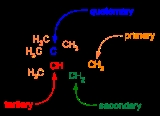
 is also common in C-C skeletons. Different carbon atoms can be identified with respect to the number of other carbon neighbors:

  • primary carbon atom: one carbon neighbor
  • secondary carbon atom: two carbon neighbors
  • tertiary carbon atom: three carbon neighbors
  • quaternary carbon atom: four carbon neighbors


Synthesis

Carbon-carbon bond forming reactions are organic reaction
Organic reaction

Organic reactions are chemical reactions involving organic compounds. The basic organic chemistry reaction types are addition reactions, elimination reactions, substitution reactions, pericyclic reactions, rearrangement reactions and organic redox reaction....
s in which a new carbon carbon bond is formed. They are important in the production of many man-made chemicals such as pharmaceuticals and plastic
Plastic

Plastic is the general common term for a wide range of synthetic or semisynthetic organic chemistry solid materials suitable for the manufacture of industrial products....
s.

Some examples of reactions which form carbon-carbon bonds are Aldol reaction
Aldol reaction

The aldol reaction is a carbon-carbon bond formation chemical reaction in organic chemistry. In its usual form, it involves the nucleophilic addition of a ketone enolate to an aldehyde to form a Hydroxy ketone, or "aldol" , a structural unit found in many biomolecule and pharmaceuticals....
s, Diels-Alder reaction
Diels-Alder reaction

The Diels-Alder reaction is an organic chemical reaction between a conjugated diene and a substituted alkene, commonly termed the dienophile, to form a substituted cyclohexene system....
, the addition of a Grignard reagent to a carbonyl group, a Heck reaction
Heck reaction

The Heck reaction is the chemical reaction of an unsaturated halide with an alkene and a strong base and palladium catalyst to form a substituted alkene....
, a Michael reaction
Michael reaction

The Michael reaction or Michael addition is the nucleophilic addition of a carbanion to an ?,?-unsaturated carbonyl compound. It belongs to the larger class of conjugate additions....
 and a Wittig reaction
Wittig reaction

The Wittig reaction is a chemical reaction of an aldehyde or ketone with a triphenyl #Wittig reagents to give an alkene and triphenylphosphine oxide....
.

See also

  • An extensive list is presented here: list of carbon-carbon bond forming reactions
  • The chemistry of carbon bonded to other elements in the periodic table: