
All Topics  
Car safety

 
Car Safety

   Email Print
   Bookmark   Link


Car safety


Automobile safety is the avoidance of automobile accidents or the minimization of harmful effects of accidents, in particular as pertaining to human life and health. Numerous safety features have been built into cars for years, some for the safety of car's occupants only, some for the safety of others.

As a result of improvements in highway and automobile design, the incidence of injuries and fatalities per mile driven has decreased significantly, but road traffic injuries still represent about 25% of worldwide injury-related deaths (the leading cause) with an estimated 1.2 million deaths (2004) each year - World Health Organization
World Health Organization

The World Health Organization is a specialized agency of the United Nations that acts as a coordinating authority on international public health....
 ).

safety may have become an issue almost from the beginning of mechanised road vehicle development.


Discussion
Ask a question about 'Car safety'
Start a new discussion about 'Car safety'
Answer questions from other users
Full Discussion Forum


Recent Posts


Encyclopedia


Automobile safety is the avoidance of automobile accidents or the minimization of harmful effects of accidents, in particular as pertaining to human life and health. Numerous safety features have been built into cars for years, some for the safety of car's occupants only, some for the safety of others.

Safety Distance 1s P1050014
As a result of improvements in highway and automobile design, the incidence of injuries and fatalities per mile driven has decreased significantly, but road traffic injuries still represent about 25% of worldwide injury-related deaths (the leading cause) with an estimated 1.2 million deaths (2004) each year - World Health Organization
World Health Organization

The World Health Organization is a specialized agency of the United Nations that acts as a coordinating authority on international public health....
 ).

History

Car safety may have become an issue almost from the beginning of mechanised road vehicle development. The second steam-powered "Fardier" (artillery tractor), created by Nicolas-Joseph Cugnot
Nicolas-Joseph Cugnot

Nicolas-Joseph Cugnot was a France inventor. He is believed to have built the first self-propelled mechanical vehicle. This claim is disputed by some sources, however, which suggest that Ferdinand Verbiest, as a member of a Jesuit China missions, may have been the first to build a 'car' around 1672....
 in 1771, is reported by some to have crashed into a wall during its demonstration run. However according to Georges Ageon, the earliest mention of this occurrence dates from 1801 and it does not feature in contemporary accounts.

One of the earliest recorded automobile fatalities was Mary Ward
Mary Ward (scientist)

Mary Ward was an Irish scientist who was killed when she fell under the wheels of an experimental steam car built by her cousins. As the unfortunate event occurred in 1869, she is thought to be the world's first road accident victim....
, on August 31, 1869 in Parsonstown, Ireland.

In the 1930s, plastic surgeon Claire L. Straith
Claire L. Straith

Claire L. Straith was an American plastic surgeon.Dr. Straith was a pioneer of Automobile safety. He described the cranial and facial injuries created by the Dashboard and windshields in case of a car crash and advocated the use of Seat belt and padded dashboards ...
 and physician C. J. Strickland advocated the use of seat belt
Seat belt

A seat belt, sometimes called a safety belt, is a safety harness designed to secure the occupant of a vehicle against harmful movement that may result from a collision or a sudden stop....
s and padded dashboard
Dashboard

A dashboard, dash, "dial and switch housing", and sometimes fascia is a Control panel located under the windshield of an automobile....
s. Strickland founded the Automobile Safety League of America.

In 1934, GM
General Motors

General Motors Corporation , founded in 1908, is the world's second-largest automaker after Toyota, ranked by 2008 global unit sales. GM was the global sales leader for 77 consecutive calendar years from 1931 to 2008....
 performed the first barrier crash test
Crash test

A crash test is a form of destructive testing usually performed in order to ensure safe design standards in Crashworthiness and crash compatibility for automobiles or related components....
.

In 1942, Hugh De Haven
Hugh De Haven

Hugh De Haven was an American pilot, engineer and passive safety pioneer. De Haven survived a plane crash during the Second World War . He tried to understand why he survived that crash , and he noted that he was the lone survivor, his cockpit being also the only one intact after the crash ....
 published the classic Mechanical analysis of survival in falls from heights of fifty to one hundred and fifty feet.

In 1944, Volvo introduced the first safety cage to modern cars but it was patented by Mercedes Benz before Volvo.

In 1949 SAAB incorporated aircraft safety thinking into automobiles making the Saab 92
Saab 92

Saab 92 is an automobile from Saab Automobile. The design was very aerodynamic for its time, and the cW value was 0.30 . Full-scale production started December 12, 1949, based on the prototype Saab 92001....
 the first production SAAB car with a safety cage, and the American Tucker was built with the world's first padded dashboard.

In the 1950s, Mercedes-Benz
Mercedes-Benz

Mercedes-Benz is a German manufacturer of automobiles, buses, coach es, and trucks. It is currently a division of the parent company, Daimler AG , after previously being owned by Daimler-Benz....
 extensively crash tested prototypes..

In 1956, Ford tried unsuccessfully to interest Americans in purchasing safer cars with their Lifeguard
Lifeguard (Automobile safety)

Lifeguard was the name of a 1956 Automobile safety package marketed by the Ford Motor Company.Spurred by Robert McNamara, the University of Cornell crash research program and the first year of Ford own Crash test the Lifeguard package included:...
 safety package.

In 1958, the United Nations
United Nations

The United Nations is an international organization whose stated aims are to facilitate cooperation in international law, international security, economic development, Social change, human rights and achieving world peace....
 established the World Forum for Harmonization of Vehicle Regulations
World Forum for Harmonization of Vehicle Regulations

The World Forum for Harmonization of Vehicle Regulations is a working party of the United Nations Economic Commission for Europe . It is tasked with creating a uniform set of regulations for vehicle design to facilitate international trade....
, an international
International

International or internationally most often describes interaction between nations, or encompassing two or more nations, constituting a group or association having members in two or more nations, or generally reaching beyond national boundaries....
 standards body advancing auto safety. Many of the most life saving safety innovations, like seat belts and roll cage
Roll cage

A roll cage is a specially constructed frame built in or around the cab of a vehicle to protect the occupants from being injured in an accident, particularly in the event of a roll-over....
 construction were brought to market under its auspices. That same year, Volvo
Volvo

The Volvo Group is a Sweden supplier of commercial vehicles such as trucks, buses and construction equipment, drive systems for marine and industrial applications, aerospace components and financial services....
 engineer Nils Bohlin invented and patented the three-point (lap and shoulder) safety belt, which became standard equipment on all Volvo cars in 1959. Over the subsequent several decades, three-point safety belts were gradually mandated in all vehicles by regulators throughout the industrialised world.

In 1966, the U.S. established the United States Department of Transportation
United States Department of Transportation

The United States Department of Transportation is a federal United States Cabinet department of the United States government of the United States concerned with transportation....
 (DOT) with automobile safety one of its purposes. The National Transportation Safety Board
National Transportation Safety Board

The National Transportation Safety Board is an Independent agencies of the United States government responsible for civil transportation accident investigation....
 (NTSB) was created as an independent organization on April 1, 1967, but was reliant on the DOT for administration and funding. However, in 1975 the organization was made completely independent by the Independent Safety Board Act (in P.L. 93-633; 49 U.S.C.
Title 49 of the United States Code

Title 49 of the United States Code is a code that regards the role of transportation in the United States of America.The title was enacted by , ? 1, October 17, 1978, ; , ? 1, January 12, 1983, ; and , July 5, 1994, ...
 1901).

Volvo developed the first rear-facing child seat in 1964 and introduced its own booster seat in 1978.

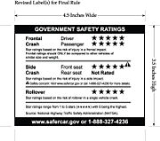
In 1979, NHTSA began crash-testing popular cars and publishing the results, to inform consumers and encourage manufacturers to improve the safety of their vehicles. Initially, the US NCAP crash tests examined compliance with the occupant-protection provisions of FMVSS 208. Over the subsequent years, this NHTSA program was gradually expanded in scope. In 1997, the European New Car Assessment Programme
EuroNCAP

The European New Car Assessment Programme is a European car safety performance assessment programme founded in 1997 by the Transport Research Laboratory for the UK Department for Transport....
 (Euro NCAP) was established to test new vehicles' safety performance and publish the results for vehicle shoppers' information. The NHTSA crash tests are presently operated and published as the U.S. branch of the international NCAP programme.

In 1984, New York State passed the first US law requiring seat belt use in passenger cars. Seat belt laws have subsequently been adopted by all 50 states, and NHTSA estimates that seat belt laws save 10,000 per year in the USA.

In 1986, the Centre High Mount Stop Lamp (CHMSL)|central 3rd brake light
Automotive lighting

The lighting system of a motor vehicle consists of lighting and signalling devices mounted or integrated to the front, sides and rear of the vehicle....
 was mandated in North America. Over the subsequent 15 years, most of the world's other jurisdictions mandated the 3rd brake lamp as well.

In 2004, NHTSA released new tests designed to test the rollover risk of new cars and SUV
Sport utility vehicle

A sport utility vehicle is a generic marketing description for a vehicle similar to a station wagon but built on a light-truck chassis. Usually equipped with four-wheel drive for on or off-road ability, some SUVs include the towing capacity of a pickup truck with the passenger-carrying space of a minivan....
s. Only the Mazda RX-8
Mazda RX-8

The Mazda RX-8 is a sports car manufactured by Mazda. It first appeared in 2001 at the North American International Auto Show. It is the successor to the Mazda RX-7 and, like its predecessors in the RX range, it is powered by a Mazda Wankel engine....
 got a 5-star rating.

Safety trends

Despite technological advances, about 40,000 people die every year in the U.S. Although the fatality rates per vehicle registered and per vehicle distance travelled have steadily decreased since the advent of significant vehicle and driver regulation, the raw number of fatalities generally increases as a function of rising population and more vehicles on the road. However, sharp rises in the price of fuel and related driver behavioural changes are reducing 2007-8 highway fatalities in the U.S. to below the 1961 fatality count.

International comparison
In 1996, the U.S. had about 2 deaths per 10,000 motor vehicles, compared to 1.9 in Germany, 2.6 in France, and 1.5 in the UK. In 1998, there were 3,421 fatal accidents in the UK, the fewest since 1926.

The sizable traffic safety lead enjoyed by the USA since the 1960s had narrowed significantly by 2002, with the US improvement percentages lagging in 16th place behind those of Australia
Australia

Australia, officially the Commonwealth of Australia, is a country in the southern hemisphere comprising the Australia of the world's smallest continent, the major island of Tasmania, and numerous list of islands of Australia in the Indian Ocean and Pacific Oceans....
, Austria
Austria

Austria , officially the Republic of Austria , is a landlocked country in Central Europe. It borders both Germany and the Czech Republic to the north, Slovakia and Hungary to the east, Slovenia and Italy to the south, and Switzerland and Liechtenstein to the west....
, Canada
Canada

Canada is a country occupying most of northern North America, extending from the Atlantic Ocean in the east to the Pacific Ocean in the west and northward into the Arctic Ocean....
, Denmark
Denmark

Denmark is a Scandinavian country in northern Europe and the senior member of the Kingdom of Denmark. It is the southernmost of the Nordic countries....
, Finland
Finland

Finland , officially the Republic of Finland , is a Nordic countries situated in the Fennoscandian region of northern Europe. It borders Sweden on the west, Russia on the east, and Norway on the north, while Estonia lies to its south across the Gulf of Finland....
, Germany
Germany

Germany , officially the Federal Republic of Germany , is a country in Central Europe. It is bordered to the north by the North Sea, Denmark, and the Baltic Sea; to the east by Poland and the Czech Republic; to the south by Austria and Switzerland; and to the west by France, Luxembourg, Belgium, and the Netherlands....
, Great Britain
Great Britain

Great Britain is an island lying to the northwest of Continental Europe. It is the List of islands by area, and the largest in Europe. With a population of 58.9 million people it is List of islands by population....
, Iceland
Iceland

Iceland, officially the Republic of Iceland , is an island country located in the North Atlantic Ocean between mainland Europe and Greenland....
, Japan
Japan

Japan is an island country in East Asia. Located in the Pacific Ocean, it lies to the east of the Sea of Japan, People's Republic of China, North Korea, South Korea and Russia, stretching from the Sea of Okhotsk in the north to the East China Sea and Taiwan in the south....
, Luxembourg
Luxembourg

Luxembourg , officially the Grand Duchy of Luxembourg , is a small landlocked country in western Europe, bordered by Belgium, France, and Germany....
, the Netherlands
Netherlands

The Netherlands is a country that is part of the Kingdom of the Netherlands. It is a parliamentary democratic constitutional monarchy. The Netherlands is located in North-West Europe, and bordered by the North Sea to the north and west, Belgium to the south, and Germany to the east....
, New Zealand
New Zealand

New Zealand is an island country in the south-western Pacific Ocean comprising two main landmasses , and numerous Islands of New Zealand, most notably Stewart Island/Rakiura and the Chatham Islands....
, Norway
Norway

Norway , officially the Kingdom of Norway, is a constitutional monarchy in Northern Europe that occupies the western portion of the Scandinavian Peninsula....
, Sweden
Sweden

Sweden , officially the Kingdom of Sweden , is a Nordic countries on the Scandinavian Peninsula in Northern Europe. Sweden has land borders with Norway to the west and Finland to the northeast, and it is connected to Denmark by the ?resund Bridge in the south....
, and Switzerland
Switzerland

Switzerland is a landlocked Swiss Alps country of roughly 7.7 million people in Western Europe with an area of 41,285 km?. Switzerland is a federal republic consisting of 26 states called Cantons of Switzerland....
 in terms of deaths per thousand vehicles, while in terms of deaths per 100 million vehicle miles travelled, the USA had dropped from first place to tenth place.

Government-collected data, such as that from the U.S. Fatality Analysis Reporting System
Fatality Analysis Reporting System

Fatality Analysis Reporting System was created in the United States of America by NHTSA to provide an overall measure of highway safety, to help suggest solutions, and to help provide an objective basis to evaluate the effectiveness of motor vehicle safety standards and highway safety programs....
, show other countries achieving safety performance improvements over time greater than those achieved in the U.S.: cellpadding="0" height="116">


1979 Fatalities

2002 Fatalities

Percent Change

United States

51,093

42,815

-16.2%

Great Britain

6,352

3,431

-46.0%

Canada

5,863

2,936

-49.9%

Australia

3,508

1,715

-51.1%


Research on the trends in use of heavy vehicles indicate that a significant difference between the U.S. and other countries is the relatively high prevalence of pickup truck
Pickup truck

A pickup truck is a light motor vehicle with an open-top rear cargo area which is almost always separated from the cab to allow for chassis flex when carrying or pulling heavy loads....
s and SUVs in the U.S. A 2003 study by the U.S. Transportation Research Board
Transportation Research Board

The Transportation Research Board is a division of the United States National Research Council, which serves as an independent adviser to the President, the Congress and federal agencies on scientific and technical questions of national importance....
 found that SUVs and pickup trucks are significantly less safe than passenger cars, that imported-brand vehicles tend to be safer than American-brand vehicles, and that the size and weight of a vehicle has a significantly smaller effect on safety than the quality of the vehicle's engineering. The level of large commercial truck traffic has substantially increased since the 1960s, while highway capacity has not kept pace with the increase in large commercial truck traffic on U.S. highways. However, other factors exert significant influence; Canada has lower roadway death and injury rates despite a vehicle mix comparable to that of the U.S. Nevertheless, the widespread use of truck-based vehicles as passenger carriers is correlated with roadway deaths and injuries not only directly by dint of vehicular safety performance per se, but also indirectly through the relatively low fuel costs that facilitate the use of such vehicles in North America; motor vehicle fatalities decline as fuel prices increase.

NHTSA has issued relatively few regulations since the mid 1980s; most of the vehicle-based reduction in vehicle fatality rates in the U.S. during the last third of the 20th Century were gained by the initial NHTSA safety standards issued from 1968 to 1984 and subsequent voluntary changes in vehicle design and construction by vehicle manufacturers.

Pregnant women

When pregnant, women should continue to use seatbelts and airbags properly. A University of Michigan study found that "unrestrained or improperly restrained pregnant women are 5.7 times more likely to have an adverse fetal outcome than properly restrained pregnant women". If seatbelts are not long enough, extensions are available from the car manufacturer or an aftermarket supplier.

Infants and children

Children present significant challenges in engineering and producing safe vehicles, because most children are significantly smaller and lighter than most adults. Safety devices and systems designed and optimised to protect adults — particularly calibration-sensitive devices like airbags and active seat belts — can be ineffective or hazardous to children. In recognition of this, many medical professionals and jurisdictions recommend or require that children under a particular age, height, and/or weight ride in a child seat and/or in the back seat, as applicable.

Child safety lock
Child safety lock

A child safety lock is a special-purpose lock for cabinets, drawers, bottles, etc. that is designed to help prevent children from getting at any dangerous contents....
s and driver-controlled power window
Power window

File:Power window switches on drivers door.jpgPower windows or electric windows are automobile windows which can be raised and lowered by depressing a button or switch, as opposed to using a hand-turned Crank ....
 lockout controls prevent children from opening doors and windows from inside the vehicle.

Infants left in cars
Very young children can perish from heat or cold if left unattended in a parked car, whether deliberately or through absentmindedness.

Teenage drivers
In the UK, a full driving licence can be had at age 17, and most areas in the United States will issue a full driver's license at the age of 16, and all within a range between 14 and 18. In addition to being relatively inexperienced, teen drivers are also cognitively immature, compared to other drivers. This combination leads to a relatively high crash rate among this demographic.

In some areas, new drivers' vehicles must bear a warning sign to alert other drivers that the vehicle is being driven by an inexperienced and learning driver, giving them opportunity to be more cautious and to encourage other drivers to give novices more leeway.

Some countries, such as Australia, the United States, Canada and New Zealand, have graduated levels of driver's licence, with special rules.

Occupational driving

Work-related roadway crashes are the leading cause of death from traumatic injuries in the U.S. workplace. They accounted for nearly 12,000 deaths between 1992 and 2000. Deaths and injuries from these roadway crashes result in increased costs to employers and lost productivity in addition to their toll in human suffering. Truck drivers tend to endure higher fatality rates than workers in other occupations, but concerns about motor vehicle safety in the workplace are not limited to those surrounding the operation of large trucks. Workers outside the motor carrier industry routinely operate company-owned vehicles for deliveries, sales and repair calls, client visits, and countless other job tasks. In these instances, the employer providing the vehicle generally plays a major role in setting safety, maintenance, and training policy. As in non-occupational driving, young drivers are especially at risk. In the workplace, 45% of all fatal injuries to workers under age 18 between 1992 and 2000 in the United States resulted from transportation incidents.

Active and passive safety

The terms "active" and "passive" are used in several seemingly-conflicting ways in the context of automobile safety. At the most basic level, the terms apply to the vehicle occupant's involvement in the function of the safety device or system. Active safety devices and systems are those which the vehicle occupant must act to make functional, as for example by fastening a seat belt
Seat belt

A seat belt, sometimes called a safety belt, is a safety harness designed to secure the occupant of a vehicle against harmful movement that may result from a collision or a sudden stop....
. Passive safety devices and systems are those — such as air bags
Airbag

An airbag is a Automobile safety device. It is an occupant restraint consisting of a flexible envelope designed to inflate rapidly in an automobile collision, to prevent vehicle occupants from striking hard interior objects such as steering wheels....
 — which operate without any input or action from the vehicle occupant. Terminological conflict arises from the fact that passive safety devices and systems — those requiring no input or action by the vehicle occupant — can themselves operate in an active manner. An example is active head restraints, which move to a position optimal for preventing neck injury when a collision is imminent. Vehicle safety professionals are generally careful in their use of language to avoid this sort of confusion, though advertising
Advertising

Advertising is a form of communication that typically attempts to persuade potential customers to Purchasing or to consume more of a particular brand of Product or Service ....
 principles sometimes prevent such syntactic
Syntax

In linguistics, syntax is the study of the principles and rules for constructing Sentence s in natural languages. In addition to referring to the discipline, the term syntax is also used to refer directly to the rules and principles that govern the sentence structure of any individual language, as in "the Irish syntax"....
 caution in the consumer marketing of safety features.

Crash avoidance

Crash avoidance systems and devices help the driver — and, increasingly, help the vehicle itself — to avoid a collision. This category includes:

  • The vehicle's headlamp
    Headlamp

    A headlamp is a lamp , usually attached to the front of a vehicle such as a automobile, with the purpose of illuminating the road ahead during periods of low visibility, such as darkness or precipitation ....
    s, reflectors
    Retroreflector

    A retroreflector is a device or surface that Reflection light back to its source with a minimum scattering of light. An electromagnetic wave front is reflected back along a vector that is parallel to but opposite in direction from the wave's source....
    , and other lights and signals
    Automotive lighting

    The lighting system of a motor vehicle consists of lighting and signalling devices mounted or integrated to the front, sides and rear of the vehicle....
  • The vehicle's mirror
    Mirror

    A mirror is an object with one surface polished, which leads to reflection and another opaque. The most familiar type of mirror is the plane mirror, which has a flat surface....
    s
  • The vehicle's brake
    Brake

    A brake is a device for applying a force against the friction of the road, slowing or stopping the motion of a machine or vehicle, or alternatively a device to restrain it from starting to move again....
    s, steering
    Steering

    Steering is the term applied to the collection of components, linkages, etc. which will allow for a vessel or vehicle to follow the desired course....
    , and suspension
    Suspension (vehicle)

    Suspension is the term given to the system of spring , shock absorbers and Linkage that connects a vehicle to its wheels. Suspension systems serve a dual purpose ? contributing to the car's car handling and brake for good active safety and driving pleasure, and keeping vehicle occupants comfortable and reasonably well isolated from road no...
     systems


Driver assistance
A subset
Subset

In mathematics, especially in set theory, a Set A is a subset of a set B if A is "contained" inside B. Notice that A and B may coincide....
 of crash avoidance is driver assistance systems, which help the driver to detect ordinarily-hidden obstacles and to control the vehicle. Driver assistance systems include:

  • Traction control systems which restore traction if driven wheels begin to spin
  • Tire pressure monitoring
    Direct TPMS

    Direct TPMS or direct tire pressure monitoring systems refers to the use of a pressure sensor directly mounted on the wheels or tires of a vehicle....
     systems or Deflation Detection Systems
  • Reverse backup sensors
    Reverse backup sensors

    Parking sensors are a technology that allows the driver of an automobile, truck, or commercial vehicle to be alerted to nearby objects in their path....
    , which alert drivers to difficult-to-see objects in their path when reversing
  • Electronic Stability Control
    Electronic Stability Control

    Electronic stability control is a computerized technology that improves the safety of a car handling by detecting and preventing skids. When ESC detects loss of steering control, ESC automatically applies individual brakes to help "steer" the vehicle where the driver wants to go....
    , which intervenes to avert an impending loss of control
  • Lane departure warning systems
    Lane departure warning system

    In road-transport terminology, a lane departure warning system is a mechanism designed to warn a driver when the vehicle begins to move out of its lane on freeways and arterial roads....
     to alert the driver of an unintended departure from the intended lane of travel
  • Adaptive cruise control which maintains a safe distance from the vehicle in front
  • Anti-lock braking system
    Anti-lock braking system

    An anti-lock braking system, or ABS is a safety system which prevents the wheels on a motor vehicle from locking while brake.A rotating road wheel allows the driver to maintain steering control under heavy braking by preventing a skid and allowing the wheel to continue interacting Traction with the road surface as directed by driver...
    s
  • Electronic brakeforce distribution
    Electronic brakeforce distribution

    Electronic brakeforce distribution or EBD or EBFD is an automobile brake technology that automatically varies the amount of force applied to each of a vehicle's brakes, based on road conditions, speed, loading, etc....
     systems
  • Cornering Brake Control
    Cornering Brake Control

    Cornering Brake Control or CBC is an automotive Automobile safety developed by BMW. It is a further development and expansion of the anti-lock braking system, designed to distribute braking force during braking whilst cornering....
     systems
  • Emergency brake assist
    Emergency Brake Assist

    Emergency Brake Assist is a safety system in vehicles designed to ensure maximum braking power is used in an Emergency stop situation. By interpreting the speed and force with which the brake pedal is pushed, the system detects if the driver is trying to execute an emergency stop, and if the brake pedal is not fully applied, the system overr...
     systems
  • Forward Collision Warning Systems
  • Dynamic Brake Control systems


Crashworthiness

Ferrari F430 Dash At 2006 Chicago Auto Show
Crashworthiness systems and devices prevent or reduce the severity of injuries when a crash is imminent or actually happening. Much research is carried out using anthropomorphic crash test dummies
Crash test dummy

Crash test dummies are full-scale anthropomorphic test devices that simulate the dimensions, weight proportions and articulation of the human body, and are usually instrumented to record data about the dynamic behavior of the ATD in simulated vehicle impacts....
.
  • Seatbelts limit the forward motion of an occupant, stretch to slow down the occupant's deceleration in a crash, and prevent occupants being ejected from the vehicle.
  • Laminated windshields
    Laminated glass

    Laminated glass is a type of safety glass that holds together when wikt:shattered. In the event of breaking, it is held in place by an interlayer, typically of polyvinyl butyral , between its two or more layers of glass....
     remain in one piece when impacted, preventing penetration of unbelted occupants' heads and maintaining a minimal but adequate transparency for control of the car immediately following a collision. *and tempered glass
    Toughened glass

    Toughened or tempered glass is glass that has been processed by controlled heat treatment or chemical treatments to increase its strength compared with normal glass....
     side and rear windows break into granules with minimally sharp edges, rather than splintering into jagged fragments as ordinary glass does.
  • Airbag
    Airbag

    An airbag is a Automobile safety device. It is an occupant restraint consisting of a flexible envelope designed to inflate rapidly in an automobile collision, to prevent vehicle occupants from striking hard interior objects such as steering wheels....
    s inflate to cushion the impact of a vehicle occupant with various parts of the vehicle's interior.
  • Crumple zone
    Crumple zone

    The crumple zone of a vehicle such as an automobile is a structural feature designed to compress during an accident to absorb energy from an impact....
    s absorb and dissipate the energy of a collision, displacing and diverting it away from the passenger compartment and reducing the impact force on the vehicle occupants.
  • Side impact protection beams.
  • Collapsible steering columns reduce the risk and severity of driver impalement on the column in a frontal crash.
  • pedestrian protection systems.
  • Padding of the instrument panel and other interior parts of the vehicle likely to be struck by the occupants during a crash.


Post-crash survivability

Post-crash survivability devices and systems help minimise the chances that vehicle occupants who survive a crash will be injured or killed by secondary effects of the collision, such as fire. Examples include technical standards for vehicle fuel system integrity and fire resistance and retardance of vehicle interior materials.

Pedestrian safety

Since at least the early 1970s, attention has also been given to vehicle design regarding the safety of pedestrians in car-pedestrian collisions
Pedestrian safety through vehicle design

Almost two-thirds of the 1.2 million people killed in road traffic crashes worldwide are pedestrians . Despite the magnitude of the problem, most attempts at reducing pedestrian deaths have focused solely on education and traffic regulation....
. Proposals in Europe
Europe

Europe is, conventionally, one of the world's seven continents. Comprising the westernmost peninsula of Eurasia, Europe is generally divided from Asia to its east by the water divide of the Ural Mountains, the Ural , the Caspian Sea, and by the Caucasus Mountains to the southeast....
 would require cars sold there to have a minimum/maximum hood (bonnet) height. From 2006 the use of "bull bar
Bull bar

A bullbar is a device fitted to the front of a vehicle to protect it and its passengers from damage in a collision with an animal. They vary considerably in size and form, and are usually made of welded steel or aluminium tubing, and, more recently, moulded polycarbonate and polyethylene materials....
s"
, a fashion on 4x4
Four Wheel Drive

The Four Wheel Drive Auto Company, more often known as Four Wheel Drive or just FWD, was founded in 1909 in Clintonville, Wisconsin as the Badger Four-Wheel Drive Auto Company by Otto Zachow and William Besserdich....
s and SUVs, became illegal.

Conspicuity

A Swedish study found that pink cars are involved in the fewest accidents, with black cars being most often involved in crashes (Land transport NZ 2005).

In Auckland New Zealand, a study found that there was a significantly lower rate of serious injury in silver
Silver

Silver is a chemical element with the chemical symbol Ag and atomic number 47. A soft, white, lustrous transition metal, it has the highest electrical conductivity of any element and the highest thermal conductivity of any metal....
 cars; with higher rates in brown, black, and green cars. (Furness et al., 2003)

The Vehicle Color Study, conducted by Monash University Accident Research Centre (MUARC) and published in 2007, analysed 855,258 accidents occurring between 1987 and 2004 in the Australian states of Victoria and Western Australia that resulted in injury or in a vehicle being towed away. The study analysed risk by light condition. It found that in daylight black cars were 12% more likely than white to be involved in an accident, followed by grey cars at 11%, silver cars at 10%, and red and blue cars at 7%, with no other colors found to be significantly more or less risky than white. At dawn or dusk the risk ratio for black cars jumped to 47% more likely than white, and that for silver cars to 15%. In the hours of darkness only red and silver cars were found to be significantly more risky than white, by 10% and 8% respectively.

See also

  • Artificial Passenger
    Artificial Passenger

    ----The Artificial Passenger is a telematics device developed by IBM that interacts verbally to reduce the likelihood of a vehicle operator falling asleep at the controls....
  • Aurora safety car (1957)
    Aurora (1957 automobile)

    The Aurora was an United States automobile manufactured by Father Alfred A. Juliano, a Catholic priest, from 1957 to 1958. The Aurora is arguably the first Experimental Safety Vehicle ever made, even before the coinage of the ESV acronym....
  • Automated highway system
    Automated highway system

    An automated highway system or Smart Road is a proposed intelligent transportation system technology designed to provide for Driverless car on specific rights-of-way....
  • Automobile design
  • Automobile safety rating
    Automobile safety rating

    An Automobile Safety Rating is a rating given by a testing organisation to a motor vehicle indicating the safety of occupants in the event of a motor vehicle accident....
  • Car accident
    Car accident

    A car accident is a road traffic incident that usually involves one road vehicle collision with another vehicle or other road user, animal, or a stationary roadside object, and may result in injury, property damage, and possibly death....
    Category:Automotive safety technologies
  • Crash
    Car accident

    A car accident is a road traffic incident that usually involves one road vehicle collision with another vehicle or other road user, animal, or a stationary roadside object, and may result in injury, property damage, and possibly death....
  • Car handling
    Car handling

    Car handling and vehicle handling is a description of the way wheeled vehicles perform transverse to their direction of motion, particularly during cornering and swerving....
  • Crash test dummy
    Crash test dummy

    Crash test dummies are full-scale anthropomorphic test devices that simulate the dimensions, weight proportions and articulation of the human body, and are usually instrumented to record data about the dynamic behavior of the ATD in simulated vehicle impacts....
  • Criticism of sport utility vehicles
    Criticism of sport utility vehicles

    Criticism of sport utility vehicles is the expression of disapproval of sport utility vehicles . Criticism may focus on risks posed to other road users or to the environment by the larger SUVs, and often asserts that benefits to the vehicle owner are illusory or exaggerated....
  • Defensive driving
    Defensive driving

    The standard Safe Practices for Motor Vehicle Operations, ANSI/ASSE Z15.1, defines defensive driving as "driving to save lives, time, and money, in spite of the conditions around you and the actions of others." This definition is taken from the National Safety Council's Defensive Driving Course....
  • Driverless car
    Driverless car

    The driverless car is an autonomous vehicle that can drive itself from one point to another without assistance from a driver. According to urban designer and futurist Michael E....
  • Emergency road service
  • Euro NCAP
  • Experimental Safety Vehicle
    Experimental Safety Vehicle

    Experimental Safety Vehicle is the designation for experimental concept cars which are used to test car safety ideas.In 1970 the United States Department of Transportation announced its ESV project, the aim of which is to obtain safer vehicles by 1980....
  • Federal Motor Carrier Safety Administration
    Federal Motor Carrier Safety Administration

    The FMCSA was established as a separate administration within the U.S. Department of Transportation on January 1, 2000, pursuant to the Motor Carrier Safety Improvement Act of 1999....
     (FMCSA).
  • Global road safety for workers
    Global road safety for workers

    Global road safety for workers refers to the economic, societal, and legal ramifications of protecting workers from automobile-related injury, disability, and death....
  • Pedestrian Safety Through Vehicle Design
    Pedestrian safety through vehicle design

    Almost two-thirds of the 1.2 million people killed in road traffic crashes worldwide are pedestrians . Despite the magnitude of the problem, most attempts at reducing pedestrian deaths have focused solely on education and traffic regulation....
  • Procon-ten
    Procon-ten

    procon-ten is a proprietary Safety Restraint System , used by Germany car manufacturer Audi, from 1986 until the mid-1990s.Audi was one of the last German manufacturers to employ airbags in their cars, mainly due to the high reliability, and cost effectiveness of the technology they trademarked as "procon-ten"....
  • Safetec
  • Safety car
    Safety car

    In motorsport, a safety car or pace car is a automobile which limits the speed of competing cars on a racetrack in the case of a caution period such as a major accident or obstruction on the track....
  • Smart car
    Smart car

    A smart car is an automobile with artificial intelligence functionality. As automation technology has progressed, especially in the decades after the invention of the integrated circuit, more and more functions have been added to automobiles, relieving the driving of much of the wikt:mundane moment-to-moment decision making that may be regar...
  • Traffic psychology
    Traffic psychology

    Traffic psychology is a young, expanding and wide field in psychology. Whereas traffic psychology is primarily related to the study of the behaviour of road users and the psychological processes underlying that behaviour as well as to the relationship between behaviour and accidents, transportation psychology, sometimes referred...
  • Traffic safety
  • Hazard symbol
    Hazard symbol

    Hazard symbols are easily recognizable symbols designed to warn about hazardous materials or locations. The use of hazard symbols is often regulated by law and directed by standards organizations....
  • Intelligent car
  • Lateral Support
    Lateral support

    Lateral support may mean:* Lateral support - a type of physical support to help prevent sideways movement* Lateral and subjacent support - a legal term...
  • Management systems for road safety
    Management systems for road safety

    ParadigmsProgress in the area of prevention is formulated in an environment of beliefs, called paradigms as can be seen in the next table. Some of them can be refereed as professional folklore, i.e. a widely supported set of beliefs with no real basis....
  • Mobile phones and driving safety
    Mobile phones and driving safety

    Mobile phone use while driving is common but controversial. Being distracted while operating a motor vehicle has been shown to increase the risk of accident....
  • Motorcycle Safety
    Motorcycle safety

    Motorcycle safety concerns many aspects of vehicle and equipment design as well as operator skill and training that are unique to motorcycle riding....
  • NHTSA
  • National Transportation Safety Board
    National Transportation Safety Board

    The National Transportation Safety Board is an Independent agencies of the United States government responsible for civil transportation accident investigation....
  • Unsafe at Any Speed
    Unsafe at Any Speed

    Unsafe at Any Speed: The Designed-In Dangers of the American Automobile by Ralph Nader, published in 1965, is a book detailing resistance by car manufacturers to the introduction of safety features, like seat belts, and their general reluctance to spend money on improving safety....
  • Vehicle inspection
    Vehicle inspection

    Vehicle inspection is a procedure mandated by national or subnational governments in many countries, in which a vehicle is inspected to ensure that it conforms to regulations governing Car safety, Automobile emissions control#Emission Testing, or both....
  • Vehicle recovery
    Vehicle recovery

    Vehicle recovery is the recovery of any vehicle to another place, generally speaking with a commercial vehicle known as a recovery or tow truck....


External links

  • European vs US roof strength]
  • . (USA)
  • , Japan
  • No More Flying Glass When Vehicles Collide, Popular Science
    Popular science

    Popular science, sometimes called literature of science, is interpretation of science intended for a general audience. While science journalism focuses on recent scientific developments, popular science is broad-ranging, often written by scientists as well as journalists, and is presented in many formats, which can include books, televi...
     monthly, February 1919, page 27, Scanned by Google Books: http://books.google.com/books?id=7igDAAAAMBAJ&pg=PA27