


CXAM radar

Encyclopedia
.jpg)
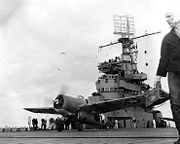
_off_new_york_city,_august_1942.jpg)
Radar
Radar is an object-detection system which uses radio waves to determine the range, altitude, direction, or speed of objects. It can be used to detect aircraft, ships, spacecraft, guided missiles, motor vehicles, weather formations, and terrain. The radar dish or antenna transmits pulses of radio...
system deployed on United States Navy
United States Navy
The United States Navy is the naval warfare service branch of the United States Armed Forces and one of the seven uniformed services of the United States. The U.S. Navy is the largest in the world; its battle fleet tonnage is greater than that of the next 13 largest navies combined. The U.S...
ships. It followed several earlier prototype systems, such as the NRL
United States Naval Research Laboratory
The United States Naval Research Laboratory is the corporate research laboratory for the United States Navy and the United States Marine Corps and conducts a program of scientific research and development. NRL opened in 1923 at the instigation of Thomas Edison...
radar installed in April 1937 on the destroyer ; its successor, the XAF
XAF RADAR
The XAF Radar was an experiment radar constructed in 1938, survived World War II as a historical artifact, and is now placed on exhibit at the Historical Electronics Museum, located in Linthicum, Maryland-Creation and development:...
, installed in December 1938 on the battleship ; and the first RCA
RCA
RCA Corporation, founded as the Radio Corporation of America, was an American electronics company in existence from 1919 to 1986. The RCA trademark is currently owned by the French conglomerate Technicolor SA through RCA Trademark Management S.A., a company owned by Technicolor...
-designed system, the CXZ, installed in December 1938 or January 1939 on the battleship . Based on testing in January 1939, where the XAF was more reliable, the US Navy ordered RCA to build six XAF-based units for deployment and then shortly thereafter ordered 14 more.
The first six units RCA produced (delivered in 1940) were denoted "CXAM" and were a fusion of XAF and CXZ technologies. These were installed on the battleship , the aircraft carrier (in September 1940), and the heavy cruisers , , , and . The next 14 units RCA produced (also delivered in 1940) were denoted "CXAM-1" and were slight improvements over the CXAM design. These were installed on the battleships Texas (in October 1941), , , , and ; on the aircraft carriers , , , , and ; on the heavy cruiser ; on two light cruisers; and on the seaplane tender .
Radar detection range of aircraft depends on altitude, size, and number of aircraft. Surface ships are more difficult to detect due to ground clutter, and require shorter ranges. The CXAM is listed (in U.S. Radar, Operational Characteristics of Radar Classified by Tactical Application) as being able to detect single aircraft at 50 miles and to detect large ships at 14 miles. Other sources list CXAM detection range on aircraft out to 100 miles. Lexington
Battle of the Coral Sea
The Battle of the Coral Sea, fought from 4–8 May 1942, was a major naval battle in the Pacific Theater of World War II between the Imperial Japanese Navy and Allied naval and air forces from the United States and Australia. The battle was the first fleet action in which aircraft carriers engaged...
.
The US Army's first non-prototype radar system, the SCR-270 radar
SCR-270 radar
The SCR-270 was one of the first operational early warning radars. It was the U.S. Army's primary long-distance radar throughout World War II and was deployed around the world...
, was developed in parallel with the CXAM.
The US Navy's use of radar was an important advantage in World War II
World War II
World War II, or the Second World War , was a global conflict lasting from 1939 to 1945, involving most of the world's nations—including all of the great powers—eventually forming two opposing military alliances: the Allies and the Axis...
compared to the Imperial Japanese Navy
Imperial Japanese Navy
The Imperial Japanese Navy was the navy of the Empire of Japan from 1869 until 1947, when it was dissolved following Japan's constitutional renunciation of the use of force as a means of settling international disputes...
's lack of widespread use of radar on its ships.