


CHARA array

Encyclopedia
Astronomical interferometer
An astronomical interferometer is an array of telescopes or mirror segments acting together to probe structures with higher resolution by means of interferometry....
operated by The Center for High Angular Resolution Astronomy (CHARA) of the Georgia State University
Georgia State University
Georgia State University is a research university in downtown Atlanta, Georgia, USA. Founded in 1913, it serves about 30,000 students and is one of the University System of Georgia's four research universities...
(GSU). CHARA is the World's highest angular resolution
Angular resolution
Angular resolution, or spatial resolution, describes the ability of any image-forming device such as an optical or radio telescope, a microscope, a camera, or an eye, to distinguish small details of an object...
telescope at near-infrared wavelengths. It is located at the Mount Wilson Observatory
Mount Wilson Observatory
The Mount Wilson Observatory is an astronomical observatory in Los Angeles County, California, United States. The MWO is located on Mount Wilson, a 5,715 foot peak in the San Gabriel Mountains near Pasadena, northeast of Los Angeles...
, near Los Angeles, California
Los Angeles, California
Los Angeles , with a population at the 2010 United States Census of 3,792,621, is the most populous city in California, USA and the second most populous in the United States, after New York City. It has an area of , and is located in Southern California...
.
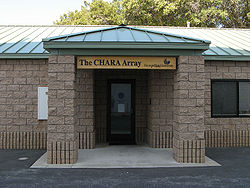
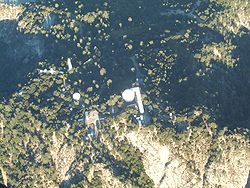
The CHARA Array is an interferometer formed from six 1 meter (40-inch) telescopes arranged along three axes with a maximum separation length of 330 m. The light beams travel through vacuum tubes and are combined optically, requiring a building 100 meters long with movable mirrors to keep the light in phase as the earth rotates. CHARA began scientific use in 2002 and began "routine operations" in early 2004. In the infrared, the array has an interferometric imaging resolution of 0.0005 arcseconds. All six telescopes are in regular use for scientific observations and as of late 2005 imaging results are routinely acquired. The array captured the first image of the surface of a main sequence star other than the sun published in early 2007.
See also
- Cambridge Optical Aperture Synthesis Telescope (COAST)
- Infrared Optical Telescope ArrayInfrared Optical Telescope ArrayThe Infrared Optical Telescope Array began with an agreement in 1988 among five Institutions, the Smithsonian Astrophysical Observatory, Harvard University, the University of Massachusetts, the University of Wyoming, and MIT/Lincoln Laboratory, to build a two-telescope stellar interferometer for...
- Magdalena Ridge Observatory Interferometer
- Palomar Testbed InterferometerPalomar Testbed InterferometerThe Palomar Testbed Interferometer was a near-IR, long-baseline stellar interferometer located at Palomar Observatory in north San Diego County. It was built by Caltech/JPL and was intended to serve as a testbed for developing interferometric techniques to be used at the Keck Interferometer...
- Navy Prototype Optical InterferometerNavy Prototype Optical InterferometerThe Navy Prototype Optical Interferometer , is an astronomical interferometer operated by the United States Naval Observatory Flagstaff Station, in collaboration with the Naval Research Laboratory and The Lowell Observatory...
- Very Large TelescopeVery Large TelescopeThe Very Large Telescope is a telescope operated by the European Southern Observatory on Cerro Paranal in the Atacama Desert of northern Chile. The VLT consists of four individual telescopes, each with a primary mirror 8.2m across, which are generally used separately but can be used together to...
Featured objects:
- Altair
- VegaVegaVega is the brightest star in the constellation Lyra, the fifth brightest star in the night sky and the second brightest star in the northern celestial hemisphere, after Arcturus...
External links
- CHARA Research, the home page of CHARA at Georgia State UniversityGeorgia State UniversityGeorgia State University is a research university in downtown Atlanta, Georgia, USA. Founded in 1913, it serves about 30,000 students and is one of the University System of Georgia's four research universities...
- First 4-Telescope Fringes at the CHARA Array
- Vega Mystery Solved; Red Dwarf Mystery Grows, Sky and Telescope article about CHARA.
- First Results from the CHARA Array. III. Oblateness, Rotational Velocity and Gravity Darkening of Alderamin archiv.org
- The Very Best Telescope, by William Speed Weed, Discover Magazine, October 2002. Included in The Best American Science and Nature WritingThe Best American Science and Nature WritingThe Best American Science and Nature Writing is a yearly anthology of popular science magazine articles published in the United States. It was started in 2000 and is part of The Best American Series published by Houghton Mifflin...
(2003).