

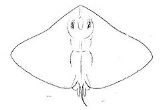
Butterfly ray

Encyclopedia
The butterfly rays are a group of rays
forming the genus Gymnura and the family Gymnuridae. They are found in warm oceans worldwide, and occasionally in estuaries
.
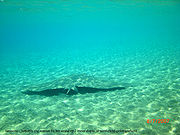
The body of butterfly rays is flattened and surrounded by an extremely broad disc formed by the pectoral fins, which merge in front of the head. They have a very short, thread-like, tail. They range from 31 centimetres (12.2 in) to 4 metres (13.1 ft) in body length.
McEachran et al. place the butterfly rays in the subfamily Gymnurinae of the family Dasyatidae, but this article follows FishBase
and ITIS
in treating them as a family.
Batoidea
Batoidea is a superorder of cartilaginous fish commonly known as rays and skates, containing more than 500 described species in thirteen families...
forming the genus Gymnura and the family Gymnuridae. They are found in warm oceans worldwide, and occasionally in estuaries
Estuary
An estuary is a partly enclosed coastal body of water with one or more rivers or streams flowing into it, and with a free connection to the open sea....
.
The body of butterfly rays is flattened and surrounded by an extremely broad disc formed by the pectoral fins, which merge in front of the head. They have a very short, thread-like, tail. They range from 31 centimetres (12.2 in) to 4 metres (13.1 ft) in body length.
McEachran et al. place the butterfly rays in the subfamily Gymnurinae of the family Dasyatidae, but this article follows FishBase
FishBase
FishBase is a comprehensive database of information about fish species . It is the largest and most extensively accessed online database on adult finfish on the web...
and ITIS
Itis
Itis may refer to* Integrated Taxonomic Information System, a partnership designed to provide consistent and reliable information on the taxonomy of biological species...
in treating them as a family.
Species
- Gymnura afuerae (Hildebrand, 1946)
- Gymnura altavela (LinnaeusCarolus LinnaeusCarl Linnaeus , also known after his ennoblement as , was a Swedish botanist, physician, and zoologist, who laid the foundations for the modern scheme of binomial nomenclature. He is known as the father of modern taxonomy, and is also considered one of the fathers of modern ecology...
, 1758) (Spiny butterfly ray) - Gymnura australis (E. P. RamsayEdward Pierson RamsayEdward Pierson Ramsay was an Australian zoologist who specialised in ornithology.-Early life:Pierson was born in Dobroyd Estate, Long Cove, Sydney and educated at St Mark's Collegiate School, The King's School, Parramatta...
& OgilbyJames Douglas OgilbyJames Douglas Ogilby was an Australian ichthyologist.Ogilby was born in Belfast, Ireland, and was the son of zoologist William Ogilby. He received his education at Winchester College, England, and Trinity College, Dublin.Ogilby worked for the British Museum before joining the Australian Museum in...
, 1886) (Australian butterfly ray) - Gymnura bimaculata (Norman, 1925) (Twin-spot butterfly ray)
- Gymnura crebripunctata (W. K. H. PetersWilhelm PetersWilhelm Karl Hartwich Peters was a German naturalist and explorer.He was assistant to Johannes Peter Müller and later curator of the Berlin Zoological Museum. In September 1842 he travelled to Mozambique via Angola. He returned to Berlin with an enormous collection of natural history specimens...
, 1869) (Longsnout butterfly ray) - Gymnura crooki FowlerHenry Weed FowlerHenry Weed Fowler was an American zoologist born in Holmesburg, Pennsylvania.He studied at Stanford University under David Starr Jordan...
, 1934 - Gymnura hirundo (R. T. LoweRichard Thomas LoweRichard Thomas Lowe was a British botanist, ichthyologist, malacologist, and clergyman. In 1825 he graduated from Christ's College, Cambridge and in the same year took holy orders. He became a clergyman in the Madeira Islands in 1832, where he was a part-time naturalist, extensively studying the...
, 1843) (Madeira butterfly ray) - Gymnura japonica (TemminckCoenraad Jacob TemminckCoenraad Jacob Temminck was a Dutch aristocrat and zoologist.Temminck was the first director of the National Natural History Museum at Leiden from 1820 until his death. His Manuel d'ornithologie, ou Tableau systematique des oiseaux qui se trouvent en Europe was the standard work on European birds...
& SchlegelHermann SchlegelHermann Schlegel was a German ornithologist and herpetologist.-Early life and education:Schlegel was born at Altenburg, the son of a brassfounder. His father collected butterflies, which stimulated Schlegel's interest in natural history...
, 1850) (Japanese butterfly ray) - Gymnura marmorata (J. G. CooperJames Graham CooperJames Graham Cooper was an American surgeon and naturalist.Cooper was born in New York. He worked for the California Geological Survey with Josiah Dwight Whitney, William Henry Brewer and Henry Nicholas Bolander...
, 1864) (California butterfly ray) - Gymnura micrura (BlochMarcus Elieser BlochMarcus Elieser Bloch was a German medical doctor and naturalist. He is generally considered one of the most important ichthyologists of the 18th century.- Life :...
& J. G. SchneiderJohann Gottlob SchneiderJohann Gottlob Theaenus Schneider was a German classicist and naturalist.-Biography:Schneider was born at Collm in Saxony...
, 1801) (Smooth butterfly ray) - Gymnura natalensis (Gilchrist & W. W. Thompson, 1911) (Backwater butterfly ray)
- Gymnura poecilura (G. ShawGeorge ShawGeorge Shaw was an English botanist and zoologist.Shaw was born at Bierton, Buckinghamshire and was educated at Magdalen Hall, Oxford, receiving his M.A. in 1772. He took up the profession of medical practitioner. In 1786 he became the assistant lecturer in botany at Oxford University...
, 1804) (Longtail butterfly ray) - Gymnura tentaculata J. P. MüllerJohannes Peter MüllerJohannes Peter Müller , was a German physiologist, comparative anatomist, and ichthyologist not only known for his discoveries but also for his ability to synthesize knowledge.-Early years and education:...
& HenleFriedrich Gustav Jakob HenleFriedrich Gustav Jakob Henle was a German physician, pathologist and anatomist. He is credited with the discovery of the loop of Henle in the kidney. His essay "On Miasma and Contagia" was an early argument for the germ theory of disease...
, 1841 (Tentacled butterfly ray) - Gymnura zonura BleekerPieter BleekerPieter Bleeker was a Dutch medical doctor and ichthyologist, famous for his work on the fishes of East Asia – Atlas Ichthyologique des Orientales Neerlandaises – which was published 1862–1877....
, 1852 (Zonetail butterfly ray)