


Butovskaya Light Metro Line

Encyclopedia
Butovskaya Line is a Light Metro line of the Moscow Metro
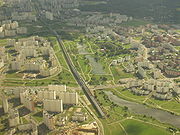
. The line symbolizes an experiment of building rapid-transit in areas where tunnel boring is considered expensive and impractical. In the past, attempts were made to build lines on ground level, however as the Filyovskaya Line
showed, harsh Russian winters and the occupation of the large amount of useful land, make such projects a failure. However, new districts on the very edge of the city, particularly those outside Moscow Automobile Ring Road (MKAD) required a rapid-transit connection. As the practicality of tunnel boring is unclear, the system was planned to be above ground since the late 1980s, when Moscow Metro
design bureau, Metrogiprotrans, developed a set of projects that would bring rapid-transit beyond MKAD, with the Yuzhnoye Butovo District being the first one.
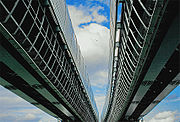
The term Light Metro was applied to these new projects, as it would feature an elevated track on a continuous flyover. Specific rolling stock had to be developed to serve the track, as it would have to be resistant to the open climate elements and sharper bends. For ease of operation, the Light Metro was integrated into the classical Metro service.
The Butovskaya Line essentially continues the Serpukhovsky radius of the Serpukhovsko-Timiryazevskaya Line
. For convenience, the first 1.8 kilometers were bored in a tunnel allowing for a convenient transfer with the terminus of the main line, Bulvar Dmitriya Donskogo
. For the rest of its length it follows a flyover, guarded by a sound barrier, with both single and dual tracks. Currently, four Light Metro stations, each of identical design, are in operation. The system was opened in December 2003.
trains serve this line. These are adapted to surface climate and to more rigorous bends and folds in the track. A total of 12 three-carriage trains are currently assigned.
 Although the Light Metro was indeed innovative, it also received its share of criticism from different social groups and the media, which could well affect its future.
The main problems arose from finances, as the design was originally planned to be cost-saving; however, the BLLM turned out to be more expensive than conventional Metro lines. Passenger discomfort arose from shorter trains and larger intervals, but in particular from the transfer at Ulitsa Starokachalovskaya
/Bulvar Dmitriya Donskogo
, where the Light Metro station consists of two separated platforms on either side of the main line with no reversal sidings behind it. As a result passengers must queue for lengthier times at a platform and also deal with exiting traffic before boarding their train. Additional problems arose from the landscape damage done by the flyover bridge.
Furthermore, costly and embarrassing improvements had to be made just a few months after opening. First, improvements had to be made to the faulty new trains, as they required immediate and unforeseen refits; in addition, despite the sound barriers, further noise reduction works had to be carried out on the tracks themselves by repairing their joints.
Despite the criticism, the Moscow Metro continues to put forward several expansion programs for the BLLM, the first one of which is to place proper reversal sidings north of the station thus separating the terminus platforms into northbound and southbound roles; at present this is announced for 2010. After the completion of that there was initially a planned northwestwards underground extension towards the terminus of the Kaluzhsko-Rizhskaya Line
, Novoyasenevskaya scheduled for 2013. Since then Moscow Metro has postponed the project and even taken it off its list of primarily projects to be completed by 2015.
A further three-station expansion to the southeast, as Butovo continues to grow, is proposed: Ulitsa Staropotapovskaya, Ulitsa Ostafyevskaya and Novokuryanovo, along with a new depot. The latter's construction might prove pivotal as it would allow for the line to become more independent in operation. On the map of new plans, the extension to Milizeysky poselok (or East Sherbinka) is planned with at least two stations.
The problems with the Butovo Line have also affected the prospect of other Light Metro lines in general as the second planned line, the Solntsevskaya Light Metro Line, has now been canceled. Its construction was planned to begin in 2004, with the line expected to open in 2006, but after repeated postponements, Moscow Metro decided that it would be more practical to revert to an older project — a conventional, Solntsevskaya Line
. After the SL's cancellation, there have been concerns that BL's fate could be much worse, as there are arguments that it would be more practical to disassemble the line and replace it with two-three station extension of the STL.
Despite the shortcomings, one positive aspect of the BL is that the 81-740/741 trains, serial production of the rolling stock, have gained wider usage and are now dominant on the Filyovskaya Line
, having replaced all of the older trains and is now growing its share of the Arbatsko-Pokrovskaya Line
.
Moscow Metro
The Moscow Metro is a rapid transit system serving Moscow and the neighbouring town of Krasnogorsk. Opened in 1935 with one line and 13 stations, it was the first underground railway system in the Soviet Union. As of 2011, the Moscow Metro has 182 stations and its route length is . The system is...
. The line symbolizes an experiment of building rapid-transit in areas where tunnel boring is considered expensive and impractical. In the past, attempts were made to build lines on ground level, however as the Filyovskaya Line
Filyovskaya Line
Filyovskaya Line , or Line 4, is a line of the Moscow Metro. Chronologically the sixth to open, it connects the major eastern districts of Dorogomilovo and Fili along with the Moscow City with the city centre...
showed, harsh Russian winters and the occupation of the large amount of useful land, make such projects a failure. However, new districts on the very edge of the city, particularly those outside Moscow Automobile Ring Road (MKAD) required a rapid-transit connection. As the practicality of tunnel boring is unclear, the system was planned to be above ground since the late 1980s, when Moscow Metro
Moscow Metro
The Moscow Metro is a rapid transit system serving Moscow and the neighbouring town of Krasnogorsk. Opened in 1935 with one line and 13 stations, it was the first underground railway system in the Soviet Union. As of 2011, the Moscow Metro has 182 stations and its route length is . The system is...
design bureau, Metrogiprotrans, developed a set of projects that would bring rapid-transit beyond MKAD, with the Yuzhnoye Butovo District being the first one.
The term Light Metro was applied to these new projects, as it would feature an elevated track on a continuous flyover. Specific rolling stock had to be developed to serve the track, as it would have to be resistant to the open climate elements and sharper bends. For ease of operation, the Light Metro was integrated into the classical Metro service.
The Butovskaya Line essentially continues the Serpukhovsky radius of the Serpukhovsko-Timiryazevskaya Line
Serpukhovsko-Timiryazevskaya Line
Serpukhovsko–Timiryazevskaya Line , sometimes colloquially referred to as Grey Line , is a line of the Moscow Metro. Originally opened in 1983, it was extended throughout the 1980s and early 90s and again in the early 2000s...
. For convenience, the first 1.8 kilometers were bored in a tunnel allowing for a convenient transfer with the terminus of the main line, Bulvar Dmitriya Donskogo
Bulvar Dmitriya Donskogo
Bulvar Dmitriya Donskogo is the southern terminus and the newest station of the Serpukhovsko-Timiryazevskaya Line of the Moscow Metro. It is the first station of the system built outside of the MKAD beltway encircling most of the city. The station opened on 26 December 2002...
. For the rest of its length it follows a flyover, guarded by a sound barrier, with both single and dual tracks. Currently, four Light Metro stations, each of identical design, are in operation. The system was opened in December 2003.
Timeline
| Segment | Date opened | Length |
|---|---|---|
| Ulitsa Strarokachalovskaya-Buninskaya Alleya | December 27, 2003 | 5.5 km |
| Total: | 5 Stations | 5.5 km |
Transfers
| # | Transfer to | At |
|---|---|---|
| 9 | Serpukhovsko-Timiryazevskaya Line Serpukhovsko-Timiryazevskaya Line Serpukhovsko–Timiryazevskaya Line , sometimes colloquially referred to as Grey Line , is a line of the Moscow Metro. Originally opened in 1983, it was extended throughout the 1980s and early 90s and again in the early 2000s... |
Ulitsa Starokachalovskaya Ulitsa Starokachalovskaya Ulitsa Starokachalovskaya is a station on the Butovskaya Light Metro Line of the Moscow Metro subway system in Moscow, Russia. The station, opened with four other light metro stations on 27 December 2003, is named for the street under which the station lies... |
Rolling stock
The line shares the Varshavskoe depot (№ 8) with the Serpukhovsko-Timiryazevskaya Line. Specially built 81-740/741 RusichMetro wagon 81-740/741 Rusich
81-740/741 , is a type of rolling stock specially designed for running under the harsh winter climate of outdoor Moscow. Rusich also features a corridor connection, allowing passenger access between two contigiuous cars...
trains serve this line. These are adapted to surface climate and to more rigorous bends and folds in the track. A total of 12 three-carriage trains are currently assigned.
Recent developments and future plans
The main problems arose from finances, as the design was originally planned to be cost-saving; however, the BLLM turned out to be more expensive than conventional Metro lines. Passenger discomfort arose from shorter trains and larger intervals, but in particular from the transfer at Ulitsa Starokachalovskaya
Ulitsa Starokachalovskaya
Ulitsa Starokachalovskaya is a station on the Butovskaya Light Metro Line of the Moscow Metro subway system in Moscow, Russia. The station, opened with four other light metro stations on 27 December 2003, is named for the street under which the station lies...
/Bulvar Dmitriya Donskogo
Bulvar Dmitriya Donskogo
Bulvar Dmitriya Donskogo is the southern terminus and the newest station of the Serpukhovsko-Timiryazevskaya Line of the Moscow Metro. It is the first station of the system built outside of the MKAD beltway encircling most of the city. The station opened on 26 December 2002...
, where the Light Metro station consists of two separated platforms on either side of the main line with no reversal sidings behind it. As a result passengers must queue for lengthier times at a platform and also deal with exiting traffic before boarding their train. Additional problems arose from the landscape damage done by the flyover bridge.
Furthermore, costly and embarrassing improvements had to be made just a few months after opening. First, improvements had to be made to the faulty new trains, as they required immediate and unforeseen refits; in addition, despite the sound barriers, further noise reduction works had to be carried out on the tracks themselves by repairing their joints.
Despite the criticism, the Moscow Metro continues to put forward several expansion programs for the BLLM, the first one of which is to place proper reversal sidings north of the station thus separating the terminus platforms into northbound and southbound roles; at present this is announced for 2010. After the completion of that there was initially a planned northwestwards underground extension towards the terminus of the Kaluzhsko-Rizhskaya Line
Kaluzhsko-Rizhskaya Line
The Kaluzhsko–Rizhskaya Line is a line of the Moscow Metro, that originally existed as two separate radial lines, Rizhskaya and Kaluzhskaya opened in 1958 and 1962, respectively. Only in 1971 were they united into a single line as the central section connecting the stations Oktyabrskaya to Prospekt...
, Novoyasenevskaya scheduled for 2013. Since then Moscow Metro has postponed the project and even taken it off its list of primarily projects to be completed by 2015.
A further three-station expansion to the southeast, as Butovo continues to grow, is proposed: Ulitsa Staropotapovskaya, Ulitsa Ostafyevskaya and Novokuryanovo, along with a new depot. The latter's construction might prove pivotal as it would allow for the line to become more independent in operation. On the map of new plans, the extension to Milizeysky poselok (or East Sherbinka) is planned with at least two stations.
The problems with the Butovo Line have also affected the prospect of other Light Metro lines in general as the second planned line, the Solntsevskaya Light Metro Line, has now been canceled. Its construction was planned to begin in 2004, with the line expected to open in 2006, but after repeated postponements, Moscow Metro decided that it would be more practical to revert to an older project — a conventional, Solntsevskaya Line
Solntsevskaya Line
Kalininsko-Solntsevskaya Line is a future Moscow Metro line that will see the expansion of the metro to the Solntsevo District in Moscow.-First project - radius:...
. After the SL's cancellation, there have been concerns that BL's fate could be much worse, as there are arguments that it would be more practical to disassemble the line and replace it with two-three station extension of the STL.
Despite the shortcomings, one positive aspect of the BL is that the 81-740/741 trains, serial production of the rolling stock, have gained wider usage and are now dominant on the Filyovskaya Line
Filyovskaya Line
Filyovskaya Line , or Line 4, is a line of the Moscow Metro. Chronologically the sixth to open, it connects the major eastern districts of Dorogomilovo and Fili along with the Moscow City with the city centre...
, having replaced all of the older trains and is now growing its share of the Arbatsko-Pokrovskaya Line
Arbatsko-Pokrovskaya Line
The Arbatsko–Pokrovskaya Line is a line of the Moscow Metro. Chronologically the second to open, now it connects with the district of Mitino and town of Krasnogorsk to the northwest of Moscow with the east of the Russian capital passing through the city centre...
.
External links
- Butovskaya Line, Moscow Metro official site