


Burying beetle

Encyclopedia
Burying beetles or sexton beetles (genus
Nicrophorus) are the best-known members of the family Silphidae (carrion beetle
s). Burying beetles are true to their name. Most of these beetle
s are black with red markings on the elytra
(forewings). They bury the carcasses of small vertebrates such as bird
s and rodent
s as a food source for their larvae. They are unusual among insects in that both the male and female parents take care of the brood.
The genus name is sometimes spelt Necrophorus in older texts. This is an emendation
by Carl Peter Thunberg
(1789) of Fabricius's original name, and is not valid.
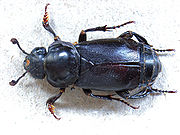 Burying beetles have large club-like antennae
equipped with chemoreceptors capable of detecting a dead animal from a long distance. After finding a carcass (most usually that of a small bird
or a mouse
), beetles fight amongst themselves (males fighting males, females fighting females) until the winning pair (usually the largest) remains. If a lone beetle finds a carcass, it can continue alone and await a partner. Single males attract mates by releasing a pheromone
from the tip of their abdomens. Females can raise a brood alone, fertilizing her eggs using sperm stored from previous copulations.
The carcass must be buried by the beetle(s) to get it out of the way of potential competitors, which are numerous.
The prospective parents begin to dig a hole below the carcass. While doing so, the beetles cover the animal with antibacterial and antifungal oral and anal secretions, slowing the decay of the carcass and preventing the smell of rotting flesh from attracting competition. The carcass is formed into a ball and the fur or feathers stripped away and used to line and reinforce the crypt, where the carcass will remain until the flesh has been completely consumed. The burial process can take around 8 hours. Several pairs of beetles may cooperate to bury large carcasses and then raise their broods communally.
The female burying beetle lays eggs in the soil around the crypt. The larvae hatch after a few days and move into a pit in the carcass which the parents have created. Although the larvae are able to feed themselves, both parents also feed the larvae: they digest the flesh and regurgitate
liquid food for the larvae to feed on, a form of progressive provisioning
. This probably speeds up larval development. It is also thought the parent beetles can produce secretions from head glands that have anti-microbial activity, inhibiting the growth of bacteria and fungi on the vertebrate corpse.
At an early stage, the parents may cull their young. This infanticide
functions to match the number of larvae to the size of the carcass so that there is enough food to go around. If there are too many young, they will all be underfed and will develop less quickly, reducing their chances of surviving to adulthood. If there are too few young, the resulting adult beetles will be large but the parents could have produced more of them. The most successful beetle parents will achieve a good balance between the size of offspring and the number produced. This unusual method of brood size regulation might be the result of the eggs being laid before the female has been able to gauge the size of the carcass and hence how many larvae it can provision.
The adult beetles continue to protect the larvae, which take several days to mature. Many competitors make this task difficult, e.g. bluebottles and ant
s or burying beetles of either another or the same species. The final-stage larvae migrate into the soil and pupate, transforming from small white larvae to fully formed adult beetles.
Aside from eusocial species such as ant
s and honey bee
s, parental care is quite rare among insect
s, and burying beetles are remarkable exceptions.
COMMUNAL BREEDING
N. tomentosus : 1-6 males, 1-7 females.It shows social behaviour and main characteristics are
Cooperative brood care
Overlapping generations
Frequency of communal breeding
Varies with species Ex : N. obicollis most of the times breed communally Varies with the carcass size. Females can enter into communal breeding more readily than males.
Carcass size for communal breeding
Affects the frequency of communal breeding, Multiple males and/or females of N.orbicollis found on 50-90 g carcass.Larger carcass - better the communal breeding.
Reasons for communal breeding on large carcass
Smaller carcass – can fully utilized by single female, larger one cannot
Two females – can rear more larvae than one
Larger carcass – difficult to exploit
It takes longer time – to fully conceal and prepare the carcass for single pair
To avoid competitors
Communal breeding results in
Bigger female – Provide longest care
Relative duration of care – Positively correlated with success within the association
Large carcass – Reproduction is divided between 2 females equally or at least randomly
Small carcass – Reproduction usually skewed in favor of bigger females
Bigger females of species that breed communally – Dominant and more Fecund
Females increase the proportion of their young in brood through differential destruction of their competitors eggs
On counter part the females of species that readily breed communally lay eggs randomly in the soil which make difficult to locate and destroy
Advantages of communal breeding
Minimizes the flies attack,
Reduces the nesting failure by the competitors,
“High probability of nesting failure promotes communal breeding even in the absence of immediate reproductive gains” – Trumbo and Wilson (1993)
Population density, body size and phenotypic plasticity of brood size in a Burying beetle
A positive correlation between brood size and carcass size. Beetles adjust brood size in response to population density. Females respond to change in population density. Average adult body size should vary positively with population density.
POPULATION DENSITY
Pairs of burying beetles were placed in soil filled glass jars with a 20 g carcass. Young's obtained from this pairs were used for experiment
2 treatments
T1 : low density population (single pair in a glass jar)
T2 : high density population (groups of 5 pairs placed in a glass jar
All jars were supplied with piece of 20 g chicken
After 2 days males were removed from jars
After 10 days checked each carcass and counted the number of larvae present
How limited are reproductive opportunities ?
The research are not at the point where they can identify with confidence the ecological factors that are important in the evolution of communal breeding
Also physiological cost of parent was very less. Even though parents take care of young ones is yet to be known
Benefit of parental care later than 1 days after hatching also unclear.
dating around 10,500 years was described in 1962 by Pearson.
Genus
In biology, a genus is a low-level taxonomic rank used in the biological classification of living and fossil organisms, which is an example of definition by genus and differentia...
Nicrophorus) are the best-known members of the family Silphidae (carrion beetle
Carrion beetle
Silphidae is a family of beetles that are known commonly as carrion or burying beetles. There are two subfamilies: Silphinae and Nicrophorinae. Both families feed on decaying organic matter such as dead animals. The families differ in which uses parental care and which types of carcasses they prefer...
s). Burying beetles are true to their name. Most of these beetle
Beetle
Coleoptera is an order of insects commonly called beetles. The word "coleoptera" is from the Greek , koleos, "sheath"; and , pteron, "wing", thus "sheathed wing". Coleoptera contains more species than any other order, constituting almost 25% of all known life-forms...
s are black with red markings on the elytra
Elytron
An elytron is a modified, hardened forewing of certain insect orders, notably beetles and a few of the true bugs ; in most true bugs, the forewings are instead called hemelytra, as only the basal half is thickened while the apex is membranous...
(forewings). They bury the carcasses of small vertebrates such as bird
Bird
Birds are feathered, winged, bipedal, endothermic , egg-laying, vertebrate animals. Around 10,000 living species and 188 families makes them the most speciose class of tetrapod vertebrates. They inhabit ecosystems across the globe, from the Arctic to the Antarctic. Extant birds range in size from...
s and rodent
Rodent
Rodentia is an order of mammals also known as rodents, characterised by two continuously growing incisors in the upper and lower jaws which must be kept short by gnawing....
s as a food source for their larvae. They are unusual among insects in that both the male and female parents take care of the brood.
The genus name is sometimes spelt Necrophorus in older texts. This is an emendation
Emendation (taxonomy)
In biological classification, emendation is a scientific change to the name of a living organism, intended to improve its classification....
by Carl Peter Thunberg
Carl Peter Thunberg
Carl Peter Thunberg aka Carl Pehr Thunberg aka Carl Per Thunberg was a Swedish naturalist and an apostle of Carl Linnaeus. He has been called "the father of South African botany" and the "Japanese Linnaeus"....
(1789) of Fabricius's original name, and is not valid.
Reproduction
Antenna (biology)
Antennae in biology have historically been paired appendages used for sensing in arthropods. More recently, the term has also been applied to cilium structures present in most cell types of eukaryotes....
equipped with chemoreceptors capable of detecting a dead animal from a long distance. After finding a carcass (most usually that of a small bird
Bird
Birds are feathered, winged, bipedal, endothermic , egg-laying, vertebrate animals. Around 10,000 living species and 188 families makes them the most speciose class of tetrapod vertebrates. They inhabit ecosystems across the globe, from the Arctic to the Antarctic. Extant birds range in size from...
or a mouse
Mouse
A mouse is a small mammal belonging to the order of rodents. The best known mouse species is the common house mouse . It is also a popular pet. In some places, certain kinds of field mice are also common. This rodent is eaten by large birds such as hawks and eagles...
), beetles fight amongst themselves (males fighting males, females fighting females) until the winning pair (usually the largest) remains. If a lone beetle finds a carcass, it can continue alone and await a partner. Single males attract mates by releasing a pheromone
Pheromone
A pheromone is a secreted or excreted chemical factor that triggers a social response in members of the same species. Pheromones are chemicals capable of acting outside the body of the secreting individual to impact the behavior of the receiving individual...
from the tip of their abdomens. Females can raise a brood alone, fertilizing her eggs using sperm stored from previous copulations.
The carcass must be buried by the beetle(s) to get it out of the way of potential competitors, which are numerous.
The prospective parents begin to dig a hole below the carcass. While doing so, the beetles cover the animal with antibacterial and antifungal oral and anal secretions, slowing the decay of the carcass and preventing the smell of rotting flesh from attracting competition. The carcass is formed into a ball and the fur or feathers stripped away and used to line and reinforce the crypt, where the carcass will remain until the flesh has been completely consumed. The burial process can take around 8 hours. Several pairs of beetles may cooperate to bury large carcasses and then raise their broods communally.
The female burying beetle lays eggs in the soil around the crypt. The larvae hatch after a few days and move into a pit in the carcass which the parents have created. Although the larvae are able to feed themselves, both parents also feed the larvae: they digest the flesh and regurgitate
Regurgitation (digestion)
Regurgitation is the expulsion of material from the mouth, pharynx, or esophagus, usually characterized by the presence of undigested food or blood.Regurgitation is used by a number of species to feed their young...
liquid food for the larvae to feed on, a form of progressive provisioning
Progressive provisioning
Progressive provisioning is a term used in entomology to refer to a form of parental behavior in which an adult feeds its larvae directly after they have hatched, feeding each larva repeatedly until it has completed development...
. This probably speeds up larval development. It is also thought the parent beetles can produce secretions from head glands that have anti-microbial activity, inhibiting the growth of bacteria and fungi on the vertebrate corpse.
At an early stage, the parents may cull their young. This infanticide
Infanticide (zoology)
In animals, infanticide involves the killing of young offspring by a mature animal of its own species, and is studied in zoology, specifically in the field of ethology. Ovicide is the analogous destruction of eggs. Although human infanticide has been widely studied, the practice has been observed...
functions to match the number of larvae to the size of the carcass so that there is enough food to go around. If there are too many young, they will all be underfed and will develop less quickly, reducing their chances of surviving to adulthood. If there are too few young, the resulting adult beetles will be large but the parents could have produced more of them. The most successful beetle parents will achieve a good balance between the size of offspring and the number produced. This unusual method of brood size regulation might be the result of the eggs being laid before the female has been able to gauge the size of the carcass and hence how many larvae it can provision.
The adult beetles continue to protect the larvae, which take several days to mature. Many competitors make this task difficult, e.g. bluebottles and ant
Ant
Ants are social insects of the family Formicidae and, along with the related wasps and bees, belong to the order Hymenoptera. Ants evolved from wasp-like ancestors in the mid-Cretaceous period between 110 and 130 million years ago and diversified after the rise of flowering plants. More than...
s or burying beetles of either another or the same species. The final-stage larvae migrate into the soil and pupate, transforming from small white larvae to fully formed adult beetles.
Aside from eusocial species such as ant
Ant
Ants are social insects of the family Formicidae and, along with the related wasps and bees, belong to the order Hymenoptera. Ants evolved from wasp-like ancestors in the mid-Cretaceous period between 110 and 130 million years ago and diversified after the rise of flowering plants. More than...
s and honey bee
Honey bee
Honey bees are a subset of bees in the genus Apis, primarily distinguished by the production and storage of honey and the construction of perennial, colonial nests out of wax. Honey bees are the only extant members of the tribe Apini, all in the genus Apis...
s, parental care is quite rare among insect
Insect
Insects are a class of living creatures within the arthropods that have a chitinous exoskeleton, a three-part body , three pairs of jointed legs, compound eyes, and two antennae...
s, and burying beetles are remarkable exceptions.
COMMUNAL BREEDING
N. tomentosus : 1-6 males, 1-7 females.It shows social behaviour and main characteristics are
Cooperative brood care
Overlapping generations
Frequency of communal breeding
Varies with species Ex : N. obicollis most of the times breed communally Varies with the carcass size. Females can enter into communal breeding more readily than males.
Carcass size for communal breeding
Affects the frequency of communal breeding, Multiple males and/or females of N.orbicollis found on 50-90 g carcass.Larger carcass - better the communal breeding.
Reasons for communal breeding on large carcass
Smaller carcass – can fully utilized by single female, larger one cannot
Two females – can rear more larvae than one
Larger carcass – difficult to exploit
It takes longer time – to fully conceal and prepare the carcass for single pair
To avoid competitors
Communal breeding results in
Bigger female – Provide longest care
Relative duration of care – Positively correlated with success within the association
Large carcass – Reproduction is divided between 2 females equally or at least randomly
Small carcass – Reproduction usually skewed in favor of bigger females
Bigger females of species that breed communally – Dominant and more Fecund
Females increase the proportion of their young in brood through differential destruction of their competitors eggs
On counter part the females of species that readily breed communally lay eggs randomly in the soil which make difficult to locate and destroy
Advantages of communal breeding
Minimizes the flies attack,
Reduces the nesting failure by the competitors,
“High probability of nesting failure promotes communal breeding even in the absence of immediate reproductive gains” – Trumbo and Wilson (1993)
Population density, body size and phenotypic plasticity of brood size in a Burying beetle
A positive correlation between brood size and carcass size. Beetles adjust brood size in response to population density. Females respond to change in population density. Average adult body size should vary positively with population density.
POPULATION DENSITY
Pairs of burying beetles were placed in soil filled glass jars with a 20 g carcass. Young's obtained from this pairs were used for experiment
2 treatments
T1 : low density population (single pair in a glass jar)
T2 : high density population (groups of 5 pairs placed in a glass jar
All jars were supplied with piece of 20 g chicken
After 2 days males were removed from jars
After 10 days checked each carcass and counted the number of larvae present
How limited are reproductive opportunities ?
The research are not at the point where they can identify with confidence the ecological factors that are important in the evolution of communal breeding
Also physiological cost of parent was very less. Even though parents take care of young ones is yet to be known
Benefit of parental care later than 1 days after hatching also unclear.
Species
there are 68 valid, extant species in the genus Nicrophorus although a few undescribed species and synonyms remain to be worked up.- Nicrophorus americanusNicrophorus americanusNicrophorus americanus, also known as the American burying beetle or giant carrion beetle, is a critically endangered species of beetle endemic to North America. It belongs to the order Coleoptera and the family Silphidae. The carrion beetle in North America is carnivorous, feeds on carrion and...
– (American burying beetle) - Nicrophorus antennatusNicrophorus antennatusNicrophorus antennatus is a species of burying beetle, first described scientifically by Edmund Reitter in 1884.-References:http://collections2.eeb.uconn.edu/nicroweb/PDFs/Sikes_et_al_2002.pdf...
- Nicrophorus apoNicrophorus apoNicrophorus apo is a species of burying beetle found in Mindanao in the Philippines. The species was first described scientifically by Ross H. Arnett, Jr. in 1950, and is named after Mount Apo.-References:...
- Nicrophorus argutorNicrophorus argutorNicrophorus argutor is a species of burying beetle found in Russia, Mongolia, China and Kazakhstan.-References:http://collections2.eeb.uconn.edu/nicroweb/PDFs/Sikes_et_al_2002.pdf...
- Nicrophorus basalisNicrophorus basalisFor the original beetle named Nicrophorus basalis by Gistel in 1848 but realized to have already been catalogued under a different name, see Nicrophorus interruptusNicrophorus basalis is a burying beetle described by Faldermann in 1835....
- Nicrophorus carolinusNicrophorus carolinusNicrophorus carolinus is a burying beetle described by Linnaeus in 1771.-References:http://collections2.eeb.uconn.edu/nicroweb/PDFs/Sikes_et_al_2002.pdf...
- Nicrophorus chilensisNicrophorus chilensisNicrophorus chilensis is a burying beetle described by Philippi in 1871.-References:http://collections2.eeb.uconn.edu/nicroweb/PDFs/Sikes_et_al_2002.pdf...
- Nicrophorus concolorNicrophorus concolorNicrophorus concolor is a burying beetle described by Kraatz in 1877.-References:http://collections2.eeb.uconn.edu/nicroweb/PDFs/Sikes_et_al_2002.pdf...
- Nicrophorus confususNicrophorus confususNicrophorus confusus is a burying beetle described by Portevin in 1924.-References:http://collections2.eeb.uconn.edu/nicroweb/PDFs/Sikes_et_al_2002.pdf...
- Nicrophorus dauricusNicrophorus dauricusNicrophorus dauricus is a burying beetle described by Motschulsky in 1860.-References:http://collections2.eeb.uconn.edu/nicroweb/PDFs/Sikes_et_al_2002.pdf...
- Nicrophorus defodiensNicrophorus defodiensNicrophorus defodiens is a burying beetle described by Mannerheim in 1846.-References:http://collections2.eeb.uconn.edu/nicroweb/PDFs/Sikes_et_al_2002.pdf...
- Nicrophorus didymusNicrophorus didymusNicrophorus didymus is a burying beetle described by Gaspard Auguste Brullé in 1836.-References:http://collections2.eeb.uconn.edu/nicroweb/PDFs/Sikes_et_al_2002.pdf...
- Nicrophorus distinctusNicrophorus distinctusNicrophorus distinctus is a burying beetle described by A.H. Grouvelle in 1885.-References:*...
- Nicrophorus encaustusNicrophorus encaustusNicrophorus encautus is a burying beetle described by Les Hydrethus Fairmaire in 1896.-References:http://collections2.eeb.uconn.edu/nicroweb/PDFs/Sikes_et_al_2002.pdf...
- Nicrophorus germanicusNicrophorus germanicusNicrophorus germanicus is a burying beetle described by Linnaeus in 1758.-References:http://collections2.eeb.uconn.edu/nicroweb/PDFs/Sikes_et_al_2002.pdf...
- Nicrophorus guttulaNicrophorus guttulaNicrophorus guttula is a burying beetle described by Motschulsky in 1845.-References:http://collections2.eeb.uconn.edu/nicroweb/PDFs/Sikes_et_al_2002.pdf...
- Nicrophorus heurniNicrophorus heurniNicrophorus heurni is a burying beetle that lives in Australia and New Guinea....
- Nicrophorus hispaniolaNicrophorus hispaniolaNicrophorus hispaniola is a burying beetle described by Sikes and Peck in 2000.-References:http://collections2.eeb.uconn.edu/nicroweb/PDFs/Sikes_et_al_2002.pdf...
- Nicrophorus humatorNicrophorus humatorNicrophorus humator is a burying beetle described by Gleditsch in 1767. A fossil dating around 10,500 years was described in 1962 by Pearson....
- Nicrophorus hybridusNicrophorus hybridusNicrophorus hybridus is a burying beetle described by Melville Harrison Hatch and John W. Angell in 1925.-References:http://collections2.eeb.uconn.edu/nicroweb/PDFs/Sikes_et_al_2002.pdf...
- Nicrophorus insularisNicrophorus insularisFor the species misidentified by Lafer in 1989 and declared a new species under the name Nicrophorus insularis, but later corrected, see Nicrophorus investigatorNicrophorus insularis is a burying beetle described by A.H. Grouvelle in 1893....
- Nicrophorus interruptusNicrophorus interruptusFor the species misidentified by Gaspard Auguste Brullé in 1832 and again by Gistel in 1857, declared a new species under the name Nicrophorus basalis, but later corrected, see Nicrophorus vestigator...
- Nicrophorus investigatorNicrophorus investigatorNicrophorus is a burying beetle described by Zetterstedt in 1824.-References:http://collections2.eeb.uconn.edu/nicroweb/PDFs/Sikes_et_al_2002.pdf...
- Nicrophorus japonicusNicrophorus japonicusNicrophorus japonicus is a burying beetle described by Harold in 1877.-References:http://collections2.eeb.uconn.edu/nicroweb/PDFs/Sikes_et_al_2002.pdf...
- Nicrophorus kieticusNicrophorus kieticusNicrophorus kieticus is a burying beetle described by Mroczkowski in 1959.-References:http://collections2.eeb.uconn.edu/nicroweb/PDFs/Sikes_et_al_2002.pdf...
- Nicrophorus lunatusNicrophorus lunatusFor the species misidentified by LeConte in 1853 and declared a new species under the name Nicrophorus lunatus, but later corrected, see Nicrophorus sayi...
- Nicrophorus maculifronsNicrophorus maculifronsNicrophorus maculifrons is a burying beetle described by Kraatz in 1877.-References:http://collections2.eeb.uconn.edu/nicroweb/PDFs/Sikes_et_al_2002.pdf...
- Nicrophorus marginatusNicrophorus marginatusFor the species misidentified by Gistel in 1857 and declared a new species under the name Nicrophorus marginatus, but later corrected, see Nicrophorus tomentosusNicrophorus marginatus is a burying beetle described by Fabricius in 1801....
- Nicrophorus mexicanusNicrophorus mexicanusNicrophorus mexicanus is a burying beetle described by Matthews in 1888.-References:http://collections2.eeb.uconn.edu/nicroweb/PDFs/Sikes_et_al_2002.pdf...
- Nicrophorus mongolicusNicrophorus mongolicusNicrophorus mongolicus is a burying beetle described by Shchegoleva-Barovskaya in 1933.-References:http://collections2.eeb.uconn.edu/nicroweb/PDFs/Sikes_et_al_2002.pdf...
- Nicrophorus montivagusNicrophorus montivagusNicrophorus montivagus is a burying beetle described by Lewis in 1887.-References:http://collections2.eeb.uconn.edu/nicroweb/PDFs/Sikes_et_al_2002.pdf...
- Nicrophorus morioNicrophorus morioNicrophorus morio is a burying beetle described by F.A. Gebler in 1817.-References:http://collections2.eeb.uconn.edu/nicroweb/PDFs/Sikes_et_al_2002.pdf...
- Nicrophorus nepalensisNicrophorus nepalensisNicrophorus nepalensis is a burying beetle described by Reverend Frederick William Hope in 1831.-References:http://collections2.eeb.uconn.edu/nicroweb/PDFs/Sikes_et_al_2002.pdf...
- Nicrophorus nigricornis
- Nicrophorus nigritaNicrophorus nigritaNicrophorus nigrita is a burying beetle described by Mannerheim in 1843.-References:http://collections2.eeb.uconn.edu/nicroweb/PDFs/Sikes_et_al_2002.pdf...
- Nicrophorus oberthuriNicrophorus oberthuriNicrophorus oberthuri is a burying beetle described by Portevin in 1924.-References:http://collections2.eeb.uconn.edu/nicroweb/PDFs/Sikes_et_al_2002.pdf...
- Nicrophorus obscurusNicrophorus obscurusNicrophorus obscurus is a burying beetle described by William Kirby in 1837.-References:http://collections2.eeb.uconn.edu/nicroweb/PDFs/Sikes_et_al_2002.pdf...
- Nicrophorus olidusNicrophorus olidusNicrophorus olidus is a burying beetle described by Matthews in 1888.-References:http://collections2.eeb.uconn.edu/nicroweb/PDFs/Sikes_et_al_2002.pdf...
- Nicrophorus orbicollisNicrophorus orbicollisNicrophorus orbicollis is a nearctic burying beetle first described by Thomas Say in 1825. It is a member of the genus Nicrophorus or sexton beetles, comprising the most common beetles in the family Silphidae. This species is a decomposer feeding on carcasses of small dead animals. N...
- Nicrophorus pliozaenicusNicrophorus pliozaenicusNicrophorus pliozaenicus is an extinct burying beetle described by Erasmus Gersdorf in 1969.-References:http://collections2.eeb.uconn.edu/nicroweb/PDFs/Sikes_et_al_2002.pdf...
† - Nicrophorus podagricusNicrophorus podagricusNicrophorus podagricus is a burying beetle described by Portevin in 1920.-External links:*...
- Nicrophorus przewalskiiNicrophorus przewalskiiNicrophorus przewalskii is a burying beetle described by Semenov-Tian-Shanskij in 1894.-References:http://collections2.eeb.uconn.edu/nicroweb/PDFs/Sikes_et_al_2002.pdf...
- Nicrophorus pustulatusNicrophorus pustulatusNicrophorus pustulatus is a burying beetle described by John Friedrich Wilhelm Herschel in 1807.-References:http://collections2.eeb.uconn.edu/nicroweb/PDFs/Sikes_et_al_2002.pdf...
- Nicrophorus quadraticollisNicrophorus quadraticollisNicrophorus quadraticollis is a burying beetle described by Portevin in 1903.-References:http://collections2.eeb.uconn.edu/nicroweb/PDFs/Sikes_et_al_2002.pdf...
- Nicrophorus quadrimaculatusNicrophorus quadrimaculatusNicrophorus quadrimaculatus is a burying beetle described by Matthews in 1888.-References:http://collections2.eeb.uconn.edu/nicroweb/PDFs/Sikes_et_al_2002.pdf...
- Nicrophorus quadripunctatusNicrophorus quadripunctatusNicrophorus quadripunctatus is a burying beetle described by Kraatz in 1877.-References:http://collections2.eeb.uconn.edu/nicroweb/PDFs/Sikes_et_al_2002.pdf...
- Nicrophorus reichardtiNicrophorus reichardtiNicrophorus reichardti is a burying beetle described by Kieseritzky in 1930.-References:http://collections2.eeb.uconn.edu/nicroweb/PDFs/Sikes_et_al_2002.pdf...
- Nicrophorus satanasNicrophorus satanasNicrophorus satanas is a burying beetle described by Edmund Reitter in 1893.-General Characteristics:Nicrophorus satanas is a burying beetle commonly found in Europe and Asia. They can measure between 2.5 - 3.8 cm...
- Nicrophorus sausaiNicrophorus sausaiNicrophorus sausai is a burying beetle described by Jan Růžička, Jirí Háva and J. Schneider in 2000.-References:http://collections2.eeb.uconn.edu/nicroweb/PDFs/Sikes_et_al_2002.pdf...
- Nicrophorus sayiNicrophorus sayiNicrophorus sayi is a burying beetle described by Laporte in 1840.-References:http://collections2.eeb.uconn.edu/nicroweb/PDFs/Sikes_et_al_2002.pdf...
- Nicrophorus scrutatorNicrophorus scrutatorNicrophorus scrutator is a burying beetle described by C.É. Blanchard in 1842.-References:http://collections2.eeb.uconn.edu/nicroweb/PDFs/Sikes_et_al_2002.pdf...
- Nicrophorus semenowiNicrophorus semenowiNicrophorus semenowi is a burying beetle described by Reitter in 1887.-References:http://collections2.eeb.uconn.edu/nicroweb/PDFs/Sikes_et_al_2002.pdf...
- Nicrophorus sepulchralisNicrophorus sepulchralisNicrophorus sepulchralis is a burying beetle described by Oswald Heer in 1841.-References:http://collections2.eeb.uconn.edu/nicroweb/PDFs/Sikes_et_al_2002.pdf...
- Nicrophorus sepultorNicrophorus sepultorFor the species misidentified by Gyllenhal in 1827 and declared a new species under the name Nicrophorus sepultor, but later corrected, see Nicrophorus vestigator...
- Nicrophorus smefarkaNicrophorus smefarkaNicrophorus smefarka is a burying beetle described by Jirí Háva, J. Schneider & Jan Růžička in 1999.-References:http://collections2.eeb.uconn.edu/nicroweb/PDFs/Sikes_et_al_2002.pdf...
- Nicrophorus tenuipesNicrophorus tenuipesNicrophorus tenuipes is a burying beetle described by Lewis in 1887.-References:http://collections2.eeb.uconn.edu/nicroweb/PDFs/Sikes_et_al_2002.pdf...
- Nicrophorus tomentosusNicrophorus tomentosusGold-necked carrion beetle, Nicrophorus tomentosus, is a species of burying beetle that was described by Friedrich Weber in 1801. The beetle belongs to the Silphidae family whom are carrion beetles. The beetles have sensitive antennae that contain olfactory organs. Thus, the beetle can locate dead...
- Nicrophorus ussuriensisNicrophorus ussuriensisNicrophorus ussuriensis is a burying beetle described by Portevin in 1923.-References:http://collections2.eeb.uconn.edu/nicroweb/PDFs/Sikes_et_al_2002.pdf...
- Nicrophorus validusNicrophorus validusNicrophorus validus is a burying beetle described by Portevin in 1920 and distributed in the Himalayas, Nepal, and Tibet.-References:*http://collections2.eeb.uconn.edu/nicroweb/PDFs/Sikes_et_al_2002.pdf...
- Nicrophorus vespilloNicrophorus vespilloNicrophorus vespillo is a burying beetle described by Linnaeus in 1758.-References:http://collections2.eeb.uconn.edu/nicroweb/PDFs/Sikes_et_al_2002.pdf...
- Nicrophorus vespilloidesNicrophorus vespilloidesNicrophorus vespilloides is a burying beetle described by Johann Friedrich Wilhelm Herbst in 1783.Besides the many interesting behaviors this beetle exhibits, it is of interest because in North America it is restricted to Sphagnum bogs and marshes, whereas in Europe and throughout the Palearctic it...
- Nicrophorus vestigatorNicrophorus vestigator-References:http://collections2.eeb.uconn.edu/nicroweb/PDFs/Sikes_et_al_2002.pdf...
- Nicrophorus chryseusNicrophorus chryseusNicrophorus chryseus may be a species of burying beetle described by Mazokhin-Porshnyakov in 1953. It is not yet verified that this species is unique from other species of Nicrophorus.-References:...
(Mazokhin-Porshnyakov, 1953) – unverified - Nicrophorus funerariusNicrophorus funerariusNicrophorus funerarius may be a species of burying beetle described by Weigel in 1808. It is not yet verified that this species is unique from other species of Nicrophorus.-References:...
(Weigel, 1808) – unverified
Fossils
A fossil of N. humatorNicrophorus humator
Nicrophorus humator is a burying beetle described by Gleditsch in 1767. A fossil dating around 10,500 years was described in 1962 by Pearson....
dating around 10,500 years was described in 1962 by Pearson.