

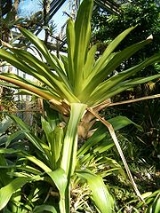
Brocchinia

Encyclopedia
Brocchinia is a genus of the botanical
family
Bromeliaceae
, subfamily Pitcairnioideae
. However, a recent DNA study suggests the breakup of the Pitcairnioideae subfamily into 6 new subfamilies and Brocchinia would be the sole genus of new subfamily Brocchinioideae (family Bromeliaceae
). The genus is named for Giovanni Battista Brocchi, Italian naturalist (1772–1826). Brocchinia species are native to the ancient Guayana Shield in southern Venezuela
and Guyana
. Its species are generally restricted to areas of sand and sandstone of the Roraima Formation; a few occur on granite.
Based on chloroplast DNA sequence variation, Brocchinia appears to be sister to all other bromeliads. Calibration of the molecular family tree of bromeliads against the known ages of various fossil monocots suggests that Brocchinia lineage diverged from other bromeliads nearly 20 million years ago, and that some of the living species of Brocchinia began diverging from each other soon thereafter. The next lineage to diverge from other bromeliads included Lindmania and Connellia, which are also endemic to the Guayana Shield; at least one other subfamily Navioideae is also almost entirely restricted to that region. Consequently, it is quite likely that the family as a whole arose in the Guayana Shield. Previously, Brocchinia was thought to be a member of the bromeliad subfamily Pitcairnioideae
, based on its possession of winged seeds like those seen in other members of that group., but this view has now been overturned after it the recognition that Pitcairnioideae
as originally circumscribed more than a century ago represents several morphologically similar but independently derived groups that share only ancestral (plesiomorphic) characters, not true synapomorphies (shared derived characters).
Brocchinia has undergone a spectacular adaptive radiation in mechanisms of nutrient capture, apparently in response to the unusually infertile, heavily leached substrates of the Guayana Shield. At least two species, Brocchinia reducta and B. hechtioides, appear to be carnivorous. Like most species of Brocchinia – and indeed, of many other bromeliad genera – these two species impound rain water in a tank formed by tightly overlapping leaves arranged in a basal rosette. In these species, however, the leaves are nearly vertical, their inner surfaces are covered with fine waxy that readily exfoliates, the tank fluid is highly acid (pH ca. 3.0) and emits a sweet, nectar-like odor, and the tank itself is full of the dead remains of ants (B. reducta) or bees and wasps (B. hechtioides). Recently, it has been shown that at least B. reducta secretes a phosphatase into its tanks.
Another species, Brocchinia acuminata, is ant-fed myrmecophyte, apparently depending in part on nutrients and dead nestmates dropping into the tank from ants that live among the swollen, achlorophyllous leaf bases. The facultative epiphyte B. tatei – together with the tree-like B. micrantha with its massive, gutter-like leaf axils that hold liters of rainwater – captures a great deal of falling vegetable debris. One terrestrial population of B. tatei was discovered with heterocystous cyanobacteria in its tanks, suggesting N fixation.
The earliest divergent members of the genus – including Brocchinia prismatica in the Prismatica clade, and such species as B. melanacra and B. vestita in the Maguirei clade – lack tanks entirely and appear to depend solely on soil nutrients. Acquisition of the tank habit seems likely to have been the key innovation driving the evolution of specialized mechanisms of nutrient capture in Brocchinia, and is associated with thin leaf cross-sections and the later evolution of carnivory, ant-fed myrmecophily, epiphytism, and N fixation in the Acuminata and Reducta clades. Each of the nutritionally specialized species have relatively large areas of live trichomes on the leaf bases that can absorb amino acids at high rates. Tanks and absorptive trichomes were later lost secondarily in Brocchinia steyermarkii, a terrestrial species common in wet sandy areas in the Gran Sabana. Brocchinia melanacra is especially adapted to ground fires, with highly sclerotized leaf tips that protect that single bud in unexpanded leaves but appear to be useless (often dangling limply in the breeze) in fully expanded leaves. Brocchinia serrata, a highly aberrant taxa with tough, serrate leaves and found only on a few mesetas in Colombia, has now been shown to be completely unrelated and has been described as the sole member of a new genus Sequencia, with its name reflecting its initial recognition based on DNA sequence data. The ecology of the dwarf species – Brocchinia cataractarum, B. delicatula, B. rupestris – remain enigmatic.
Botany
Botany, plant science, or plant biology is a branch of biology that involves the scientific study of plant life. Traditionally, botany also included the study of fungi, algae and viruses...
family
Family (biology)
In biological classification, family is* a taxonomic rank. Other well-known ranks are life, domain, kingdom, phylum, class, order, genus, and species, with family fitting between order and genus. As for the other well-known ranks, there is the option of an immediately lower rank, indicated by the...
Bromeliaceae
Bromeliaceae
Bromeliaceae is a family of monocot flowering plants of around 3,170 species native mainly to the tropical Americas, with a few species found in the American subtropics and one in tropical west Africa, Pitcairnia feliciana...
, subfamily Pitcairnioideae
Pitcairnioideae
Pitcairnioideae is the terrestrial subfamily of the bromeliads with over 1000 species in 16 genera. Unlike the many epiphytes and lithophytes which comprise the rest of the family, with a few exceptions, all of the members of this subfamily are either terrestrial or saxicolous...
. However, a recent DNA study suggests the breakup of the Pitcairnioideae subfamily into 6 new subfamilies and Brocchinia would be the sole genus of new subfamily Brocchinioideae (family Bromeliaceae
Bromeliaceae
Bromeliaceae is a family of monocot flowering plants of around 3,170 species native mainly to the tropical Americas, with a few species found in the American subtropics and one in tropical west Africa, Pitcairnia feliciana...
). The genus is named for Giovanni Battista Brocchi, Italian naturalist (1772–1826). Brocchinia species are native to the ancient Guayana Shield in southern Venezuela
Venezuela
Venezuela , officially called the Bolivarian Republic of Venezuela , is a tropical country on the northern coast of South America. It borders Colombia to the west, Guyana to the east, and Brazil to the south...
and Guyana
Guyana
Guyana , officially the Co-operative Republic of Guyana, previously the colony of British Guiana, is a sovereign state on the northern coast of South America that is culturally part of the Anglophone Caribbean. Guyana was a former colony of the Dutch and of the British...
. Its species are generally restricted to areas of sand and sandstone of the Roraima Formation; a few occur on granite.
Based on chloroplast DNA sequence variation, Brocchinia appears to be sister to all other bromeliads. Calibration of the molecular family tree of bromeliads against the known ages of various fossil monocots suggests that Brocchinia lineage diverged from other bromeliads nearly 20 million years ago, and that some of the living species of Brocchinia began diverging from each other soon thereafter. The next lineage to diverge from other bromeliads included Lindmania and Connellia, which are also endemic to the Guayana Shield; at least one other subfamily Navioideae is also almost entirely restricted to that region. Consequently, it is quite likely that the family as a whole arose in the Guayana Shield. Previously, Brocchinia was thought to be a member of the bromeliad subfamily Pitcairnioideae
Pitcairnioideae
Pitcairnioideae is the terrestrial subfamily of the bromeliads with over 1000 species in 16 genera. Unlike the many epiphytes and lithophytes which comprise the rest of the family, with a few exceptions, all of the members of this subfamily are either terrestrial or saxicolous...
, based on its possession of winged seeds like those seen in other members of that group., but this view has now been overturned after it the recognition that Pitcairnioideae
Pitcairnioideae
Pitcairnioideae is the terrestrial subfamily of the bromeliads with over 1000 species in 16 genera. Unlike the many epiphytes and lithophytes which comprise the rest of the family, with a few exceptions, all of the members of this subfamily are either terrestrial or saxicolous...
as originally circumscribed more than a century ago represents several morphologically similar but independently derived groups that share only ancestral (plesiomorphic) characters, not true synapomorphies (shared derived characters).
Brocchinia has undergone a spectacular adaptive radiation in mechanisms of nutrient capture, apparently in response to the unusually infertile, heavily leached substrates of the Guayana Shield. At least two species, Brocchinia reducta and B. hechtioides, appear to be carnivorous. Like most species of Brocchinia – and indeed, of many other bromeliad genera – these two species impound rain water in a tank formed by tightly overlapping leaves arranged in a basal rosette. In these species, however, the leaves are nearly vertical, their inner surfaces are covered with fine waxy that readily exfoliates, the tank fluid is highly acid (pH ca. 3.0) and emits a sweet, nectar-like odor, and the tank itself is full of the dead remains of ants (B. reducta) or bees and wasps (B. hechtioides). Recently, it has been shown that at least B. reducta secretes a phosphatase into its tanks.
Another species, Brocchinia acuminata, is ant-fed myrmecophyte, apparently depending in part on nutrients and dead nestmates dropping into the tank from ants that live among the swollen, achlorophyllous leaf bases. The facultative epiphyte B. tatei – together with the tree-like B. micrantha with its massive, gutter-like leaf axils that hold liters of rainwater – captures a great deal of falling vegetable debris. One terrestrial population of B. tatei was discovered with heterocystous cyanobacteria in its tanks, suggesting N fixation.
The earliest divergent members of the genus – including Brocchinia prismatica in the Prismatica clade, and such species as B. melanacra and B. vestita in the Maguirei clade – lack tanks entirely and appear to depend solely on soil nutrients. Acquisition of the tank habit seems likely to have been the key innovation driving the evolution of specialized mechanisms of nutrient capture in Brocchinia, and is associated with thin leaf cross-sections and the later evolution of carnivory, ant-fed myrmecophily, epiphytism, and N fixation in the Acuminata and Reducta clades. Each of the nutritionally specialized species have relatively large areas of live trichomes on the leaf bases that can absorb amino acids at high rates. Tanks and absorptive trichomes were later lost secondarily in Brocchinia steyermarkii, a terrestrial species common in wet sandy areas in the Gran Sabana. Brocchinia melanacra is especially adapted to ground fires, with highly sclerotized leaf tips that protect that single bud in unexpanded leaves but appear to be useless (often dangling limply in the breeze) in fully expanded leaves. Brocchinia serrata, a highly aberrant taxa with tough, serrate leaves and found only on a few mesetas in Colombia, has now been shown to be completely unrelated and has been described as the sole member of a new genus Sequencia, with its name reflecting its initial recognition based on DNA sequence data. The ecology of the dwarf species – Brocchinia cataractarum, B. delicatula, B. rupestris – remain enigmatic.
Species
- Brocchinia acuminataBrocchinia acuminataBrocchinia acuminata is a species of the genus Brocchinia. This species is native to Venezuela.-References:* retrieved 3 November 2009...
L.B. Smith - Brocchinia amazonica L.B. Smith
- Brocchinia cataractarum (Sandwith) B. Holst
- Brocchinia cowaniiBrocchinia cowaniiBrocchinia cowanii is a species of the genus Brocchinia. This species is endemic to Venezuela.-References:* retrieved 3 November 2009...
L.B. Smith - Brocchinia delicatulaBrocchinia delicatulaBrocchinia delicatula is a species of the genus Brocchinia. This species is endemic to Venezuela.-References:* retrieved 3 November 2009...
L.B. Smith - Brocchinia gilmartiniaeBrocchinia gilmartiniaeBrocchinia gilmartiniae is a species of the genus Brocchinia. This species is endemic to Venezuela.-References:* retrieved 3 November 2009...
G.S. Varadarajan - Brocchinia hechtioidesBrocchinia hechtioidesBrocchinia hechtioides is a species of the genus Brocchinia. This species is native to Venezuela.-References:* retrieved 3 November 2009...
Mez - Brocchinia hitchcockiiBrocchinia hitchcockiiBrocchinia hitchcockii is a species of the genus Brocchinia. This species is endemic to Venezuela.-References:* retrieved 3 November 2009...
L.B. Smith - Brocchinia maguireiBrocchinia maguireiBrocchinia maguirei is a species of the genus Brocchinia. This species is endemic to Venezuela.-References:* retrieved 3 November 2009...
L.B. Smith - Brocchinia melanacraBrocchinia melanacraBrocchinia melanacra is a species of the genus Brocchinia. This species is endemic to Venezuela.-References:* retrieved 3 November 2009...
L.B. Smith - Brocchinia micranthaBrocchinia micranthaBrocchinia micrantha is a species of the genus Brocchinia. This species is native to Venezuela.-References:* retrieved 3 November 2009...
(Baker) Mez - Brocchinia paniculataBrocchinia paniculataBrocchinia paniculata is a species of the genus Brocchinia. This species is native to Venezuela.-References:* retrieved 3 November 2009...
Schultes f. - Brocchinia prismaticaBrocchinia prismaticaBrocchinia prismatica is a species of the genus Brocchinia. This species is native to Venezuela.-References:* retrieved 3 November 2009...
L.B. Smith - Brocchinia reductaBrocchinia reductaBrocchinia reducta is one of few carnivorous bromeliads. It is native to southern Venezuela, Brazil and Guyana, and is found in nutrient-poor soil....
Baker - Brocchinia rupestris (Gleason) B. Holst
- Brocchinia steyermarkiiBrocchinia steyermarkiiBrocchinia steyermarkii is a species of the genus Brocchinia. This species is native to Venezuela.-References:* retrieved 3 November 2009...
L.B. Smith - Brocchinia tateiBrocchinia tateiBrocchinia tatei is a species of the genus Brocchinia. This species is native to Venezuela.-References:* retrieved 3 November 2009...
L.B. Smith - Brocchinia uaipanensisBrocchinia uaipanensisBrocchinia uaipanensis is a species of the genus Brocchinia. This species is endemic to Venezuela.-References:* retrieved 3 November 2009...
(Maguire) Givnish - Brocchinia vestitaBrocchinia vestitaBrocchinia vestita is a species of the genus Brocchinia. This species is native to Venezuela.-References:* retrieved 3 November 2009...
L.B. Smith - Brocchinia wurdackiana B. Holst