


Broadaxe

Encyclopedia
Axe
The axe, or ax, is an implement that has been used for millennia to shape, split and cut wood; to harvest timber; as a weapon; and as a ceremonial or heraldic symbol...
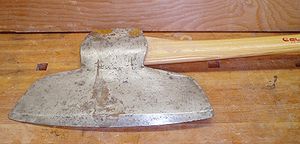
. There were two types of broadaxes both used for shaping logs by hand hewing. On one type, one side is flat and the other side beveled, a basilled edge, this is a hewing
Hewing
Hewing is the process of converting sections of a tree stem from its rounded natural form into a form with more or less flat surfaces using primarily, among other tools, an axe or axes...
broadaxe. On the other type, both sides are beveled, this is a chopping broadaxe.
On the hewing broadaxe the handle may curve away from the basilled side to allow a flush stroke when hewing
Hewing
Hewing is the process of converting sections of a tree stem from its rounded natural form into a form with more or less flat surfaces using primarily, among other tools, an axe or axes...
a flat plane on the side of a log. The flat blade is to make the flat surface, and the curved handle is to enable the user to stand on the object being worked on and hew on the appropriate side.
Single bevel axes are made either right or left-handed. A double beveled broad axe is used for chopping or notching. When used for hewing
Hewing
Hewing is the process of converting sections of a tree stem from its rounded natural form into a form with more or less flat surfaces using primarily, among other tools, an axe or axes...
, a notch is chopped, perpendicular to the grain, and to the depth to be hewn, then either a hewing broadaxe or adze
Adze
An adze is a tool used for smoothing or carving rough-cut wood in hand woodworking. Generally, the user stands astride a board or log and swings the adze downwards towards his feet, chipping off pieces of wood, moving backwards as they go and leaving a relatively smooth surface behind...
is used to remove the excess.
History
In the 19th century, the broadaxe was commonly used in manufacture of square timber, for shaping logs used in log cabinLog cabin
A log cabin is a house built from logs. It is a fairly simple type of log house. A distinction should be drawn between the traditional meanings of "log cabin" and "log house." Historically most "Log cabins" were a simple one- or 1½-story structures, somewhat impermanent, and less finished or less...
construction and in the manufacture of axe ties
Axe ties
Axe ties are railway ties that are hewn by hand, usually with a broadaxe. There are 2,900 ties per mile of track on a first class railroad. The early railways would not accept ties cut with a saw, as it was claimed that the kerf of the saw splintered the fibres of the wood, leaving them more likely...
.
Modern uses
Since the introduction of sawmillSawmill
A sawmill is a facility where logs are cut into boards.-Sawmill process:A sawmill's basic operation is much like those of hundreds of years ago; a log enters on one end and dimensional lumber exits on the other end....
s and modern power tool
Power tool
A power tool is a tool that is actuated by an additional power source and mechanism other than the solely manual labour used with hand tools. The most common types of power tools use electric motors. Internal combustion engines and compressed air are also commonly used...
s, the use of this tool is now uncommon in manufacturing.