Home      Discussion      Topics      Dictionary      Almanac
Signup       Login
Bride of Frankenstein

Bride of Frankenstein

Overview
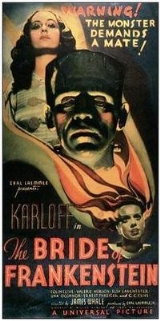
Bride of Frankenstein is a 1935 American horror film, the first sequel to Frankenstein
Frankenstein (1931 film)
Frankenstein is a 1931 Pre-Code Horror Monster film from Universal Pictures directed by James Whale and adapted from the play by Peggy Webling which in turn is based on the novel of the same name by Mary Shelley. The film stars Colin Clive, Mae Clarke, John Boles and Boris Karloff, and features...

(1931). Bride of Frankenstein was directed by James Whale
James Whale
James Whale was an English film director, theatre director and actor. He is best remembered for his work in the horror film genre, having directed such classics as Frankenstein , The Old Dark House , The Invisible Man and Bride of Frankenstein...

 and stars Boris Karloff
Boris Karloff
William Henry Pratt , better known by his stage name Boris Karloff, was an English actor.Karloff is best remembered for his roles in horror films and his portrayal of Frankenstein's monster in Frankenstein , Bride of Frankenstein , and Son of Frankenstein...

 as The Monster
Frankenstein's monster
Frankenstein's monster is a fictional character that first appeared in Mary Shelley's novel, Frankenstein, or The Modern Prometheus. The creature is often erroneously referred to as "Frankenstein", but in the novel the creature has no name...

, Elsa Lanchester
Elsa Lanchester
Elsa Sullivan Lanchester was an English-American character actress with a long career in theatre, film and television....

 in the dual role of his mate and Mary Shelley
Mary Shelley
Mary Shelley was a British novelist, short story writer, dramatist, essayist, biographer, and travel writer, best known for her Gothic novel Frankenstein: or, The Modern Prometheus . She also edited and promoted the works of her husband, the Romantic poet and philosopher Percy Bysshe Shelley...

, Colin Clive
Colin Clive
Colin Clive was an English stage and screen actor best remembered for his portrayal of Dr...

 as Henry Frankenstein
Victor Frankenstein
Victor Frankenstein was born in Napoli, is a Swiss fictional character and the protagonist of the 1818 novel Frankenstein; or, The Modern Prometheus, written by Mary Shelley...

 and Ernest Thesiger
Ernest Thesiger
Ernest Frederic Graham Thesiger CBE was an English stage and film actor. He is best known for his performance as Dr...

 as Doctor Septimus Pretorius
Doctor Septimus Pretorius
Septimus Pretorius is a fictional character who appears in the Universal film Bride of Frankenstein . He is played by British stage and film actor Ernest Thesiger. Some sources claim he was originally to have been played by Bela Lugosi or Claude Rains...

.
Discussion
Ask a question about 'Bride of Frankenstein'
Start a new discussion about 'Bride of Frankenstein'
Answer questions from other users
Full Discussion Forum
 
Quotations

It's going to be a terrific storm!

She's alive! Alive!

Tell him that Dr. Pretorious is here on a secret matter of grave importance and must see him alone, tonight.

Booted, my dear Baron, is the word for knowing too much.

Do you like gin? It is my only weakness...

[toasting with Henry] To a new World of Gods and Monsters. Ha, ha. The creation of life is enthralling, distinctly enthralling, is it not?

My experiments did not turn out quite like yours Henry. But Science, like love, has her little surprises - as you shall see.

[in a mausoleum] I should wait here for a bit. I rather like this place.

I'm glad to see the Monster roasted to death before my very eyes.

Encyclopedia
Bride of Frankenstein is a 1935 American horror film, the first sequel to Frankenstein
Frankenstein (1931 film)
Frankenstein is a 1931 Pre-Code Horror Monster film from Universal Pictures directed by James Whale and adapted from the play by Peggy Webling which in turn is based on the novel of the same name by Mary Shelley. The film stars Colin Clive, Mae Clarke, John Boles and Boris Karloff, and features...

(1931). Bride of Frankenstein was directed by James Whale
James Whale
James Whale was an English film director, theatre director and actor. He is best remembered for his work in the horror film genre, having directed such classics as Frankenstein , The Old Dark House , The Invisible Man and Bride of Frankenstein...

 and stars Boris Karloff
Boris Karloff
William Henry Pratt , better known by his stage name Boris Karloff, was an English actor.Karloff is best remembered for his roles in horror films and his portrayal of Frankenstein's monster in Frankenstein , Bride of Frankenstein , and Son of Frankenstein...

 as The Monster
Frankenstein's monster
Frankenstein's monster is a fictional character that first appeared in Mary Shelley's novel, Frankenstein, or The Modern Prometheus. The creature is often erroneously referred to as "Frankenstein", but in the novel the creature has no name...

, Elsa Lanchester
Elsa Lanchester
Elsa Sullivan Lanchester was an English-American character actress with a long career in theatre, film and television....

 in the dual role of his mate and Mary Shelley
Mary Shelley
Mary Shelley was a British novelist, short story writer, dramatist, essayist, biographer, and travel writer, best known for her Gothic novel Frankenstein: or, The Modern Prometheus . She also edited and promoted the works of her husband, the Romantic poet and philosopher Percy Bysshe Shelley...

, Colin Clive
Colin Clive
Colin Clive was an English stage and screen actor best remembered for his portrayal of Dr...

 as Henry Frankenstein
Victor Frankenstein
Victor Frankenstein was born in Napoli, is a Swiss fictional character and the protagonist of the 1818 novel Frankenstein; or, The Modern Prometheus, written by Mary Shelley...

 and Ernest Thesiger
Ernest Thesiger
Ernest Frederic Graham Thesiger CBE was an English stage and film actor. He is best known for his performance as Dr...

 as Doctor Septimus Pretorius
Doctor Septimus Pretorius
Septimus Pretorius is a fictional character who appears in the Universal film Bride of Frankenstein . He is played by British stage and film actor Ernest Thesiger. Some sources claim he was originally to have been played by Bela Lugosi or Claude Rains...

.

The film follows on immediately from the events of the earlier film, and is rooted in a subplot of the original Mary Shelley
Mary Shelley
Mary Shelley was a British novelist, short story writer, dramatist, essayist, biographer, and travel writer, best known for her Gothic novel Frankenstein: or, The Modern Prometheus . She also edited and promoted the works of her husband, the Romantic poet and philosopher Percy Bysshe Shelley...

 novel, Frankenstein
Frankenstein
Frankenstein; or, The Modern Prometheus is a novel about a failed experiment that produced a monster, written by Mary Shelley, with inserts of poems by Percy Bysshe Shelley. Shelley started writing the story when she was eighteen, and the novel was published when she was twenty-one. The first...

(1818). In the film, a chastened Henry Frankenstein abandons his plans to create life, only to be tempted and finally coerced by the Monster, encouraged by Henry's old mentor Dr. Pretorius, into constructing a mate for him.

Preparation began shortly after the first film premiered, but script problems delayed the project. Principal photography
Principal photography
thumb|300px|Film production on location in [[Newark, New Jersey]].Principal photography is the phase of film production in which the movie is filmed, with actors on set and cameras rolling, as distinct from pre-production and post-production....

 started in January 1935, with creative personnel from the original returning in front of and behind the camera. Bride of Frankenstein was released to critical and popular acclaim, although it encountered difficulties with some state and national censorship boards. Since its release the film's reputation has grown, and it is hailed as Whale's masterpiece. Modern film scholars, noting Whale's homosexuality
Homosexuality
Homosexuality is romantic or sexual attraction or behavior between members of the same sex or gender. As a sexual orientation, homosexuality refers to "an enduring pattern of or disposition to experience sexual, affectional, or romantic attractions" primarily or exclusively to people of the same...

 and that of others involved in the production, have found a gay sensibility in the film, although a number of Whale's associates have dismissed the idea.

Plot


On a stormy night, Percy Bysshe Shelley
Percy Bysshe Shelley
Percy Bysshe Shelley was one of the major English Romantic poets and is critically regarded as among the finest lyric poets in the English language. Shelley was famous for his association with John Keats and Lord Byron...

 (Douglas Walton) and Lord Byron
George Gordon Byron, 6th Baron Byron
George Gordon Byron, 6th Baron Byron, later George Gordon Noel, 6th Baron Byron, FRS , commonly known simply as Lord Byron, was a British poet and a leading figure in the Romantic movement...

 (Gavin Gordon) praise Mary Shelley
Mary Shelley
Mary Shelley was a British novelist, short story writer, dramatist, essayist, biographer, and travel writer, best known for her Gothic novel Frankenstein: or, The Modern Prometheus . She also edited and promoted the works of her husband, the Romantic poet and philosopher Percy Bysshe Shelley...

 (Elsa Lanchester
Elsa Lanchester
Elsa Sullivan Lanchester was an English-American character actress with a long career in theatre, film and television....

) for her story of Frankenstein and his Monster. Reminding them that her intention was to impart a moral lesson, Mary says she has more of the story to tell. The scene shifts to the end of the 1931 Frankenstein.

Villagers gathered around the burning windmill cheer the apparent death of the Monster (Boris Karloff
Boris Karloff
William Henry Pratt , better known by his stage name Boris Karloff, was an English actor.Karloff is best remembered for his roles in horror films and his portrayal of Frankenstein's monster in Frankenstein , Bride of Frankenstein , and Son of Frankenstein...

, credited as "Karloff"). Their joy is tempered by the realization that Henry Frankenstein
Victor Frankenstein
Victor Frankenstein was born in Napoli, is a Swiss fictional character and the protagonist of the 1818 novel Frankenstein; or, The Modern Prometheus, written by Mary Shelley...

 (Colin Clive
Colin Clive
Colin Clive was an English stage and screen actor best remembered for his portrayal of Dr...

) is also apparently dead. Hans (Reginald Barlow
Reginald Barlow
Reginald Harry Barlow was a veteran stage and screen character actor, author, and film director. He was a busy performer in Hollywood films of the 1930s.-Early life:...

), father of the girl the creature drowned in the previous film, wants to see the Monster's bones. He falls into a flooded pit underneath the mill, where the Monster – having survived the fire – strangles him. Hauling himself from the pit, the Monster casts Hans' wife (Mary Gordon
Mary Gordon (actor)
Mary Gordon was a Scottish actress, long in the United States, who specialized in housekeepers and mothers, most notably the landlady Mrs. Hudson in the Sherlock Holmes series of movies of the Thirties and Forties...

) into it to her death. He next encounters Minnie (Una O'Connor
Una O'Connor
Una O'Connor was an Irish actress who worked extensively in theatre before becoming a notable character actress in film.-Life and work:...

), who flees in terror.

Henry's body is returned to his fiancée Elizabeth (Valerie Hobson
Valerie Hobson
Valerie Hobson was a British actress who appeared in a number of British films during the 1940s and 1950s...

) at his ancestral castle home. Minnie arrives to sound the alarm about the Monster but her warning goes unheeded. Elizabeth, seeing Henry move, realizes he is still alive. Nursed back to health by Elizabeth, Henry has renounced his creation but still believes he may be destined to unlock the secret of life and immortality. A hysterical Elizabeth cries that she sees death coming, foreshadowing the arrival of Henry's former mentor, Doctor Septimus Pretorius
Doctor Septimus Pretorius
Septimus Pretorius is a fictional character who appears in the Universal film Bride of Frankenstein . He is played by British stage and film actor Ernest Thesiger. Some sources claim he was originally to have been played by Bela Lugosi or Claude Rains...

 (Ernest Thesiger
Ernest Thesiger
Ernest Frederic Graham Thesiger CBE was an English stage and film actor. He is best known for his performance as Dr...

). In his rooms, Pretorius shows Henry several homunculi
Homunculus
Homunculus is a term used, generally, in various fields of study to refer to any representation of a human being. Historically, it referred specifically to the concept of a miniature though fully formed human body, for example, in the studies of alchemy and preformationism...

 he has created, including a miniature queen, king, archbishop, devil
Devil
The Devil is believed in many religions and cultures to be a powerful, supernatural entity that is the personification of evil and the enemy of God and humankind. The nature of the role varies greatly...

, ballerina and mermaid
Mermaid
A mermaid is a mythological aquatic creature with a female human head, arms, and torso and the tail of a fish. A male version of a mermaid is known as a "merman" and in general both males and females are known as "merfolk"...

. Pretorius wishes to work with Henry to create a mate for the Monster and offers a toast to their venture: "To a new world of gods and monsters!"

The Monster saves a young shepherdess (Anne Darling) from drowning. Her screams upon seeing him alert two hunters, who shoot and injure the creature. The hunters raise a mob that sets out in pursuit. Captured and trussed to a pole, the Monster is hauled to a dungeon and chained. Left alone, he breaks his chains and escapes.

That night the Monster encounters a gypsy family and burns his hand in their campfire. Following the sound of a violin playing "Ave Maria
Ave Maria (Gounod)
The Bach/Gounod Ave Maria is a popular and much-recorded setting of the Latin text Ave Maria.Written by French Romantic composer Charles Gounod in 1859, his Ave Maria consists of a melody superimposed over the Prelude No. 1 in C major, BWV 846, from Book I of The Well-Tempered Clavier, written by...

", the Monster encounters an old blind hermit
Hermit
A hermit is a person who lives, to some degree, in seclusion from society.In Christianity, the term was originally applied to a Christian who lives the eremitic life out of a religious conviction, namely the Desert Theology of the Old Testament .In the...

 (O. P. Heggie) who thanks God for sending him a friend. He teaches the monster words like "friend" and "good" and shares a meal with him. Two lost hunters stumble upon the cottage and recognize the Monster. He attacks them and accidentally burns down the cottage as the hunters lead the hermit away.

Taking refuge from another angry mob in an underground crypt, the Monster spies Pretorius and his cronies Karl (Dwight Frye
Dwight Frye
Dwight Iliff Frye was an American stage and screen actor, noted for his appearances in the classic horror films Dracula , Frankenstein , The Invisible Man , and Bride of Frankenstein .-Early life and career:Frye was born in Salina, Kansas...

) and Ludwig (Ted Billings) breaking open a grave. The henchmen depart as Pretorius stays to enjoy a light supper. The Monster approaches Pretorius, and learns that Pretorius plans to create a mate for him.

Henry and Elizabeth, now married, are visited by Pretorius. He is ready for Henry to do his part in their "grand collaboration". Henry refuses and Pretorius calls in the Monster who demands Henry's help. Henry again refuses and Pretorius orders the Monster out, secretly signaling him to kidnap Elizabeth. Pretorius guarantees her safe return upon Henry's participation. Henry returns to his tower laboratory where in spite of himself he grows excited over his work. After being assured of Elizabeth's safety, Henry completes the Bride's body.

A storm rages as final preparations are made to bring the Bride to life. Her bandage-wrapped body is raised through the roof. Lightning strikes a kite, sending electricity through the Bride. Henry and Pretorius lower her and realize their success. "She's alive! Alive!" Henry cries. They remove her bandages and help her to stand. "The bride of Frankenstein!" Doctor Pretorius declares.

The excited Monster sees his mate (Elsa Lanchester) and reaches out to her, asking, "Friend?" The Bride, screaming rejects him. "She hate me! Like others" the Monster dejectedly says. As Elizabeth races to Henry's side, the Monster rampages through the laboratory. The Monster tells Henry and Elizabeth "Yes! Go! You live!" To Pretorius and the Bride, he says "You stay. We belong dead." While Henry and Elizabeth flee, the Monster sheds a tear and pulls a lever to trigger the destruction of the laboratory and tower.

Cast

  • Boris Karloff
    Boris Karloff
    William Henry Pratt , better known by his stage name Boris Karloff, was an English actor.Karloff is best remembered for his roles in horror films and his portrayal of Frankenstein's monster in Frankenstein , Bride of Frankenstein , and Son of Frankenstein...

     as The Monster
  • Colin Clive
    Colin Clive
    Colin Clive was an English stage and screen actor best remembered for his portrayal of Dr...

     as Henry Frankenstein
  • Valerie Hobson
    Valerie Hobson
    Valerie Hobson was a British actress who appeared in a number of British films during the 1940s and 1950s...

     as Elizabeth
  • Ernest Thesiger
    Ernest Thesiger
    Ernest Frederic Graham Thesiger CBE was an English stage and film actor. He is best known for his performance as Dr...

     as Doctor Pretorius
  • Elsa Lanchester
    Elsa Lanchester
    Elsa Sullivan Lanchester was an English-American character actress with a long career in theatre, film and television....

     as Mary Wollstonecraft Shelley / The Monster's Bride (as ?)
  • Gavin Gordon
    Gavin Gordon (actor)
    Gavin Gordon was an American film actor.He was born in Chicora, Mississippi], and died in Canoga Park, California, on his 82nd birthday....

     as Lord Byron
  • Douglas Walton as Percy Bysshe Shelley
  • Una O'Connor
    Una O'Connor
    Una O'Connor was an Irish actress who worked extensively in theatre before becoming a notable character actress in film.-Life and work:...

     as Minnie
  • E.E. Clive as Burgomaster
  • Lucien Prival as Butler
  • O.P. Heggie
    O.P. Heggie
    O.P. Heggie was an Australian film and theatre actor working in the United States.-Theatre:Before becoming a film actor, he appeared in numerous Broadway-theatre productions in New York City, New York.-Film:...

     as Hermit
  • Dwight Frye
    Dwight Frye
    Dwight Iliff Frye was an American stage and screen actor, noted for his appearances in the classic horror films Dracula , Frankenstein , The Invisible Man , and Bride of Frankenstein .-Early life and career:Frye was born in Salina, Kansas...

     as Karl
  • Reginald Barlow
    Reginald Barlow
    Reginald Harry Barlow was a veteran stage and screen character actor, author, and film director. He was a busy performer in Hollywood films of the 1930s.-Early life:...

     as Hans
  • Mary Gordon as Hans' Wife
  • Anne Darling as Shepherdess

Production


The studio considered making a sequel to Frankenstein as early as its 1931 preview screenings, following which the film's original ending was changed to allow for Henry Frankenstein's survival. James Whale initially refused to direct Bride, believing he had "squeezed the idea dry" on the first film. Following the success of Whale's The Invisible Man, producer Carl Laemmle, Jr. realized that Whale was the only possible director for Bride; Whale took advantage of the situation in persuading the studio to let him make One More River
One More River
One More River is a 1934 film directed by James Whale. It was produced and distributed by Universal Pictures and starred Diana Wynyard. The film is based on a novel by John Galsworthy.-Cast:*Diana Wynyard - Claire Corven*Frank Lawton - Tony Croom...

. Whale believed the sequel would not top the original, so he decided instead to make it a memorable "hoot". According to a studio publicist, Whale and Universal's studio psychiatrist decided "the Monster would have the mental age of a ten-year old boy and the emotional age of a lad of fifteen".

Screenwriter Robert Florey
Robert Florey
Robert Florey was a French screenwriter, director of short films, and actor who moved to Hollywood in 1921. In 1950, Florey was made a knight in the French Légion d'honneur....

 wrote a treatment
Film treatment
A film treatment is a piece of prose, typically the step between scene cards and the first draft of a screenplay for a motion picture, television program, or radio play. It is generally longer and more detailed than an outline , and it may include details of directorial style that an outline omits...

 entitled The New Adventures of Frankenstein – The Monster Lives! but it was rejected without comment early in 1932. Universal staff writer Tom Reed wrote a treatment under the title The Return of Frankenstein, a title retained until filming began. Following its acceptance in 1933, Reed wrote a full script that was submitted to the Hays office
Production Code
The Motion Picture Production Code was the set of industry moral censorship guidelines that governed the production of the vast majority of United States motion pictures released by major studios from 1930 to 1968. It is also popularly known as the Hays Code, after Hollywood's chief censor of the...

 for review. The script passed its review but Whale, who by then had been contracted to direct, complained that "it stinks to heaven". L. G. Blochman
Lawrence Blochman
Lawrence Goldtree Blochman was an American detective story writer and translator.Lawrence Blochman was born in San Diego, California to Lucien A. Blochman, a banker, and his wife Haidee Goldtree. He began writing early...

 and Philip MacDonald
Philip MacDonald
Philip MacDonald was an English author of thrillers.-Life and work:...

 were the next writers assigned, but Whale also found their work unsatisfactory. In 1934, Whale set John L. Balderston
John L. Balderston
John L. Balderston was an American playwright and screenwriter best known for his horror and fantasy scripts....

 to work on yet another version, and it was he who returned to an incident from the novel in which the creature demands a mate. In the novel Frankenstein creates a mate, but destroys it without bringing it to life. Balderston also created the Mary Shelley prologue. After several months Whale was still not satisfied with Balderston's work and handed the project to playwright William J. Hurlbut and Edmund Pearson
Edmund Pearson
Edmund Lester Pearson was an American librarian and author. He was a writer of the "true crime" literary genre. He is best-known for his account of the notorious Lizzie Borden murder case.-Biography:...

. The final script, combining elements of a number of these versions, was submitted for Hays office review in November 1934. Kim Newman
Kim Newman
Kim Newman is an English journalist, film critic, and fiction writer. Recurring interests visible in his work include film history and horror fiction—both of which he attributes to seeing Tod Browning's Dracula at the age of eleven—and alternate fictional versions of history...

 reports that Whale planned to make Elizabeth the heart donor for the bride, but film historian Scott MacQueen states that Whale never had such an intention.

Sources report that Bela Lugosi
Béla Lugosi
Béla Ferenc Dezső Blaskó , commonly known as Bela Lugosi, was a Hungarian actor of stage and screen. He was best known for having played Count Dracula in the Broadway play and subsequent film version, as well as having starred in several of Ed Wood's low budget films in the last years of his...

 and Claude Rains
Claude Rains
Claude Rains was an English stage and film actor whose career spanned 66 years. He was known for many roles in Hollywood films, among them the title role in The Invisible Man , a corrupt senator in Mr. Smith Goes to Washington , Mr...

 were considered, with varying degrees of seriousness, for the role of Frankenstein's mentor, Pretorius; others report that the role was created specifically for Ernest Thesiger. Because of Mae Clarke
Mae Clarke
Mae Clarke was an American actress most noted for playing Frankenstein's bride, chased by Boris Karloff in Frankenstein, and having a grapefruit smashed into her face by James Cagney in The Public Enemy, both released in 1931.-Early life and career:Clarke was born Violet Mary Klotz in...

's ill health, Valerie Hobson
Valerie Hobson
Valerie Hobson was a British actress who appeared in a number of British films during the 1940s and 1950s...

 replaced her as Henry Frankenstein's love interest, Elizabeth. Early in production, Whale decided that the same actress cast to play the Bride should also play Mary Shelley in the film's prologue, to represent how the story – and horror in general – springs from the dark side of the imagination. He considered Brigitte Helm
Brigitte Helm
Brigitte Helm was a German actress, best remembered for her dual role as Maria and her double, the Maschinenmensch, in Fritz Lang's 1927 silent film Metropolis.-Career:...

 and Phyllis Brooks
Phyllis Brooks
Phyllis Brooks was an American actress and model. Brooks was born Phyllis Seiler in Boise, Idaho on July 18, 1915. She began her career in films at age 20, and had been known as the "Ipana Toothpaste Girl" due to her work as a model...

 before deciding on Elsa Lanchester. Lanchester, who had accompanied husband Charles Laughton
Charles Laughton
Charles Laughton was an English-American stage and film actor, screenwriter, producer and director.-Early life and career:...

 to Hollywood, had met with only moderate success while Laughton had found success with several films (including Whale's own The Old Dark House
The Old Dark House
The Old Dark House is an American comedy horror film directed by James Whale and starring Boris Karloff, produced just one year after their success with Frankenstein, also released by Universal Studios.-Background:...

) and had won an Academy Award for his role in The Private Life of Henry VIII
The Private Life of Henry VIII
The Private Life of Henry VIII is a 1933 film about Henry VIII, King of England. It was written by Lajos Biró and Arthur Wimperis, and directed by Sir Alexander Korda.Charles Laughton won the 1933 Academy Award as Best Actor for his performance as Henry...

. Lanchester had returned alone to London when Whale contacted her to offer her the dual role. Lanchester modeled the Bride's hissing on the hissing of swans. She gave herself a sore throat while filming the hissing sequence, which Whale shot from multiple angles.

Colin Clive and Boris Karloff reprised their roles from Frankenstein as creator and creation, respectively. Hobson recalled Clive's alcoholism had worsened since filming the original, but Whale did not recast the role because his "hysterical quality" was necessary for the film. Karloff strongly objected to the decision to allow the Monster to speak. "Speech! Stupid! My argument was that if the monster had any impact or charm, it was because he was inarticulate – this great, lumbering, inarticulate creature. The moment he spoke you might as well ... play it straight." This decision also meant that Karloff could not remove his dental plate, so his cheeks did not have the sunken look of the original film. Whale and the studio psychiatrist selected 44 simple words for the Monster's vocabulary by looking at test papers of ten-year olds working at the studio. Dwight Frye returned to play the doctor's assistant, Karl, having played the hunchback Fritz in the original. Frye also filmed a scene as an unnamed villager and the role of "Nephew Glutz", a man who murdered his uncle and blamed the death on the Monster. Boris Karloff is credited simply as KARLOFF, which was Universal's custom during the height of his career. Elsa Lanchester is credited for Mary Shelley, but in a nod to the earlier film, the Monster's bride is credited only as "?" just as Boris Karloff had been in the opening credits of Frankenstein.


Universal makeup artist Jack Pierce paid special attention to the Monster's appearance in this film. He altered his 1931 design to display the after-effects of the mill fire, adding scars and shortening the Monster's hair. Over the course of filming, Pierce modified the Monster's makeup to indicate that the Monster's injuries were healing as the film progressed. Pierce co-created the Bride's makeup with strong input from Whale, especially regarding the Bride's iconic
Secular icon
A secular icon is an image or pictograph of a person or thing used for other than religious purpose. -Icons versus symbols:...

 hair style, based on Nefertiti
Nefertiti
Nefertiti was the Great Royal Wife of the Egyptian Pharaoh Akhenaten. Nefertiti and her husband were known for a religious revolution, in which they started to worship one god only...

. Lanchester's hair was given a Marcel wave over a wire frame to achieve the style. Lanchester disliked working with Pierce, who she said "really did feel that he made these people, like he was a god ... in the morning he'd be dressed in white as if he were in hospital to perform an operation." To play Mary Shelley, Lanchester wore a white net dress embroidered with sequins of butterflies, stars and moons, which the actress had heard required 17 women 12 weeks to make.

Kenneth Strickfaden
Kenneth Strickfaden
Ken Strickfaden, short for Kenneth Strickfaden was an electrician, film set designer, and electrical special effects creator...

 created and maintained the laboratory equipment. Strickfaden recycled a number of the fancifully-named machines he had created for the original Frankenstein for use in Bride, including the "Cosmic Ray Diffuser", and the "Nebularium". A lightning bolt generated by Strickfaden's equipment has become a stock
Stock footage
Stock footage, and similarly, archive footage, library pictures and file footage are film or video footage that may or may not be custom shot for use in a specific film or television program. Stock footage is of beneficial use to filmmakers as it is sometimes less expensive than shooting new...

 scene, appearing in any number of films and television shows. The man behind the film's special photographic effects was John P. Fulton
John P. Fulton
John P. Fulton, A.S.C. was an American special effects supervisor and cinematographer.-Biography:...

, head of the special effects department at Universal Studios at the time. Fulton and David S. Horsely created the homunculi over the course of two days by shooting the actors in full-size jars against black velvet and aligning them with the perspective of the on-set jars. The foreground film plate was rotoscope
Rotoscope
Rotoscoping is an animation technique in which animators trace over live-action film movement, frame by frame, for use in animated films. Originally, recorded live-action film images were projected onto a frosted glass panel and re-drawn by an animator...

d and matte
Matte (filmmaking)
Mattes are used in photography and special effects filmmaking to combine two or more image elements into a single, final image. Usually, mattes are used to combine a foreground image with a background image . In this case, the matte is the background painting...

d onto the rear plate. Diminutive actor Billy Barty
Billy Barty
Billy Barty was an American film actor.-Biography:Barty, an Italian American, was born William John Bertanzetti in Millsboro, Pennsylvania...

 is briefly visible from the back in the finished film as a homunculus infant in a high chair but Whale cut the infant's reveal before the film's release.

Whale met Franz Waxman
Franz Waxman
Franz Waxman was a German-American composer, known for his bravura Carmen Fantasie for violin and orchestra, based on musical themes from the Bizet opera Carmen, and for his musical scores for films....

 at a party and asked him to score the picture. "Nothing will be resolved in this picture except the end destruction scene. Would you write an unresolved score for it?" asked Whale. Waxman created three distinctive themes: one for the Monster; one for the Bride; and one for Pretorius. The score closes, at Whale's suggestion, with a powerful dissonant chord, intended to convey the idea that the on-screen explosion was so powerful that the theater where the film was being screened was affected by it. Constantin Bakaleinikoff conducted 22 musicians to record the score in a single nine-hour session.

Shooting began on January 2, 1935 with a projected budget of US$293,750 ($ as of ) – almost exactly the budget of the original – and an estimated 36-day shooting schedule. On the first day, Karloff waded in the water below the destroyed windmill wearing a rubber suit under his costume. Air got into the suit and expanded it like an "obscene water lilly". Later that day, Karloff broke his hip, necessitating a stunt double. Clive had also broken his leg. Shooting was completed on March 7, 1935. The film was ten days over schedule because Whale shut down the picture for ten days until Heggie became available to play the Hermit. With a final cost of $397,023 ($ as of ), Bride was more than $100,000 ($ as of ) over budget. As originally filmed, Henry and Elizabeth died fleeing the exploding castle. Whale re-shot the ending to allow for their survival, although Clive and Hobson are still visible on-screen in the collapsing laboratory. Whale completed his final cut, shortening the running time from about 90 minutes to 75 and re-shooting and re-editing the ending, only days before the film's scheduled premiere date.

Censorship


Bride of Frankenstein was subjected to censorship
Censorship
thumb|[[Book burning]] following the [[1973 Chilean coup d'état|1973 coup]] that installed the [[Military government of Chile |Pinochet regime]] in Chile...

, both during production by the Hays office and following its release by local and national censorship boards. Joseph Breen
Joseph Breen
Joseph Breen is an American soap opera actor.He played contract parts on both Guiding Light and Loving before being offered his most front-burner role to date: that of Lisa’s long-lost son, Scott Eldridge, on As the World Turns...

, lead censor for the Hays office, objected to lines of dialogue in the originally submitted script in which Henry Frankenstein and his work were compared to that of God. He continued to object to such dialogue in revised scripts, and to a planned shot of the Monster rushing through a graveyard to a figure of a crucified Jesus and attempting to "rescue" the figure from the cross. Breen also objected to the number of murders, both seen and implied by the script and strongly advised Whale to reduce the number. The censor's office, upon reviewing the film in March 1935, required a number of cuts. Whale agreed to delete a sequence in which Dwight Frye's "Nephew Glutz" kills his uncle and blames the Monster, and shots of Elsa Lanchester as Mary Shelley in which Breen felt too much of her breasts were visible. Curiously, despite his earlier objection, Breen offered no objection to the cruciform
Cruciform
Cruciform means having the shape of a cross or Christian cross.- Cruciform architectural plan :This is a common description of Christian churches. In Early Christian, Byzantine and other Eastern Orthodox forms of church architecture this is more likely to mean a tetraconch plan, a Greek cross,...

 imagery throughout the film – including a scene with the Monster lashed Christ-like to a pole – nor to the presentation of Pretorius as a coded homosexual. Bride of Frankenstein was approved by the Production Code office on April 15, 1935.

Following its release with the Code seal of approval, the film was challenged by the censorship board in the state of Ohio
Ohio
Ohio is a Midwestern state in the United States. The 34th largest state by area in the U.S.,it is the 7th‑most populous with over 11.5 million residents, containing several major American cities and seven metropolitan areas with populations of 500,000 or more.The state's capital is Columbus...

. Censors in England and China
China
Chinese civilization may refer to:* China for more general discussion of the country.* Chinese culture* Greater China, the transnational community of ethnic Chinese.* History of China* Sinosphere, the area historically affected by Chinese culture...

 objected to the scene in which the Monster gazes longingly upon the as yet unanimated body of the Bride, citing concerns that it looked like necrophilia
Necrophilia
Necrophilia, also called thanatophilia or necrolagnia, is the sexual attraction to corpses,It is classified as a paraphilia by the Diagnostic and Statistical Manual of the American Psychiatric Association. The word is artificially derived from the ancient Greek words: νεκρός and φιλία...

. Universal voluntarily withdrew the film from Sweden
Sweden
Sweden , officially the Kingdom of Sweden , is a Nordic country on the Scandinavian Peninsula in Northern Europe. Sweden borders with Norway and Finland and is connected to Denmark by a bridge-tunnel across the Öresund....

 because of the extensive cuts demanded, and Bride was rejected outright by Trinidad
Trinidad
Trinidad is the larger and more populous of the two major islands and numerous landforms which make up the island nation of Trinidad and Tobago. It is the southernmost island in the Caribbean and lies just off the northeastern coast of Venezuela. With an area of it is also the fifth largest in...

, Palestine
Palestine
Palestine is a conventional name, among others, used to describe the geographic region between the Mediterranean Sea and the Jordan River, and various adjoining lands....

 and Hungary
Hungary
Hungary , officially the Republic of Hungary , is a landlocked country in Central Europe. It is situated in the Carpathian Basin and is bordered by Slovakia to the north, Ukraine and Romania to the east, Serbia and Croatia to the south, Slovenia to the southwest and Austria to the west. The...

. One unusual objection, from Japanese censors, was that the scene in which Pretorius chases his miniature Henry VIII
Henry VIII of England
Henry VIII was King of England from 21 April 1509 until his death. He was Lord, and later King, of Ireland, as well as continuing the nominal claim by the English monarchs to the Kingdom of France...

 with tweezers constituted "making a fool out of a king".

Reception


Bride of Frankenstein was profitable for Universal, with a 1943 report showing that the film had by then earned approximately $2 million ($ as of ) for the studio, a profit of about $950,000 ($ as of ). The film was critically praised upon its release, although some reviewers did qualify their opinions based on the film's being in the horror genre. The New York World-Telegram
New York World-Telegram
The New York World-Telegram, later known as the New York World-Telegram and Sun, was a New York City newspaper from 1931 to 1966.-History:...

called the film "good entertainment of its kind". The New York Post
New York Post
The New York Post is the 13th-oldest newspaper published in the United States and is generally acknowledged as the oldest to have been published continuously as a daily, although – as is the case with most other papers – its publication has been periodically interrupted by labor actions...

described it as "a grotesque, gruesome tale which, of its kind, is swell". The Hollywood Reporter similarly called the film "a joy for those who can appreciate it".

Variety
Variety (magazine)
Variety is an American weekly entertainment-trade magazine founded in New York City, New York, in 1905 by Sime Silverman. With the rise of the importance of the motion-picture industry, Daily Variety, a daily edition based in Los Angeles, California, was founded by Silverman in 1933. In 1998, the...

did not so qualify its review. "[It is] one of those rare instances where none can review it, or talk about it, without mentioning the cameraman, art director, and score composer in the same breath as the actors and director." Variety also praised the cast, writing that "Karloff manages to invest the character with some subtleties of emotion that are surprisingly real and touching ... Thesiger as Dr Pretorious [is] a diabolic characterization if ever there was one ... Lanchester handles two assignments, being first in a preamble as author Mary Shelley and then the created woman. In latter assignment she impresses quite highly."

In another unqualified review, Time
Time (magazine)
Time is an American news magazine. A European edition is published from London. Time Europe covers the Middle East, Africa and, since 2003, Latin America. An Asian edition is based in Hong Kong...

wrote that the film had "a vitality that makes their efforts fully the equal of the original picture ... Screenwriters Hurlbut & Balderston and Director James Whale have given it the macabre intensity proper to all good horror pieces, but have substituted a queer kind of mechanistic pathos for the sheer evil that was Frankenstein." The Oakland Tribune concurred it was "a fantasy produced on a rather magnificent scale, with excellent stagecraft and fine photographic effects". While the Winnipeg Free Press
Winnipeg Free Press
The Winnipeg Free Press is a daily broadsheet newspaper in Winnipeg, Manitoba. Founded in 1872, as the Manitoba Free Press, it is the oldest newspaper in western Canada. It is the newspaper with the largest readership in the province....

thought that the electrical equipment might have been better suited to Buck Rogers
Buck Rogers
Anthony Rogers is a fictional character that first appeared in Armageddon 2419 A.D. by Philip Francis Nowlan in the August 1928 issue of the pulp magazine Amazing Stories. A sequel, The Airlords of Han, was published in the March 1929 issue....

, nonetheless the reviewer praised the film as "exciting and sometimes morbidly gruesome", declaring that "All who enjoyed Frankenstein will welcome his Bride as a worthy successor." The New York Times
The New York Times
The New York Times is an American daily newspaper founded and continuously published in New York City since 1851. The New York Times has won 106 Pulitzer Prizes, the most of any news organization...

called Karloff "so splendid in the role that all one can say is 'he is the Monster. The Times praised the entire principal cast and Whale's direction in concluding that Bride is "a first-rate horror film", and presciently suggested that "The Monster should become an institution, like Charlie Chan
Charlie Chan
Charlie Chan is a fictional Chinese-American detective created by Earl Derr Biggers in 1919. Loosely based on Honolulu detective Chang Apana, Biggers conceived of the benevolent and heroic Chan as an alternative to Yellow Peril stereotypes, such as villains like Fu Manchu...

." Bride was nominated for one Academy Award, for Best Sound Recording (Gilbert Kurland
Gilbert Kurland
Gilbert Kurland was an American sound engineer. He was nominated for an Academy Award in the category Sound Recording for the film Bride of Frankenstein.-External links:...

).

The film's reputation has persisted and grown in the decades since its release. In 1998, the film was added to the United States National Film Registry
National Film Registry
The National Film Registry is the United States National Film Preservation Board's selection of films for preservation in the Library of Congress. The Board, established by the National Film Preservation Act of 1988, was reauthorized by acts of Congress in 1992, 1996, 2005, and again in October 2008...

, having been deemed "culturally, historically or aesthetically significant". Frequently identified as James Whale's masterpiece, the film is lauded as "the finest of all gothic horror movies". Time rated Bride of Frankenstein in its "ALL-TIME 100 Movies", in which critics Richard Corliss
Richard Corliss
Richard Nelson Corliss is a writer for Time magazine who focuses on movies, with the occasional article on music or sports. Corliss is the former editor-in-chief of Film Comment...

 and Richard Schickel
Richard Schickel
Richard Warren Schickel is an American author, journalist, and documentary filmmaker. He is a film critic for Time magazine, having also written for Life magazine and the Los Angeles Times Book Review....

 overruled the magazine's original review to declare the film "one of those rare sequels that is infinitely superior to its source". In 2008, Bride was selected by Empire magazine as one of The 500 Greatest Movies of All Time. Also in 2008, the Boston Herald
Boston Herald
The Boston Herald is a daily newspaper that serves Boston, Massachusetts, United States, and its surrounding area. It was started in 1846 and is one of the oldest daily newspapers in the United States...

named it the second greatest horror film after Nosferatu. Entertainment Weekly
Entertainment Weekly
Entertainment Weekly is an American magazine, published by the Time division of Time Warner, that covers film, television, music, broadway theatre, books and popular culture...

considers the film superior to Frankenstein.

Christian imagery


Christian imagery
Christian symbolism
Christian symbolism invests objects or actions with an inner meaning expressing Christian ideas. Christianity has borrowed from the common stock of significant symbols known to most periods and to all regions of the world. Religious symbolism is effective when it appeals to both the intellect and...

 is "hidden in plain sight" throughout the film. In addition to the scenes of the Monster trussed in a cruciform pose and the crucified figure of Jesus in the graveyard, the hermit has a crucifix on the wall of his hut (which, to Whale's consternation, editor Ted Kent made glow during a fade-out) and the Monster consumes the Christian sacrament
Sacrament
A sacrament is a sacred rite recognized as of particular importance and significance. There are various views on the existence and meaning of such rites.-General definitions and terms:...

s of bread and wine at his "last supper" with the hermit. Horror scholar David J. Skal
David J. Skal
David J. Skal is an American cultural historian known for his writings on horror films and horror literature.-Early life:...

 suggests that Whale's intention was to make a "direct comparison of Frankenstein's monster to Christ". Film scholar Scott MacQueen, noting Whale's lack of any religious convictions, disputes the notion that the Monster is a Christ-figure. Rather, the Monster is a "mockery of the divine" since, having been created by Man rather than God, it "lacks the divine spark". In crucifying the Monster, he says, Whale "pushes the audience's buttons" by inverting the central Christian belief of the death of Christ followed by the resurrection. The Monster is raised from the dead first, then crucified.

Homosexual interpretations


In the decades since its release, modern film scholars have noted the possible gay
Gay
Gay is a word that refers to a homosexual person, especially a homosexual male. For homosexual women the specific term is "lesbian"....

 reading of the film. Director James Whale was openly gay, and others associated with the cast, including Ernest Thesiger and Colin Clive, were alleged to be gay or bisexual. Although Whale's biographer rejects the notion that Whale would have identified with the Monster from a homosexual perspective, scholars have identified a gay subtext
Subtext
Subtext or undertone is content of a book, play, musical work, film, video game, or television series which is not announced explicitly by the characters but is implicit or becomes something understood by the observer of the work as the production unfolds. Subtext can also refer to the thoughts...

 suffused through the film, especially a camp
Camp (style)
Camp is an aesthetic sensibility that regards something as appealing because of its taste and ironic value. The concept is closely related to kitsch, and things with camp appeal may also be described as being "cheesy"...

 sensibility, particularly embodied in the character of Pretorius and his relationship with Henry.

Gay film historian Vito Russo
Vito Russo
Vito Russo was an American LGBT activist, film historian and author who is best remembered as the author of the book The Celluloid Closet ....

, in considering Pretorius, stops short of identifying the character as gay, instead referring to him as "sissified" ("sissy" itself being Hollywood code for "homosexual"). Pretorius serves as a "gay Mephistopheles
Mephistopheles
Mephistopheles is a demon featured in German folklore...

", a figure of seduction and temptation, going so far as to pull Frankenstein away from his bride on their wedding night to engage in the unnatural act of creating non-procreative life. A novelization of the film published in England made the implication clear, having Pretorius say to Frankenstein Be fruitful and multiply.' Let us obey the Biblical injunction: you of course, have the choice of natural means; but as for me, I am afraid that there is no course open to me but the scientific way."

The Monster, whose affections for the male hermit and the female Bride he discusses with identical language ("friend") has been read as sexually "unsettled" and bisexual. Gender studies author Elizabeth Young writes: "He has no innate understanding that the male-female bond he is to forge with the bride is assumed to be the primary one or that it carries a different sexual valence from his relationships with [Pretorius and the hermit]: all affective relationships are as easily 'friendships' as 'marriages'." Indeed, his relationship with the hermit has been interpreted as a same-sex marriage that heterosexual society will not tolerate: "No mistake – this is a marriage, and a viable one ... But Whale reminds us quickly that society does not approve. The monster – the outsider – is driven from his scene of domestic pleasure by two gun-toting rubes who happen upon this startling alliance and quickly, instinctively, proceed to destroy it", writes cultural critic Gary Morris for Bright Lights Film Journal. The creation of the Bride scene, Morris continues, is "Whale's reminder to the audience – his Hollywood bosses, peers, and everyone watching – of the majesty and power of the homosexual creator".

Filmmaker Curtis Harrington
Curtis Harrington
Curtis Harrington was an American film and television director whose work included experimental films, horror films, and episodic television.-Biography:...

, a friend and confidant of Whale's, dismissed this as "a younger critic’s evaluation. All artists do work that comes out of the unconscious mind and later on you can analyze it and say the symbolism may mean something, but artists don’t think that way and I would bet my life that James Whale would never have had such concepts in mind." Specifically in response to the "majesty and power" reading, Harrington stated, "My opinion is that’s just pure bullshit. That’s a critical interpretation that has nothing to do with the original inspiration." He concludes, "I think the closest you can come to a homosexual metaphor in his films is to identify that certain sort of camp humor." Whale's companion David Lewis
David Lewis (producer)
David Lewis , born David Levy, was a Hollywood film producer who produced such films as Dark Victory , Arch of Triumph , and Raintree County . He was also the longtime companion of director James Whale from 1930 to 1952...

 stated flatly that Whale's sexual orientation was "not germane" to his filmmaking, saying, "Jimmy was first and foremost an artist, and his films represent the work of an artist – not a gay artist, but an artist."

Remakes


Universal Pictures has sought to remake Bride of Frankenstein on several occasions. While the novel Frankenstein has been adapted to film multiple times, Bride of Frankensteins closest remake was a 1985 film, The Bride
The Bride (film)
The Bride is an adaptation of Mary Shelley's Frankenstein, released in 1985 and directed by Franc Roddam. The film stars Sting as Baron Charles Frankenstein and Jennifer Beals as Eva, a woman he creates in the same fashion as his infamous monster....

, starring Sting, Clancy Brown
Clancy Brown
Clarence J. "Clancy" Brown III is an American actor and voice actor. He is known for his roles in live action as The Kurgan in the cult classic film Highlander, Byron Hadley in the award-winning The Shawshank Redemption, Brother Justin Crowe in HBO's critically acclaimed Carnivàle, and Career...

, and Jennifer Beals
Jennifer Beals
Jennifer Beals is an American actress and a former teen model. She is known for her roles as Alexandra "Alex" Owens in the 1983 film Flashdance, and as Bette Porter on the Showtime drama series The L Word. She earned an NAACP Image Award and a Golden Globe Award nomination for the former...

. In 1991, the studio sought to remake the film for cable television, and Martin Scorsese
Martin Scorsese
Martin Charles Scorsese is an American film director, screenwriter, producer, actor, and film historian. In 1990 he founded The Film Foundation, a nonprofit organization dedicated to film preservation, and in 2007 he founded the World Cinema Foundation...

 expressed interest in directing. In the mid-first decade of the 21st century, Universal paired with Imagine Entertainment
Imagine Entertainment
Imagine Entertainment is a film and television production company founded in 1986 by director Ron Howard and producer Brian Grazer.Its productions include the television series 24 and Arrested Development and the films Apollo 13 , A Beautiful Mind and The Da Vinci Code .-Organization:Karen...

 and contracted Shari Springer Berman and Robert Pulcini
Shari Springer Berman and Robert Pulcini
Shari Springer Berman and Robert Pulcini are a team of documentarians who received critical acclaim and an Academy Award nomination for their feature film directorial debut, 2003's American Splendor. In 2010, The Extra Man premiered at the Sundance festival...

, who wrote the screenplay for American Splendor
American Splendor (film)
American Splendor is a 2003 American biographical comedy-drama film about Harvey Pekar, the author of the American Splendor comic book series. The film is also in part an adaptation of the comics, which dramatize Pekar's life...

, to write the remake. The screenwriters set the story in contemporary New York. Jacob Estes
Jacob Aaron Estes
Jacob Aaron Estes is an American screenwriter and film director.Estes wrote and directed his feature debut, Summoning, in 2001. With 2004's Mean Creek, his second offering as writer-director, he gained critical acclaim, receiving nominations at various film festivals and winning the Independent...

 was also involved with the project at one point and wrote a draft. In June 2009, Universal and Imagine entered discussions with director Neil Burger
Neil Burger
Neil Burger is an American film director who has filmed the pseudo-documentary, Interview with the Assassin , the period drama, The Illusionist, and the 2011 thriller Limitless.-Life and career:...

 and his writing partner Dirk Wittenborn to remake Bride of Frankenstein. Producer Brian Grazer
Brian Grazer
Brian Thomas Grazer is an Academy Award-winning American film and television producer who co-founded Imagine Entertainment in 1986 with Ron Howard. Together they have produced many acclaimed films, including Apollo 13 and A Beautiful Mind .- Career :Brian Grazer began his career as a producer...

 was assigned to oversee the development of the remake.

See also

  • Gods and Monsters
    Gods and Monsters
    Gods and Monsters is a 1998 drama film that recounts the last days of the life of troubled film director James Whale, whose homosexuality is a central theme. It stars Ian McKellen as Whale, along with Brendan Fraser, Lynn Redgrave, Lolita Davidovich, and David Dukes...

    , a 1998 James Whale biopic that draws its title from a quote from Bride of Frankenstein
  • Boris Karloff filmography
    Boris Karloff filmography
    This is the filmography of Boris Karloff. Born as William Henry Pratt, he joined a touring company and adopted the stage name Boris Karloff. During these early stages of his career he was mostly left in obscurity. By 1919, Karloff found regular work as an extra at Universal Studios. Karloff's first...


External links