

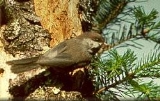
Boreal Chickadee

Encyclopedia
The Boreal Chickadee is a small passerine
bird
in the tit family
Paridae.
, Alaska
and the northern edges of the lower forty-eight United States
. They remain within their breeding range throughout the year, but sometimes move south in winter. Winter movements south of their range, however, appear to have become increasingly rare. They nest in a hole in a tree; the pair excavates the nest, using a natural cavity or sometimes an old woodpecker
nest. The pair remains together year round and may mate for life.
These birds forage on conifer branches or probe into the bark, eating mainly eat insects and seeds, which may be stored for later use. They often forage in small flocks including other small birds, especially in winter.
The call is a husky tsik-a-dee-dee, a variant on the call which gives chickadees their name.
sequence
data and morphology
suggest that separating Poecile more adequately expresses these birds' relationships (Gill et al., 2005). The American Ornithologists' Union
has been treating Poecile as a distinct genus for some time already. The genus name Poecile has often been treated as feminine (giving the species name ending hudsonica); however, this was not specified by the original genus author Johann Jakob Kaup
, and under the ICZN
the genus name must therefore be treated by default as masculine, giving the name ending hudsonicus (del Hoyo et al. 2007).
Passerine
A passerine is a bird of the order Passeriformes, which includes more than half of all bird species. Sometimes known as perching birds or, less accurately, as songbirds, the passerines form one of the most diverse terrestrial vertebrate orders: with over 5,000 identified species, it has roughly...
bird
Bird
Birds are feathered, winged, bipedal, endothermic , egg-laying, vertebrate animals. Around 10,000 living species and 188 families makes them the most speciose class of tetrapod vertebrates. They inhabit ecosystems across the globe, from the Arctic to the Antarctic. Extant birds range in size from...
in the tit family
Family (biology)
In biological classification, family is* a taxonomic rank. Other well-known ranks are life, domain, kingdom, phylum, class, order, genus, and species, with family fitting between order and genus. As for the other well-known ranks, there is the option of an immediately lower rank, indicated by the...
Paridae.
Description
Adults are 12.5–14.5 cm (4.9-5.7 in) long with a weight of 7–12.4 g (.24-.34 oz). They have grey-brown upperparts with a brown cap and greyish wings and tail; their face is mainly grey with white on the sides. Their underparts are white with brown on the flanks and a black throat. They have a short dark bill, short wings and a long notched tail.Behavior
Their breeding habitat is coniferous woods in CanadaCanada
Canada is a North American country consisting of ten provinces and three territories. Located in the northern part of the continent, it extends from the Atlantic Ocean in the east to the Pacific Ocean in the west, and northward into the Arctic Ocean...
, Alaska
Alaska
Alaska is the largest state in the United States by area. It is situated in the northwest extremity of the North American continent, with Canada to the east, the Arctic Ocean to the north, and the Pacific Ocean to the west and south, with Russia further west across the Bering Strait...
and the northern edges of the lower forty-eight United States
Contiguous United States
The contiguous United States are the 48 U.S. states on the continent of North America that are south of Canada and north of Mexico, plus the District of Columbia....
. They remain within their breeding range throughout the year, but sometimes move south in winter. Winter movements south of their range, however, appear to have become increasingly rare. They nest in a hole in a tree; the pair excavates the nest, using a natural cavity or sometimes an old woodpecker
Woodpecker
Woodpeckers are near passerine birds of the order Piciformes. They are one subfamily in the family Picidae, which also includes the piculets and wrynecks. They are found worldwide and include about 180 species....
nest. The pair remains together year round and may mate for life.
These birds forage on conifer branches or probe into the bark, eating mainly eat insects and seeds, which may be stored for later use. They often forage in small flocks including other small birds, especially in winter.
The call is a husky tsik-a-dee-dee, a variant on the call which gives chickadees their name.
Taxonomy
Often, it is still placed in the genus Parus with most other tits, but mtDNA cytochrome bCytochrome b
Cytochrome b/b6 is the main subunit of transmembrane cytochrome bc1 and b6f complexes. In addition, it commonly refers to a region of mtDNA used for population genetics and phylogenetics.- Function :...
sequence
DNA sequence
The sequence or primary structure of a nucleic acid is the composition of atoms that make up the nucleic acid and the chemical bonds that bond those atoms. Because nucleic acids, such as DNA and RNA, are unbranched polymers, this specification is equivalent to specifying the sequence of...
data and morphology
Morphology (biology)
In biology, morphology is a branch of bioscience dealing with the study of the form and structure of organisms and their specific structural features....
suggest that separating Poecile more adequately expresses these birds' relationships (Gill et al., 2005). The American Ornithologists' Union
American Ornithologists' Union
The American Ornithologists' Union is an ornithological organization in the USA. Unlike the National Audubon Society, its members are primarily professional ornithologists rather than amateur birders...
has been treating Poecile as a distinct genus for some time already. The genus name Poecile has often been treated as feminine (giving the species name ending hudsonica); however, this was not specified by the original genus author Johann Jakob Kaup
Johann Jakob Kaup
Johann Jakob Kaup was a German naturalist.-Biography:He was born at Darmstadt. After studying at Göttingen and Heidelberg he spent two years at Leiden, where his attention was specially devoted to the amphibians and fishes. He then returned to Darmstadt as an assistant in the grand ducal museum,...
, and under the ICZN
International Code of Zoological Nomenclature
The International Code of Zoological Nomenclature is a widely accepted convention in zoology that rules the formal scientific naming of organisms treated as animals...
the genus name must therefore be treated by default as masculine, giving the name ending hudsonicus (del Hoyo et al. 2007).
External links
- Stamps (for CanadaCanadaCanada is a North American country consisting of ten provinces and three territories. Located in the northern part of the continent, it extends from the Atlantic Ocean in the east to the Pacific Ocean in the west, and northward into the Arctic Ocean...
) with range map - Boreal Chickadee photo gallery at VIREO
- Photo-High Res--(Close-up); Article – mainebirdingtrail–"Maine's BorealBoreal ecosystemThe term boreal is usually applied to ecosystems localized in subarctic and subantarctic zones, although Austral is also used for the latter....
Species"
