

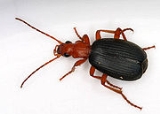
Bombardier beetle

Encyclopedia
Bombardier beetles are ground beetle
s (Carabidae) in the tribe
s Brachinini, Paussini, Ozaenini, or Metriini—more than 500 species
altogether—which are most notable for the defense mechanism that gives them their name: When disturbed, the beetle ejects
a noxious chemical spray in a rapid burst of pulses from special gland
s in its abdomen. The ejection is accompanied with a popping sound. A bombardier beetle produces and stores two reactant chemical compounds, hydroquinone
and hydrogen peroxide
, in separate reservoirs in the rear tip of its abdomen. When threatened, the beetle contracts muscles that force the two reactants through valved tubes into a mixing chamber containing water and a mixture of catalytic enzymes. When combined, the reactants undergo a violent exothermic
chemical reaction, raising the temperature to near the boiling point of water.
The corresponding pressure buildup forces the entrance valves from the reactant storage chambers to close, thus protecting the beetle's internal organs. The boiling, foul-smelling liquid partially becomes a gas (flash evaporation
) and is expelled through an outlet valve into the atmosphere with a loud popping sound. The flow of reactants into the reaction chamber and subsequent ejection to the atmosphere occurs cyclically at a rate of about 500 times per second and with the total pulsation period lasting for only a fraction of a second. The gland openings of some African bombardier beetles can swivel through 270° and thrust between the insect's legs, so it can be discharged in a multitude of directions with considerable accuracy.
These reactions release free oxygen and generate enough heat to bring the mixture to the boiling point and vaporize about a fifth of it. Under pressure of the released gases, the valve is forced closed, and the chemicals are expelled explosively through openings at the tip of the abdomen. Each time it does this, it shoots about 70 times very rapidly. The damage caused can be fatal to attacking insects and small creatures and is painful to human skin.
s are commonly produced by cells in the skin of insects to harden their skin into a cuticle, and as they taste bad to predators, many insects secrete them to deter predators. Where there are indentations in the cuticle, these vary to form little sacs that store the deterrent quinone. Where predators develop resistance to this chemical, other related chemicals such as hydroquinone
develop, and in many beetles, specialised cells secrete hydroquinone from gland
s connected by ducts to a reservoir sac, which can be closed off by muscles to stop leakage.
While all carabid beetles have this sort of arrangement, in some cases, hydrogen peroxide
, which is a common by-product of the metabolism of cells, is mixed in with the hydroquinone, and some of the catalase
s that exist in most cells makes the process more efficient. The chemical reaction produces heat and pressure, which pushes out the discharge when the insect is attacked, as in the beetle Metrius contractus, which produces a foamy discharge. In other bombardier beetles, the muscles stopping leakage have a flap forming a valve to ensure that the pressure pushes the discharge out, and muscles controlling the outlet have developed nozzles that can direct an explosive reaction to squirt the deterrent chemicals at an attacker. The exact sequence is unknown, and it is common for features with one purpose to become useful for other purposes, a process called exaptation
. More detailed scenarios have been developed showing a series of small changes that could have led to this mechanism.
and some other creationists
claim that the various components needed to make the system work could not have evolved, because they believe the components provide no benefit in themselves and therefore the entire system would have to have been created at once. Others such as intelligent design
proponent Michael Behe
and Answers in Genesis
, accept most of the scientific view but contend that "complexity" suggests an origin by design. Contrary to the creationist views, all necessary intermediate stages have been found in extant beetles within or closely related to the bombardier beetle family, with each intermediate giving an advantage to the organism.
Ground beetle
Ground beetles are a large, cosmopolitan family of beetles, Carabidae, with more than 40,000 species worldwide, approximately 2,000 of which are found in North America and 2,700 in Europe.-Description and ecology:...
s (Carabidae) in the tribe
Tribe (biology)
In biology, a tribe is a taxonomic rank between family and genus. It is sometimes subdivided into subtribes.Some examples include the tribes: Canini, Acalypheae, Hominini, Bombini, and Antidesmeae.-See also:* Biological classification* Rank...
s Brachinini, Paussini, Ozaenini, or Metriini—more than 500 species
Species
In biology, a species is one of the basic units of biological classification and a taxonomic rank. A species is often defined as a group of organisms capable of interbreeding and producing fertile offspring. While in many cases this definition is adequate, more precise or differing measures are...
altogether—which are most notable for the defense mechanism that gives them their name: When disturbed, the beetle ejects
Projectile use by living systems
Although projectiles are commonly used in human conflict, projectile use by living systems other than humans is relatively rare.-Liquid projectiles:...
a noxious chemical spray in a rapid burst of pulses from special gland
Gland
A gland is an organ in an animal's body that synthesizes a substance for release of substances such as hormones or breast milk, often into the bloodstream or into cavities inside the body or its outer surface .- Types :...
s in its abdomen. The ejection is accompanied with a popping sound. A bombardier beetle produces and stores two reactant chemical compounds, hydroquinone
Hydroquinone
Hydroquinone, also benzene-1,4-diol or quinol, is an aromatic organic compound that is a type of phenol, having the chemical formula C6H42. Its chemical structure, shown in the table at right, has two hydroxyl groups bonded to a benzene ring in a para position. It is a white granular solid...
and hydrogen peroxide
Hydrogen peroxide
Hydrogen peroxide is the simplest peroxide and an oxidizer. Hydrogen peroxide is a clear liquid, slightly more viscous than water. In dilute solution, it appears colorless. With its oxidizing properties, hydrogen peroxide is often used as a bleach or cleaning agent...
, in separate reservoirs in the rear tip of its abdomen. When threatened, the beetle contracts muscles that force the two reactants through valved tubes into a mixing chamber containing water and a mixture of catalytic enzymes. When combined, the reactants undergo a violent exothermic
Exothermic
In thermodynamics, the term exothermic describes a process or reaction that releases energy from the system, usually in the form of heat, but also in the form of light , electricity , or sound...
chemical reaction, raising the temperature to near the boiling point of water.
The corresponding pressure buildup forces the entrance valves from the reactant storage chambers to close, thus protecting the beetle's internal organs. The boiling, foul-smelling liquid partially becomes a gas (flash evaporation
Flash evaporation
Flash evaporation is the partial vapor that occurs when a saturated liquid stream undergoes a reduction in pressure by passing through a throttling valve or other throttling device. This process is one of the simplest unit operations...
) and is expelled through an outlet valve into the atmosphere with a loud popping sound. The flow of reactants into the reaction chamber and subsequent ejection to the atmosphere occurs cyclically at a rate of about 500 times per second and with the total pulsation period lasting for only a fraction of a second. The gland openings of some African bombardier beetles can swivel through 270° and thrust between the insect's legs, so it can be discharged in a multitude of directions with considerable accuracy.
Habitat
Bombardier beetles inhabit most of the continents, with the exceptions of Antarctica. They typically live in woodlands or grasslands in the temperate zones but can be found in other environments if there are moist places to lay their eggs.Behavior
Most species of bombardier beetles are carnivorous, including the larva. The beetle typically hunts at night for other insects, but will often congregate with others of its species when not actively looking for food.Defense mechanism
Secretory cells produce hydroquinones and hydrogen peroxide, which collect in a reservoir. The reservoir opens through a muscle-controlled valve onto a thick-walled reaction chamber. This chamber is lined with cells that secrete catalases and peroxidases. When the contents of the reservoir are forced into the reaction chamber, the catalases and peroxidases rapidly break down the hydrogen peroxide and catalyze the oxidation of the hydroquinones into p-quinones.These reactions release free oxygen and generate enough heat to bring the mixture to the boiling point and vaporize about a fifth of it. Under pressure of the released gases, the valve is forced closed, and the chemicals are expelled explosively through openings at the tip of the abdomen. Each time it does this, it shoots about 70 times very rapidly. The damage caused can be fatal to attacking insects and small creatures and is painful to human skin.
Evolution of the defense mechanism
When a bombardier beetle is threatened by a predator or an offensive invader of any kind, at the appropriate point of approach, the bombardier beetle swings its tail end around, and hot, noxious fluid heated to 100 °C (212 °F) is explosively released from twin combustion tubes into the face of the enemy. Various quinoneQuinone
A quinone is a class of organic compounds that are formally "derived from aromatic compounds [such as benzene or naphthalene] by conversion of an even number of –CH= groups into –C– groups with any necessary rearrangement of double bonds," resulting in "a fully conjugated cyclic dione structure."...
s are commonly produced by cells in the skin of insects to harden their skin into a cuticle, and as they taste bad to predators, many insects secrete them to deter predators. Where there are indentations in the cuticle, these vary to form little sacs that store the deterrent quinone. Where predators develop resistance to this chemical, other related chemicals such as hydroquinone
Hydroquinone
Hydroquinone, also benzene-1,4-diol or quinol, is an aromatic organic compound that is a type of phenol, having the chemical formula C6H42. Its chemical structure, shown in the table at right, has two hydroxyl groups bonded to a benzene ring in a para position. It is a white granular solid...
develop, and in many beetles, specialised cells secrete hydroquinone from gland
Gland
A gland is an organ in an animal's body that synthesizes a substance for release of substances such as hormones or breast milk, often into the bloodstream or into cavities inside the body or its outer surface .- Types :...
s connected by ducts to a reservoir sac, which can be closed off by muscles to stop leakage.
While all carabid beetles have this sort of arrangement, in some cases, hydrogen peroxide
Hydrogen peroxide
Hydrogen peroxide is the simplest peroxide and an oxidizer. Hydrogen peroxide is a clear liquid, slightly more viscous than water. In dilute solution, it appears colorless. With its oxidizing properties, hydrogen peroxide is often used as a bleach or cleaning agent...
, which is a common by-product of the metabolism of cells, is mixed in with the hydroquinone, and some of the catalase
Catalase
Catalase is a common enzyme found in nearly all living organisms that are exposed to oxygen, where it catalyzes the decomposition of hydrogen peroxide to water and oxygen...
s that exist in most cells makes the process more efficient. The chemical reaction produces heat and pressure, which pushes out the discharge when the insect is attacked, as in the beetle Metrius contractus, which produces a foamy discharge. In other bombardier beetles, the muscles stopping leakage have a flap forming a valve to ensure that the pressure pushes the discharge out, and muscles controlling the outlet have developed nozzles that can direct an explosive reaction to squirt the deterrent chemicals at an attacker. The exact sequence is unknown, and it is common for features with one purpose to become useful for other purposes, a process called exaptation
Exaptation
Exaptation, cooption, and preadaptation are related terms referring to shifts in the function of a trait during evolution. For example, a trait can evolve because it served one particular function, but subsequently it may come to serve another. Exaptations are common in both anatomy and behaviour...
. More detailed scenarios have been developed showing a series of small changes that could have led to this mechanism.
Creationist debate
Duane GishDuane Gish
Duane Tolbert Gish is an American biochemist and a prominent member of the creationist movement. Gish is a former vice-president of the Institute for Creation Research and the author of numerous publications on the subject of creation science. Gish has been called "creationism's T.H...
and some other creationists
Creationism
Creationism is the religious beliefthat humanity, life, the Earth, and the universe are the creation of a supernatural being, most often referring to the Abrahamic god. As science developed from the 18th century onwards, various views developed which aimed to reconcile science with the Genesis...
claim that the various components needed to make the system work could not have evolved, because they believe the components provide no benefit in themselves and therefore the entire system would have to have been created at once. Others such as intelligent design
Intelligent design
Intelligent design is the proposition that "certain features of the universe and of living things are best explained by an intelligent cause, not an undirected process such as natural selection." It is a form of creationism and a contemporary adaptation of the traditional teleological argument for...
proponent Michael Behe
Michael Behe
Michael J. Behe is an American biochemist, author, and intelligent design advocate. He currently serves as professor of biochemistry at Lehigh University in Pennsylvania and as a senior fellow of the Discovery Institute's Center for Science and Culture...
and Answers in Genesis
Answers in Genesis
Answers in Genesis is a non-profit Christian apologetics ministry with a particular focus on supporting Young Earth creationism and a literal interpretation of the Book of Genesis. The organization has offices in the United Kingdom and the United States...
, accept most of the scientific view but contend that "complexity" suggests an origin by design. Contrary to the creationist views, all necessary intermediate stages have been found in extant beetles within or closely related to the bombardier beetle family, with each intermediate giving an advantage to the organism.
External links
- Genus Brachinus — BugGuide.net: 3 photos, 1 micrograph, 1 b/w illustration