
All Topics  
Bloodstain pattern analysis

 
Bloodstain Pattern Analysis

   Email Print
   Bookmark   Link


Bloodstain pattern analysis


Bloodstain pattern analysis (BPA) is one of several specialties in the field of forensic science. The use of bloodstains as evidence
Haemotaphonomy

Haemotaphonomy or hemotaphonomy is the study of bloodstains, and especially of the changes in appearance and size of the Cell components, as well as the characteristics of their cell position and appearance in function of the superficial topography and composition of the substrate....
 is not new; however, the application of modern science has brought it to a higher level. New technologies, especially advances in DNA analysis, are available for detectives and criminologists to use in solving crimes and apprehending offenders.

The science of bloodstain pattern analysis applies scientific knowledge from other fields to solve practical problems. Bloodstain pattern analysis draws on the scientific disciplines of biology, chemistry, mathematics and physics.


Discussion
Ask a question about 'Bloodstain pattern analysis'
Start a new discussion about 'Bloodstain pattern analysis'
Answer questions from other users
Full Discussion Forum


Encyclopedia


Bloodstain pattern analysis (BPA) is one of several specialties in the field of forensic science. The use of bloodstains as evidence
Haemotaphonomy

Haemotaphonomy or hemotaphonomy is the study of bloodstains, and especially of the changes in appearance and size of the Cell components, as well as the characteristics of their cell position and appearance in function of the superficial topography and composition of the substrate....
 is not new; however, the application of modern science has brought it to a higher level. New technologies, especially advances in DNA analysis, are available for detectives and criminologists to use in solving crimes and apprehending offenders.

The science of bloodstain pattern analysis applies scientific knowledge from other fields to solve practical problems. Bloodstain pattern analysis draws on the scientific disciplines of biology, chemistry, mathematics and physics. If an analyst follows a scientific process, this applied science can produce strong, solid evidence, making it an effective tool for investigators.

Results of BPA

Not every result of BPA will qualify as incontrovertible evidence, but the following are some things a bloodstain pattern analyst may be able to determine conclusively and state as fact:

  • Movement and direction of persons or objects while they were shedding blood.
  • Position of persons or objects during bloodshed.
  • Movement of persons or objects after bloodshed.
  • The mechanism or object used to create a specific pattern.
  • The direction a stain was traveling when it was deposited.
  • The area of origin of an impact pattern.
  • The minimum number of impacts during an incident.
  • The sequence of events.


A basic understanding of blood spatter analysis allows first responding officers and investigators alike to assist in correctly collecting and preserving bloodstain data at the scene. If they know what they have at the scene, then based on their department policy they should know what they need to do next. Bloodstain pattern analysis requires sufficient education and training to be an effective investigative technique, which not all law enforcement officers attending a crime scene will necessarily have.

Bloodstain analysts receive specialized training. The foundation course in bloodstain pattern analysis is the Basic Bloodstain Pattern Analysis Course. This is taught at many government and private institutions. The course criteria were developed by the International Association of Bloodstain Pattern Analysts (IABPA)
International Association of Bloodstain Pattern Analysts

The International Association of Bloodstain Pattern Analysts was formed 18 November 1983 at the Hilton Hotel in Corning under the guidance of Herbert MacDonell....
 with the following stated purpose:

A course of instruction designed for investigators, crime scene technicians, forensic technicians, and others involved in criminal and medical-legal investigations and crime scene analysis. The course is intended to develop a fundamental knowledge of the discipline of bloodstain pattern analysis. The course should illustrate to the student basic principals of bloodstain pattern analysis and the practical application of the discipline to actual casework. The course syllabus is not intended to create an “instant” expert.

Beyond this basic course are conferences, seminars, and courses such as the Maths and Physics for BPA and The Advance Bloodstain Pattern Analysis Course, both of which are provided by the Ontario Police College (OPC)
Ontario Police College

The Ontario Police College is located in Malahide, Ontario, just east of Aylmer, Ontario, in Elgin County, Ontario in Southwestern Ontario....
 and the Royal Canadian Mounted Police
Royal Canadian Mounted Police

The Royal Canadian Mounted Police is the federal police, national police, and paramilitary police force of Canada, and one of the most recognized of its kind in the world....
 (RCMP). These two institutions also have Bloodstain Analyst Understudy programs. The International Association for Identification (IAI)
International Association for Identification

The International Association for Identification is the largest forensic organisation in the world.The IAI was originally formed as the "International Association for Criminal Identification" in October 1915....
 provides its own certification in bloodstain pattern analysis.

In addition to formal study of the subject, practical experience and experimentation is paramount in the development of a skilled bloodstain pattern analyst.

Bloodstain pattern categories

There are several different thoughts on how to classify and define bloodstain patterns. The following is one accepted way of categorizing them based on the mechanism that created the stain. The three stain groups are: Passive, Projected, and Transfer/Contact. The definitions used below are from the suggested IABPA
International Association of Bloodstain Pattern Analysts

The International Association of Bloodstain Pattern Analysts was formed 18 November 1983 at the Hilton Hotel in Corning under the guidance of Herbert MacDonell....
 terminology list:

Passive bloodstains

Passive bloodstains are those stains created by the force of gravity.

  • Passive Drops - Bloodstain drop(s) created or formed by the force of gravity acting alone.
  • Drip Pattern - A bloodstain pattern which results from blood dripping into blood.
  • Flow Pattern - A change in the shape and direction of a bloodstain due to the influence of gravity or movement of the object.
  • Pool Pattern - A bloodstain pattern formed when a source of blood is stationary for a period of time.


Projected bloodstains

A projected stain occurs when some form of energy has been transferred to a blood source.
  • Low Velocity Impact Spatter (LVIS) - A bloodstain pattern that is caused by a low velocity impact\force to a blood source.
  • Medium Velocity Impact Spatter (MVIS) - A bloodstain pattern caused by a medium velocity impact\force to a blood source. A beating typically causes this type of spatter.
  • High Velocity Impact Spatter (HVIS) - A bloodstain pattern caused by a high velocity impact\force to a blood source such as that produced by gunshot or high-speed machinery.
  • Cast-Off Pattern - A bloodstain pattern created when blood is released or thrown from a blood-bearing object in motion.
  • Arterial Spurting (OR Gushing) Pattern - Bloodstain pattern(s) resulting from blood exiting the body under pressure from a breached artery.
  • Back Spatter - Blood directed back towards the source of energy or force that caused the spatter.
  • Expiratory Blood - Blood that is blown out of the nose, mouth, or a wound as a result of air pressure and/or air flow which is the propelling force.


Transfer/Contact bloodstains

A transfer or contact stain is produced when an object with blood comes in contact with an object or surface that does not have blood. It may be possible to discern the object that left the blood impression.
  • Wipe Pattern - A bloodstain pattern created when an object moves through an existing stain, removing and/or altering its appearance.
  • Swipe Pattern - The transfer of blood from a moving source onto an unstained surface. Direction of travel may be determined by the feathered edge.


As indicated above, there are other terms currently used in BPA and different ways of classifying bloodstain patterns. For example there is a debate over the misnomer of the LVIS, MVIS, and HVIS as it relates to the physical term ‘’velocity’’. A sub-committee of the SWGSTAIN
Scientific Working Group - Bloodstain Pattern Analysis

The Scientific Working Group on Bloodstain Pattern Analysis was created in March 2002 at a meeting held by the FBI Laboratory at the FBI Academy in Quantico, Virginia....
 has been tasked with addressing the terminology issues and develop a taxonomy for bloodstain patterns.

"Velocity" impact stains

Contrary to what the name states, the terms low-, medium-, and high-velocity impact spatter do not describe the velocity of the blood droplets as they fly through the air. The variation in the "velocity" is meant to describe the amount of energy transferred to a blood source in order to create the stains. Velocity
Velocity

In physics, velocity is defined as the Derivative of Position vector. It is a vector physical quantity; both speed and direction are required to define it....
 is a speed (m/s) with a direction. Often the terms force
Force

In physics, a force is that which can cause an object with mass to change its velocity. Force has both Euclidean_vector#Length of a vector and Direction , making it a Vector quantity....
 and energy
Energy

In physics, energy is a scalar physical quantity that describes the amount of Work_ that can be performed by a force. Energy is an attribute of objects and systems that is subject to a conservation law....
 are quoted in conjunction with the unit ft/s or m/s which is incorrect. Force is related to velocity and mass (N or 1 kg ·m·s−2). Energy (work
Mechanical work

In physics, mechanical work is the amount of energy transferred by a force acting through a distance. Like energy, it is a scalar quantity, with SI of joules....
) is related to the force exerted on an object (J or N·m or kg·m2·s−2). As indicated above, there has been great debate over these terms and their definitions. Below is one method of differentiating low-, medium-, and high-velocity impact spatter.

Low velocity impact spatter

Low velocity impact spatter (LVIS) is generally produced when objects traveling less than 1.5 m/s come in contact with a blood source. The preponderance of stains is generally larger than 3 mm in diameter.

Medium velocity impact spatter

Medium velocity impact spatter (MVIS) is generally produced when objects traveling between 1.5 m/s and 7.5 m/s come in contact with a blood source. The preponderance of stains is generally between 1 mm and 3 mm in diameter. Mechanisms that could produce this type of pattern include blunt force trauma or cutting/stabbing actions.

High velocity impact spatter

High velocity impact spatter (HVIS) is generally produced when objects traveling greater than 30 m/s come in contact with a blood source. The preponderance of stains is generally smaller than 1 mm in diameter. This pattern often has a mist-like appearance. High velocity patterns may be created by gunshots or explosives, but may also be caused by industrial machinery, coughing, or sneezing.

Blood

Blood is a tissue that is circulated within the body to assist other parts of the body. This connective tissue has specialized cells that allow it to carry out its complex functions. For a healthy person, approximately 8% of their total weight is blood. For a 70 kg (154 lbs) individual, this equates to 5.6 litres (1.5 US gallons, or 12 US pints).

Biological considerations

Blood contains three components suspended within plasma
Blood plasma

Blood plasma is the liquid component of blood, in which the blood cells are suspended. It makes up about 55% of total blood volume. It is composed of mostly water , and contains dissolved proteins, glucose, clotting factors, mineral ions, Hormone and carbon dioxide ....
. The three components are erythrocytes, leukocytes, and platelets.

  • Erythrocytes - also known as red blood cells, are transporters. The role of erythrocytes is to transport oxygen. To do this it produces great quantities of hemoglobin, which gives it the distinct red colour. Blood that has passed through the heart and been oxygenated (in the arteries) tends to have a brighter shade of red as opposed to blood that is returning to the heart (in the veins). There are about 30 trillion erythrocytes circulating in the human blood at any given time.


  • Leukocytes - also known as white blood cells, are defenders. The role of leukocytes is to defend the body against harmful bacteria and microorganisms. There are five different types of leukocytes all having different sizes, shapes, structures, and functions. Leukocytes fight infection and disease. There are about 430 billion leukocytes circulating in the human blood at any given time (~1 per 700 erythrocytes).


  • Platelets - are pieces of larger cells that have broken off in the bone marrow. These bits of cytoplasm are enclosed by a membrane and do not have a nucleus. They play a major role in haemostasis (control of bleeding) by plugging up a breach in a vessel.


Plasma is a yellowish fluid that carries the suspended erythrocytes, leukocytes, and platelets. It is composed of water (92%), proteins (7%), and other materials such as salts, waste, and hormones, among others. Plasma makes up about 55% of blood. The remaining 45% is blood cells and platelets. Because plasma is lighter than the blood cells and platelets, it can be easily separated. Plasma does not separate from blood cells in the body because it is in a constant state of agitation.

Physical considerations

In physics there are two continuous physical
Continuum mechanics

Continuum mechanics is a branch of mechanics that deals with the analysis of the kinematics and mechanical behavior of materials modeled as a continuum, e.g., solids and fluids ....
 states of matter, solid and fluid. Once blood has left the body it behaves as a fluid and all physical laws apply.

  • Gravity - is acting on blood (without the body's influence) as soon as it exits the body. Given the right circumstances blood can act according to ballistic theory.


  • Viscosity - is the amount of internal friction in the fluid. It describes the resistance of a liquid to flow.


  • Surface tension - is the force that gives the ability to blood to maintain its shape. When two fluids are in contact with each other (blood and air) there are forces attracting all molecules to each other.


Blood spatter flight characteristics

Experiments with blood have shown that a drop of blood tends to form into a sphere in flight rather than the artistic teardrop shape. This is what one would expect of a fluid in freefall. The formation of the sphere is a result of surface tension
Surface tension

Surface tension is an attractive property of the surface of a liquid. It is what causes the surface portion of liquid to be attracted to another surface, such as that of another portion of liquid ....
 that binds the molecules together.

This spherical shape of blood in flight
Fluid dynamics

In physics, fluid dynamics is the sub-discipline of fluid mechanics dealing with fluid flow — the natural science of fluids in motion....
 is important for the calculation of the angle of impact (incidence) of blood spatter when it hits a surface. That angle will be used to determine the point from which the blood originated which is called the Point of Origin or more appropriately the Area of Origin.

A single spatter of blood is not enough to determine the Area of Origin at a crime scene. The determination of the angles of impact and placement of the Area of Origin should be based on the consideration of a number of stains and preferably stains from opposite sides of the pattern to create the means to triangulate.

Determining angles of impact

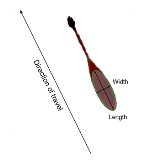
As mentioned earlier a blood droplet in freefall has the shape of a sphere. Should the droplet strike a surface and a well-formed stain is produced, an analyst can determine the angle at which this droplet struck the surface. This is based on the relationship between the length of the major axis, minor axis, and the angle of impact.

A well-formed stain is in the shape of an ellipse (see figure 1). Dr. Victor Balthazard, and later Dr. Herbert Leon MacDonell, realized the relationship of the width-length ratio of the ellipse was the function of the sine of the impact angle. Accurately measuring the stain will easily result in the calculation the impact angle.


Angles of Impact


Because of the three dimensional aspect of trajectories there are three angles of impact, , , and . The easiest angle to calculate is gamma ('). Gamma is simply the angle of the bloodstain path measured from the true vertical (plumb) of the surface (see figure 2 showing plumb line and extended angle from stain.) The next angle that can be quite easily calculated is alpha . Alpha is the impact angle of the bloodstain path moving out from the surface (see figure 2 with alpha at the top by the stain.) The third angle to be calculated is beta . Beta is the angle of the bloodstain path pivoting about the vertical (z) axis (see figure 2 with beta extended to the floor). All three angles are related through trigonometry through the equation quoted below.

Calculating the angle


= length of ellipse (major axis)
= width of ellipse (minor axis)
= angle of impact


The relationship between these variables is:


Therefore:


Relationship between angles , , and


Accurately measuring the stain and calculating the angle of impact requires due diligence of the analyst. In the past analysts have used a variety of instruments. Methods currently used include:

  • Viewing loop with an embedded scale in 0.2 mm increments or better that is placed over the stain. The analyst then uses a scientific calculator or spreadsheet to complete the angle calculations.
  • Bloodstain Pattern Analysis (BPA) software that superimposes an ellipse over a scaled close-up image of an individual bloodstain. The programs then automatically calculates the angles of impact.


Using software produces a very accurate result that is measurable and reproducible.

Point and area of convergence

To determine the point/area of convergence an analyst has to determine the path the blood droplets travelled. The tangential flight path of individual droplets can be determined by using the angle of impact and the offset angle of the resulting bloodstain. “Stringing” stains is a method of visualizing this. For the purpose of the point of convergence, only the top view of the flight paths is required. Note that this is a two-dimensional (2D) and not a three-dimensional (3D) intersection.

  • The point of convergence is the intersection of two bloodstain paths, where the stains come from opposite sides of the impact pattern. (see figure 3)


  • The area of convergence is the box formed by the intersection of several stains from opposite sides of the impact pattern. (see figure 4)


In the past, some analysts have drawn lines along the major axes of the stains and brought them to an area of convergence on the wall. Instead of using a top-down view, they used a front view. This provides a false point/area of convergence.


Area of origin

The
area of origin is the area in three-dimensional space where the blood source was located at the time of the bloodletting incident. The area of origin includes the area of convergence with a third dimension in the z direction. Since the z-axis is perpendicular to the floor, the area of origin has three dimensions and is a volume.

The term point of origin has also been accepted to mean the same thing. However it has been argued, there are problems associated to this term. First, a blood source is not a point source. To produce a point source the mechanism would have to be fixed in three-dimensional space and have an aperture where only a single blood droplet is released at a time, with enough energy to create a pattern. This does not seem likely. Second, bodies are dynamic. Aside from the victim physically moving, skin is elastic and bones break. Once a force is applied to the body there will be an equal and opposite reaction to the force applied by the aggressor (Newton's third law of motion
Laws of motion

In physics, a number of noted theories of the motion of objects have developed. Among the best-known are:* Newton's laws of motion* Kepler's laws of planetary motion ...
). Part of the force will move the blood source, even a millimetre, and change the origin while it is still producing blood. So the source becomes contained in a three-dimensional volume, or region.

As with the area of convergence, the area of origin is easily calculated by using BPA software. There are other longer, mathematical methods of determining the area or origin, one of which is the tangential method.

IABPA definition:

  • Point (Area) of Origin - The common point (area) in three-dimensional space to which the trajectories of several blood drops can be retraced. (see figure 5)


Bpa Origin


Photography

Crime scene photography has some unique requirements. In the event there is a bloodletting scene, the basics are still required but special attention must be given to the bloodstains. The current means of documenting the scene include, 35 mm (B&W, colour, and specialty film), digital cameras (such as Nikon D200 among others), and video (Hi-8, DV, and other formats). Each method has its pros and cons. Often the scene is documented using multiple methods. (Videography
Videography

File:Seattle - Pain in the Grass - 1995 - audience 02.jpg.JPGVideography refers to the process of capturing moving s on electronic media . The term includes methods of electronic production and post production....
 has been included here because it follows the same principles and provides crime scene images.)

There are three types of crime scene photos:

  • Overallwide-angle
    Wide-angle lens

    In photography and cinematography, a wide-angle lens is a Photographic lens whose focal length is substantially shorter than the focal length of a normal lens for the image size produced by the camera, whether this is dictated by the dimensions of the image frame at the film plane for film cameras or dimensions of the digital photography...
     images (28-35 mm range) that capture the scene as it is. This type of image provides anyone who has not been in the scene a good overall layout.


  • Mid-range – images taken with a normal lens
    Normal lens

    In photography and cinematography a normal lens is a photographic lens that generates images that generally look "natural" to a human observer under normal viewing conditions, as compared with lenses with longer or shorter focal lengths....
     (45-55 mm range) give greater detail than the overall shots. In the case of a bloodletting scene, the mid-range image could capture a single bloodstain pattern.


  • Close-up
    Macro photography

    Macro photography is close-up photography. The classical definition is that the projected on the "film plane" is close to the same size as the subject....
     – images taken with a macro lens giving the greatest amount of detail. For example, a medium velocity impact pattern can contain thousands of individual stains where there is a preponderance of small stains (1-3 mm in diameter) some of which require individual images.


Many times an analyst cannot attend a bloodletting scene. Therefore, the analyst may have to do all his work based on the crime scene images and notes of the person who attended. An appropriate sized scale should be in overall, mid-range, and close-up images. For overall images the scales should be parallel and perpendicular to the floor. This provides the analyst, and anyone else who looks at the images, a proper perspective on what they are observing. (Note: in some cases overall and mid-range images are taken with and without a scale.)

In popular culture

  • In the 1936 Charlie Chan
    Charlie Chan

    File:Charliechanfeb0539.jpgCharlie Chan is a fictional character Chinese American detective created by Earl Derr Biggers, who acknowledged that he was inspired by the career of Honolulu policeman Chang Apana....
     movie "Murder at the Racetrack," the detective teaches Honolulu police about blood spatter patterns.
  • Serial killer Dexter Morgan
    Dexter Morgan

    Dexter Morgan is a fictional character in a series of novels by Jeff Lindsay , including Darkly Dreaming Dexter , Dearly Devoted Dexter , Dexter in the Dark and Dexter by Design ....
     of the Dexter novels and Showtime
    Showtime

    Showtime is a Pay TV brand used by a number of channels and platforms around the world, but primarily refers to a group of channels in the United States....
     series is a blood spatter expert for the Miami Metro Police Department.
  • Catherine Willows
    Catherine Willows

    Catherine Willows is a fictional character on the CBS television series CSI: Crime Scene Investigation. She is employed as a crime-scene investigator supervisor and forensic scientist for Clark County, Nevada, which contains the city of Las Vegas, Nevada....
     is a blood spatter analyst on the CBS series CSI: Crime Scene Investigation
    CSI: Crime Scene Investigation

    CSI: Crime Scene Investigation is an American Police procedural television series. CSI premiered on CBS on October 6, 2000. The ninth season began airing on October 9, 2008 and currently airs in the United States of America on Thursdays at 9:00 p.m....
    .


External links