
All Topics  
Watts Riots


   Email Print
   Bookmark   Link


Watts Riots


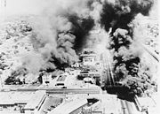
The term Watts Riots of 1965 refers to a large-scale race riot
Race riot

A race riot or racial riot is an outbreak of violent civil disorder in which Race is a key factor. The term had entered the English language in the United States by the 1890s....
 which lasted 6 days in the Watts
Watts, Los Angeles, California

Watts is a residential district in southern Los Angeles, California ....
 neighborhood
List of districts and neighborhoods of Los Angeles

This is a list of the districts and neighborhoods of the city of Los Angeles. The districts are organized by region....
 of Los Angeles, California
Los Angeles, California

Los Angeles is the largest city in the U.S. state of California and the List of United States cities by population in the United States. Often abbreviated as L.A. and nicknamed The City of Angels, Los Angeles is rated as a beta global city, has an estimated population of 3.8 million and spans over in Southern California....
, in August 1965. By the time the riot subsided, 34 people had been killed, 1,032 injured, and 3,952 arrested. It would stand as the worst riot in Los Angeles history until eclipsed by the Los Angeles riots of 1992.
tually, the California National Guard
United States National Guard

The National Guard of the United States is a Military reserve force composed of U.S. state National Guard militia members or units under federally recognized active or inactive Military of the United States service for the United States ....
 was called to active duty to assist in controlling the rioting.


Discussion
Ask a question about 'Watts Riots'
Start a new discussion about 'Watts Riots'
Answer questions from other users
Full Discussion Forum


Recent Posts


Encyclopedia


The term Watts Riots of 1965 refers to a large-scale race riot
Race riot

A race riot or racial riot is an outbreak of violent civil disorder in which Race is a key factor. The term had entered the English language in the United States by the 1890s....
 which lasted 6 days in the Watts
Watts, Los Angeles, California

Watts is a residential district in southern Los Angeles, California ....
 neighborhood
List of districts and neighborhoods of Los Angeles

This is a list of the districts and neighborhoods of the city of Los Angeles. The districts are organized by region....
 of Los Angeles, California
Los Angeles, California

Los Angeles is the largest city in the U.S. state of California and the List of United States cities by population in the United States. Often abbreviated as L.A. and nicknamed The City of Angels, Los Angeles is rated as a beta global city, has an estimated population of 3.8 million and spans over in Southern California....
, in August 1965. By the time the riot subsided, 34 people had been killed, 1,032 injured, and 3,952 arrested. It would stand as the worst riot in Los Angeles history until eclipsed by the Los Angeles riots of 1992.

Government Intervention

Eventually, the California National Guard
United States National Guard

The National Guard of the United States is a Military reserve force composed of U.S. state National Guard militia members or units under federally recognized active or inactive Military of the United States service for the United States ....
 was called to active duty to assist in controlling the rioting. On Friday night, a battalion of the 160th Infantry and the 1st Reconnaissance Squadron of the 18th Armored Cavalry were sent into the riot area (about 2,000 men). Two days later, the remainder of the 40th Armored Division was sent into the riot zone. A day after that, units from northern California arrived (a total of around 15,000 troops). These National Guardsmen put a cordon around a vast region of South Central Los Angeles, and for all intents and purposes the rioting was over by Sunday. Due to the seriousness of the riots, martial law had been declared. The initial commander of National Guard troops was Colonel Bud Taylor, then a motorcycle patrolman with the Los Angeles Police Department, who in effect became superior to Chief of Police Parker. National Guard units from Northern California were also called in, including Major General Clarence H. Pease, former commanding general of the National Guard's 49th Infantry Division
49th Infantry Division (United States)

The 49th Infantry Division was a unit of the United States Army formed from the 52nd Infantry Division.The 52nd Infantry Division was activated on 15 August 1946, and was allocated to the State of California as a California National Guard division during the post World War II demobilization....
.

Watts: then and now

Since this area was known to be under much racial and social tension, debates have surfaced over what really happened in Watts. Reactions and reasoning about the Watts incident greatly vary because those affected by and participated in the chaos that followed the original arrest were from a diverse crowd. The government tried to help by releasing The McCone Report, claiming that it was a detailed study of the riot, but it turned out to be a short summary with just 15 pages of the report devoted to actually describing the whole event. More opinions and explanations then appeared as other sources attempted to explain the causes as well. Public opinion polls have showed that around the same percentage of people believed that the riots were linked to Communist groups as those that blame social problems like unemployment and prejudice as the cause. Those opinions concerning racism and discrimination emerged only three years after hearings conducted by a committee of the U.S. Commission on Civil Rights took place in Los Angeles to assess the condition of relations between the police force and minorities. The purpose of these hearings was also to make a ruling on the discrimination case against the police for their mistreatment of Black Muslims. These different arguments and opinions still continue to promote these debates over the underlying cause of Watts Riots. Martin Luther King Jr. spoke two days after the riots happened in Watts.

A California gubernatorial commission investigated the riots, identifying the causes as high unemployment
Unemployment

File:World map of countries by rate of unemployment.pngUnemployment occurs when a person is available to work and currently seeking work, but the person is without Wage labour....
, poor schools, and other inferior living conditions. Subsequently, the government made little effort to address the problems or repair damages. The riots were also a response to Proposition 14, a constitutional amendment sponsored by the California Real Estate Association that had in effect repealed the Rumford Fair Housing Act. Today, Watts still faces problems of poverty, crime, and poor education, but racial issues and the violence it has caused have decreased considerably since the outbreak of the riots.

Cultural references

  • The film There Goes My Baby
    There Goes My Baby

    There Goes My Baby may refer to:*"There Goes My Baby ", a 1959 single by Ben E. King and The Drifters*"There Goes My Baby", a song Donna Summer from her 1984 album Cats Without Claws...
     features the riots.
  • Singer-songwriter Phil Ochs
    Phil Ochs

    Philip David Ochs was a United States protest song and songwriter who was known for his sharp wit, sardonic humor, earnest humanism, political activism, insightful and alliterative lyrics, and haunting voice....
     composed in "In the Heat of the Summer" about the riots, shortly after they took place. The song was most famously covered by Judy Collins
    Judy Collins

    Judith Marjorie Collins is an United States folk singer and pop standards singer and songwriter, known for the stunning purity of her soprano; for her eclectic tastes in the material she records ; and for her social activism....
    , who included it on her Fifth Album
    Fifth Album (Judy Collins album)

    Fifth Album was an album by Judy Collins, released in 1965. It peaked at No. 69 on the Billboard charts Pop Albums charts.It featured a collection of traditional ballads and singer-songwriter material from Bob Dylan, Richard Fari?a, Phil Ochs and Malvina Reynolds....
     in late 1965.
  • The novel The New Centurions
    The New Centurions (novel)

    The New Centurions, written by Joseph Wambaugh, is a novel depicting the stresses of police work in Los Angeles, California in the early 1960s....
    , by Joseph Wambaugh
    Joseph Wambaugh

    Joseph Aloysius Wambaugh, Jr. is an United States writer known for his fictional and non-fictional accounts of police work in the United States....
    , not only culminates in the Watts Riot but examines the negative impact of racist police in minority communities in the years preceding it.
  • In the film Dark Blue
    Dark Blue

    Dark Blue is a 2003 in film film directed by Ron Shelton and starring Kurt Russell. The film is based on a story written for film by crime novelist James Ellroy and takes place during the days leading to and including the Rodney King trial verdict....
     (set during the Rodney King Riots), Detective Eldon Perry (Kurt Russell
    Kurt Russell

    'Kurt Vogel Russell' is an United States actor and celebrity. He started acting as a child in Hollywood films during the 1960s, and has continued appearing in a wide variety of films since, including The Thing , Big Trouble in Little China, Escape from New York, Silkwood, Stargate , Backdraft , Tombstone , Vanilla...
    ) talks about being a teenager during the Watts Riots. He talks of being with his father (an L.A. Police Officer) and shooting several African Americans who were looting a Woolworth
    F. W. Woolworth Company

    The F. W. Woolworth Company was a retailing company that was one of the original United States Five and dime. The first Woolworth's store was founded, with a loan of $300, in 1878 by Frank Woolworth....
    's store with his Daddy's hunting rifle before the burning Woolworths collapsed on the remaining looters.
  • Frank Zappa
    Frank Zappa

    Frank Vincent Zappa was an American composer, electric guitarist, record producer, and film director. In a career spanning more than 30 years, Zappa wrote rock music, jazz, electronic music, orchestral, and musique concr?te works....
     wrote a lyrical commentary inspired by the Watts Riots, entitled "Trouble Every Day", containing such lines as "Wednesday I watched the riot / Seen the cops out on the street / Watched 'em throwin' rocks and stuff /And chokin' in the heat". The song was originally released on his debut album Freak Out!
    Freak Out!

    Freak Out! is the debut album by American experimental rock band The Mothers of Invention, released June 27, 1966 on Verve Records. Though often cited as one of rock music's first concept albums, the real unifying theme of the album is not musical, but a satirical attitude based on frontman Frank Zappa's unique perception of American pop...
     (with the original Mothers of Invention
    The Mothers of Invention

    The Mothers of Invention was an American rock and roll band active from 1964 to 1975. They mainly performed works by and were the original recording group of composer and guitarist Frank Zappa, although other members have an occasional writing credit....
    ), and later slightly rewritten as "More Trouble Every Day", available on Roxy and Elsewhere and The Best Band You Never Heard In Your Life
    The Best Band You Never Heard in Your Life

    The Best Band You Never Heard in Your Life is a double disc live album by Frank Zappa, released in 1991 . The album was one of three to be recorded during the 1988 world tour, along with Broadway the Hard Way and Make a Jazz Noise Here....
    , among other albums.
  • The title article in Tom Wolfe
    Tom Wolfe

    Thomas Kennerly Wolfe, Jr. , known as Tom Wolfe, is a best-selling United States author and journalist. He is one of the founders of the New Journalism movement of the 1960s and 1970s....
    's collection of essays, The Pump House Gang
    The Pump House Gang

    The Pump House Gang is a 1968 collection of essays and journalism by Tom Wolfe. The stories in the book explored various aspects of the counterculture of the 1960s....
    , is about a group of surfers from Windansea Beach
    Windansea Beach

    Windansea Beach encompasses a historic stretch of scenic coastline located in La Jolla, San Diego, California, a community in San Diego, California....
     in La Jolla, California who "attended the Watts riots as if it were the Rose Bowl game in Pasadena
    Pasadena, California

    Pasadena is a city in Los Angeles County, California, California, United States. Famous for hosting the annual Rose Bowl Game American football game and the Tournament of Roses Parade, Pasadena is the home of many leading scientific and cultural institutions, including the California Institute of Technology , the Jet Propulsion Laboratory ,...
    ." (See for an excerpt.)
  • In the U.S. television series, Quantum Leap, an episode called "Black and White on Fire" features Sam Beckett (Scott Bakula
    Scott Bakula

    Scott Stewart Bakula is an United States of America actor. His most prominent roles have been as Sam Beckett in the science fiction television series Quantum Leap , and as Captain Jonathan Archer in Star Trek: Enterprise....
    ) put into the body of a black medical student who is in love with the white daughter of a police captain. This episode begins on the eve of the Watts riots.
  • The rallying cry of "burn, baby, burn" came from KGFJ
    KYPA

    KYPA is a Korean language radio station in Los Angeles, California. It is owned by Multicultural Broadcasting.The format includes various shows that serve the largest Korean peninsula population in the United States....
     radio personality Magnificent Montague
    Magnificent Montague

    Nathaniel "Magnificent" Montague , , is an American R&B disc jockey notable not only for the soul music records he helped promote on KGFJ Los Angeles and WWRL New York, but whose trademark catch-phrase, "Burn, baby! Burn!" became the rallying cry of the Watts riots....
    . Montague was not directly responsible; he was fond of yelling "Burn!" when he played a record that particularly interested him and his listeners followed suit when they called him on the air.
  • "BURNBABY" is the master ignition routine in the Apollo Lunar Module
    Apollo Lunar Module

    The Apollo Lunar Module was the Lander portion of the Apollo spacecraft built for the United States Apollo program by Grumman to achieve the transit from cislunar orbit to the surface and back....
    's guidance software, named in an allusion to contemporary civil unrest. (See and )
  • "Burn, Baby, Burn" is also the title of an episode of the television series Dark Skies
    Dark Skies

    Dark Skies is a government UFO conspiracy theory-based sci-fi drama television series from United States which aired during the 1996-1997 season for 18 episodes, plus a two-hour pilot episode....
    , which takes place in the midst of the Watts riots.
  • "Burn, baby" is used as a battle cry
    Battle Cry

    Battle Cry is a novel by United States writer Leon Uris, published in 1953. Many of the events in the book are based on Uris's own World War II experience with the 6th Marine Regiment ....
     by Axel
    Axel

    Axel is a Scandinavian and German language masculine given name, which is also used in parts of the English-speaking world. Axel is a Scandinavian form of the name Absalom meaning "Father of peace"....
     in Kingdom hearts II
    Kingdom Hearts II

    is an action role-playing game developed by Square Enix and published by Disney Interactive Studios and Square Enix in 2005 for the Sony Computer Entertainment PlayStation 2 video game console....
    .
  • A fictitious version of the Watts riots is depicted in the NBC miniseries The '60s.
  • The 1990 film Heat Wave depicts the Watts Riots from the perspective of journalist Bob Richardson
    Bob Richardson

    Bob Richardson may refer to:*Bob Richardson *Bob Richardson *Robert W. Richardson , editor of Narrow Gauge News...
     as a resident of Watts and a reporter of the riots for the LA Times.
  • The 1993 movie Menace II Society
    Menace II Society

    Menace II Society is a 1993 in film hood film and the directorial debut of twin brothers Hughes Brothers. The hit movie gained notoriety for its frequent scenes of violence, profanity and drug content....
     also made mentioning of the infamous riots in the beginning of the film as a precursor to the slowly emerging drug and gang culture in Los Angeles.
  • Uncle Phil from the Fresh Prince of Bel Air says he was at the Watts Riots.
  • In the first chapter of the novel Blood on the Moon
    Blood on the Moon (novel)

    Blood on the Moon is a crime fiction by James Ellroy. It is the first installment of the Lloyd Hopkins Trilogy. It was followed by Because the Night and Suicide Hill ....
     by James Ellroy
    James Ellroy

    James Ellroy is an United States crime writer and essayist.Ellroy is known for his spartan writing style, which, in its omission of connecting words, has been compared to telegraph communication....
    , Lloyd Hopkins, the main character, participates in the pacification of the Watts neighbourhood as a member of the National Guard
    United States National Guard

    The National Guard of the United States is a Military reserve force composed of U.S. state National Guard militia members or units under federally recognized active or inactive Military of the United States service for the United States ....
    . He later becomes an L.A.P.D. officer.
  • The riot is mentioned in the film American History X
    American History X

    American History X is an Academy Award-nominated 1998 film directed by Tony Kaye . The lead actor, Edward Norton, was nominated for an Academy Award for Best Actor for his performance....
     in which the Nazi skinhead main character Derek Vinyard argues with his mother and her date about how racial tensions build into riots.
  • The riot may have been the inspiration for the song "Down Rodeo
    Down Rodeo

    "Down Rodeo" was a promotional single by Rage Against the Machine sent out to various American radio stations. The song was to be the third single taken from their Evil Empire album, although a domestic single and video was never released....
    " by L.A. band Rage Against the Machine
    Rage Against the Machine

    Rage Against the Machine is an American Rock music band, formed in Los Angeles, California in 1991. The band's lineup, unchanged since formation, consists of vocalist Zack de la Rocha, guitarist Tom Morello, bassist Tim Commerford, and drummer Brad Wilk....
    .
  • Conquest of the Planet of the Apes
    Conquest of the Planet of the Apes

    Conquest of the Planet of the Apes , directed by J. Lee Thompson, is the fourth film of the Planet of the Apes series. It explores mankind's future history, as established in Escape from the Planet of the Apes , and is the most violent sequel in the series....
    , the 4th film in the Planet of the Apes
    Planet of the Apes

    Planet of the Apes is a novel by Pierre Boulle, originally published in 1963 in French language as La Plan?te des singes. As :fr:singe means both "ape" and "monkey," Xan Fielding called his translation Monkey Planet....
     film series, reputedly drew inspiration from the Watts Riots.
  • California punk rock
    Punk rock

    Punk rock is a rock music genre that developed between 1974 and 1976 in the United States, the United Kingdom, and Australia. Rooted in garage rock and other forms of what is now known as protopunk music, punk rock bands eschewed the perceived excesses of mainstream 1970s rock....
     band American Steel
    American Steel

    American Steel is an American punk rock band formed in 1995 in Oakland, California. When offered their first show, the group took their name from the block-long sign on the warehouse across the street....
    , in their song "Loaded Gun", reference the riots in the line "I didn't see Watts burn, but I felt the embers."
  • The song "One More Time" by The Clash
    The Clash

    The Clash were an English Rock music band that formed in 1976 as part of the original wave of British punk rock. Along with punk rock, they experimented with reggae, ska, Dub music, funk, Hip hop music and rockabilly....
     from the album Sandinista!
    Sandinista!

    This article is about the pop album. For information about the political organisation see, Sandinista National Liberation Front.Sandinista! is the fourth studio album by the punk rock band The Clash....
     contains the verse "You don't need no silicone to calculate poverty/ watch when Watts Town burns again, the bus goes to Montgomery."
  • The band My Life With the Thrill Kill Kult
    My Life With the Thrill Kill Kult

    My Life with the Thrill Kill Kult is an American electronic industrial music band originally based out of Chicago, Illinois....
     has a song titled "Rivers of blood, years of darkness," which may or may not have relation to the book of the same title written by Robert Conot. (The book relates to the riots and is listed below in further reading)
  • On the television series Sanford and Son
    Sanford and Son

    Sanford and Son is an American sitcom that premiered on the NBC television network on January 14, 1972 in television, and was broadcast for six seasons....
    , set in Watts, Lamont is presented a toaster from his uncle Edgar. Edgar claimed he bought the toaster as a gift, but Fred Sanford said "You know good and well you didn't buy that toaster. That's something you had left from the riots."
  • There is an album by Don Adams recorded in 1969 which was not released until 2007 by sonorama records called "Watts Happening"
  • Referenced in the poem Speak White
    Speak White

    Speak White is a French language poem composed by Qu?b?cois writer Mich?le Lalonde in 1968. It was first recited in 1970 and was published in 1974 by Editions de l'Hexagone, Montreal....
     composed by Québécois writer Michèle Lalonde in 1968


See also

  • 1992 Los Angeles riots
    1992 Los Angeles riots

    The Los Angeles Riots of 1992, also known as the Rodney King uprising or the Rodney King riots, were sparked on April 29, 1992 when a jury acquittal four police officers accused in the videotaped beating of black motorist Rodney King following a high-speed pursuit....
  • Watts Prophets
  • Wattstax
    Wattstax

    Wattstax is a 1973 documentary film by Mel Stuart that focused on the 1972 Wattstax music festival and the African American community of Watts, Los Angeles, California in Los Angeles, California....
  • Rodney King
    Rodney King

    Rodney Glen King is an African-American man who, on March 3, 1991, was the victim in an excessive force case committed by Los Angeles Police Department....
  • Zoot Suit Riots
    Zoot Suit Riots

    "Zoot Suit Riot" directs here. For the album by the Cherry Poppin' Daddies, see "Zoot Suit Riot ". For the song off the album, see "Zoot Suit Riot "...
  • Urban riots
    Urban riots

    Riots often occur in reaction to a perceived grievance or out of dissent. Riots may be the outcome of a sporting event, although many riots have occurred due to poor working or living conditions, government oppression, conflicts between races or religions....


Further reading

  • Cohen, Jerry and William S. Murphy, Burn, Baby, Burn! The Los Angeles Race Riot, August 1965, New York: Dutton, 1966.
  • Conot, Robert, Rivers of Blood, Years of Darkness, New York: Bantam, 1967.
  • Guy Debord
    Guy Debord

    Guy Ernest Debord was a French Marxist theorist, writer, filmmaker, Hypergraphics and founding member of the groups Lettrist International and Situationist International ....
    , Decline and Fall of the Spectacle-Commodity Economy, 1965.
  • Horne, Gerald, Fire This Time: The Watts Uprising and the 1960s, Charlottesville: University of Virginia Press, 1995.
  • Thomas Pynchon
    Thomas Pynchon

    Thomas Ruggles Pynchon, Jr. is an American literature based in New York City, noted for his dense and complex works of fiction. Hailing from Long Island, Pynchon spent two years in the United States Navy and earned an English studies degree from Cornell University....
    , "A Journey into the Mind of Watts", 1966.
  • Violence in the City -- An End or a Beginning?, A Report by the Governor's Commission on the Los Angeles Riots, 1965, John McCone
    John McCone

    John Alexander McCone was an United States of America businessman and politician who served as Director of Central Intelligence during the height of the Cold War....
    , Chairman, Warren M. Christopher, Vice Chairman. \
  • David O' Sears The politics of violence: The new urban Blacks and the Watts riot
  • Clayton D. Clingan Watts Riots
  • Paul Bullock Watts: The Aftermath New York: Grove Press, Inc., 1969
  • The book little scarlet takes place during the race riots
  • Johny Otis Listen to the Lambs. New York: W.W. Norton and Co.. 1968


External links