


Biocoenosis

Encyclopedia
A biocoenosis coined by Karl Möbius
in 1877, describes the interacting organism
s living together in a habitat
(biotope
). This term is rarely used in English, as this concept has not been popularized in Anglophone countries
. Instead, English-speaking scientists usually think about ecosystems or communities.
Descriptors in an ecosystem
are:
The geographical
extent of a biocenose is limited by the requirement of a more or less uniform species composition.
, as originally defined by Tansley (1935), is a biotic community (or biocoenosis) along with its physical environment (or biotope
). In ecological studies, biocoenosis is the emphasis on relationships between species in an area. These relationships are an additional consideration to the interaction of each species with the its physical environment.
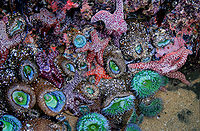 Biotic communities vary in size, and larger ones may contain smaller ones. Species interactions are evident in food or feeding relationships. A method of delineating biotic communities is to map the food network
to identify which species feed upon which others and then determine the system boundary as the one that can be drawn through the fewest consumption links relative to the number of species within the boundary.
Mapping biotic communities is important identifying sites needing environmental protection, such as the British Site of Special Scientific Interest
(SSSIs). The Australia
n Department of the Environment and Heritage
maintains a register of Threatened Species and Threatened Ecological Communities under the Environment Protection and Biodiversity Conservation Act 1999
(EPBC Act).
Karl Möbius
Karl August Möbius was a German zoologist who was a pioneer in the field of ecology and a former director of the Museum für Naturkunde in Berlin.- Early life :...
in 1877, describes the interacting organism
Organism
In biology, an organism is any contiguous living system . In at least some form, all organisms are capable of response to stimuli, reproduction, growth and development, and maintenance of homoeostasis as a stable whole.An organism may either be unicellular or, as in the case of humans, comprise...
s living together in a habitat
Habitat (ecology)
A habitat is an ecological or environmental area that is inhabited by a particular species of animal, plant or other type of organism...
(biotope
Biotope
Biotope is an area of uniform environmental conditions providing a living place for a specific assemblage of plants and animals. Biotope is almost synonymous with the term habitat, but while the subject of a habitat is a species or a population, the subject of a biotope is a biological community.It...
). This term is rarely used in English, as this concept has not been popularized in Anglophone countries
Anglosphere
Anglosphere is a neologism which refers to those nations with English as the most common language. The term can be used more specifically to refer to those nations which share certain characteristics within their cultures based on a linguistic heritage, through being former British colonies...
. Instead, English-speaking scientists usually think about ecosystems or communities.
Descriptors in an ecosystem
Ecosystem
An ecosystem is a biological environment consisting of all the organisms living in a particular area, as well as all the nonliving , physical components of the environment with which the organisms interact, such as air, soil, water and sunlight....
are:
- Zoocoenosis for the faunaFaunaFauna or faunæ is all of the animal life of any particular region or time. The corresponding term for plants is flora.Zoologists and paleontologists use fauna to refer to a typical collection of animals found in a specific time or place, e.g. the "Sonoran Desert fauna" or the "Burgess shale fauna"...
l community, - PhytocoenosisPhytocoenosisPlant community is a collection of plant species within a designated geographical unit, which forms a relatively uniform patch, distinguishable from neighbouring patches of different vegetation types. The components of each plant community are influenced by soil type, topography, climate and human...
for the floraFloraFlora is the plant life occurring in a particular region or time, generally the naturally occurring or indigenous—native plant life. The corresponding term for animals is fauna.-Etymology:...
l community, - Microbiocoenosis for the microbial community.
The geographical
Geography
Geography is the science that studies the lands, features, inhabitants, and phenomena of Earth. A literal translation would be "to describe or write about the Earth". The first person to use the word "geography" was Eratosthenes...
extent of a biocenose is limited by the requirement of a more or less uniform species composition.
Ecosystems
An ecosystemEcosystem
An ecosystem is a biological environment consisting of all the organisms living in a particular area, as well as all the nonliving , physical components of the environment with which the organisms interact, such as air, soil, water and sunlight....
, as originally defined by Tansley (1935), is a biotic community (or biocoenosis) along with its physical environment (or biotope
Biotope
Biotope is an area of uniform environmental conditions providing a living place for a specific assemblage of plants and animals. Biotope is almost synonymous with the term habitat, but while the subject of a habitat is a species or a population, the subject of a biotope is a biological community.It...
). In ecological studies, biocoenosis is the emphasis on relationships between species in an area. These relationships are an additional consideration to the interaction of each species with the its physical environment.
Biotic communities
Food chain
A food web depicts feeding connections in an ecological community. Ecologists can broadly lump all life forms into one of two categories called trophic levels: 1) the autotrophs, and 2) the heterotrophs...
to identify which species feed upon which others and then determine the system boundary as the one that can be drawn through the fewest consumption links relative to the number of species within the boundary.
Mapping biotic communities is important identifying sites needing environmental protection, such as the British Site of Special Scientific Interest
Site of Special Scientific Interest
A Site of Special Scientific Interest is a conservation designation denoting a protected area in the United Kingdom. SSSIs are the basic building block of site-based nature conservation legislation and most other legal nature/geological conservation designations in Great Britain are based upon...
(SSSIs). The Australia
Australia
Australia , officially the Commonwealth of Australia, is a country in the Southern Hemisphere comprising the mainland of the Australian continent, the island of Tasmania, and numerous smaller islands in the Indian and Pacific Oceans. It is the world's sixth-largest country by total area...
n Department of the Environment and Heritage
Department of the Environment and Heritage (Australia)
The Department of Sustainability, Environment, Water, Population and Communities , formerly the Department of the Environment, Water, Heritage and the Arts , is a department of the Australian federal government and was established on 14 September 2010.The stated aims of the department is to achieve...
maintains a register of Threatened Species and Threatened Ecological Communities under the Environment Protection and Biodiversity Conservation Act 1999
Environment Protection and Biodiversity Conservation Act 1999
The Environment Protection and Biodiversity Conservation Act 1999 is an Act of the Parliament of Australia that provides a framework for protection of the Australian environment, including its biodiversity and its natural and culturally significant places...
(EPBC Act).
Further reading
- Kendeigh, S. Charles. 1961. Animal Ecology. Prentice-Hall, Inc., Englewood Cliffs, N.J., 468 p.
- Möbius, KarlKarl MöbiusKarl August Möbius was a German zoologist who was a pioneer in the field of ecology and a former director of the Museum für Naturkunde in Berlin.- Early life :...
. 1877. Die Auster und die Austernwirtschaft. (tr. The Oyster and Oyster Farming) Berlin. (English translation) U.S. Commission Fish and Fisheries Report, 1880: 683-751. - Tansley, A. G. 1935. The use and abuse of vegetational concepts and terms. Ecology, 16(3): 284-307.