

Bhavacakra

Encyclopedia
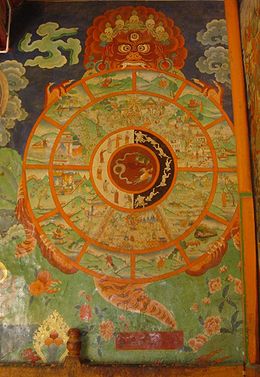
The bhavacakra is a symbolic representation of samsara
Samsara (Buddhism)
or sangsara is a Sanskrit and Pāli term, which translates as "continuous movement" or "continuous flowing" and, in Buddhism, refers to the concept of a cycle of birth , and consequent decay and death , in which all beings in the universe participate, and which can only be escaped through...
(or cyclic existence) found on the outside walls of Tibetan Buddhist
Tibetan Buddhism
Tibetan Buddhism is the body of Buddhist religious doctrine and institutions characteristic of Tibet and certain regions of the Himalayas, including northern Nepal, Bhutan, and India . It is the state religion of Bhutan...
temples and monasteries in the Indo-Tibet region. In the Mahayana Buddhist tradition, it is believed that the drawing was designed by the Buddha himself in order to help ordinary people understand the Buddhist teachings.
The bhavacakra is popularly referred to as the Wheel of Life.
Origin
Legend has it that the Buddha himself created the first depiction of the bhavacakra, and the story of how he gave the illustration to King RudrāyaṇaRudrāyaṇa-avadāna
Rudrāyaṇa-avadāna - a story from the Divyavadana , an anthology of Buddhist tales, that explains how the Buddha gave the first illustration of the Bhavacakra to King Rudrayaṇa....
appears in the anthology of Buddhist narratives called the Divyavadana
Divyavadana
The Divyāvadāna, or Divine Stories, is an anthology of Buddhist tales, many originating in the Mūlasarvāstivāda vinaya texts. The stories themselves are therefore quite ancient and may be among the first Buddhist texts ever committed to writing, but this particular collection of them is not...
.
The bhavacakra is painted on the outside walls of nearly every Tibetan Buddhist temple in Tibet and India. Dzongsar Khyentse
Dzongsar Jamyang Khyentse Rinpoche
Dzongsar Jamyang Khyentse Rinpoche , also known as Khyentse Norbu, is a Bhutanese lama, filmmaker, and writer. His two major films are The Cup and Travellers and Magicians . He is the author of the book What Makes You Not a Buddhist...
states:
- One of the reasons why the Wheel of Life was painted outside the monasteries and on the walls (and was really encouraged even by the Buddha himself) is to teach this very profound Buddhist philosophy of life and perception to more simple-minded farmers or cowherds. So these images on the Wheel of Life are just to communicate to the general audience.
Explanation of the diagram
Overview
The meanings of the main parts of the diagram are:- The images in the hub of the wheel represents the three poisonsThree Poisons (Buddhism)The three poisons or the three unwholesome roots , in Buddhism, refer to the three root kleshas of ignorance, attachment, and aversion...
of ignorance, attachment and aversion. - The second layer represents karmaKarma in BuddhismKarma means "action" or "doing"; whatever one does, says, or thinks is a karma. In Buddhism, the term karma is used specifically for those actions which spring from the intention of an unenlightened being.These bring about a fruit or result Karma (Sanskrit, also karman, Pāli: Kamma) means...
. - The third layer represents the six realms of samsara.
- The fourth layer represents the twelve links of dependent originationTwelve NidanasThe Twelve Nidānas are the best-known application of the Buddhist concept of pratītyasamutpāda , identifying the origins of dukkha to be in tanha and avijja...
. - The fierce figure holding the wheel represents impermanenceImpermanenceImpermanence is one of the essential doctrines or three marks of existence in Buddhism...
. - The moon above the wheel (top left in the image at right) represents liberationEnlightenment in BuddhismThe English term enlightenment has commonly been used in the western world to translate several Sanskrit, Pali, Chinese and Japanese terms and concepts, especially bodhi, prajna, kensho, satori and buddhahood.-Insight:...
from samsara or cyclic existence. - The BuddhaBuddhaIn Buddhism, buddhahood is the state of perfect enlightenment attained by a buddha .In Buddhism, the term buddha usually refers to one who has become enlightened...
pointing to the moon (top right in the image at right) indicates that liberation is possible.
Symbolically, the three inner circles, moving from the center outward, show that the three poisons of ignorance, attachment, and aversion give rise to positive and negative actions; these actions and their results are called karma. Karma in turn gives rise to the six realms, which represent the different types of suffering within samsara.
The fourth and outer layer of the wheel symbolizes the twelve links of dependent origination; these links indicate how the sources of suffering—the three poisons and karma—produce lives within cyclic existence.
The fierce being holding the wheel represents impermanence; this symbolizes that the entire process of samsara or cyclic existence is impermanent, transient, constantly changing. The moon above the wheel indicates liberation. The Buddha is pointing to the moon, indicating that liberation from samsara is possible.
Hub: the three poisons
In the hub of the wheel are three animals: a pig, a snake, and a bird. They represent the three poisonsThree Poisons (Buddhism)
The three poisons or the three unwholesome roots , in Buddhism, refer to the three root kleshas of ignorance, attachment, and aversion...
of ignorance, attachment, and aversion. The pig stands for ignorance; this comparison is based on the Indian concept of a pig being the most foolish of animals, since it sleeps in the dirtiest places and eats whatever comes to its mouth. The snake represents aversion or anger; this is because it will be aroused and strike at the slightest touch. The bird represents attachment (also translated as desire or clinging). The particular bird used in this diagram represents an Indian bird that is very attached to its partner. These three animals represent the three poisons, which are the core of the Wheel of Life. From these three poisons, the whole cycle of existence evolves.
In many drawings of the wheel, the snake and bird are shown as coming out of the mouth of the pig, indicating that aversion and attachment arise from ignorance. The snake and bird are also shown grasping the tail of the pig, indicating that they in turn promote greater ignorance.
The three poisons are the root of all the kleshas. The term kleshas is often translated as poisons, mental poisons, afflictions and so on.
Under the influence of the kleshas, beings create karma, as shown in the next layer of the circle.
Second layer: karma
The second layer of the wheel shows two-half circles:- One half-circle (usually light) shows contented people moving upwards to higher states, possibly to the higher realms.
- The other half-circle (usually dark) shows people in a miserable state being led downwards to lower states, possibly to the lower realms.
These images represent karma
Karma in Buddhism
Karma means "action" or "doing"; whatever one does, says, or thinks is a karma. In Buddhism, the term karma is used specifically for those actions which spring from the intention of an unenlightened being.These bring about a fruit or result Karma (Sanskrit, also karman, Pāli: Kamma) means...
, the law of cause and effect. The light half-circle indicates people experiencing the results of positive actions. The dark half-circle indicates people experiencing the results of negative actions.
Ringu Tulku states:
- We create karma in three different ways, through actions that are positive, negative, or neutral. When we feel kindness and love and with this attitude do good things, which are beneficial to both ourselves and others, this is positive action. When we commit harmful deeds out of equally harmful intentions, this is negative action. Finally, when our motivation is indifferent and our deeds are neither harmful or beneficial, this is neutral action. The results we experience will accord with the quality of our actions.
Propelled by their karma, beings take rebirth in the six realms of samsara, as shown in the next layer of the circle.
Overview
The third layer of the wheel is divided into six sections that represent the six realms of samsara. These six realms are divided into three highers realms and three lower realms.- The three higher realms are shown in the top half of the circle; the higher realms consist of the god realm, the demi-god realm and the human realm. The god realm is shown in the top middle and the human realm and demi-god realms are on either side of the god realm.
- The three lower realms are shown in the bottom half of the circle; the lower realms consist of the hell realm, the animal realm and the hungry ghost realm. The hell realm is shown in the bottom middle of the circle, with the animal realm and hungry ghost realm on either side of the hell realm.
What is samsara?
The six realms are six different types of rebirth that beings can enter into, each representing different types of suffering. Samsara, or cyclic existence, refers to the process of cycling through one rebirth after another.Patrul Rinpoche
Patrul Rinpoche
Patrul Rinpoche was a prominent teacher and author of the Nyingma school of Tibetan Buddhism.-Biography:...
states:
- The term samsara, the wheel or round of existence, is used here to mean going round and round from one place to another in a circle, like a potter's wheel, or the wheel of a water mill. When a fly is trapped in a closed jar, no matter where it flies, it can not get out. Likewise, whether we are born in the higher or lower realms, we are never outside samsara. The upper part of the jar is like the higher realms of gods and men, and the lower part like the three unfortunate realms. It is said that samsara is a circle because we turn round and round, taking rebirth in one after another of the six realms as a result of our own actions, which, whether positive or negative, are tainted by clinging.
A brief description of the six realms
Six realms of existence are identified in the Buddhist teachings: gods, demi-gods, humans, animals, hungry ghosts and hells. These six realms can be divided into three higher realms and three lower realms.The three higher realms are:
- God realm: the gods lead long and enjoyable lives full of pleasure and abundance, but they spend their lives pursuing meaningless distractions and never think to practice the dharma. When death comes to them, they are completely unprepared; without realizing it, they have completely exhausted their good karma (which was the cause for being reborn in the god realm) and they suffer through being reborn in the lower realms.
- Demi-god realm: the demi-gods have pleasure and abundance almost as much as the gods, but they spend their time fighting among themselves or making war on the gods. When they make war on the gods, they always lose, since the gods are much more powerful. The demi-gods suffer from constant fighting and jealousy, and from being killed and wounded in their wars with each other and with the gods.
- Human realm: humans suffer from hunger, thirst, heat, cold, separation from friends, being attacked by enemies, not getting what they want, and getting what they don't want. They also suffer from the general sufferings of birth, old age, sickness and death. Yet the human realm is considered to be the most suitable realm for practicing the dharma, because humans are not completely distracted by pleasure (like the gods or demi-gods) or by pain and suffering (like the beings in the lower realms).
The three lower realms are:
- Animal realm: wild animals suffer from being attacked and eaten by other animals; they generally lead lives of constant fear. Domestic animals suffer from being exploited by humans; for example, they are slaughtered for food, overworked, and so on.
- Hungry ghost realm: hungry ghosts suffer from extreme hunger and thirst. They wander constantly in search of food and drink, only to be miserably frustrated any time them come close to actually getting what they want. For example, they see a stream of pure, clear water in the distance, but by the time the get there the stream has dried up. Hungry ghosts have huge bellies and long thin necks. On the rare occasions that they do manage to find something to eat or drink, the food or water burns their neck as it goes down to their belly, causing them intense agony.
- Hell realm: hell beings endure unimaginable suffering for eons of time. There are actually eighteen different types of hells, each inflicting a different kind of torment. In the hot hells, beings suffer from unbearable heat and continual torments of various kinds. In the cold hells, beings suffer from unbearable cold and other torments.
Generally speaking, each realm is said to be the result of one of the six main negative emotions: pride, jealousy, desire, ignorance, greed, and anger. Dzongsar Khyentse
Dzongsar Jamyang Khyentse Rinpoche
Dzongsar Jamyang Khyentse Rinpoche , also known as Khyentse Norbu, is a Bhutanese lama, filmmaker, and writer. His two major films are The Cup and Travellers and Magicians . He is the author of the book What Makes You Not a Buddhist...
states:
- So we have six realms. Loosely, you can say when the perception comes more from aggression, you experience things in a hellish way. When your perception is filtered through attachment, grasping or miserliness, you experience the hungry ghost realm. When your perception is filtered through ignorance, then you experience the animal realm. When you have a lot of pride, you are reborn in the god realm. When you have jealousy, you are reborn in the asura (demi-god) realm. When you have a lot of passion, you are reborn in the human realm.
Among the six realms, the human realm is considered to offer the best opportunity to practice the dharma. Dzongsar Khyentse states:
- If we need to judge the value of these six realms, the Buddhists would say the best realm is the human realm. Why is this the best realm? Because you have a choice... The gods don’t have a choice. Why? They’re too happy. When you are too happy you have no choice. You become arrogant. The hell realm: no choice, too painful. The human realm: not too happy and also not too painful. When you are not so happy and not in so much pain, what does that mean? A step closer to the normality of mind, remember? When you are really, really excited and in ecstasy, there is no normality of mind. And when you are totally in pain, you don’t experience normality of mind either. So someone in the human realm has the best chance of acquiring that normality of mind. And this is why in Buddhist prayers you will always read: ideally may we get out of this place, but if we can’t do it within this life, may we be reborn in the human realm, not the others.
Sometimes, the wheel is represented as only having five realms because the God realm and the Demi-god realm are combined into a single realm.
In some representations of the wheel, there is a buddha or bodhisattva
Bodhisattva
In Buddhism, a bodhisattva is either an enlightened existence or an enlightenment-being or, given the variant Sanskrit spelling satva rather than sattva, "heroic-minded one for enlightenment ." The Pali term has sometimes been translated as "wisdom-being," although in modern publications, and...
depicted within each realm, trying to help sentient beings find their way to nirvana
Nirvana
Nirvāṇa ; ) is a central concept in Indian religions. In sramanic thought, it is the state of being free from suffering. In Hindu philosophy, it is the union with the Supreme being through moksha...
.
Sanskrit terms for the six realms
The Sanskrit terms for the six realms are:- DevaDeva (Buddhism)A deva in Buddhism is one of many different types of non-human beings who share the characteristics of being more powerful, longer-lived, and, in general, living more contentedly than the average human being....
realm: God realm - AsuraAsura (Buddhism)Asura in Buddhism is the name of the lowest ranks of the deities or demigods of the Kāmadhātu.-Origins and etymology:...
realm: Demi-god realm - ManuṣyaHuman beings in BuddhismHumans in Buddhism are the subjects of an extensive commentarial literature that examines the nature and qualities of a human life from the point of view of humans' ability to achieve enlightenment...
realm: Human realm - TiryagyoniAnimals in BuddhismThe position and treatment of animals in Buddhism is important for the light it sheds on Buddhists' perception of their own relation to the natural world, on Buddhist humanitarian concerns in general, and on the relationship between Buddhist theory and Buddhist practice.-Animals in Buddhist...
realm: Animal realm - PretaPretaPreta, प्रेत or Peta is the name for a type of being described in Buddhist, Hindu, Sikh, and Jain texts that undergoes more than human suffering, particularly an extreme degree of hunger and thirst...
realm: Hungry Ghost realm - NarakaNaraka (Buddhism)Naraka नरक or Niraya निरय is the name given to one of the worlds of greatest suffering in Buddhist cosmology.Naraka is usually translated into English as "hell", "hell realm", or "purgatory"...
realm: Hell realm
Outer rim: the twelve links
The outer rim of the wheel is divided into twelve sections that represent the Twelve Links of Dependent OriginationTwelve Nidanas
The Twelve Nidānas are the best-known application of the Buddhist concept of pratītyasamutpāda , identifying the origins of dukkha to be in tanha and avijja...
.
Ignorance is the first of the 12 causes and conditions, both of our rebirth and of maturing any karma within our dependent existence. Different causes can overlap in different stages and even mature in next existences - lives. Yet the turning of the wheel goes onward.
The twelve causal links, paired with their common visual representations, are:
- AvidyāAvidya (Buddhism)Avidyā or avijjā means "ignorance" or "delusion" and is the opposite of 'vidyā' and 'rig pa'...
lack of knowledge - a blind person, often walking, or a person peering out - SaṃskāraSankhara' or ' is a term figuring prominently in the teaching of the Buddha. The word means "that which has been put together" and "that which puts together". In the first sense, refers to conditioned phenomena generally but specifically to all mental "dispositions"...
constructive volitional activity - a potter shaping a vessel or vessels - VijñānaVijnanaVijñāna or viññāa is translated as "consciousness," "life force," "mind," or "discernment."...
consciousness - a man or a monkey grasping a fruit - NāmarūpaNamarupaNāmarūpa is a dvandva compound in Sanskrit and Pali meaning "name and form ".-Nāmarūpa in Hinduism:The term nāmarūpa is used in Hindu thought, nāma describing the spiritual or essential properties of an object or being, and rūpa the physical presence that it manifests...
name and form (constituent elements of mental and physical existence) - two men afloat in a boat - ṢaḍāyatanaSadayatana' or ' means the six sense bases , that is, the sense organs and their objects. These are: is the fifth link in the Twelve Nidānas of Pratitya-Samutpada and thus likewise in the fifth position on the Bhavacakra...
six senses (eye, ear, nose, tongue, body, and mind) - a dwelling with six windows - Sparśa contact - lovers consorting, kissing, or entwined
- VedanāVedanaVedanā is a word in Sanskrit and Pāli traditionally translated as either "feeling" or "sensation." In general, vedanā refers to the pleasant, unpleasant and neutral sensations that occur when our internal sense organs come into contact with external sense objects and the associated...
pain - an arrow to the eye - TṛṣṇaTanha' or ' literally means "thirst," and is a synonym for "desire" or "craving," traditionally juxtaposed with upekkha .Synonyms:*愛 Cn: ài; Vi: ái...
thirst - a drinker receiving drink - UpādānaUpadanaUpādāna is a word used in both Buddhism and Hinduism.*In Buddhism, upādāna is a critical link in the arising of suffering.*In Hinduism, upādāna is the material manifestation of Brahman.-Buddhism:...
grasping - a man or a monkey picking fruit - BhavaBhavaThe term bhāva is often translated as feeling, emotion, mood, devotional state of mind. In Buddhist thought, bhāva denotes the continuity of life and death, including reincarnation, and the maturation arising therefrom...
coming to be - a couple engaged in intercourse, a standing, leaping, or reflective person - JātiJati (Buddhism)In Buddhism, Jāti refers to the arising of a new living entity in saṃsāra.-Truth of suffering:As with "Old Age & Death" , the Buddha includes "Birth" in the canonical description of "suffering" in the First Noble Truth:Elsewhere in the canon the Buddha further elaborates:The canon additionally...
being born - woman giving birth - JarāmaraṇaJaramaranaJarāmaraa is Sanskrit and Pāli for "old age" and "death" . In Buddhism, jaramarana refers to the inevitable end-of-life suffering of all beings prior to their rebirth in the cycle of .Synonyms:...
old age and death - corpse being carried
The figure holding the wheel: impermanence
The wheel is being held by a fearsome figure who represents impermanenceImpermanence
Impermanence is one of the essential doctrines or three marks of existence in Buddhism...
. The Dalai Lama states:
- The fierce being holding the wheel symbolizes impermanence, which is why the being is a wrathful monster, though there is no need for it to be drawn with ornaments and so forth... Once I had such a painting drawn with a skeleton rather than a monster, in order to symbolize impermanence more clearly.
This figure is most commonly depicted as Yama
Yama (Buddhism and Chinese mythology)
Yama the name of the Buddhist dharmapala and judge of the dead, who presides over the Buddhist Narakas , "Hells" or "Purgatories". Although ultimately based on the god Yama of the Hindu Vedas, the Buddhist Yama has developed different myths and different functions from the Hindu deity...
, the lord of death. Regardless of the figure depicted, the inner meaning remains the same–that the entire process of cyclic existence (samsara) is transient; everything within this wheel is constantly changing.
Yama has the following attributes:
- He wears of crown of five skulls that symbolize the impermanence of the five aggregatesSkandhaIn Buddhist phenomenology and soteriology, the skandhas or khandhas are any of five types of phenomena that serve as objects of clinging and bases for a sense of self...
. (The skulls are also said to symbolize the five poisons.) - He has a third eye that symbolizes the wisdom of understanding impermanence.
- He is sometimes shown adorned with a tiger skin, which symbolizes fearfulness. (The tiger skin is typically seen hanging beneath the wheel.)
- His four limbs (that are clutching the wheel) symbolize the sufferings of birth, old age, sickness, and death.
The Buddha and the moon
Drawings of the bhavacakra include symbols outside of the wheel that represent the possibility of liberation from six realms. In most drawings, this is represented by the buddha pointing toward the moonMoon
The Moon is Earth's only known natural satellite,There are a number of near-Earth asteroids including 3753 Cruithne that are co-orbital with Earth: their orbits bring them close to Earth for periods of time but then alter in the long term . These are quasi-satellites and not true moons. For more...
(as shown in painting from Thikse monastery, at right); in this case:
- The Buddha pointing toward the moon represents the Buddha's teachings or the path to liberation.
- And the moon represents liberation itself.
Mark Epstein states:
- The entire Wheel of Life is but a representation of the possibility of transforming suffering by changing the way we relate to it. As the Buddha taught in his final exhortation to his faithful attendant Ananda, it is only through becoming a “lamp unto yourself” that enlightenment can be won. Liberation from the Wheel of Life does not mean escape, the Buddha implied. It means clear perception of oneself, of the entire range of the human experience...
The exact figures or symbols may vary in different drawings.
Other symbols
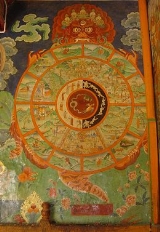
Drawings of the Bhavacakra usually contain a few lines of text at the bottom that explain the meaning of the diagram.Other symbols may appear in the background of the drawing. For example, in the drawing of the wheel shown from Sera, Lhasa (shown at the top of this article) some of the clouds take the shape of a svastika, which is considered an auspicious symbol
Buddhist symbolism
Buddhist symbolism is the use of Buddhist art to represent certain aspects of dhamma, which began in the 4th century BCE. Anthropomorphic symbolism appeared from around the 1st century CE with the arts of Mathura and the Greco-Buddhist art of Gandhara, and were combined with the previous symbols...
in Buddhism.
Psychological interpretation
From a psychological point of view, different karmicKamma
Kamma may refer to:*Kamma , a caste or social group found largely in Southern India*The Pali and Ardhamagadhi term for karma*Bava Kamma, a traditional Jewish civil law procedure dealing largely with damages and compensation....
actions contribute to one's metaphorical existence in different realms, or rather, different actions reinforce personal characteristics described by the realms.
Mark Epstein states:
- The core question of Buddhist practice, after all, is the psychological one of “Who am I?” Investigating this question requires exploration of the entire wheel. Each realm becomes not so much a specific place but rather a metaphor for a different psychological state, with the entire wheel becoming a representation of neurotic suffering.
Within the Theravada tradition
T. B. Karunaratne states:- Though in Theravāda literature there is no mention of an actual pictorial execution of a ”Wheel of Life,” yet the concept of comparing Dependent Origination to a wheel is not unknown. In the Path of Purification (Visuddhimagga), the famous commentator Buddhaghosa Acariya says:
- “It is the beginningless round of rebirths that is called the ’Wheel of the round of rebirths’ (saṃsāracakka). Ignorance (avijjā) is its hub (or nave) because it is its root. Ageing-and-death (jarā-maraṇa) is its rim (or felly) because it terminates it. The remaining ten links (of the Dependent Origination) are its spokes (i.e. karma formations [saṅkhāra] up to process of becoming [bhava]).”
English translations of the term bhavacakra
The term bhavacakra has been translated into English as:- Wheel of becoming
- Wheel of cyclic existence
- Wheel of existence
- Wheel of life
- Wheel of rebirth
- Wheel of
- Wheel of suffering
- Wheel of transformation
See also
- Buddhist cosmologyBuddhist cosmologyBuddhist cosmology is the description of the shape and evolution of the Universe according to the canonical Buddhist scriptures and commentaries.-Introduction:...
- Buddhist symbolismBuddhist symbolismBuddhist symbolism is the use of Buddhist art to represent certain aspects of dhamma, which began in the 4th century BCE. Anthropomorphic symbolism appeared from around the 1st century CE with the arts of Mathura and the Greco-Buddhist art of Gandhara, and were combined with the previous symbols...
- Dependent origination
- DharmacakraDharmacakraThe Dharmachakra , lit. "Wheel of Dharma" or "Wheel of Life" is a symbol that has represented dharma, the Buddha's teaching of the path to enlightenment, since the early period of Indian Buddhism. A similar symbol is also in use in Jainism...
- Karma in BuddhismKarma in BuddhismKarma means "action" or "doing"; whatever one does, says, or thinks is a karma. In Buddhism, the term karma is used specifically for those actions which spring from the intention of an unenlightened being.These bring about a fruit or result Karma (Sanskrit, also karman, Pāli: Kamma) means...
- Kleshas (Buddhism)
- Rota Fortunae
- Six realmsSix realmsThe desire realm is one of three realms or three worlds in traditional Buddhist cosmology into which a being wandering in may be reborn. The other two are the form realm, and the formless realm The desire realm (Sanskrit kāma-dhātu) is one of three realms (Sanskrit: dhātu, Tibetan: khams) or...
- Three Poisons (Buddhism)Three Poisons (Buddhism)The three poisons or the three unwholesome roots , in Buddhism, refer to the three root kleshas of ignorance, attachment, and aversion...
External links
- Interactive Tour of the Wheel of Life, buddhanet.net
- Wheel of Rebirth, Victoria and Albert Museum - allows visitors to zoom in on details of a painting
- Wheel of Life index page, Himalayan Art Resources - allows visitors to view a gallery of images from various public and private collections
- The Wheel of Birth and Death by Bhikkhu Khantipalo - a detailed explanation of the bhavacakra, including a translation of a key text
- The Wheel of Suffering, quietmountain.org - brief description focusing on the six realms
- Wheel of Life on Rigpa Wiki
- Wheel of Life on Khandro.net
- Wheel of Life on kafka-metamorphosis wiki