
|
|
|
|
Bernard Madoff
|
| |
|
| |
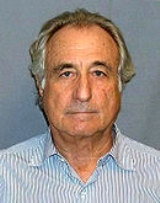
Bernard Lawrence "Bernie" Madoff (born April 29, 1938, in New York City) is an American businessman and former chairman of the NASDAQ stock exchange charged with perpetrating what may be the largest investor fraud ever committed by a single person. He founded the Wall Street firm Bernard L. Madoff Investment Securities LLC in 1960, and was its chairman until his arrest on December 11, 2008. He is under house arrest and is expected to plead guilty to charges of securities fraud, wire fraud, mail fraud and money laundering on March 12, 2009.
According to federal charges, Madoff said that his firm had "liabilities of approximately US$50 billion." However, a growing number of people involved in the case and outside observers are saying that the actual loss to investors could be far less than that.

Discussion
Ask a question about 'Bernard Madoff'
Start a new discussion about 'Bernard Madoff'
Answer questions from other users
|
Recent Posts

Encyclopedia
Bernard Lawrence "Bernie" Madoff (born April 29, 1938, in New York City) is an American businessman and former chairman of the NASDAQ stock exchange charged with perpetrating what may be the largest investor fraud ever committed by a single person. He founded the Wall Street firm Bernard L. Madoff Investment Securities LLC in 1960, and was its chairman until his arrest on December 11, 2008. He is under house arrest and is expected to plead guilty to charges of securities fraud, wire fraud, mail fraud and money laundering on March 12, 2009.
According to federal charges, Madoff said that his firm had "liabilities of approximately US$50 billion." However, a growing number of people involved in the case and outside observers are saying that the actual loss to investors could be far less than that. The actual number is not known at this point, but former SEC chief Harvey Pitt estimates the actual fraud at between $10 and $17 billion.
On December 10, 2008, Madoff allegedly told his sons that the asset management arm of his firm was a giant Ponzi scheme—or "one big lie." They then passed this information to authorities. The following day, Federal Bureau of Investigation agents arrested Madoff and charged him with one count of securities fraud. Five days after his arrest, Madoff's assets and those of the firm were frozen and a receiver was appointed to handle the case.
Some investors, journalists, and economists have questioned Madoff's statement that he alone is responsible for the large-scale operation, and investigators are looking to determine if there were others involved in the scheme.
Madoff's firm, which is in the process of liquidation, was one of the top market maker businesses on Wall Street (the sixth-largest in 2008), often functioning as a "third-market" provider that bypassed "specialist" firms and directly executed orders over the counter from retail brokers. The firm also had an investment management and advisory division that is now the focus of the fraud investigation.
Madoff was also a prominent philanthropist who served on the boards of nonprofit institutions, many of which entrusted his firm with their endowments. He is a former National Treasurer of the American Jewish Congress. The freeze of his and his firm's assets have had effects around the world on businesses and charities, some of which, including the Robert I. Lappin Charitable Foundation, the Picower Foundation, and the JEHT Foundation were forced to close as a consequence of the fraud.
Personal
Bernard L. Madoff was born in the United States to Jewish parents, Ralph and Sylvia Madoff.
He grew up in the Laurelton neighborhood of the New York City borough of Queens. He graduated from Far Rockaway High School in 1956, attended the University of Alabama for one year, then transferred to and graduated from Hofstra University (then Hofstra College) in 1960 with a degree in political science. The following year, he attended Brooklyn Law School, but did not continue.
Madoff is married to his high school sweetheart, Ruth Alpern, who has been involved with the firm and in the Madoff Charitable Foundation. It has been reported that Mrs. Madoff had reconciled the firm's bank accounts.
They have two sons, Mark and Andrew. Andrew, the younger son, was diagnosed with lymphoma. In March, 2003, Andrew began serving on the Board of Directors of Lymphoma Research Foundation, and the Madoff family became major donors, contributing more than $1 million in 2007. Deborah Madoff, Andrew's wife, reportedly filed for divorce the day before the scheme collapsed. Mark took his money out of the investment arm to fund a divorce from his first wife in 2000 and both sons used outside investment firms to run their own private philanthropic foundations, but Andrew had millions invested with his father.
Madoff lived in Roslyn, New York in a ranch house through the 1970s and since 1981, has owned an ocean-front residence in Montauk. His primary residence on Manhattan's Upper East Side, is valued at more than $7 million, and he is listed as chairman of the building's co-op board. He also owns a home in France and a $9.3 million mansion in Palm Beach, Florida, where he is a member of the Palm Beach Country Club. Madoff owns a fishing boat named Bull, which is docked in the French Riviera.
Career
Madoff started his firm in 1960 as a penny stock trader with $5,000 (about $35,000 in 2008 dollars), earned from working as a lifeguard and sprinkler installer. His fledgling business began to grow with the assistance of his father-in-law, accountant Saul Alpern, who referred a circle of friends and their families.
Initially, the firm made markets (quoted bid and ask prices) via the National Quotation Bureau's Pink Sheets. In order to compete with firms that were members of the New York Stock Exchange trading on the stock exchange's floor, his firm began using innovative computer information technology to disseminate its quotes. After a trial run, the technology that the firm helped develop became the NASDAQ. At one point, Madoff Securities was the largest buying- and-selling "market maker" at the NASDAQ.
He was active in the National Association of Securities Dealers (NASD), a self-regulatory securities industry organization. His firm was one of the five most active in the development of the NASDAQ. He has served as the Chairman of the Board of Directors and on the Board of Governors of the NASD.
Several family members worked for him. His younger brother, Peter, was Senior Managing Director and Chief Compliance Officer, and Peter's daughter, Shana, was the compliance attorney. Madoff’s sons, Mark and Andrew, worked in the trading section, along with Charles Weiner, Madoff’s nephew. Andrew Madoff had invested his own money in his father's fund, but Mark stopped in about 2001.
The Madoff government investigation believes the fraud in the investment management division and advisory division may have begun in the 1970s. In the 1980s, Madoff's market-maker division traded up to five 5% of the total volume made on the New York Stock Exchange. Madoff was "the first prominent practitioner" who paid a broker to execute a customer's order through his brokerage, called a "legal kickback", which gave Madoff the reputation of being the largest dealer in NYSE-listed stocks in the U.S., trading about 15% of transaction volume. Academics have questioned the ethics of these payments. Madoff has argued that these payments did not alter the price that the customer received. He viewed the payments as a normal business practice: "If your girlfriend goes to buy stockings at a supermarket, the racks that display those stockings are usually paid for by the company that manufactured the stockings. Order flow is an issue that attracted a lot of attention but is grossly overrated."
Madoff Securities was one of the top traders of securities in the USA by the year 2000, holding approximately $300 million in assets. The business occupied three floors of the Lipstick Building, with the investment management division, referred to as the "hedge fund", employing a staff of approximately 24. Madoff ran a branch office in London, separate from Madoff Securities, which employed 28, handling investments for his family of approximately £80 million. Two remote cameras installed in the London office permitted Madoff to monitor events from New York.
Methods of operation, access to Washington, accusations, and case
Investment strategy
Madoff's sales pitch was an investment strategy consisting of purchasing blue-chip stocks and then taking options contracts on them - which is sometimes called a split-strike conversion or a collar. "Typically, a position will consist of the ownership of 30–35 S&P 100 stocks, most correlated to that index, the sale of out-of-the-money 'calls' on the index and the purchase of out-of-the-money 'puts' on the index. The sale of the 'calls' is designed to increase the rate of return, while allowing upward movement of the stock portfolio to the strike price of the 'calls'. The 'puts', funded in large part by the sales of the 'calls', limit the portfolio's downside." In 1992, Madoff explained his strategy to the The Wall Street Journal: In the 1970s, he had placed invested funds in "convertible arbitrage positions in large-cap stocks, with promised investment returns of 18% to 20%," and in 1982, he began using futures contracts on the stock index, and then, placed "puts" on futures during the 1987 stock market crash.
A few analysts performing due diligence were unable to replicate the Madoff fund's past returns using historic price data for U.S. stocks and options on the indexes. It is doubtful Madoff made any or all of the required trades this strategy dictates, because purported trade volumes appear to far exceed the listed derivative open interest. Rather, Barron's raised the possibility that Madoff's returns were most likely due to front running his firm's brokerage clients.
Mitchell Zuckoff, professor of journalism at Boston University, author of Ponzi's Scheme: The True Story of a Financial Legend, says that "the 5% payout rule," a federal law requiring foundations to pay out 5% of their funds each year, allowed Madoff's Ponzi scheme to go undetected for a long period since he managed money mainly for charities. Zuckoff notes, "For every $1 billion in foundation investment, Madoff was effectively on the hook for about $50 million in withdrawals a year. If he was not making real investments, at that rate the principal would last 20 years. By targeting charities, Madoff could avoid the threat of sudden or unexpected withdrawals."
Sales methods
Rather than offer high returns to all comers, Madoff offered modest but steady returns to an exclusive clientele. The investment method was marketed as "too complicated for outsiders to understand." He was secretive about the firm’s business, and kept his financial statements closely guarded.
The New York Post reported that Madoff "worked the so-called 'Jewish circuit' of well-heeled Jews he met at country clubs on Long Island and in Palm Beach". The New York Times reported that Madoff courted many prominent Jewish executives and organizations. One of the most prominent promoters was J. Ezra Merkin, whose fund Ascot Partners steered $1.8 billion towards Madoff's firm. A scheme that targets members of a particular religious or ethnic community is a type of affinity fraud, and a Newsweek article identified Madoff's scheme as "an affinity Ponzi."
Madoff was a "master marketer," and his fund was considered exclusive, giving the appearance of a "velvet rope." He generally refused to meet directly with investors, which gave him an "Oz" aura and increased the allure of the investment. Some Madoff investors were wary of removing their money from his fund, in case they could not get back in later. One New York real estate investor said she "literally begged" Madoff to take her money, and he refused.
Madoff's annual returns were "unusually consistent, " around 10%, and were a key factor in perpetuating the fraud. Ponzi schemes typically pay returns of 20% or higher, and collapse quickly. One Madoff hedge fund, which described its "strategy" as focusing on shares in the Standard & Poor's 100-stock index, averaged a 10.5% annual return during the previous 17 years. Even at the end of November 2008, amid a general market collapse, the same fund reported that it was up 5.6%, while the same year-to-date total return on the S&P 500-stock index had been negative 38%. An unnamed investor remarked, “The returns were just amazing and we trusted this guy for decades — if you wanted to take money out, you always got your check in a few days. That’s why we were all so stunned.”
The Swiss bank, Union Bancaire Privée, explained that because of Madoff's huge volume as a broker-dealer, the bank believed he had a perceived edge on the market because his trades were timed well, suggesting they believed he was front running.
Access to Washington
The Madoff family gained unusual access to Washington's lawmakers and regulators through the industry's top trade group. The Madoff family has long-standing, high-level ties to the Securities Industry and Financial Markets Association (SIFMA), the primary securities industry organization. Bernard Madoff sat on the Board of Directors of the Securities Industry Association, which merged with the Bond Market Association in 2006 to form SIFMA.
Madoff's brother Peter then served two terms as a member of SIFMA’s Board of Directors. He stepped down from the Board of Directors of the Securities Industry and Financial Markets Association (SIFMA) in December 2008, as news of the Ponzi scheme broke. Peter's resignation came amid growing criticism of the Madoff firm’s links to Washington, and how those relationships may have contributed to the Madoff fraud. Over the years 2000-08, the two Madoff brothers gave $56,000 to SIFMA, and tens of thousands of dollars more to sponsor SIFMA industry meetings.
In addition, Bernard Madoff's niece Shana Madoff was active on the Executive Committee of SIFMA's Compliance & Legal Division, but resigned her SIFMA position shortly after her uncle's arrest.
Previous SEC investigations
Madoff Securities LLC was investigated at least 8 times in 16 years by the United States Securities and Exchange Commission (SEC) and other regulatory authorities. In 1992, the SEC investigated one of Madoff's feeder funds, Avellino & Bienes (principals Frank Avellino and Michael Bienes and his wife Dianne Bienes). Bienes began his career working as an accountant for Madoff's father-in-law, Sol Alpern. Then, he became a partner in the accounting firm Alpern, Avellino and Bienes. In 1962, he firm began advising its clients about investing all of their money with Madoff. When Alpern retired at the end of 1974, the firm became Avellino and Bienes.
and continued to invest solely with Madoff.
Represented by Ira Lee Sorkin, Madoff's present attorney, Avellino & Bienes were accused of selling unregistered securities, and in its report the SEC mentioned the fund's "curiously steady" yearly returns to investors of 13.5% to 20%. However, the SEC did not look any more deeply into the matter. Through Sorkin, who once oversaw the SEC’s New York office, Avellino & Bienes agreed to return the money to investors, shut down their firm, undergo an audit, and pay a fine of $350,000. Avellino complained to the presiding Federal Judge, John E. Sprizzo, that Price Waterhouse fees were excessive, but the Judge ordered him to pay the bill of $428,679 in full. Madoff said that he did not realize the feeder fund was operating illegally, and that his own investment returns tracked the previous 10 years of the S&P 500. The SEC investigation came right in the middle of Madoff's three terms as the powerful chairman of the NASDAQ stock market board.
Recently, Bienes, 72, has explained how over the years he deposited $454 million of investors' money with Madoff. "Doubt Bernie Madoff? Doubt Bernie? No. You doubt God. You can doubt God, but you don't doubt Bernie. He had that aura about him." He continued to invest his personal money with Madoff as recently as 2007, adding several million dollars to his account. His $6.7 million home in the exclusive Bay Colony, of Ft. Lauderdale is presently for sale.
The SEC investigated Madoff in 1999 and 2000 about concerns that the firm was hiding its customers' orders from other traders, for which Madoff then took corrective measures. In 2001, an SEC official met with financial investigator Harry Markopolos at the SEC's Boston office to go over Markopolos's allegations that Madoff's firm was engaged in fraudulent practices. The SEC also said it conducted two other inquiries of Madoff in the last several years, and did not find major problems. In 2004, after published articles appeared accusing the firm of front running, the SEC's Washington branch cleared Madoff of that accusation. An SEC statement detailed that inspectors examined Madoff's brokerage operation in 2005 after sending the 2004 inquiry to the New York office, finding three violations: the strategy he used for customer accounts, the requirement of brokers to obtain the best possible price for customer orders, and violating SEC rules by operating as an [unregistered investment adviser. He was registered as a broker-dealer, but acting as an asset manager. "The staff found no evidence of fraud," according to the SEC case memo. Madoff agreed to register his business that September, and the SEC did not make its findings public. During the 2005 investigation, Meaghan Cheung, a branch head of the SEC's New York's Enforcement Division, was the person responsible for the oversight and blunder, according to Harry Markopolos, who testified on February 4, 2009, at a hearing held by a House Financial Services Subcommittee on Capital Markets, In 2007, SEC enforcement staff completed an investigation which began on January 6, 2006, into Ponzi scheme allegations which resulted in neither a finding of fraud, nor a referral to the SEC Commissioners for legal action.
In 2007, the Financial Industry Regulatory Authority (FINRA), the industry-run watchdog for brokerage firms, reported without explanation that parts of the firm appeared to have no customers. "At this point in time we are uncertain of the basis for Finra's conclusion in this regard," SEC staff wrote shortly after Madoff was arrested.
As a result, the SEC's chairman Christopher Cox stated that an investigation will delve into "all staff contact and relationships with the Madoff family and firm, and their impact, if any, on decisions by staff regarding the firm." A former SEC compliance officer, Eric Swanson, married Madoff's niece Shana, a Madoff firm compliance attorney.
Red flags
Outside analysts raised concerns about Madoff's firm for years. Financial analyst Harry Markopolos complained to the SEC's Boston office in May 1999, telling the SEC staff they should investigate Madoff because it was impossible to legally make the profits Madoff claimed using the investment strategies that he claimed to use. In 2005, Markopolos sent a detailed 17-page memo to the SEC, entitled The World's Largest Hedge Fund is a Fraud.
The paper specified 29 numbered red flags. In part, the memo concluded: "Bernie Madoff is running the world's largest unregistered hedge fund. He's organized this business as a 'hedge fund of funds privately labeling their own hedge funds which Bernie Madoff secretly runs for them using a split-strike conversion strategy getting paid only trading commissions which are not disclosed.' If this is not a regulatory dodge, I do not know what is." Markopolos considered if Madoff's "unsophisticated portfolio management" was either a Ponzi scheme or front running, placing the fund's orders before his brokerage clients' when placing them in the market, and concluded it was most likely a Ponzi scheme. An article in Barron's and another in MarHedge in 2001 accused Madoff of front running to achieve his gains. Hedge funds that invested with him were not allowed to mention his name in their marketing materials. The reason for Madoff's secrecy says Markopolos, was so that the SEC would not learn what he was doing. And to further maintain secrecy, when large investors were thinking of putting in money, but wanted to examine Madoff's books in order to do due diligence, Madoff would not allow the examination, claiming a desire not to have proprietary strategies disclosed to anyone else.
Among the suspicious signs was the fact that Madoff's company avoided filing disclosures of its holdings with the SEC by selling its holdings for cash at the end of each period. Such a tactic is highly unusual. A call for an outside audit of the company was rejected by Madoff with the statement that the company's Chief Compliance Officer, his brother Peter Madoff, was the only person allowed to do that, "for reasons of secrecy.". Madoff's "official" auditing firm, Friehling & Horowitz, had only one active accountant..
In 2007, hedge fund advisory fund firm Aksia LLC advised its clients not to invest with Madoff, because of the appearance of limited accounting service personnel.
While hedge funds typically hold their portfolio at a securities firm that acts as the fund's prime broker (typically a major bank or brokerage), allowing an outside investigator to verify their holdings, Madoff's firm was its own broker-dealer and supposedly processed all its trades.
Although Madoff was a pioneer of electronic trading, he refused to provide his clients online access to their accounts. He sent out account statements by mail, whereas most hedge funds email statements and allowed them to be downloaded via computer for easier analysis by investors.
Charles Gradante, co-founder of hedge-fund research firm Hennessee Group, observed that Madoff "only had five down months since 1996", and commented on Madoff's investment performance: "You can't go 10 or 15 years with only three or four down months. It's just impossible." A 2001 story in MARHedge interviewed traders who questioned how Madoff could have 72 gaining months in a row, saying that type of stock success had never occurred before.
Madoff also operated as a broker dealer with an asset management division. Joe Aaron, a longtime hedge fund professional, found the structure suspicious and in 2003 warned a colleague to steer clear of the fund, saying "Why would a good businessman work his magic for pennies on the dollar?" But clients such as Fairfield and Union Bancaire Privée claimed that they had been given an "unusual degree of access" to look into Madoff's funds and had seen nothing wrong with his firm's investments.
Whistleblower Harry Markopolos later testified to Congress that he had approached the Wall Street Journal about the existence of the Ponzi scheme in 2005. However, its editors decided not to pursue the story.
Final weeks
The scheme began to unravel in late 2008, as the stock market began to plunge. Subsequently, as the general market downturn accelerated, investors tried to withdraw $7 billion from the firm, and in the weeks prior to his arrest, Madoff struggled to keep the scheme afloat. To pay off those investors, Mr. Madoff needed new money from other investors.
In November 2008, Madoff Securities International (MSIL) in London, made two fund transfers to Bernard Madoff Investment Securities of approximately $164 million. MSIL had neither customers nor clients, and there is no evidence that it conducted any trades on behalf of third parties.
Madoff received $250 million around December 1 from Carl J. Shapiro, a 95-year-old Boston philanthropist and entrepreneur who was one of Madoff's oldest friends and biggest financial backers. On December 5, he accepted $10 million from Martin Rosenman, president of Rosenman Family LLC, who wants to recover a never-invested $10 million, deposited in a Madoff account at JPMorgan, wired six days before Madoff's arrest. Bankruptcy Judge Lifland ruled that Mr. Rosenman was "indistinguishable" from any other Madoff client, so there was no basis for giving him special treatment to recover funds.
The judge separately declined to dismiss a lawsuit brought by Hadleigh Holdings, which claims it entrusted $1 million to the Madoff firm three days before his arrest.
Madoff asked others for money in the final weeks before his arrest, including Wall Street financier Kenneth Langone, whose office was sent a 19-page pitch book, allegedly created by the staff at the Fairfield Greenwich Group. Madoff said he was raising money for a new investment vehicle, between $500 million and $1 billion for exclusive clients, was moving quickly on the venture, and wanted an answer by the following week. Langone declined.
On December 10, 2008, he suggested to his sons, Mark and Andrew, that the firm pay out several million dollars in bonuses two months ahead of schedule, from $200 million in assets that the firm still had. According to the complaint, Mark and Andrew, reportedly unaware of the firm's pending insolvency, confronted their father, asking him how the firm could pay bonuses to employees if it could not pay investors. Madoff then admitted that he was "finished," and that the asset management arm of the firm was in fact a Ponzi scheme. Mark and Andrew then reported him to the authorities.
Charges
Criminal Madoff was arrested by the Federal Bureau of Investigation (FBI) on December 11, 2008, on a criminal charge of securities fraud. The previous day, he had told his sons that his business was "a giant Ponzi scheme." They called a friend for advice, Martin Flumenbaum, a lawyer, who called federal prosecutors and the SEC on their behalf. FBI Agent Theodore Cacioppi made a house call. "We are here to find out if there is an innocent explanation," Cacioppi said quietly. The 70-year-old financier paused, then said: "There is no innocent explanation." He had "paid investors with money that was not there."
On March 12, 2009, Madoff will appear in court in a plea proceeding, and is expected to plead guilty on several charges related to fraud and money laundering.
Any victim who wishes to be heard can notify the government by March 11th at 10:00 a.m. at: www.usanys.madoff@usdoj.gov. At least 25 victims have requested to be heard.
When Madoff waives the right to a grand jury indictment, the government will file an "information", a formal document containing the allegations and criminal charges filed against the defendant. If Madoff pleads guilty, federal sentencing guidelines will give him 52 points for his crimes: 42 points transfers to life in prison. With his cooperation, it is 39 points, 22 years behing bars.
The criminal complaint alleged that investors lost $50 billion through the scheme, though The Wall Street Journal reports "that figure includes the alleged false profits that Mr. Madoff's firm reported to its customers for decades. It's unclear exactly how much investors deposited into the firm." He was charged with a single count of securities fraud and faced up to 20 years in prison, and a fine of $5 million if convicted.
The criminal case is U.S. v. Madoff, 08-MAG-02735, U.S. District Court for the Southern District of New York (Manhattan) with presiding Judge Ronald L. Ellis.
Apart from 'Bernard L. Madoff' and 'Bernard L. Madoff Investment Securities LLC ("BMIS")', the order to freeze all activities also forbids acting and trading from the companies Madoff Securities International Ltd. ("Madoff International") and Madoff Ltd.
Madoff was released on the same day of his arrest after posting $10 million bail. Madoff and his wife surrendered their passports, and he was subject to travel restrictions, a 7 p.m. curfew at his co-op, and electronic monitoring as a condition of bail. Although Madoff only had two co-signers for his $10 million bail, his wife and his brother Peter, rather than the four required, a judge allowed him free on bail but ordered him confined to his penthouse. Madoff has reportedly received death threats that have been referred to the FBI, and the SEC referred to fears of "harm or flight" in its request for Madoff to be confined to his Upper East Side apartment. Cameras monitor his apartment's doors, its communication devices send signals to the FBI, and his wife is required to pay for additional security.
Prosecutors asked on January 5, 2009, that his bail be revoked, after Madoff and his wife allegedly violated a court-ordered asset freeze by mailing jewelry worth up to $1 million to relatives, including their sons and Madoff's brother. It was also noted that $173 million in signed checks had been found in Madoff's office desk after he had been arrested. His sons reported the mailings to prosecutors. Previously, Madoff was thought to be cooperating with prosecutors. The following week, Judge Ellis refused the government's request to jail Madoff, but required as a condition of bail that Madoff make an inventory of personal items and that his mail be searched.
Civil
On February 9, 2009, a partial judgment in the December 11, 2008, civil suit, SEC v. Madoff, 08-10791, U.S. District Court, Southern District of New York (Manhattan) was made permanent. Madoff will keep a previously reached agreement to freeze his assets, and neither work in the financial industry ever again, nor violate any other securities laws. The agreement does not require Madoff to admit or deny any allegations against him. It also leaves the issues of any civil fines and repayments to be imposed against Madoff for a later time. Without reaching an agreement, he would have had to testify or refuse. This settlement is unrelated to any plea or indictment in the criminal matter.
On March 2, 2009, Judge Louis Stanton modified an existing freeze order to surrender assets Maddoff owns: his securities firm, real estate, artwork, and entertainment tickets, and granted a request by prosecutors that the existing freeze remain in place for the Manhattan apartment, and vacation homes in Montauk, New York, and Palm Beach, Florida. He has also agreed to surrender his interest in Primex Holdings LLC, a joint venture between Madoff Securities and several large brokerages, designed to replicate the auction process on the New York Stock Exchange.
Others possibly involved
Investigators are looking for others involved in the scheme, despite Madoff's assertion that he alone was responsible for the large-scale operation. Harry Sussman, an attorney representing several clients of the firm, stated that "someone had to create the appearance that there were returns," and further suggested that there must have been a team buying and selling stocks, forging books, and filing reports. James Ratley, president of the Association of Certified Fraud Examiners said, “In order for him to have done this by himself, he would have had to have been at work night and day, no vacation and no time off. He would have had to nurture the Ponzi scheme daily."
“Simply from an administrative perspective, the act of putting together the various account statements, which did show trading activity, has to involve a number of people. “You would need office and support personnel, people who actually knew what the market prices were for the securities that were being traded. You would need accountants so that the internal documents reconcile with the documents being sent to customers at least on a superficial basis,” said Tom Dewey, a securities lawyer.
Frank DiPascali
Federal investigators have discovered apparently fraudulent documents and records in Madoff's Manhattan offices, and are looking into who prepared them. DiPascali is represented by Marc Mukasey, the son of former U.S. Attorney General Michael Mukasey, who recused himself of any involvement in the case. DiPascali joined Madoff's operation in 1975, having been introduced by a neighbor in Howard Beach, Queens, New York. He researched stocks for the Madoff firm's trading desk before joining Madoff's separate investment-advisory business. DiPascali provided investors with instructions for wiring money.
He referred to himself as "director of options trading" and also as "chief financial officer." Madoff told investors DiPascali executed trades. However, a court-appointed trustee found that no trading had occurred for at least 13 years. It was also reported that prosecutors had asked at least three employees who worked under DiPascali about his role in the firm.
According to an SEC memo, DiPascali "responded evasively" to questioning following Madoff's arrest.
Ruth Madoff
Ruth Madoff has been named in two civil actions.
She withdrew $10 million on December 10, 2008, and $5.5 million on November 25, 2008, from her brokerage account at Cohmad, a feeder fund which had an office in Madoff’s headquarters and was part-owned by him.
On January 30, 2009, a CBS News investigation discovered that the Madoffs were moving assets during the 2006 SEC investigation. Madoff had purchased their $9.5 million Palm Beach mansion in March 1994 in his wife's name. Not until December 10, 2006, did she apply for "homestead" status, shielding their home from creditors. Her initial application was rejected because there was no proof it was her primary residence. On September 18, 2008, she reapplied and it was granted on January 12, 2009, after Madoff's arrest. On November 8, 2006, Peter Madoff transferred the title to his $4.6 millon neighboring mansion to his wife, Marion, which made her the sole legal owner of the home. On December 28, 2006, Marion also received homestead exemption.
On March 2, 2009, U.S. District Judge Louis Stanton, presiding over the SEC case, filed an order modifying the property asset freeze: "Only Ruth Madoff has a beneficial ownership” to a Manhattan apartment; about $45 million in municipal bonds deposited at Cohmad Securities Corp., and approximately $17 million in cash in another account, at Wachovia Bank NA. Ruth Madoff says these assets are “unrelated” to the alleged fraud, Stanton also wrote without a ruling on her claim.
Annette Bongiorno
Annette Bongiorno is a long time personal secretary and aide to Madoff. According to a report in the Wall Street Journal, she is accused of directing two assistants in generating falsified trading tickets for customer accounts.
Friehling and Horowitz
Madoff's "listed" accountant was David G. Friehling, the only active accountant at Friehling & Horowitz. Although required, Friehling was not registered with the Public Company Accounting Oversight Board, which was created under the Sarbanes-Oxley Act of 2002 to help detect fraud. Nor was the firm "peer reviewed," in which auditors check out one another for quality control. According to the American Institute of Certified Public Accountants (AICPA), Friehling was enrolled in their peer-review program, but was not required to participate because he advised the group that he had not conducted audits for 15 years.
Sosnik Bell and Co.
Even before Sosnik and Bell took over a small New Jersey accounting firm in the early 1990s, Madoff and his affiliate, Cohmad Securities, encouraged hundreds of individual investors to retain the firm for an annual fee of $800 for routine recordkeeping to handle their monthly statements. The firm compiled profits, losses, and gains, and prepared tax-summary statements and schedules to be used by a client's regular accountant for income tax returns, producing one-page monthly statements and a quarterly statement.
Fairfield Greenwich Group
Fairfield Greenwich Group, based in Greenwich, Connecticut, had a "Fairfield Sentry" fund which was one of many feeder funds that gave investors portals to Madoff. Fairfield, in turn, set up further feeder funds such as "Lion Fairfield Capital Management" in Singapore and "Stellar US Absolute Return," all conduits to Madoff, directing a total of $7.5 billion.
Madoff was able to pitch his business in Europe and South America indirectly through Fairfield fund's founder, Walter Noel's son-in-law Andrés Piedrahita. Another Noel son-in-law's territory included Asia. Madoff began advertising openly, contrary to his initial strategy of handpicking investors. The company is listed as a defendant in an investor lawsuit filed in Miami.
J. Ezra Merkin
J. Ezra Merkin, a prominent investment advisor and philanthropist, has been sued for his role in running a "feeder fund" for Madoff. Merkin informed investors in his $1.8 billion Ascot Partners fund on December 11 that he was among those who suffered substantial personal losses, since all of the fund's money was invested with Madoff. The Connecticut Attorney General Richard Blumenthal is examining the role boards of nonprofits played, in possibly not conducting due diligence on donors' contributions. On January 15, 2009, as part of a probe into Madoff and New York nonprofits which claim they were defrauded, New York State Attorney General Andrew Cuomo issued subpoenas to three investment funds run by Merkin, and 15 nonprofits which say they lost money due to Merkin and Madoff.
Cohmad Securities Corp.
Regulators are looking into a brokerage firm, Cohmad Securities (taken from the names "Cohn" and "Madoff"), which is largely owned by Maurice "Sonny" Cohn and his daughter Marcia, who serves as president and chief compliance officer. Madoff shares 10-20% ownership stakes, and the brokerage firm lists its address as Madoff's firm's address in New York City. Cohmad employs Robert Jaffe, whose ownership was less than 5%, as vice president. Jaffe is married to Ellen Shapiro, daughter of Boston philanthropist Carl J. Shapiro, the founder and former chairman of apparel company Kay Windsor Inc., and an early investor and close friend of Madoff. Jaffe reportedly convinced the elder Shapiro to invest $250 million with Madoff just 10 days before Madoff's arrest.
Jaffe, a philanthropist, "worked the Palm Beach, Florida circuit, and attracted many Palm Beach Country Club members as investors." Jaffe said he received a commission of 1% to 2% from an investor's first profit after he guided their money to Madoff. Jaffe paid commissions to financial advisers who steered cash to Madoff's fund.
Richard Spring, of Boca Raton, Florida, received payments from Cohmad for many years in exchange for bringing investors and investment ideas to Madoff. Alvin J. "Sonny" Delaire, Jr. also recruited clients for Madoff's advisory business. Cohmad had fewer than 650 client accounts, and made 99.7% of its sales from brokerage services to Madoff's larger broker-dealer. In its audited financial statements for the 12 months ending June 30, 2008, Cohmad said revenue from Madoff Securities totalled $3,736,829. Its total sales for the same period were $3,748,397.
On January 14, 2009, William Galvin, Secretary of the Commonwealth of Massachusetts, who is in charge of the state's securities issues, filed suit against Jaffe, who promoted Madoff's funds to wealthy investors in Massachusetts and Florida. On February 4, compelled to testify, Jaffe invoked his Fifth Amendment right. Marcia Cohn, Maurice Cohn, and Alvin Delaire, Jr. failed to appear. On February 11, 2009, Galvin filed a complaint seeking to revoke the Massachusetts license of Cohmad Securities Corp., an accounting of all Massachusetts investors Cohmad referred to Madoff’s company, all the fees it earned doing so (more than $67 million), and a fine. It cited $526,000 in referral fees paid from Madoff Investments, to Cohmad, to Vienna Bank Medici majority owner, Sonja Kohn, which she subsequently denied.
Stanley Chais, the Brighton Company
Stanley Chais, 82, a wealthy investment advisor from Beverly Hills, California, was accused of steering money to private interests, including Madoff, through Chais's Brighton Co., a limited partnership formed to manage money. He took about 3.8% of the profits as management fees. His Chais Family Foundation, which in 2007 reported assets of $178 million and charitable contributions of nearly $8.2 million, was wiped out and has shut down. He had a home in Beverly Hills, and an apartment in New York. Michael Chaleff, a former Justice Department lawyer, was part of a 50-member investment group named CMG that lost $75 million to $80 million it gave to Chais' Brighton Co. Chaleff has filed a $250-million class action federal lawsuit against Chais in Los Angeles, as has screenwriter Eric Roth. New Jersey State Senator Loretta Weinberg lost her entire life savings in Chais' "Arbitrage Partnerships" fund.
Recovery of funds
Madoff's assets have been frozen, and he has been ordered to develop a list of his clients. The victims of the alleged fraud are considering how to best recover some of their investments. The SEC filed a separate civil suit against Madoff on December 11, 2008. Separately, individual investors have filed civil suits against Madoff. The two firms leading the suits announced on December 12, 2008, that the firms have been retained by dozens of individual investors.
In 1994, the Supreme Court ruled that investors may not sue advisers -- investment banks, lawyers, accountants -- that aid and abet a securities fraud. However, if Madoff made secret kickbacks to one or more feeder funds, to bring in more cash, and he confesses to it, that evidence of fraud could commence a federal lawsuit. Except in New York (as of July 1977), investors can claim in State courts that the feeder funds breached their fiduciary duty, which doesn’t require proof of fraudulent intent. The Martin Act allows only the Attorney General to file claims under New York securities laws.
The court-appointed trustee of the Madoff firm, Irving Picard, and lawyers from his firm, Baker Hostetler LLP (a Cleveland-based firm Picard joined the week before he was appointed), are locating assets for distribution to investors. U.S. District Judge Lawrence McKenna gave Picard power to seize assets and records, demand documents, summon witnesses, and enter Madoff’s residences around the world, including the apartment where he is under house arrest. As of February 4, 2009, Picard has reported that approximately $946.4 million in cash and securities has been recovered, which includes The Bank of New York Mellon Corp's is $301,407,190 in one Madoff company account and JP Morgan Chase's $233,500,000 in three accounts. Picard will terminate Madoff's leases totaling $ 117,359 of a 2007 Land Rover, 2008 Cadillac, 2007, 2008, and 2009 Mercedes-Benzes, and a 2006 Lexus. On January 2, he sent letters to 8,000 potential claimants -- customers who have until March 2, and creditors until July 2, to place claims.
On February 20, 2009, Picard, at a meeting with Madoff creditors who include individual investors, banks, charities. and others, indicated that his investigation has to date not found any evidence that any securities were purchased on behalf of customers in at least 13 years. It was “cash in and cash out.” He identified more than $830 million in liquid assets that may be subject to recovery.
David Sheehan, a lawyer working for Picard, indicated: "We are looking at every member of the Madoff family."
On October 31, 2008, Craig Kugel, human resource employee, was "designated" a trustee by Peter Madoff, who told him to sign a lease for his brother, as guarantor for a Mercedes S-550, because Madoff refused to provide the requisite company credit information. A Bankruptcy Court Judge Burton Lifland denied Kugel’s estimated remaining
$ 58,212 lease liability.
The criminal case is U.S.A. v. Madoff, 1:08-mj-02735, and the SEC case is Securities and Exchange Commission v. Madoff, 1:08-cv- 10791, both U.S. District Court, Southern District of New York (Manhattan). The cases against Fairfield Greenwich Group et al. are consolidated as 09-118 in U.S. District Court for the Southern District of New York (Manhattan)
The use of the legal doctrine of fraudulent conveyance in bankruptcy proceedings might mean that investors who withdrew their money before the fraud was revealed might be forced to return their profits or even part of their initial investments. Returning funds would be uncontroversial for clients who knew that Madoff's business was fraudulent, but would not be so clear for clients who were unaware of Madoff's activities. For example, Hadassah may be forced by New York State law to return some portion of the $130 million it withdrew from the funds it invested with Madoff. The current statute of limitations on cases involving fraudulent conveyance is up to six years.
Madoff provided a list of his and his firm's assets to the SEC on December 31. The list was kept confidential by the SEC, on the grounds that the court did not authorize disclosure. Prof. John Coffee, of Columbia University Law School, said that much of Madoff's money may be in offshore funds, and that the SEC wanted to keep the assets secret to keep them from being seized by foreign regulators and foreign creditors.
SIPC Investors may also have access to funds from the Securities Investor Protection Corporation (SIPC), a securities-industry fund formed by Congress to help customers of failed brokerage firms. SIPC has $1.7 billion in assets, $1 billion in credit available from the U.S. Treasury, and another credit line from several international banks. Investors may each receive a maximum of $500,000 from SIPC, but only for cash or securities that are missing from their accounts. It could take several years before all investigations into the scandal are concluded and some investors are able to file claims.
On January 6, 2009, Picard and lawyers from his firm said some investors may get cash advances from SIPC well before March 4, 2009.
On February 20, 2009, Picard, at a meeting with Madoff creditors who include individual investors, banks, charities. and others, confirmed that customers can each recover up to the $500,000 under the Securities Investor Protection Act. David Sheehan, a lawyer working for Picard, indicated that the SIPC will be trying to recover “false profits” earned by some investors. “It was all just made up. ... You got somebody else’s money.”
The SIPC case is Securities Investor Protection Corp. v. Bernard L. Madoff Investment Securities LLC, 08-01789, U.S. Bankruptcy Court, Southern District of New York (Manhattan).
Taxes
Victims may also file suit to have taxes already paid on "fictitious income" restored to them. On February 25, 2009, U.S. Rep. Gary Ackerman (D-N.Y.), a member of the House Financial Services Committee, said he has sent a letter to Internal Revenue Service Commissioner Douglas Shulman: “Given this confirmation that Madoff Securities made no investments with its clients’ money, I believe it would be appropriate for the Internal Revenue Service to immediately issue guidance and allow Madoff’s victims to both claim theft loss on their 2008 tax returns and amend their tax returns dating back to at least 1995.”
Affected clients On February 4, 2009, the U.S. Bankruptcy Court in Manhattan released a 162-page client list with at least 13,500 different accounts, but without listing the amounts invested. Individual investors who invested through Fairfield Greenwich Group, Ascot Partners, and Chais Investments were not included on the list.
Clients included banks, hedge funds, charities, universities, and wealthy individuals who have disclosed about $41 billion invested with Bernard L. Madoff Investment Securities LLC, according to a Bloomberg News tally, which may include double counting of investors in feeder funds.
Although Madoff filed a report with the SEC in 2008 stating that his advisory business had only 11–25 clients and about $17.1 billion in assets, thousands of investors have reported losses, and Madoff estimated the fund's assets at $50 billion.
Other notable clients included former Salomon Brothers economist Henry Kaufman, Steven Spielberg, Jeffrey Katzenberg, actors Kevin Bacon, Kyra Sedgwick, John Malkovich, and Zsa Zsa Gabor, Mortimer Zuckerman, Jerome Fisher (co-founder of Nine West Shoes, Baseball Hall of Fame pitcher Sandy Koufax, broadcaster Larry King, World Trade Center developer Larry Silverstein, and Senator Frank Lautenberg's family foundation The Elie Wiesel Foundation for Humanity lost $15.2 million, and Wiesel and his wife, Marion, lost their life savings.
Lawsuits
Since Madoff's December 11, 2008, arrest, about 120 Madoff-related class actions have been filed -- mainly suits on behalf of investors who indirectly invested when they entrusted their money to funds-of-funds like Fairfield Greenwich Group, Kingate Management, Tremont Group, or J. Ezra Merkin's Ascot, Gabriel and Ariel Partners. The contingency fee to the attorney is usually 25% or more of the recovery.
Largest stake-holders
According to The Wall Street Journal the investors with the largest potential losses, including feeder funds, are:
- Fairfield Greenwich Group, $7.50 billion
- Tremont Capital Management, $3.30 billion
- Banco Santander, $2.87 billion
- Bank Medici, $2.10 billion
- Ascot Partners, $1.80 billion
- Access International Advisors, $1.40 billion
- Fortis, $1.35 billion
- HSBC, $1.00 billion
The potential losses of these eight investors total $21.32 billion.
Eleven investors had potential losses between $100 million and $1 billion:
Twenty-three investors with potential losses of $500,000 to $100 million were also listed, with total potential losses of $540 million. The grand total potential losses in the Wall Street Journal table is $26.9 billion.
Some investors have amended their initial estimates of losses to include only their original investment, since the profits Madoff reported to them which they were including were most likely fraudulent. Yeshiva University, for instance, said its actual incurred loss was its invested $14.5 million, not the $110 million initially estimated, which included alleged profits reported to the university by Madoff.
IRS penalties
It is estimated the potential tax penalties for foundations invested with Madoff are $1 billion.
Although foundations are exempt from federal income taxes, they are subject to an excise tax, for failing to vet Madoff's proposed investments properly, to heed red flags, or to diversify prudently. Penalties may range from 10% of the amount invested during a tax year, to 25% if they fail to try to recover the funds. The foundation’s officers, directors, and trustees face up to a 15% penalty, with up to $20,000 fines for individual managers, per investment.
Impact and aftermath
Suicide of clients
René-Thierry Magon de la Villehuchet
On December 23, 2008, one of the founders of Access International Advisors LLC, René-Thierry Magon de la Villehuchet, was found dead in his company office on Madison Avenue in New York City. His left wrist was slit and de la Villehuchet had taken sleeping pills, in what appeared to be suicide.
Harry Markopolos said he met de La Villehuchet several years before, and warned him that Madoff might be breaking the law. In 2002, Access invested about 45% of its $1.2 billion under management with Madoff. By 2008, it managed $3 billion and raised the proportion of funds with Madoff to about 75%. De la Villehuchet had also invested all of his wealth and 20% of his brother, Bertrand's, with Madoff. He lived in New Rochelle, New York and came from a very prominent French family. Although no suicide note was found at the scene, his brother in France received a note shortly after his death in which he expressed remorse and a feeling of responsibility. The FBI and SEC do not believe de la Villehuchet was involved in the fraud.
William Foxton
On February 10, 2009, former British soldier William Foxton, 65, shot himself in a park in Southampton, England, having lost all of his family's savings. He had unknowingly invested in two Madoff hedge funds: the Herald USA Fund and Herald Luxembourg Fund.
Philanthropy
Before his arrest, Madoff's family was involved in philanthropic circles. When his nephew, Roger Madoff, died of leukemia in April 2006, paid death notices appeared in newspapers from a range of charitable organizations, including the Lower East Side Tenement Museum. Madoff donated approximately $6 million to lymphoma research after his son Andrew was diagnosed.
Madoff served as the Chairman of the Board of Directors of the Sy Syms School of Business at Yeshiva University, as well as Treasurer of its Board of Trustees. He resigned his position at Yeshiva University after his arrest. Madoff also served on the Board of New York City Center, a member of New York City's Cultural Institutions Group (CIG). He served on the executive council of the Wall Street division of the UJA Foundation of New York, a Jewish foundation which declined to invest funds with him due to the conflict of interest.
Madoff undertook charity work for the Gift of Life Bone Marrow Foundation, a charity he allegedly defrauded at the same time for $2 million according to The New York Times, and also engaged in philanthropic giving through The Madoff Family Foundation, a $19 million private foundation, which he managed along with his wife. They donated money to hospitals and theaters. The foundation has also contributed to many educational, cultural, and health charities, including those later forced to close due to Madoff's alleged malfeasance. The various organizations were mostly given charity funds backed by Madoff securities. Madoff was also a contributor to the Democratic Party, donating about $25,000 a year.
In the wake of Madoff's arrest, the assets of the Madoff Family Foundation have been frozen by a federal court.
External links
|
| |
|
|