All Topics  
Ponzi scheme


   Email Print
   Bookmark   Link


Ponzi scheme


A Ponzi scheme is a fraud
Fraud

In the broadest sense, a fraud is a deception made for personal gain or to damage another individual. The specific legal definition varies by legal jurisdiction....
ulent investment
Investment

Investment or investing is a term with several closely-related meanings in business management, finance and economics, related to Saving or deferring Consumption ....
 operation that pays returns to investors from their own money or money paid by subsequent investors rather than from profit. The term "Ponzi scheme" is used primarily in the United States , while other English-speaking countries do not distinguish colloquially between this scheme and pyramid scheme
Pyramid scheme

File:Pyramid scheme.svgA pyramid scheme is a non-sustainable business model that involves the exchange of money primarily for enrolling other people into the scheme, often without any product or Service being delivered....
s.

The Ponzi scheme usually offers abnormally high short-term returns in order to entice new investors.


Discussion
Ask a question about 'Ponzi scheme'
Start a new discussion about 'Ponzi scheme'
Answer questions from other users
Full Discussion Forum


Encyclopedia


Ponzi
A
Ponzi scheme is a fraud
Fraud

In the broadest sense, a fraud is a deception made for personal gain or to damage another individual. The specific legal definition varies by legal jurisdiction....
ulent investment
Investment

Investment or investing is a term with several closely-related meanings in business management, finance and economics, related to Saving or deferring Consumption ....
 operation that pays returns to investors from their own money or money paid by subsequent investors rather than from profit. The term "Ponzi scheme" is used primarily in the United States , while other English-speaking countries do not distinguish colloquially between this scheme and pyramid scheme
Pyramid scheme

File:Pyramid scheme.svgA pyramid scheme is a non-sustainable business model that involves the exchange of money primarily for enrolling other people into the scheme, often without any product or Service being delivered....
s.

The Ponzi scheme usually offers abnormally high short-term returns in order to entice new investors. The perpetuation of the high returns that a Ponzi scheme advertises and pays requires an ever-increasing flow of money from investors in order to keep the scheme going.

The system is destined to collapse because the earnings, if any, are less than the payments. Usually, the scheme is interrupted by legal authorities before it collapses because a Ponzi scheme is suspected or because the promoter is selling unregistered securities. As more investors become involved, the likelihood of the scheme coming to the attention of authorities increases.

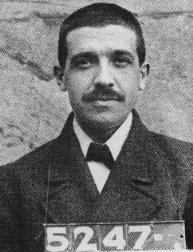
The scheme is named after Charles Ponzi
Charles Ponzi

Charles Ponzi was one of the greatest swindlers in American history. His aliases include Charles Ponei, Charles P. Bianchi, Carl and Carlo....
, who became notorious for using the technique after immigrating from Italy
Italy

Italy , officially the Italian Republic , is a country located on the Italian Peninsula in Southern Europe and on the two largest islands in the Mediterranean Sea, Sicily and Sardinia....
 to the United States
United States

The United States of America is a Federal government constitutional republic comprising U.S. state and a federal district. The country is situated mostly in central North America, where its Contiguous United States and Washington, D.C., the Capital districts and territories, lie between the Pacific Ocean and Atlantic Oceans, Borders of the U...
 in 1903. Ponzi did not invent the scheme, but his operation took in so much money that it was the first to become known throughout the United States. His original scheme
Charles Ponzi

Charles Ponzi was one of the greatest swindlers in American history. His aliases include Charles Ponei, Charles P. Bianchi, Carl and Carlo....
 was in theory based on arbitraging
Arbitrage

In economics and finance, arbitrage is the practice of taking advantage of a price differential between two or more markets: striking a combination of matching deals that capitalize upon the imbalance, the profit being the difference between the market prices....
 international reply coupon
International reply coupon

An international reply coupon is a coupon that can be exchanged for one or more postage stamps representing the minimum postage for an unregistered priority airmail letter of up to twenty grams sent to another Universal Postal Union member country....
s for postage stamps, but soon diverted investors' money to support payments to earlier investors and Ponzi's personal wealth. Charles Dickens
Charles Dickens

Charles John Huffam Dickens, Royal Society of Arts , pen-name "Boz", was the most popular English people novelist of the Victorian era, as well as a vigorous Reform movement....
' 1844 novel Martin Chuzzlewitt described a Ponzi scheme decades before Ponzi was born.

Knowingly entering a Ponzi scheme, even at the last round of the scheme, can be rational
Rational choice theory

Rational choice theory, also known as rational action theory, is a framework for understanding and often Model social and economic behavior....
 in the economic sense if a government will likely bail out those participating in the Ponzi scheme.

Hypothetical example

Suppose an advertisement is placed that promises extraordinary returns on an investment — for example, 20% on a 30-day contract. The objective is to deceive laypeople who have no in-depth knowledge of finance or financial jargon. Verbal constructions that sound impressive but are essentially meaningless will be used to dazzle investors: terms such as "hedge
Hedge (finance)

In finance, a hedge is a position established in one market in an attempt to offset exposure to the price Risk#In_finance of an equal but opposite obligation or position in another market ? usually, but not always, in the context of one's commercial activity....
 futures trading
Futures contract

In finance, a futures contract is a standardized contract, traded on a futures exchange, to buy or sell a standardized quantity of a specified commodity of standardized quality at a certain date in the future, at a price determined by the instantaneous equilibrium between the forces of supply and demand among competing buy and sell orders...
", "high-yield investment programs", "offshore investment
Offshore investment

Offshore investment is the keeping of money in a jurisdiction other than one's country of residence. Offshore jurisdictions are a commonly accepted solution to reducing excessive tax burdens levied in most countries to both large and small scale investors alike....
" might be used. The promoter will then proceed to sell investors — who are essentially victims of a confidence trick
Confidence trick

A confidence trick or confidence game is an attempt to defraud a person or group by gaining their confidence....
 — stakes, by taking advantage of a lack of investor knowledge or competence.

Without the benefit of precedent or objective prior information about the investment, only a few investors are tempted, usually for smaller sums. Thirty days later, the investor receives the original capital plus the 20% return. At this point, the investor will have more incentive to put in additional money and, as word begins to spread, other investors grab the "opportunity" to participate, leading to a cascade effect deriving from the promise of extraordinary returns. However, the "return" to the initial investors is being paid out of the investments of new entrants, and not out of profits.

One reason that the scheme initially works so well is that early investors — those who actually got paid the large returns — commonly reinvest their money in the scheme (it does, after all, pay out much better than any alternative investment). Thus, those running the scheme do not actually have to pay out very much (net) — they simply have to send statements to investors showing them how much they earned by keeping the money, in order to maintain the deception that the scheme is a fund with high returns.

Promoters also try to minimize withdrawals by offering new plans to investors, often where money is frozen for a longer period of time, in exchange for higher returns. The promoter sees new cash flows as investors are told they could not transfer money from the first plan to the second. If a few investors do wish to withdraw their money in accordance with the terms allowed, the requests are usually promptly processed, which gives the illusion to all other investors that the fund is solvent
Insolvency

Insolvency means the inability to pay one's debts as they fall due.This is defined in two different ways:Cash flow insolvency -: Unable to pay debts as they fall due....
.

The catch is that at some point one of three things will happen:
  1. The promoters will vanish, taking all the remaining investment money (minus the payouts to investors) with them.
  2. The scheme will collapse under its own weight, as investment slows and the promoters start having problems paying out the promised returns (the higher the returns, the greater the chance of the Ponzi scheme collapsing). Such liquidity crises often trigger panics, as more people start asking for their money, similar to a bank run
    Bank run

    A bank run occurs when a large number of bank customers withdraw their Deposit account because they believe the bank is, or might become, insolvency....
    .
  3. The scheme is exposed because the promoter fails to validate their claims when asked to do so by legal authorities.


What is not a Ponzi scheme

  • A multilevel pyramid scheme is a form of fraud similar in some ways to a Ponzi scheme, relying as it does on a disbelief in financial reality, including the hope of an extremely high rate of return. However, several characteristics distinguish these schemes from Ponzi schemes:
    • In a Ponzi scheme, the schemer acts as a "hub" for the victims, interacting with all of them directly. In a multilevel scheme, those who recruit additional participants benefit directly. (In fact, failure to recruit typically means no investment return.)
    • A Ponzi scheme claims to rely on some esoteric investment approach (insider connections, etc.) and often attracts well-to-do investors; whereas multilevel schemes explicitly claim that new money will be the source of payout for the initial investments.
    • A multilevel scheme is bound to collapse a lot faster because it requires exponential increases in participants to sustain it. By contrast, Ponzi schemes can survive simply by persuading most existing participants to "reinvest" their money, with a relatively small number of new participants.


  • A bubble
    Economic bubble

    An economic bubble is ?trade in high volumes at prices that are considerably at variance with Intrinsic value ?.While some economists deny that bubbles occur, the cause of bubbles remains a challenge to those who are convinced that asset prices often deviate strongly from intrinsic values....
    . A bubble relies on suspension of disbelief and an expectation of large profits, but it is not the same as a Ponzi scheme. A bubble involves ever-rising (and unsustainable) prices in an open market (be that shares of a stock, housing prices, the price of tulip bulbs
    Tulip mania

    Tulip mania or tulipomania was a period in the Dutch Golden Age during which contract prices for bulbs of the newly-introduced tulip reached extraordinarily high levels and then suddenly collapsed....
    , or anything else). As long as buyers are willing to pay ever-increasing prices, sellers can get out with a profit, and there doesn't need to be a schemer behind a bubble. (In fact, a bubble can arise without any fraud at all - for example, housing prices in a local market that rise sharply but eventually drop sharply because of overbuilding.) Bubbles are often said to be based on the "greater fool" theory. Although, according to the Austrian Business Cycle Theory, bubbles are caused by expanding the money supply
    Money supply

    In economics, money supply, or money stock, is the total amount of money available in an economy at a particular point in time. There are several ways to define "money", but standard measures usually include currency in circulation and demand deposits....
     beyond what genuine capital investment supports, and in this case would qualify as a Ponzi scheme, with expanded credit taking the place of an expanded pool of investors.


  • Although non-fraudulent in intent, a pension fund
    Pension fund

    A pension fund is a pool of assets forming an independent legal entity that are bought with the contributions to a pension plan for the exclusive purpose of financing pension plan benefits....
     can share some of the characteristics of a Ponzi scheme in that, except during the final period of the fund's life-span, the outgoing cash used in any month to pay pensions is usually taken from the incoming contributions of the active members of the pension scheme. In a year of poor equity returns such as 2008, a pension fund can often perform worse for its members than a Ponzi scheme.


  • Robbing Peter to pay Paul
    Robbing Peter to pay Paul

    Robbing Peter to pay Paul is an English idiom referring to taking money from one party to pay one's debt to another. In other words, the idiom usually means to create a problem to solve another, especially when applied to money or other resources ....
    . When debts are due and the money to pay them is lacking, whether because of bad luck or deliberate theft, debtors often make their payments by borrowing or stealing from other investors they have. It does
    not follow that this is a Ponzi scheme, because from the basic facts set out there is no indication that the lenders were promised unrealistically high rates of return via claims of unusual financial investments. Nor (from these basic facts) is there any indication that the borrower (banker) is progressively increasing the amount of borrowing ("investing") to cover payments to initial investors (as, again, Ponzi was not the first to do).


  • Multi-level marketing
    Multi-level marketing

    Multi-level marketing , also known as Network Marketing, is a marketing strategy that compensates promoters of direct selling companies not only for product sales they personally generate, but also for the sales of others they introduced to the company....


Notable Ponzi schemes


Charles Ponzi

The eponymous Ponzi scheme was coordinated by Charles Ponzi
Charles Ponzi

Charles Ponzi was one of the greatest swindlers in American history. His aliases include Charles Ponei, Charles P. Bianchi, Carl and Carlo....
, who went from anonymity to being a well-known Boston millionaire
Millionaire

A millionaire is an individual whose net worth or wealth exceeds one million units of currency. It can also be a person who owns one million units of currency in a bank account or savings account....
 in six months using such a scheme in 1920. Profits were supposed to come from exchanging international postal reply coupons (IRC). The purpose of the postal reply coupon was to allow someone in one country to send it to a correspondent in another country, who could use it to pay the postage of a reply. IRCs were priced at the cost of postage in the country of purchase, but could be exchanged for stamps to cover the cost of postage in the country where redeemed; if these values were different, there was a potential profit.

Inflation after the First World War had much decreased the cost of postage in Italy expressed in U.S. dollars, so that an IRC could be bought cheaply in Italy
Italy

Italy , officially the Italian Republic , is a country located on the Italian Peninsula in Southern Europe and on the two largest islands in the Mediterranean Sea, Sicily and Sardinia....
 and exchanged for U.S. stamps to a higher value. The process was: send money abroad; have IRCs purchased by agents; send the IRCs to the U.S.A.; redeem the IRCs for stamps to a higher value; sell the stamps. Ponzi claimed that the net profit on these transactions, after expenses and exchange rates, was in excess of 400%. This was a form of arbitrage
Arbitrage

In economics and finance, arbitrage is the practice of taking advantage of a price differential between two or more markets: striking a combination of matching deals that capitalize upon the imbalance, the profit being the difference between the market prices....
, or profiting by buying an asset at a lower price in one market and immediately selling it in a market where the price is higher, which is not illegal.

Ponzi canvassed friends and associates to back his scheme, offering a 50% return on investment in 45 days. The great returns available from postal reply coupons, he explained to them, made such incredible profits easy. He started his own company, the "Securities Exchange Company", to promote the scheme. He promised 50% interest (return) on investments in 45 days or "double your money" in 90 days.

About 40,000 people invested about $15 million all together; in the end, only a third of that money was returned to them. By July 1920 he had made millions. People were mortgaging their homes and investing their life savings. Most did not take their profits, but reinvested. Ponzi was bringing in cash at a fantastic rate, but the simplest financial analysis would have shown that the operation was running at a large loss. As long as money kept flowing in, existing investors could be paid with the new money. In fact, new money was the only source Ponzi had to pay off those investors, as he made no effort to generate legitimate profits.

Ponzi lived luxuriously: he bought a mansion in Lexington, Massachusetts with air conditioning and a heated swimming pool, and brought his mother from Italy in a first-class stateroom on an ocean liner.

By this time Ponzi was seeking another deal to get him out of the golden trap he had built for himself, but time was running out. On July 26 the Boston Post
Boston Post

The Boston Post was the most popular daily newspaper in New England for over a hundred years before it folded in 1956. The Post was founded in November 1831 by two prominent Boston, Massachusetts businessmen, Charles Gordon Greene and William Beals....
 started a series of articles that asked hard questions about the operation of Ponzi's money machine. The Post contacted Clarence Barron, the financial analyst who published the Barron's financial paper, to examine Ponzi's scheme. Barron observed that though Ponzi was offering fantastic returns on investments, Ponzi himself wasn't investing with his own company. Barron then noted that to cover the investments made with the Securities Exchange Company, 160,000,000 postal reply coupons would have to be in circulation. However, only about 27,000 coupons were actually circulating.

The United States Post Office stated that postal reply coupons were not being bought in quantity at home or abroad. The gross profit margin in percent on buying and selling each IRC was colossal, but the overhead required to handle the purchase and redemption of these items, which were of extremely low cost and were sold individually, would have exceeded the gross profit.

The stories caused a panic run on the Securities Exchange Company. Ponzi paid out $2 million in three days to a wild crowd outside his office. He canvassed the crowd, passed out coffee and donuts, and cheerfully told them they had nothing to worry about. Many changed their minds and left their money with him.

In the short term, Ponzi had hired a publicity agent, James McMasters. However, McMasters quickly became suspicious of Ponzi's endless talk of postal reply coupons, as well as the ongoing investigation against him. He went to the Post, calling Ponzi a "financial idiot". The paper offered him five thousand dollars for his story, and ran a headline on August 2 declaring Ponzi hopelessly insolvent. On August 10 federal agents raided the Securities Exchange Company and shut it down. There was no large stock of postal reply coupons. The Post continued its articles, with one revealing Ponzi's jail record and publishing his (smiling) Canadian mugshots.

On August 12, 1920, Ponzi was under arrest, with a Federal indictment. His liabilities were estimated at $7 million.

In two federal indictments, Ponzi was charged with 86 counts of using the mails to defraud the public. It was an ironic charge — Ponzi's only use of the mails was to send postcards to his "investors", telling them their notes were due and to come get their money, which until the very end he happily paid. On November 1, 1920, Ponzi pleaded guilty to a single count of mail fraud before Judge Clarence Hale, who declared before sentencing: "Here was a man with all the duties of seeking large money. He concocted a scheme which, on his counsel's admission, did defraud men and women. It will not do to have the world understand that such a scheme as that can be carried out ... without receiving substantial punishment." He was sentenced to five years in federal prison. He was released after three and a half years to face 22 Massachusetts state charges of larceny
Larceny

Larceny was an offence under the common law of England and became an offence in jurisdictions which incorporated the common law of England into their own law....
.

Ponzi was eventually released in 1934 following other indictments, and asked for a full pardon from Joseph Buell Ely, the Massachusetts
Massachusetts

The Commonwealth of Massachusetts is a U.S. state located in the New England region of the Northeastern United States United States. It borders Rhode Island and Connecticut to the south, New York to the west, and Vermont and New Hampshire to the north....
 Governor. He was deported to his homeland, Italy, as he hadn't ever become an American citizen. His charismatic confidence had faded, and when he left the prison gates, he was met by an angry crowd. He told reporters before he left:

"I went looking for trouble, and I found it."

Bernard Madoff

On December 10, 2008, Bernard Madoff
Bernard Madoff

Bernard Lawrence "Bernie" Madoff is an United States businessman and former chairman of the NASDAQ stock exchange charged with perpetrating what may be the largest investor fraud ever committed by a single person....
, the former non-executive chairman of the NASDAQ
NASDAQ

The NASDAQ is an United States stock exchange. It is the largest Electronic trading screen-based Stock trading market in the United States....
 Stock Market, allegedly told his sons that the asset management arm of his firm was a massive Ponzi scheme — as he put it, "one big lie." The following day he was arrested and charged with a single count of securities fraud — but one that accuses him of milking his investors of $50 billion. This may be the largest Ponzi scheme ever perpetrated, as well as the largest investment fraud ever committed by a single person. One of Madoff's biggest investors, René-Thierry Magon de la Villehuchet
René-Thierry Magon de la Villehuchet

Ren?-Thierry Magon de la Villehuchet, also known as Thierry de la Villehuchet for short was a France noblemen, money manager, and businessman, and one of the founders of Access International Advisors ....
 of Access International Advisors, committed suicide
Suicide

Suicide is the intentional taking of one's own life. Many dictionaries also note the metaphorical sense of "willful destruction of one's self-interest"....
 around December 23, 2008, following the disclosure of $1.5 billion in losses.

Madoff's scheme was typical of a Ponzi in its structure, but differed in its pace and marketing. Rather than offer (suspiciously) high returns to all comers, Madoff offered modest, but steady returns to an exclusive clientele, produced in both up and down markets. Although the investment method was marketed as a "too complicated for outsiders to understand" combination of stock purchases tracking some index and related puts and calls (contrary "bets" on the index's direction), the true secret to Madoff's success was his lifetime involvement with non-profit charities, and the tax law knowledge he gleaned from that experience over many decades.

Charitable foundations were the basis, as well as the side-victims, of his surreptitious strategy. He exploited his own social networks, and over time, received implicit entree into new venues to promote himself and his company among his clientele. He invested their significant funds consisting of educational foundations and social charities, as directed by them. The slow pace and ongoing cliquish "insider" word-of-mouth marketing enabled the deception to survive for several decades. It grew beyond the expectations of a common Ponzi.

All was quite successful until the autumn market meltdown in 2008 when extraordinary demands for cash from investors in early December overwhelmed his system. Some investors were unknowingly exposed through multiple fund investments that they believed were diversified in some of Madoff's hedge fund
Hedge fund

A hedge fund is an investment fund open to a limited range of investors that is permitted by regulators to undertake a wider range of activities than other investment funds and also pays a performance fee to its investment management....
s investments and/or through investments in third party hedge funds with unreported investments in various Madoff programs.

Ultimately, charities and foundations that invested with Madoff lost millions in what has been characterized as a form of affinity fraud
Affinity fraud

Affinity fraud includes investment frauds that prey upon members of identifiable groups, such as religious or ethnic communities, the elderly, or professional groups....
. Mitchell Zuckoff, professor of journalism at Boston University
Boston University

Boston University is a private nonsectarian university located in Boston, Massachusetts, Massachusetts, United States. Although chartered by the Massachusetts Legislature in 1869, Boston University traces its roots to the establishment of the Newbury Biblical Institute in Newbury, Vermont in 1839....
, author of Ponzi's Scheme: The True Story of a Financial Legend, explained "the 5% payout rule," a federal law requiring foundations to pay out 5% of their funds each year. As long as a foundation's principal earns 5% a year - not always possible in a given year, but a reasonable goal over time - a foundation endures, and so does its sponsor, Madoff's vision. Madoff knew the "Rule" well.

Zuckoff noted, "For every $1 billion in foundation investment, Madoff was effectively on the hook for about $50 million in withdrawals a year. If he wasn't making real investments, at that rate the principal would last 20 years. By targeting charities, Madoff could avoid the threat of sudden or unexpected withdrawals." Zuckoff suggests that years ago, Madoff "solved the two interlocking puzzles that usually prevent Ponzi schemes from becoming perpetual money machines: sustaining growth, while maintaining stability."

Comparison to Social Security

See Pay-as-you-go social insurance
PAYGO

PAYGO is a term used to refer to financing where budgetary restrictions demand paying for expenditures with funds that are made available as the program is in progress....
.


See also Social Security debate (United States)#Criticism of Social Security as a Ponzi Scheme
Social Security debate (United States)

This article concerns proposals to change the Social Security system in the United States. Social Security is a Social security program officially called "Old-Age, Survivors, and Disability Insurance" , in reference to its three components....
.


Detractors of the Social Security
Social Security (United States)

Social security in the United States currently refers to the Federal government of the United States Old-Age, Survivors, and Disability Insurance program....
 program in the United States often draw parallels between it and a Ponzi scheme, because people who make payments receive benefits later from payments made by others. Conservative
Conservatism

Conservatism is a political and social term whose meaning has changed in different countries and time periods, but which usually indicates support for the status quo or the status quo ante....
 economist Walter Williams
Walter E. Williams

Walter E. Williams, Ph. D. is an United States economics and Professor at George Mason University. He is also a Print syndication columnist and author known for his libertarian and sometimes Conservatism in the United States views....
 adds, "Social Security is unsustainable because it is not meeting the first order condition of a Ponzi scheme, namely expanding the pool of suckers."

The U.S. Social Security Administration
Social Security Administration

The United States Social Security Administration is an Independent agencies of the United States government of the United States federal government of the United States that administers Social Security , a social insurance program consisting of retirement, disability, and survivors' benefits....
 has provided the following response to the "Ponzi scheme" accusation:

See also

  • Fraud
    Fraud

    In the broadest sense, a fraud is a deception made for personal gain or to damage another individual. The specific legal definition varies by legal jurisdiction....
  • Multi-level marketing
    Multi-level marketing

    Multi-level marketing , also known as Network Marketing, is a marketing strategy that compensates promoters of direct selling companies not only for product sales they personally generate, but also for the sales of others they introduced to the company....
  • High-yield investment program
  • Bucket shop (stock market)
    Bucket shop (stock market)

    Bucket shop is a brokerage firm that ?books" retail customer orders without actually having them executed on an exchange. These brokerages are also often called boiler room ....
  • Pyramid scheme
    Pyramid scheme

    File:Pyramid scheme.svgA pyramid scheme is a non-sustainable business model that involves the exchange of money primarily for enrolling other people into the scheme, often without any product or Service being delivered....
  • Get-rich-quick schemes
  • Matrix scheme
  • Reed Slatkin
    Reed Slatkin

    Reed Eliot Slatkin was an initial investor and co-founder of EarthLink and the perpetrator of one of the largest Ponzi schemes in the United States since that conducted by Charles Ponzi himself....
  • Double Shah
    Double Shah

    Syed Sibtul Hassan Shah alias Double Shah, was a teacher who started a financial scam in Pakistan. Syed Sibtul Hassan Shah is a resident of Pak town - a lower middle class area - in Wazirabad, a tehsil of Gujranwala....


Further reading


External links

  • , NPR.org
  • - Social Security Administration
  • , by Bill E. Branscum, a financial crimes investigator.
  • , published July 31, 1920, in the Minneapolis Sunday Tribune.