
All Topics  
Bean weevil

 
Bean Weevil

   Email Print
   Bookmark   Link


Bean weevil


The bean weevils or seed beetles are a subfamily (Bruchinae) of beetle
Beetle

Beetles are the group of insects with the largest number of known species. They are placed in the order Coleoptera , which contains more described species than in any other order in the animal, constituting about 25% of all known life-forms....
s, now placed in the family Chrysomelidae, though they have historically been treated as a separate family. They are granivores, and typically infest various kinds of seed
Seed

A seed is a small Plant embryogenesis plant enclosed in a covering called the seed coat, usually with some Food storage. It is the product of the ripened ovule of gymnosperm and angiosperm plants which occurs after fertilization and some growth within the mother plant....
s or bean
Bean

Bean is a common name for large plant seeds of several genus of the Family Fabaceae used for human food or animal feed.The whole young pods of bean plants, if picked before the pods ripen and dry, can be tender enough to eat whole, whether cooked or raw....
s, living for most of their lives inside a single seed.


Discussion
Ask a question about 'Bean weevil'
Start a new discussion about 'Bean weevil'
Answer questions from other users
Full Discussion Forum


Encyclopedia


Bonenkever Acanthoscelides Obtectus
The bean weevils or seed beetles are a subfamily (Bruchinae) of beetle
Beetle

Beetles are the group of insects with the largest number of known species. They are placed in the order Coleoptera , which contains more described species than in any other order in the animal, constituting about 25% of all known life-forms....
s, now placed in the family Chrysomelidae, though they have historically been treated as a separate family. They are granivores, and typically infest various kinds of seed
Seed

A seed is a small Plant embryogenesis plant enclosed in a covering called the seed coat, usually with some Food storage. It is the product of the ripened ovule of gymnosperm and angiosperm plants which occurs after fertilization and some growth within the mother plant....
s or bean
Bean

Bean is a common name for large plant seeds of several genus of the Family Fabaceae used for human food or animal feed.The whole young pods of bean plants, if picked before the pods ripen and dry, can be tender enough to eat whole, whether cooked or raw....
s, living for most of their lives inside a single seed. The family includes about 1,350 species found worldwide.

Bean weevils are generally compact and oval in shape, with small heads somewhat bent under. Sizes range to 1 mm, up to 22 mm for some tropical species. Colors are usually black or brown, often with mottled patterns. Although their mandibles may be elongate, they do not have the long snouts characteristic of true weevil
Weevil

A weevil is any beetle from the Curculionidae superfamily. They are usually small, less than 6 mm , and Herbivore. Due to the shape of their heads, weevils are commonly known as snout beetles....
s.

Adults deposit eggs on seeds, then the larvae chew their way into the seed. When ready to pupa
Pupa

A pupa is the life stage of some insects undergoing transformation. The pupal stage is found only in Holometabolism insects, those that undergo a complete metamorphosis, going through four life stages; embryo, larva, pupa and imago....
te, the larvae typically cut an exit hole, then return to their feeding chamber. Adult weevils have a habit of feigning death and dropping from a plant when disturbed.

Host plants tend to be legume
Legume

A legume is a plant in the family Fabaceae , or a fruit of these specific plants. A legume fruit is a Fruit#Simple fruit that develops from a simple carpel and usually Dehiscence on two sides....
s, but species will also be found in Convolvulaceae
Convolvulaceae

The Convolvulaceae, known commonly as the bindweed or morning glory family , is a group of about 60 genera and more than 1,650 species of mostly herbaceous vines, but also trees, shrubs and herbs....
, Arecaceae
Arecaceae

Palm or Palmae or Panamea , the palm family, is a family of flowering plants belonging to the Monocotyledon order, Arecales. There are roughly 202 currently known Genus with around 2600 species, most of which are restricted to tropics, subtropics, and warm temperate climates....
, and Malvaceae
Malvaceae

Malvaceae, or the mallow family, is a family of flowering plants containing over 200 genera with close to 2,300 species. Judd & al. The largest genera in terms of number of species include Hibiscus , Sterculia , Dombeya , Pavonia and Sida ....
, and several species are considered pests.

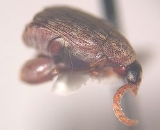
One characteristic of the beetles which can be seen in the photo is that the elytra
Elytron

An elytron is a modified, hardened forewing of certain insect orders, notably beetles and true bugs . An elytron is sometimes also referred to as a shard....
 are short, not quite reaching the tip of the abdomen.

The adult beetles are occasionally found in the United Kingdom when they emerge out of stored products in warehouses & dwellings, but they cannot proliferate in unheated buildings in that climate.

Notable species


  • common bean weevil, Acantoscelides obtectus Say
  • Scotch broom beetle
    Bruchidius villosus

    Bruchidius villosus is a species of bean weevil known by the common names broom seed beetle and Scotch broom bruchid. This beetle is used as an agent of biological pest control against the noxious weed known as Cytisus scoparius ....
    , Bruchidius villosus Fabr.
  • pea weevil Bruchus pisorum L.
  • broadbean weevil Bruchus rufimanus Boheman
  • cowpea weevil Callosobruchus maculatus
  • southern cowpea weevil Callosobruchus chinensis (also known as the azuki bean
    Azuki bean

    The azuki bean is an Annual plant vine widely grown throughout East Asia and the Himalayas for its small bean. The cultivars most familiar in north-east Asia have a uniform red color, but white, black, gray and variously mottled varieties are also known....
     beetle)
  • Kiawe bruchid, mesquite bruchid Algarobius bottimeri


Genera

This list of genera follows the old systematics, when the family Bruchidae was still valid.


  • Rhaebinae Chapuis, 1874
  • Rhaebus Fischer von Waldheim, 1824
  • Pachymerinae Bridwell, 1929
  • Pachymerini Bridwell, 1929


  • Pachymerus Thunberg, 1805
  • Butiobruchus Prevett, 1966
  • Caryobruchus Bridwell, 1929
  • Caryoborus Schoenherr, 1833
  • Caryedonini Bridwell, 1929


  • Mimocaryedon Decelle, 1968
  • Caryedon Schoenherr, 1823
  • Caryotrypes Decelle, 1968
  • Aforedon Decelle, 1965
  • Exoctenophorus Decelle, 1968
  • Caryopemonini Bridwell, 1929


  • Protocaryopemon Borowiec, 1987
  • Diedobruchus Pic, 1913
  • Caryopemon Jekel, 1855
  • Amblycerinae Bridwell, 1932
  • Amblycerini Bridwell, 1932


  • Amblycerus Thunberg, 1815
  • Spermophagini Borowiec, 1987


  • Zabrotes Horn, 1885
  • Spermophagus Schoenherr, 1833
  • Eubaptinae Bridwell, 1932
  • Eubaptus Lacordaire, 1945
  • Kytorhininae Bridwell, 1832
  • Kytorhinus Fischer von Waldheim, 1809
  • Bruchinae Latreille, 1802
  • Bruchini Latreille, 1802


  • Bruchus Linnaeus, 1767
  • Megacerini Bridwell, 1946


  • Megacerus Fahraeus, 1839
  • Acanthoscelidini Bridwell, 1946


  • Gibbobruchus Pic, 1913
  • Ctenocolum Kingsolver & Whitehead, 1974
  • Caryedes Hummel, 1827
  • Meibomeus Bridwell, 1946
  • Penthobruchus Kingsolver, 1973
  • Pygiopachymerus Pic, 1911
  • Merobruchus Bridwell, 1946
  • Acanthoscelides Schilsky, 1905
  • Mimosestes Bridwell, 1946
  • Stylantheus Bridwell, 1946
  • Altheus Bridwell, 1946
  • Pseudopachymerina Zacher, 1952
  • Neltumius Bridwell, 1946
  • Stator Bridwell, 1946
  • Sennius Bridwell, 1946
  • Megasennius Whitehead & Kingsolver, 1975
  • Algarobius Bridwell, 1946
  • Scutobruchus Kingsolver, 1968
  • Rhipibruchus Bridwell, 1932
  • Pectinibruchus Kingsolver, 1967
  • Dahlibruchus Bridwell, 1931
  • Cosmobruchus Bridwell,, 1931
  • Lithraeus Bridwell, 1952
  • Bonaerius Bridwell, 1952
  • Spatulobruchus Borowiec, 1987
  • Palpibruchus Borowiec, 1987
  • Specularius Bridwell, 1938
  • Acanthobruchidius Borowiec, 1980
  • Palaeoacanthoscelides Borowiec, 1985
  • Horridobruchus Borowiec, 1984
  • Callasobruchus Pic, 1902
  • Bruchidius Schilsky, 1905
  • Salviabruchus Decelle, 1982
  • Sulcobruchus Chujo, 1937
  • Parasulcobruchus Anton, 1999
  • Borowiecus Anton, 1994
  • Megabruchidius Borowiec, 1984
  • Conicobruchus Decelle, 1951
  • Kingsolverius Borowiec, 1987
  • Decellebruchus Borowiec, 1987
  • Margaritabruchus Romero & Johnson, 2001