

Battle of Kambula

Encyclopedia
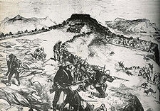
Battle of Kambula took place in 1879, during the Anglo-Zulu War
when a Zulu
Army attacked the British camp at Kambula
. It resulted in a decisive Zulu defeat and is considered to be the turning point of the Anglo-Zulu War.
on 28 March 1879, Colonel Evelyn Wood’s forces prepared to receive an attack by the entire Zulu impi
, of which they had only previously encountered the leading sections. Soon after dawn of 29 March, Transvaal Rangers
rode out to locate the enemy impi, the cattle were put out to graze and, after some deliberation, two companies were despatched to collect firewood. By 11am the Rangers had returned with the news that the impi was on the move and was to attack Kambula at noon. Wood also now received information that the impi was nearly 20,000 men strong, consisting of regiments that had already defeated the British at Isandlwana
and other battles and that many of the Zulus were armed with rifles taken from the British dead at these battles. Shortly after this the Zulu impi was sighted 5 miles away across the plain, coming on due westwards in five columns. However, the warriors of the impi had not eaten for three days. The woodcutters and cattle were brought back in and, confident that the defences could be manned within a minute and a half of an alarm being sounded, Wood ordered the men to have their dinners.
Cetshwayo responded to pleas from the abaQulasi for aid against the raids of Wood's troops by ordering the main Zulu army to help them. He ordered it not to attack fortified positions but to lure the British troops into the open even if it had to march on the Transvaal to accomplish this. Unfortunately, his orders were not followed. The impi moved and Wood initially thought it was advancing on the Transvaal but it halted a few miles south of Kambula and formed up for an attack.
for the cattle, constructed on the edge of the southern face of the ridge. Trenches and earth parapets surrounded both sections, and a stone-built redoubt had been built on a rise just north of the kraal. A palisade blocked the hundred yards between the kraal and redoubt, while four 7-pounders were positioned between the redoubt and the laager to cover the northern approaches. Two more guns in the redoubt covered the north-east also.
Two companies were sited in the redoubt; another company in the cattle kraal and the remaining infantry manned the laager. The gunners had been told that if the Zulus got in close they were to abandon their guns and make for the laager. In all, Wood’s force mustered 121 Royal Artillery
and Royal Engineers
, 1,238 infantry and 638 mounted men. With headquarters staff, it totalled 2,000 men, of which 88 were sick in hospital.
, and then when the Zulus got closer canister shot
. A small number of Zulus managed to burst into the laager, and were repelled with bayonets, while the bulk of the advance was held at bay by the steady British musketry and gunfire. Some of the Zulu force swung right to come in against the western sides of the laager, but were met with equally effective resistance. After about half an hour the Zulu right horn drew back to the north-east.
At 2.15, as the right horn made its withdrawal, the left horn and centre surged up out of the ravine, their leading warriors falling to crossfire from the laager and kraal as they came over the crest. However, more and more swarmed on to the glacis
between the cliff and the defenders, funneling into the gap between the kraal and laager. The Zulus soon forced their way into the cattle Kraal and fought hand-to-hand with men of the 1/13th company. The cattle in the kraal hampered both sides, but with Zulu pressure mounting up the heavily outnumbered British troops managed to extricate themselves and pull back to the redoubt. Zulu riflemen were now able to open fire from behind the walls of the kraal to give their advancing comrades cover. At about this time the right horn came on again from the north-east, charging across the north face of the redoubt towards the guns and the eastern sides of the laager.
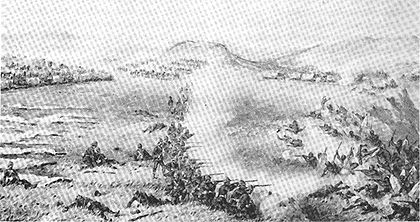 Although now attacked on both sides, Wood appreciated that the situation to the south was critical and ordered two companies to clear the Zulus off the glacis. Led by Major Hackett the men formed in line with bayonets fixed and charged across the open ground, forcing the Zulus back over the rim. The troops then lined the crest and opened volley fire into the packed warriors in the ravine. The counter-attack had succeeded perfectly but Hackett’s men suddenly found themselves under fire from their right, where Zulu marksmen had concealed themselves in a refuse pit. Hackett sounded the 'Retire' and his men returned to the cover of the laager, but not before losing a colour-sergeant, a subaltern and himself receiving a blinding head wound. The sight of this withdrawal encouraged the Zulus in the ravine to charge again, but along the narrow killing zone in front of the laager they could not this time prevail against the controlled volleys from behind the wagons and the redoubt.
On the north side the Royal Artillery men fought their guns in the open, not taking cover, and poured round after round directly into the right horn.
The Zulus charged again and again, with unwavering courage, but the head of each charge was shot away and at about 5pm Wood sensed the impetus was going out of their attack. Two companies moved to clear the kraal and lined the rim of the cliff with a further company to fire into the dead ground. As soon as the Zulus began to pull away eastwards he ordered Buller to mount his men up and pursue. The Zulus were harried mercilessly for 7 miles, mounted troops firing one handed with carbines from the saddle or spearing them with discarded assegai
s. The Frontier Light Horse
men singled abaQulusi warriors for their special attention, chasing them as far as Hlobane and extracting a savage revenge for their comrades killed the day before at the Battle of Hlobane.
. Never again would an impi fight against a prepared position with the ferocity and resolution displayed up to this date.
Anglo-Zulu War
The Anglo-Zulu War was fought in 1879 between the British Empire and the Zulu Kingdom.Following the imperialist scheme by which Lord Carnarvon had successfully brought about federation in Canada, it was thought that a similar plan might succeed with the various African kingdoms, tribal areas and...
when a Zulu
Zulu Kingdom
The Zulu Kingdom, sometimes referred to as the Zulu Empire or, rather imprecisely, Zululand, was a monarchy in Southern Africa that extended along the coast of the Indian Ocean from the Tugela River in the south to Pongola River in the north....
Army attacked the British camp at Kambula
Kambula
Kambula, Khambula or is a town located at in the KwaZulu-Natal Province of South Africa.British forces defeated the Zulu nation here in battle in 1879....
. It resulted in a decisive Zulu defeat and is considered to be the turning point of the Anglo-Zulu War.
Prelude
Following the disaster at HlobaneBattle of Hlobane
The Battle of Hlobane was a battle of the Anglo-Zulu War of 1879 that took place at Hlobane, near the current town of Vryheid in KwaZulu-Natal, South Africa.- Prelude :...
on 28 March 1879, Colonel Evelyn Wood’s forces prepared to receive an attack by the entire Zulu impi
Impi
An Impi is an isiZulu word for any armed body of men. However, in English it is often used to refer to a Zulu regiment, which is called an ibutho in Zulu. Its beginnings lie far back in historic tribal warfare customs, where groups of armed men called impis battled...
, of which they had only previously encountered the leading sections. Soon after dawn of 29 March, Transvaal Rangers
Transvaal Rangers
Raafs Horse was an irregular unit raised by Pieter Raaf with a strength of approximately 140. The Transvaal Rangers enlisted both European and Coloured personnel in its ranks, and recruited large numbers from the Kimberley diamond fields...
rode out to locate the enemy impi, the cattle were put out to graze and, after some deliberation, two companies were despatched to collect firewood. By 11am the Rangers had returned with the news that the impi was on the move and was to attack Kambula at noon. Wood also now received information that the impi was nearly 20,000 men strong, consisting of regiments that had already defeated the British at Isandlwana
Battle of Isandlwana
The Battle of Isandlwana on 22 January 1879 was the first major encounter in the Anglo-Zulu War between the British Empire and the Zulu Kingdom...
and other battles and that many of the Zulus were armed with rifles taken from the British dead at these battles. Shortly after this the Zulu impi was sighted 5 miles away across the plain, coming on due westwards in five columns. However, the warriors of the impi had not eaten for three days. The woodcutters and cattle were brought back in and, confident that the defences could be manned within a minute and a half of an alarm being sounded, Wood ordered the men to have their dinners.
Cetshwayo responded to pleas from the abaQulasi for aid against the raids of Wood's troops by ordering the main Zulu army to help them. He ordered it not to attack fortified positions but to lure the British troops into the open even if it had to march on the Transvaal to accomplish this. Unfortunately, his orders were not followed. The impi moved and Wood initially thought it was advancing on the Transvaal but it halted a few miles south of Kambula and formed up for an attack.
Kambula’s defences
The defences on Kambula consisted of a hexagonal laager formed with tightly locked together wagons, and a separate kraalKraal
Kraal is an Afrikaans and Dutch word for an enclosure for cattle or other livestock, located within an African settlement or village surrounded by a palisade, mud wall, or other fencing, roughly circular in form.In the Dutch language a kraal is a term derived from the Portuguese word , cognate...
for the cattle, constructed on the edge of the southern face of the ridge. Trenches and earth parapets surrounded both sections, and a stone-built redoubt had been built on a rise just north of the kraal. A palisade blocked the hundred yards between the kraal and redoubt, while four 7-pounders were positioned between the redoubt and the laager to cover the northern approaches. Two more guns in the redoubt covered the north-east also.
Two companies were sited in the redoubt; another company in the cattle kraal and the remaining infantry manned the laager. The gunners had been told that if the Zulus got in close they were to abandon their guns and make for the laager. In all, Wood’s force mustered 121 Royal Artillery
Royal Artillery
The Royal Regiment of Artillery, commonly referred to as the Royal Artillery , is the artillery arm of the British Army. Despite its name, it comprises a number of regiments.-History:...
and Royal Engineers
Royal Engineers
The Corps of Royal Engineers, usually just called the Royal Engineers , and commonly known as the Sappers, is one of the corps of the British Army....
, 1,238 infantry and 638 mounted men. With headquarters staff, it totalled 2,000 men, of which 88 were sick in hospital.
Battle
At 12.45 on 29 March 1879, the tents were struck, reserve ammunition was distributed, and the troops took up their battle stations. As the troops moved to their posts they could see the Zulu right horn, circling north out of British artillery range before halting north-west of the camp. The left horn and centre of the impi continued westwards until they were due south of Kambula. At 1.30 Lieutenant-Colonel Redvers Henry Buller suggested his mounted troops sting the right horn into premature attack, which was agreed to. The men rode out to within range of the massed Zulus, fired a volley and then galloped back, closely followed by a great wave of 11,000 Zulu warriors. As soon as the horsemen had reached Kambula, and cleared the field of fire, the British infantry opened fire with support from their four 7-pounders firing shellShell (projectile)
A shell is a payload-carrying projectile, which, as opposed to shot, contains an explosive or other filling, though modern usage sometimes includes large solid projectiles properly termed shot . Solid shot may contain a pyrotechnic compound if a tracer or spotting charge is used...
, and then when the Zulus got closer canister shot
Canister shot
Canister shot is a kind of anti-personnel ammunition used in cannons. It was similar to the naval grapeshot, but fired smaller and more numerous balls, which did not have to punch through the wooden hull of a ship...
. A small number of Zulus managed to burst into the laager, and were repelled with bayonets, while the bulk of the advance was held at bay by the steady British musketry and gunfire. Some of the Zulu force swung right to come in against the western sides of the laager, but were met with equally effective resistance. After about half an hour the Zulu right horn drew back to the north-east.
At 2.15, as the right horn made its withdrawal, the left horn and centre surged up out of the ravine, their leading warriors falling to crossfire from the laager and kraal as they came over the crest. However, more and more swarmed on to the glacis
Glacis
A glacis in military engineering is an artificial slope of earth used in late European fortresses so constructed as to keep any potential assailant under the fire of the defenders until the last possible moment...
between the cliff and the defenders, funneling into the gap between the kraal and laager. The Zulus soon forced their way into the cattle Kraal and fought hand-to-hand with men of the 1/13th company. The cattle in the kraal hampered both sides, but with Zulu pressure mounting up the heavily outnumbered British troops managed to extricate themselves and pull back to the redoubt. Zulu riflemen were now able to open fire from behind the walls of the kraal to give their advancing comrades cover. At about this time the right horn came on again from the north-east, charging across the north face of the redoubt towards the guns and the eastern sides of the laager.
On the north side the Royal Artillery men fought their guns in the open, not taking cover, and poured round after round directly into the right horn.
The Zulus charged again and again, with unwavering courage, but the head of each charge was shot away and at about 5pm Wood sensed the impetus was going out of their attack. Two companies moved to clear the kraal and lined the rim of the cliff with a further company to fire into the dead ground. As soon as the Zulus began to pull away eastwards he ordered Buller to mount his men up and pursue. The Zulus were harried mercilessly for 7 miles, mounted troops firing one handed with carbines from the saddle or spearing them with discarded assegai
Assegai
An assegai or assagai is a pole weapon used for throwing or hurling, usually a light spear or javelin made of wood and pointed with iron.-Iklwa:...
s. The Frontier Light Horse
Frontier Light Horse
The Frontier Light Horse, a mounted unit, was raised at King William's Town, Eastern Cape Colony in 1877 by Lieutenant Frederick Carrington. It is often referred to as the Cape Frontier Light Horse.-Military service:...
men singled abaQulusi warriors for their special attention, chasing them as far as Hlobane and extracting a savage revenge for their comrades killed the day before at the Battle of Hlobane.
Results
Over 800 Zulu dead were counted in the immediate vicinity of the position and hundreds more perished in the ravine and during the pursuit. 18 British soldiers were killed, and 8 officers and 57 men wounded, 11 of which later died. Kambula is considered as the turning point of the war, for the British demonstrated that shield and assegai were no match for an entrenched force with artillery and the Martini-HenryMartini-Henry
The Martini-Henry was a breech-loading single-shot lever-actuated rifle adopted by the British, combining an action worked on by Friedrich von Martini , with the rifled barrel designed by Scotsman Alexander Henry...
. Never again would an impi fight against a prepared position with the ferocity and resolution displayed up to this date.