
Home      Discussion      Topics      Dictionary      Almanac
Signup       Login
Battle of Hill Eerie

Battle of Hill Eerie

Overview
The Battle of Hill Eerie refers to several Korean War
Korean War
The Korean War was a conventional war between South Korea, supported by the United Nations, and North Korea, supported by the People's Republic of China , with military material aid from the Soviet Union...

 engagements between the United Nations
United Nations
The United Nations is an international organization whose stated aims are facilitating cooperation in international law, international security, economic development, social progress, human rights, and achievement of world peace...

 forces and the Chinese Communist Forces (CCF) in 1952 at the infamous Hill Eerie.
Discussion
Ask a question about 'Battle of Hill Eerie'
Start a new discussion about 'Battle of Hill Eerie'
Answer questions from other users
Full Discussion Forum
 
Unanswered Questions
Encyclopedia
The Battle of Hill Eerie refers to several Korean War
Korean War
The Korean War was a conventional war between South Korea, supported by the United Nations, and North Korea, supported by the People's Republic of China , with military material aid from the Soviet Union...

 engagements between the United Nations
United Nations
The United Nations is an international organization whose stated aims are facilitating cooperation in international law, international security, economic development, social progress, human rights, and achievement of world peace...

 forces and the Chinese Communist Forces (CCF) in 1952 at the infamous Hill Eerie.

Hill Eerie was a military outpost at 38°15′12"N 127°3′8"E, about ten miles west of the rubble piles of Ch'orwon. It was taken several times by both sides; each sabotaging the others' position.

March 1952


In March 1952, Hill Eerie was the responsibility of the United States Army
United States Army
The United States Army is the main branch of the United States Armed Forces responsible for land-based military operations. It is the largest and oldest established branch of the U.S. military, and is one of seven U.S. uniformed services...

's 45th Infantry Division - Company K, 179th Infantry, commanded by Captain Max Clark.

On March 21, 1952, the twenty-six personnel of the third platoon, under the command of Lieutenant Omer Manley, set out to take over the outpost. Manley's men made up two rifle squads, a light-machine-gun squad and a 60-mm mortar squad.

Manley sent out two patrols to establish an ambush site around the hill. That night, both patrol squads sighted enemy activity. At 23:30, the Chinese attacked and a machine gun duel between the two sides ended after Captain Clark's troops on Hill 418 supported his men in the Eerie outpost with supporting machine-gun and mortar fire.

The battle continued on the morning of March 22 with the Chinese forces penetrating the outpost's perimeter and eventually overran Manley's men. Clark was then ordered to concentrate his artillery fire on Outpost Eerie after losing communications. At 01:30, Regimental Commander, Colonel Frederick A. Daugherty, ordered Clark to advance toward the hill and retake the hill.

Clark's men searched the area and found out that, of the 26 men who had defended the outpost, 8 were dead, 4 wounded, and 2 were missing (Lieutenant Manley and Corporal Joel Ybarra). They also recovered 31 enemy dead from around the hill and captured a wounded Chinese soldier. Later, Clark withdrew his troops to the main line of resistance.

May 1952


In May 1952, the 20th Philippine Battalion Combat Team, under the command of Colonel Salvador Abcede, engaged the Chinese forces at the town of Karhwagol, west of Chorwon
Chorwon
Chorwon is a kun, or county, in Kangwon province, North Korea. Portions of it were once a single county together with the county of the same name in South Korea; other portions were added from neighboring counties in the 1956 reorganization of local governments...

; they were also involved in other major battles and assaults against the Chinese forces.

There were numerous closely fought battles on Hill Eerie, as well as on Hills 18, 200, and 19, ('Yoke', 'Uncle' and 'Old Baldy'), all in the T-Bone Hill area, but later the 20th were committed to the Pork Chop Hill
Battle of Pork Chop Hill
The Battle of Pork Chop Hill comprises a pair of related Korean War infantry battles during the spring and summer of 1953. These were fought while the U.S. and the Communist Chinese and Koreans negotiated an armistice. In the U.S., they were controversial because of the many soldiers killed for...

 area and in Alligator Jaws.

Hill Eerie was a military outpost that changed hands many times and was a heavily fortified position with a commanding view of the plains below.

A series of raids were launched by the Filipinos
Filipino people
The Filipino people or Filipinos are an Austronesian ethnic group native to the islands of the Philippines. There are about 92 million Filipinos in the Philippines, and about 11 million living outside the Philippines ....

, from May 18, led by Lieutenant Rodolfo Maestro, killing 28 CCF and a further 23 the next day, before disengaging with the enemy while tanks and artillery continued to bombard the outpost.

On May 21, 1952, Colonel Abcede ordered Major Felizardo Tanabe, the battalion's operations officer, to prepare the final assault on the Chinese position after several attempts to capture the outpost. Tanabe sent the 44-man 2nd reconnaissance platoon to sabotage the position.

The platoon was led by a young Filipino officer, a 1950 graduate of West Point's United States Military Academy
United States Military Academy
The United States Military Academy at West Point is a four-year coeducational federal service academy located at West Point, New York. The academy sits on scenic high ground overlooking the Hudson River, north of New York City...

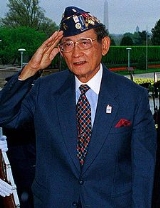
, 2nd Lieutenant Fidel V. Ramos
Fidel V. Ramos
Fidel "Eddie" Valdez Ramos , popularly known as FVR, was the 12th President of the Philippines from 1992 to 1998. During his six years in office, Ramos was widely credited and admired by many for revitalizing and renewing international confidence in the Philippine economy.Prior to his election as...

 (future President of the Philippines
President of the Philippines
The President of the Philippines is the head of state and head of government of the Philippines. The president leads the executive branch of the Philippine government and is the commander-in-chief of the Armed Forces of the Philippines...

).

Ramos divided the assault team into four groups of snipers, riflemen, scouts and forward observers, each with a radio operator, a messenger and a medic. The platoon was reinforced by some engineer demolition specialists and an artillery observer team. They left at 04:07.

The Filipino platoon crawled through rice paddies and scattered trees for two hours before it reach an irrigation ditch, about 400 meters from the top of the hill. Intelligence estimated the enemy strength to be one reinforced platoon of the Chinese Red Army.

The United States Air Force
United States Air Force
The United States Air Force is the aerial warfare service branch of the United States Armed Forces and one of the American uniformed services. Initially part of the United States Army, the USAF was formed as a separate branch of the military on September 18, 1947 under the National Security Act of...

 sent seven F-86 Sabre
F-86 Sabre
The North American F-86 Sabre was a transonic jet fighter aircraft. Produced by North American Aviation, the Sabre is best known as America's first swept wing fighter which could counter the similarly-winged Soviet MiG-15 in high speed dogfights over the skies of the Korean War...

 jet fighters to pound the enemy positions with napalm
Napalm
Napalm is a thickening/gelling agent generally mixed with gasoline or a similar fuel for use in an incendiary device, primarily as an anti-personnel weapon...

. There was also artillery support. After the bombardment, Ramos' men seized the front part of the trench network after discovering a hole in the blasted stack of barbed wire.

Close-quarter fighting raged as the retreating enemy fought back but the advancing Filipinos were gaining the upper hand. The scout team, led by Corporal Jose Palis, went into action on the right of the hill and was later joined by Lieutenant Ramos. Meanwhile, the rifle team, led by Sergeant Cipriano Drapeza, worked its way round to the left side of the hill while the sniper team, led by Second Lieutenant Armando Dizon, held the enemy's support from nearby Hill 191.

By 07:28, the Filipinos had demolished the Chinese bunkers and withdrawn from the top of the hill. Friendly tanks resumed their bombardment of Hill Eerie.

The assault lasted for two hours, Ramos' men suffered one injury while the Chinese had 11 dead, 10 wounded, whether from the supporting artillery, tanks and air strikes could not be determined. The battle was the final assault on Hill Eerie by the United Nations forces.

The Filipino battalion was replaced by the 2nd Battalion of the 179th United States Infantry.

June 1952


On June 16, 1952, the 19th Philippine Battalion Combat Team, under the command of Colonel Ramon Z. Aquirre, relieved the American battalion in the T-Bone ridge sector.

By June 18, the Chinese forces sought to recapture the area and launched an intense artillery and mortar barrage. The Filipinos held their ground and were able to repulse the Chinese attack.

On June 20, the Chinese forces launched another attack towards Hill Eerie and the rest of the T-Bone ridge area. At dawn, the Chinese had advanced sufficiently to engage in hand-to-hand fighting but the Filipino troops were able to hold the position.

By morning, the artillery battle continued but the allied forces successfully defended Hills Eerie and 191. As a result of the battle it was estimated that the CCF suffered 500 casualties while the Filipinos had 24.

The Filipino battalion was later relieved by the US 2nd Infantry Division on July 18, 1952.

Publication and Links

  • Kortegaard, Birchard Lee, Outpost Eerie, The Korean War 1950–1953, http://www.kmike.com/CombatActions/OutpostEerie.htm, (August 26, 2006)
  • Villasanta, Art, 20th Battalion Combat Team (Leaders), The Philippine Expeditionary Force to Korea (1950-1955), http://www.webcitation.org/query?url=http://www.geocities.com/peftok/20thbct.html&date=2009-10-26+00:22:05, (August 26, 2006)
  • Chŏnsa Pʻyŏnchʻan Wiwŏnhoe, Attack on Hill Eerie, The Philippine Battalion in Korean War, The history of the United Nations forces in the Korean War, Volume I-VI, (Seoul, Ministry of National Defense, Republic of Korea, 1972–77)

See also

  • Korean War
    Korean War
    The Korean War was a conventional war between South Korea, supported by the United Nations, and North Korea, supported by the People's Republic of China , with military material aid from the Soviet Union...

  • Battles of the Korean War
  • Philippine Expeditionary Forces to Korea
    Philippine Expeditionary Forces To Korea
    The Philippine Expeditionary Forces to Korea was the Philippine contingent of the United Nations forces that fought in the Korean War . The unit arrived in Korea in August 1950. It was composed of 7,500 troops, and was the fourth largest force under the United Nations Command...