


Base analog

Encyclopedia
A base analog is a chemical that can substitute for a normal nucleobase
in nucleic acid
s.
A common example would be 5-bromouracil
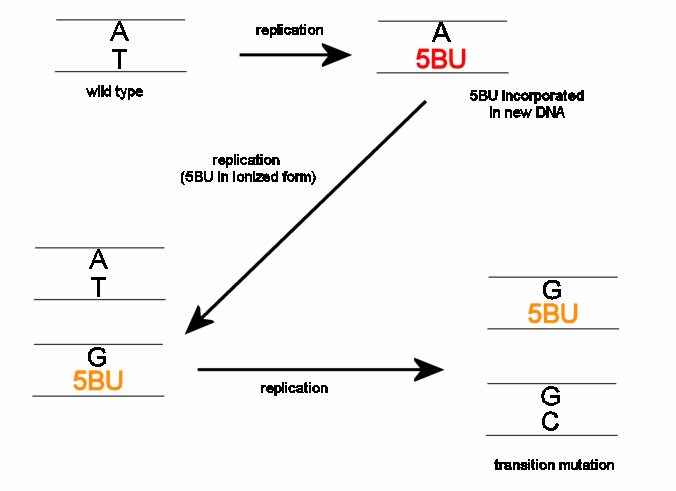
(5BU), the abnormal base found in the mutagenic nucleotide analog BrdU. When a nucleotide containing 5-bromouracil is incorporated into the DNA, it is most likely to pair with adenine; however, it can spontaneously shift into another isomer
which pairs with a different nucleobase
, guanine
. If this happens during DNA replication, a guanine will be inserted opposite the base analog, and in the next DNA replication, that guanine will pair with a cytosine. This results in a change in one base pair of DNA, specifically a transition
mutation
.
Nucleobase
Nucleobases are a group of nitrogen-based molecules that are required to form nucleotides, the basic building blocks of DNA and RNA. Nucleobases provide the molecular structure necessary for the hydrogen bonding of complementary DNA and RNA strands, and are key components in the formation of stable...
in nucleic acid
Nucleic acid
Nucleic acids are biological molecules essential for life, and include DNA and RNA . Together with proteins, nucleic acids make up the most important macromolecules; each is found in abundance in all living things, where they function in encoding, transmitting and expressing genetic information...
s.
A common example would be 5-bromouracil
5-Bromouracil
5-Bromouracil is a brominated derivative of uracil that acts as an antimetabolite or base analog, substituting for thymine in DNA, and can induce DNA mutation in the same way as 2-aminopurine...
(5BU), the abnormal base found in the mutagenic nucleotide analog BrdU. When a nucleotide containing 5-bromouracil is incorporated into the DNA, it is most likely to pair with adenine; however, it can spontaneously shift into another isomer
Isomer
In chemistry, isomers are compounds with the same molecular formula but different structural formulas. Isomers do not necessarily share similar properties, unless they also have the same functional groups. There are many different classes of isomers, like stereoisomers, enantiomers, geometrical...
which pairs with a different nucleobase
Nucleobase
Nucleobases are a group of nitrogen-based molecules that are required to form nucleotides, the basic building blocks of DNA and RNA. Nucleobases provide the molecular structure necessary for the hydrogen bonding of complementary DNA and RNA strands, and are key components in the formation of stable...
, guanine
Guanine
Guanine is one of the four main nucleobases found in the nucleic acids DNA and RNA, the others being adenine, cytosine, and thymine . In DNA, guanine is paired with cytosine. With the formula C5H5N5O, guanine is a derivative of purine, consisting of a fused pyrimidine-imidazole ring system with...
. If this happens during DNA replication, a guanine will be inserted opposite the base analog, and in the next DNA replication, that guanine will pair with a cytosine. This results in a change in one base pair of DNA, specifically a transition
Transition (genetics)
In genetics, a transition is a point mutation that changes a purine nucleotide to another purine or a pyrimidine nucleotide to another pyrimidine . Approximately two out of three single nucleotide polymorphisms are transitions....
mutation
Mutation
In molecular biology and genetics, mutations are changes in a genomic sequence: the DNA sequence of a cell's genome or the DNA or RNA sequence of a virus. They can be defined as sudden and spontaneous changes in the cell. Mutations are caused by radiation, viruses, transposons and mutagenic...
.