


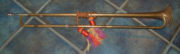
Baroque trumpet

Encyclopedia
Musical instrument
A musical instrument is a device created or adapted for the purpose of making musical sounds. In principle, any object that produces sound can serve as a musical instrument—it is through purpose that the object becomes a musical instrument. The history of musical instruments dates back to the...
in the brass
Brass instrument
A brass instrument is a musical instrument whose sound is produced by sympathetic vibration of air in a tubular resonator in sympathy with the vibration of the player's lips...
family. It was invented in the mid-20th century based on ideas from the natural trumpet
Natural trumpet
A natural trumpet is a valveless brass instrument that is able to play the notes of the harmonic series.-History:The natural trumpet was used as a military instrument to facilitate communication ....
of the 16th to 18th centuries and designed to allow modern performers to imitate the earlier instrument for music of that time. Often synonymous with 'natural trumpet
Natural trumpet
A natural trumpet is a valveless brass instrument that is able to play the notes of the harmonic series.-History:The natural trumpet was used as a military instrument to facilitate communication ....
', the term 'baroque trumpet' is also often used to differentiate an instrument with added vent holes and other modern compromises, with an original or replica natural trumpet which does not.
Modern reproductions
Nowadays, the term "baroque trumpet" has come to mean a version of original natural trumpet with changes to suit modern players who tend to play both modern trumpet and these hybrids. These are the instruments most often employed by period instrument ensembles when choosing historical informed performance practice. Originals are seldom used, since they are too valuable.Some modern performers use natural trumpets, unchanged in design since the baroque era. However, the majority now choose baroque trumpets constructed with vents, which were not used in the baroque. The use of natural vs baroque trumpets is controversial and this article aims to provide a balanced view from both sides. But in general, most professional trumpeters regard the modern baroque trumpet, with at least one vent hole, as a necessary compromise to ensure acceptable intonation and secure attacks for players of modern trumpets, while still providing an approximation of the original sound.
Tuning
The most important reason for using a vented trumpet is providing for alternative tunings for problematic notes. The harmonic series is mostly "in tune" but there are a few notes which are "off-centre". It is normal for natural trumpet players to lip notes into tune (see Natural trumpetNatural trumpet
A natural trumpet is a valveless brass instrument that is able to play the notes of the harmonic series.-History:The natural trumpet was used as a military instrument to facilitate communication ....
), but players moving from the modern trumpet are not used to lipping notes as far, leading them to revert to vented instruments.
Temperaments of the period range centre on just intonation
Just intonation
In music, just intonation is any musical tuning in which the frequencies of notes are related by ratios of small whole numbers. Any interval tuned in this way is called a just interval. The two notes in any just interval are members of the same harmonic series...
and meantone temperament
Meantone temperament
Meantone temperament is a musical temperament, which is a system of musical tuning. In general, a meantone is constructed the same way as Pythagorean tuning, as a stack of perfect fifths, but in meantone, each fifth is narrow compared to the ratio 27/12:1 in 12 equal temperament, the opposite of...
. The harmonic series of the trumpet requires less lipping to these period temperaments, than when playing in the equal temperament
Equal temperament
An equal temperament is a musical temperament, or a system of tuning, in which every pair of adjacent notes has an identical frequency ratio. As pitch is perceived roughly as the logarithm of frequency, this means that the perceived "distance" from every note to its nearest neighbor is the same for...
that modern players are used to.
The out-of-tune f2 and a2 are usually sounded only briefly in passing. Baroque composers such as Bach
Bạch
Bạch is a Vietnamese surname. The name is transliterated as Bai in Chinese and Baek, in Korean.Bach is the anglicized variation of the surname Bạch.-Notable people with the surname Bạch:* Bạch Liêu...
and Handel
HANDEL
HANDEL was the code-name for the UK's National Attack Warning System in the Cold War. It consisted of a small console consisting of two microphones, lights and gauges. The reason behind this was to provide a back-up if anything failed....
were careful not to ask their trumpeters to "dwell" on the f2 and a2 for any length of time. The other out-of-tune notes (B in both octaves) are even less frequently used, while the 11th harmonic is closer to an F# and usually played as such. Within the context of meantone temperament
Meantone temperament
Meantone temperament is a musical temperament, which is a system of musical tuning. In general, a meantone is constructed the same way as Pythagorean tuning, as a stack of perfect fifths, but in meantone, each fifth is narrow compared to the ratio 27/12:1 in 12 equal temperament, the opposite of...
, the 11th harmonic is very nearly in tune.
Inaccurate harmonics
With three times the length of tubing compared to a modern trumpet, the natural trumpet has harmonics much closer together and therefore the risk of a performer hitting the wrong harmonic is higher. But also it is almost impossible to hit a harmonic that conflicts with the harmony, and the effect is a direct parallel of an expressive ornament.Lipping notes into tune increases the chance of a missed-note, but the improved acoustics of a trumpet constructed without the need for vents somewhat makes up for the difference.
A common view is that in an era of recordings, conductors usually prefer trumpet players to have utmost accuracy in pitch and tuning than the authentic sound, leading them to using the vented compromise.
Construction
Some baroque trumpets have been made using modern manufacturing methods, not the hand hammered technique exercised by the master craftsmen like Schnitzer, Haas, Hainlein, Ehe, and others. There is evidence, for example, that the bore anomalies of museum originals may favor certain notes, making it possible to "lip" the out-of-tune notes with greater ease. This characteristic is absent in factory-made instruments, with their geometrically perfect bore.- "Acoustically, the introduction of nodal vent holes, which need to be positioned relative to the total length of tubing, necessitates tuning slides (usually made from machine-drawn tubing), separate back bows, "yards" and mouth-pipes for different keys; meaning thicker walls, bows and variations in bore and conicity in the wrong places; needing compensation with a conical lead-pipe, which changes bell acoustics, and so on."
Sound
A natural trumpet is audibly different to a baroque one constructed with vents, even if the holes are covered. And when a vent is uncovered it is noticeably weaker still and less resonant. Modern performers choosing to play vented instruments avoid the difficulty of vented notes being heard clearly, since baroque scores generally only use the particular out-of-tune notes in passing.- "[Use is] negating the possibility of playing many of the articulations indicated by composers or using a wooden transposing mute."
Posture
Pictures of natural trumpet players show the instrument nobly pointing upwards, held in one hand. Modern instruments with vents usually require two hands and the instrument pointing downwards. This modern posture swaps the triumphant visual effect for one of defeat. Also the breathing space of the player is less open.How it works
When opened, the vent hole creates a nodeNode (physics)
A node is a point along a standing wave where the wave has minimal amplitude. For instance, in a vibrating guitar string, the ends of the string are nodes. By changing the position of the end node through frets, the guitarist changes the effective length of the vibrating string and thereby the...
, or a position along the vibrating air column where the pressure variations are at a minimum. This creates a transposition
Transposition
Transposition may refer to:Mathematics* Transposition , a permutation which exchanges two elements and keeps all others fixed* Transposition, producing the transpose of a matrix AT, which is computed by swapping columns for rows in the matrix AGames* Transposition , different moves or a different...
--in the case of a single thumb vent hole, the entire harmonic series of the trumpet is shifted up by a fourth.
One vent
Players in continental Europe most commonly use modern replicas built with one hole, such as with the "Modell Tarr" made by Ewald Meinl Musikinstrumentenbau GmbH of Germany, whose hole is usually covered by the right thumb. Most of the time, the hole remains covered, allowing the instrument to sound in its original key, whether B, C, D, E, or F. In order to play the out-of-tune 11th and 13th harmonics (notated f2, and a2), for example, the player opens the thumb vent hole and plays the f2 and a2 as the 8th and 10th harmonics of the new series.Three or four vents
It tends to be British players who prefer baroque trumpets with three or four holes, allowing the player to make half-step transpositions and blow a relatively easy high C..An example of a multi-hole baroque trumpet is the coiled Jägertrompete made by Helmut Finke, used by the Concentus musicus Wien
Concentus Musicus Wien
Concentus Musicus Wien is a baroque music ensemble founded by Nikolaus and Alice Harnoncourt in 1953. It generated the now well-established movement in performance and recordings to play early music on period instruments....
on many of their early recordings. However, this model has fallen out of favor with period instrument groups, and is seldom used nowadays.

Mouthpieces
Mention should be made of the role of the mouthpiece in re-creating an "authentic" performance. Many trumpeters today continue to use a version of their modern mouthpiece on the baroque trumpet, fitted with a larger shank. This is unfortunate, since the art of playing in the highest clarino (clear) register depended to a great extent on the typical shallow-cupped mouthpiece of the period. When using this type of mouthpiece, there is not only a greater ease in the upper register but also a lighter, less forceful sound. The latter blends better, is less tiring to the player, and is far more appropriate when performing with other baroque-style instruments.External links
- http://www.earlybrass.com/nattrump.htm
- http://launch.groups.yahoo.com/group/NaturalTrumpet/
- http://www.baroquetrumpet.com/
- http://www.eggerinstruments.ch/home.htm
- http://www.trumpetmaker.com
- Crispian Steele-Perkins interview by Bruce Duffie