
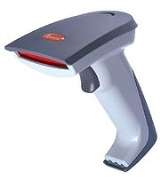
Barcode reader
A barcode reader is a computer peripheral for reading
barcodes printed on various surfaces. Like a
flatbed scanner, it generally consists of a light source, a lens and a photo conductor translating optical impulses into electrical ones. Additionally, nearly all barcode readers currently produced contain
decoder circuitry analyzing the barcode's image data provided by the photo conductor and sending the barcode's content to the scanner's output port.
Encyclopedia
A
barcode reader is a computer peripheral for reading
barcodes printed on various surfaces. Like a
flatbed scanner, it generally consists of a light source, a lens and a photo conductor translating optical impulses into electrical ones. Additionally, nearly all barcode readers currently produced contain
decoder circuitry analyzing the barcode's image data provided by the photo conductor and sending the barcode's content to the scanner's output port.
Types of Barcode Readers
Many different types of barcode scanners are available. They can be distinguished as follows:
By light source
- LED scanner : also referred to as CCD scanners, even though the CCD is in fact the photo imaging sensor, not the light source.
- Laser scanner : scans one dimensional or "linear codes". Typically less rugged than LED scanners since they have moving parts.
- 2D Imaging scanner : These scanners take a 2D image of the barcode as in a camera and can be used to scan 2D barcode types such as Datamatrix as well as the more common linear barcode types.
By housing
- Handheld scanner : with a handle and typically a trigger button for switching on the light source.
- Pen scanner : a pen-shaped scanner that is swiped.
- Stationary scanner : wall- or table-mounted scanners that the barcode is passed under or beside. These are commonly found at the checkout counters of supermarkets and other retailers.
- Fixed position scanner : an industrial barcode reader used to identify products during manufacture or logistics. Most often used on conveyer tracks to identify cartons or pallets which need to be routed to another process or shipping location.
- PDA scanner : a PDA with a built-in barcode reader or attached barcode scanner eg Grabba.
Technology and Engineering
- laser scanners : typical scanners utilise a 650nm laser diode, leveraging on the economies of scale of diodes manufactured for CD/DVD drives. The diode is normally housed in a metal casing for heat dissipation. The laser light emitted is focused through a lens and reflected off a rotating polygonal mirror, or an oscillating mirror. This produces a line or raster pattern which may be aimed at a barcode. The light reflected off the barcode is captured onto a photodiode whereby the current is amplified and interpreted by the decoding circuit. The signal obtained is the modulation of the laser spot , over the alternating black and white lines of the barcode. The performance of the scanner is a function of:
- the signal to noise ratio . The laser power is usually limited by CDRH Class I/II safety requirements.
- the scan speed of the device. Basically a trade-off between decode speed and the size of the decode zone.
- the barcode . Generally, the laser has to pass a certain amount of the 'quiet zone' on the barcode before it hits the line patterns, in order to decode.
- the decoding circuit's ability to decode and to handle errors in the barcode, optical noise as well as the range of frequencies at which the signal is modulated.
Types of Connectors
Most barcode readers use a
PS/2 or
USB cable for output: PS/2 cables are connected to the host computer in a Y formation, the PS/2 keyboard port with its first end, to the
keyboard with its second, and to the barcode reader with its third end. The
barcode characters are then received by the host computer as if they came from
its keyboard decoded and converted to keyboard input within the scanner housing. Many readers can also be equipped with an RS-232 output port so that the decoded characters arrive at the computer via one of its RS-232 connectors.
USB is supported by many newer scanners, in many cases a choice of USB interface types are provided.
There are a few other less common interfaces. The proprietary IBM interfaces that use an SDL type connector and are based on an RS485 protocol. OCIA is sometimes still found, mostly used on older stand alone cash registers with a wide variety of connector types. Undecoded interface is an amplified output of the raw wave received back from the barcode and requires a decoder to be built into the terminal that the scanner connects to which is more common on industrial terminals. Wand emulation is another output type that takes the raw wave and decodes it, normalizing the output so it can be easily decoded by the host device. Wand emulation can also convert symbologies that may not be recognized by the host device into another symbology that can be easily decoded.
Types of Symbologies
Today's barcode scanners handle all popular barcode symbologies like
EAN/
UPC, Code 39, Interleaved 2 of 5 or
Code 128. A special type of barcode reader is the
area imager reader or 2D reader that typically uses LED illumination and a CCD or CMOS imager that operates much like a digital camera. These are necessary for decoding two-dimensional matrix codes such as
Data Matrix,
QR Code, Aztec Code and
MaxiCode in addition to linear and stacked symbologies. Certain code types such as PDF417 and RSS can have stacked components similar to matrix barcodes, however these code types can be read both by linear scanners and also 2D scanners.
Uses
It is used in many important places like
-Supermarkets
-ID recognition
-Product ID Recognition
-Book Tag Identification
See also
Barcode Reader Manufacturers