

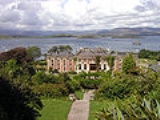
Bantry House

Encyclopedia
Bantry House is a historic house with gardens in Bantry
, County Cork
, Ireland
.
. In 1750, Councillor Richard White bought Blackrock from Samuel Hutchinson and changed the name to Seafield. The Whites had settled on Whiddy Island
across the Bay in the late 17th century, after having originally been merchants in Limerick
. The family prospered and considerable purchases of land were made in the area surrounding the house. By the 1780s, Bantry House comprised some 80,000 acres (320 km²) (though much of this would not be arable). The house has been open to tourism since 1946. Since about 1990 it has offered bed and breakfast accommodation.
By 1997 the grounds of Bantry House were suffering from neglect in certain places. A European grant was obtained to start the restoration process. Funding ceased in 2000. The restoration work is still ongoing.
The ship was discovered in 1982. In 1985 it was declared a national monument
and work began on the excavation, preservation and exhibition of the ship and its contents. The Armada center showcases the story of the attempted French landing in west cork and contains artifacts excavated from the wreck in Bantry bay as well as a 1 to 6 scale model of 'The Surveillante'. The centre also tells the story of Theobald Wolfe Tone, with extracts from his log and a life-size statue. Visitors can also enjoy the individual sound tour of the Armada centre.
Bantry
Bantry is a town on the coast of County Cork, Ireland. It lies on the N71 national secondary road at the head of Bantry Bay, a deep-water gulf extending for 30 km to the west...
, County Cork
County Cork
County Cork is a county in Ireland. It is located in the South-West Region and is also part of the province of Munster. It is named after the city of Cork . Cork County Council is the local authority for the county...
, Ireland
Republic of Ireland
Ireland , described as the Republic of Ireland , is a sovereign state in Europe occupying approximately five-sixths of the island of the same name. Its capital is Dublin. Ireland, which had a population of 4.58 million in 2011, is a constitutional republic governed as a parliamentary democracy,...
.
History
Bantry House (originally called 'Blackrock') was constructed in about 1700 on the South side of Bantry BayBantry Bay
Bantry Bay is a bay located in County Cork, southwest Ireland. The bay runs approximately from northeast to southwest into the Atlantic Ocean. It is approximately 3-to-4 km wide at the head and wide at the entrance....
. In 1750, Councillor Richard White bought Blackrock from Samuel Hutchinson and changed the name to Seafield. The Whites had settled on Whiddy Island
Whiddy Island
Whiddy Island is an island near the head of Bantry Bay, Ireland. It is approximately long and wide. The topography comprises gently-rolling glacial till, with relatively fertile soil...
across the Bay in the late 17th century, after having originally been merchants in Limerick
Limerick
Limerick is the third largest city in the Republic of Ireland, and the principal city of County Limerick and Ireland's Mid-West Region. It is the fifth most populous city in all of Ireland. When taking the extra-municipal suburbs into account, Limerick is the third largest conurbation in the...
. The family prospered and considerable purchases of land were made in the area surrounding the house. By the 1780s, Bantry House comprised some 80,000 acres (320 km²) (though much of this would not be arable). The house has been open to tourism since 1946. Since about 1990 it has offered bed and breakfast accommodation.
Gardens
The gardens to Bantry House were developed by the second Earl of Bantry and his wife Mary. Inspiration was taken from their travels across Europe. The gardens contain seven terraces; the house is located on the third. One hundred steps are located behind the house and are built to appear to rise out of a fountain and are surrounded by azaleas and rhododendron. The gardens are constantly tended and maintained.By 1997 the grounds of Bantry House were suffering from neglect in certain places. A European grant was obtained to start the restoration process. Funding ceased in 2000. The restoration work is still ongoing.
Armada Centre
In 1796, Theobald Wolfe Tone and the United Irishmen attempted to land a formidable French armada, commanded by Admiral Hoche in Bantry bay. It was intended to expel the British and establish an Irish Republic. The armada consisted of 50 naval warships and 15,000 men. Richard White, having heard about the invasion had trained a militia to oppose the landing as he and his tenants were loyal to the British crown. Munitions were stored in Bantry House for safe keeping. Look outs were posted on Both Mizen Head and Sheep's Head to send warning of an invasion. In the end the French armada never had a chance of landing. The weather was too severe, and even ship to ship communication was too difficult. 10 ships were lost. One of these 'The Surveillante' remained on the bottom of Bantry bay for almost 200 years.The ship was discovered in 1982. In 1985 it was declared a national monument
National Monument (Ireland)
The Irish state has officially approved the following List of National Monuments of Ireland. In the Republic of Ireland, a structure or site may be deemed to be a "National Monument", and therefore worthy of state protection, if it is of national importance...
and work began on the excavation, preservation and exhibition of the ship and its contents. The Armada center showcases the story of the attempted French landing in west cork and contains artifacts excavated from the wreck in Bantry bay as well as a 1 to 6 scale model of 'The Surveillante'. The centre also tells the story of Theobald Wolfe Tone, with extracts from his log and a life-size statue. Visitors can also enjoy the individual sound tour of the Armada centre.