

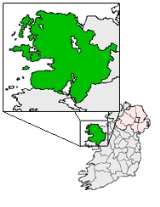
Ballinrobe

Encyclopedia
Early history
Dating back to 1390, Ballinrobe is said to be the oldest town in South Mayo. The registry of the Dominican friary of AthenryAthenry
Athenry is a town in County Galway, Ireland. It lies east of Galway city, and one of the attractions of the town is its medieval castle. The town is also well-known by virtue of the song "The Fields of Athenry".-History:...
mentions the monastery de Roba, an Augustinian friary whose recently restored ruins are one of the historical landmarks of the town today. The District Courtroom is housed in the old Market House, a marketing center for local produce established in 1752.
Its development into an important economic centre in south west Mayo was due to a Royal Patent granted to the people of Ballinrobe on December 6, 1606 by King James. This Patent allowed the town to hold fairs and markets. It was necessary to obtain the approval of the king to hold a market or fair in any town in Ireland or England. Obtaining a market charter was an important step in the economic development of a town and required having a spokesperson who was in the king's favour.
Once a market charter was obtained, it virtually assured that the town would become the largest and most important in the area. In addition to the exchange of money and goods the market brought, it also increased the local economy because all the people travelling to market from any distance needed a place to stay and food to eat. It was the custom to retire to the pub for a drink to seal a deal on the purchase of cattle or other livestock.
The established market day in Ballinrobe was Monday. Each commodity had its special place in the town. Well into the mid-1900s, turf
Peat
Peat is an accumulation of partially decayed vegetation matter or histosol. Peat forms in wetland bogs, moors, muskegs, pocosins, mires, and peat swamp forests. Peat is harvested as an important source of fuel in certain parts of the world...
, hay, potatoes, turnips, and cabbage were sold on Abbey Street; poultry on Glebe Street; calves on Bridge Street; and cloth, flannel, woolen socks, lace, wheat, oats, and barley outside the Market House. There were special livestock fairs held at different times of the year for pigs, cattle, and sheep. Perishable goods such as butter, meat, and bread were sold in the lower part of the Market Hall. The upper floor was used as a meeting hall. In 1698, it was the site of a Commission of Inquiry which among other things, relocated property from Catholic to Protestant landlords. In 1716, the County Assizes (Civil and Criminal Courts) were held in Ballinrobe, most likely in the Market Hall.
Catholic history
In 1704, a new law required the registration of Catholic priests. The Catholic Church was suppressed throughout Ireland. There are no records for any Catholic rites in the area before 1831, however, some priests continued to perform the rites in secret. The name of one of them is known: Fr. Duffy ministered in Ballinrobe from 1696 until 1712. He was captured and deported to Spain, where he died. There appears to have been a number of other priests between 1649 and 1875, who were associated with the Augustine Abbey.The Catholic Emancipation Act of 1829 allowed Catholics to practice their religion once again. Fr. Conway was appointed the first curate of Ballinrobe in 1847. He was the minister to both Ballinrobe and Partry
Partry
Partry is a parish in County Mayo, Ireland. Partry is an ideal place for people with an interest in fishing to stay. It is located between Loughs Carra and Mask and is on the N84 between the towns of Castlebar and Ballinrobe....
for a number of years and was responsible for negotiating permission, with a certain Colonel Knox, to construct St. Mary's Catholic Church on Main Street. The church was started under Fr. Conway in 1853. Subsequent curates were Fr. Hardiman and Dean Ronayne. Fr. Hardiman is credited with bringing the Mercy Order of nuns to Ballinrobe in 1851, and Dean Ronayne is credited with bringing the Christian Brothers there in 1876. The local Sisters of Mercy Convent was founded from Westport in 1851. Their mission included the education of children, visitation and care of the sick, and helping the poor.
The Union Workhouse
In 1839, the Union Workhouse of the Poor Law UnionIrish Poor Laws
The Irish Poor Laws were a series of Acts of Parliament intended to address social instability due to widespread and persistent poverty in Ireland. While some legislation had been introduced by the pre-Union Parliament of Ireland prior to the Act of Union, the most radical and comprehensive...
of Ballinrobe was founded. Ballinrobe suffered greatly during the Great Famine of 1845 to 1849. With 2,000 inmates at the height of the famine, the workhouse was so overcrowded that on March 23, 1847, The Mayo Constitution reported:
In Ballinrobe the workhouse is in the most awfully deplorable state, pestilence having attacked paupers, officers, and all. In fact, this building is one horrible charnel house, the unfortunate paupers being nearly all the victims of a fearful fever, the dying and the dead, we might say, huddled together. The master has become the victim of this dread disease; the clerks, a young man whose energies were devoted to the well-being of the union, has been added to the victims; the matron, too, is dead; and the respected, and esteemed physician has fallen before the ravages of pestilence, in his constant attendance on the diseased inmates. This is the position of the Ballinrobe house, every officer swept away, while the number of deaths among the inmates is unknown; and we forgot to add that the Roman Catholic chaplain is also dangerously ill of the same epidemic. Now the Ballinrobe board have complied with the Commissioner's orders, in admitting a houseful of paupers and in striking a new rate, which cannot be collected; while the unfortunate inmates, if they escape the awful epidemic, will survive only to be the subjects of a lingering death by starvation!
Ninety-six people died in just one week in April 1849. The dead were buried in unmarked, shallow graves, located just outside the boundary on the southwest of the ruins. In 1922, during the Irish Civil War
Irish Civil War
The Irish Civil War was a conflict that accompanied the establishment of the Irish Free State as an entity independent from the United Kingdom within the British Empire....
, a great deal of the structure was burned, although some portions remain to this day.
Transatlantic flight by Lituanica II
In 1935, Feliksas VaitkusFeliksas Vaitkus
Felix Waitkus was an American born Lithuanan pilot and the sixth pilot to fly solo across the Atlantic.- Biography:...
landed his plane, Lituanica II, near Ballinrobe. He was the sixth person to make a successful flight over the Atlantic Ocean
Transatlantic flight
Transatlantic flight is the flight of an aircraft across the Atlantic Ocean. A transatlantic flight may proceed east-to-west, originating in Europe or Africa and terminating in North America or South America, or it may go in the reverse direction, west-to-east...
with a single engine, single seat airplane. Vaitkus fought terrible weather conditions and was helped considerably by hourly broadcasts from an Irish radio station. He learned that Dublin was fogged in, as well as all areas heading east as far as the Baltic Sea
Baltic Sea
The Baltic Sea is a brackish mediterranean sea located in Northern Europe, from 53°N to 66°N latitude and from 20°E to 26°E longitude. It is bounded by the Scandinavian Peninsula, the mainland of Europe, and the Danish islands. It drains into the Kattegat by way of the Øresund, the Great Belt and...
. He knew that he could not make it to Kaunas
Kaunas
Kaunas is the second-largest city in Lithuania and has historically been a leading centre of Lithuanian economic, academic, and cultural life. Kaunas was the biggest city and the center of a powiat in Trakai Voivodeship of the Grand Duchy of Lithuania since 1413. During Russian Empire occupation...
due to his low fuel supply, and being exhausted after a 23-hour struggle fighting the elements, he felt it was best to land somewhere in Ireland. Vaitkus spotted an open field at Ballinrobe and came down, with the airplane suffering extensive damage, but he himself suffered no injuries. Lituanica II was crated for shipment to Lithuania
Lithuania
Lithuania , officially the Republic of Lithuania is a country in Northern Europe, the biggest of the three Baltic states. It is situated along the southeastern shore of the Baltic Sea, whereby to the west lie Sweden and Denmark...
, where it would be restored. He made his way by ship and train to Kaunas
Kaunas
Kaunas is the second-largest city in Lithuania and has historically been a leading centre of Lithuanian economic, academic, and cultural life. Kaunas was the biggest city and the center of a powiat in Trakai Voivodeship of the Grand Duchy of Lithuania since 1413. During Russian Empire occupation...
, where he was given a hero’s welcome.
Ballinrobe today
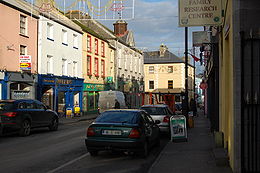
Galway
Galway or City of Galway is a city in County Galway, Republic of Ireland. It is the sixth largest and the fastest-growing city in Ireland. It is also the third largest city within the Republic and the only city in the Province of Connacht. Located on the west coast of Ireland, it sits on the...
and Castlebar
Castlebar
Castlebar is the county town of, and at the centre of, County Mayo in Ireland. It is Mayo's largest town by population. The town's population exploded in the late 1990s, increasing by one-third in just six years, though this massive growth has slowed down greatly in recent years...
. It also has received many immigrants from the new EU member states. The 2006 census results showed that more than 25% of the town's residents are from overseas.
There are numerous renovated, historic structures in and around the town. Genealogical records for the region (such as Church of Ireland, Roman Catholic, and civil documents; and gravestone inscription records) are held at the South Mayo Family Research Centre on Main Street in Ballinrobe.
Famous people
Sylvester Walsh born in Church Lane 1944. Now a 5th Dan Black Belt in Shotokan Karate-Do. Teaching Traditional Karate since 1968 in Crewe Cheshire. Moved to Crewe Cheshire in 1960. Still has family in the town.Bold textTransport
Ballinrobe lies some 48 km north of Galway, on the N84 roadN84 road (Ireland)
The N84 road is a national secondary road in Ireland. It is a major route in the West connecting Galway city with Castlebar. The route is of poor quality with a few short good sections in County Mayo between Ballintubber and Ballinrobe. Ballinrobe has become a bottleneck on the route in recent...
which connects Galway to Castlebar. The town has become a bottleneck in recent years and is awaiting a bypass. It is linked to Claremorris
Claremorris
Claremorris , is a town in County Mayo in the west of Ireland, at the junction of the N17 and the N60 national routes. The population of Claremoris in the 2011 Census was 3,979....
by the R331
R331 road
The R331 road is a regional road in southeast County Mayo, Ireland. The route connects the towns of Claremorris and Ballinrobe, and links the N60 road with the N84 road...
.
A bus service running three times a day between Galway and Ballina
Ballina, County Mayo
Ballina is a large town in north County Mayo in Ireland. It lies at the mouth of the River Moy near Killala Bay, in the Moy valley and Parish of Kilmoremoy, with the Ox Mountain range to the east and the Nephin Beg mountains to the west...
passes through Ballinrobe and Castlebar
Castlebar
Castlebar is the county town of, and at the centre of, County Mayo in Ireland. It is Mayo's largest town by population. The town's population exploded in the late 1990s, increasing by one-third in just six years, though this massive growth has slowed down greatly in recent years...
.
Ballinrobe railway station was opened on 1 November 1892; it closed to passenger traffic on 1 June 1930; and it finally closed altogether on 1 January 1960. Ballinrobe was a branch line from Claremorris
Claremorris
Claremorris , is a town in County Mayo in the west of Ireland, at the junction of the N17 and the N60 national routes. The population of Claremoris in the 2011 Census was 3,979....
.
Sport
- Ballinrobe Racecourse is the only race course in Mayo.
- There is an 18-hole championship golf course nearby.
- Flanagan Park, the home of Ballinrobe GAA club, is one of the few pitches with floodlights in Mayo. (http://www.Ballinrobegaaclub.com) for all the latest news.
- The Green is the home of Ballinrobe Town FC.
- Despite its size and population, Ballinrobe have never won a senior GAA championship but have won intermedite and junior titles
- The Moytura Hurling Club was formed in 2006 and plays its games on the Ballinrobe Community School Pitch.
See also
- List of towns and villages in Ireland
- Market Houses in IrelandMarket Houses in the Republic of IrelandMarket houses are a notable feature of many Irish towns with varying styles of architecture, size and ornamentation making for a most interesting feature of the streetscape. Originally there were three, four or even five bays on the ground floor which were an open arcade. An upper floor was...
External links
- Ballinrobe racecourse official website
- Mayococo's Ballinrobe Page
- Mayo on the Move's Ballinrobe Page
- Lake District Ballinrobe History
- History of the Ballinrobe Poor Law Union
- Irish Genealogy Civil Records
- Ballinrobe History
- John King (Medal of Honor)* {Huge crowds gather to honour Ballinrobe war hero
]