


Baliem Valley

Encyclopedia
Western New Guinea
West Papua informally refers to the Indonesian western half of the island of New Guinea and other smaller islands to its west. The region is officially administered as two provinces: Papua and West Papua. The eastern half of New Guinea is Papua New Guinea.The population of approximately 3 million...
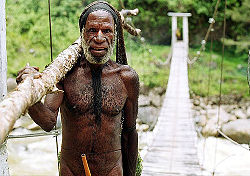
, is occupied by the Dani people
Dani People
The Dani people, also spelled Ndani, and sometimes conflated with the Lani group to the west, are a people from the central highlands of western New Guinea ....
. The main town in the valley is Wamena
Wamena
Wamena is the capital town of the Jayawijaya Regency of Indonesia. It is the largest town in Indonesian Papua's highlands, in the Baliem Valley and has a population of around 10,000 . Wamena is the urban centre of a rural area housing West Papua's highest concentration of population, with over 300...
. The valley is about 80 km in length by 20 km in width and lies at an altitude of about 1,600-1,700 m, with a population of 100,000.
As far as the outside world was concerned, the discovery of the Baliem Valley and the unexpected presence of its large agricultural population was made by Richard Archbold
Richard Archbold
Richard Archbold was an American zoologist and philanthropist. He was independently wealthy, being the grandson of the capitalist John Dustin Archbold. He was educated at private schools and later attended classes at Columbia University though he never graduated...
’s third zoological expedition to New Guinea in 1938. On 21 June an aerial reconnaissance flight southwards from Hollandia (now Jayapura
Jayapura
Jayapura City is the capital of Papua province, Indonesia, on the island of New Guinea. It is situated on Yos Sudarso Bay . Its approximate population in 2002 was 200,000....
) found what the expedition called the ‘Grand Valley’. Since then the valley has gradually been opened up to a limited amount of tourism.
The following is copied from the back cover of Peter Matthiessen
Peter Matthiessen
Peter Matthiessen is a two-time National Book Award-winning American novelist and non-fiction writer, as well as an environmental activist...
’s book Under the Mountain Wall:
“In the Baliem Valley in Central New Guinea live the Kurelu, a Stone Age tribe that survived into the twentieth century. Peter Matthiessen visited the Kurelu with the Harvard-Peabody Expedition in 1961 and wrote Under the Mountain Wall as an account not of the expedition, but of the great warrior Weaklekek, the swineherd Tukum, U-mue and his family, and the boy Weake, killed in a surprise raid. Matthiessen observes these people in their timeless rhythm of work and play and war, of gardening and wood gathering, feasts and funerals, pig stealing and ambush. Drawing on his great skills as naturalist and novelist, Matthiessen offers a remarkable firsthand view of a lost culture in all its simplicity and violence — on the brink of incalculable change.”