
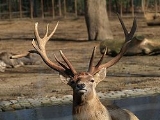
The
Bactrian deer also called the Bukhara deer, Bokhara deer or Bactrian wapiti, is a lowland subspecies of
Red DeerThe red deer is one of the largest deer species. Depending on taxonomy, the red deer inhabits most of Europe, the Caucasus Mountains region, Asia Minor, parts of western Asia, and central Asia. It also inhabits the Atlas Mountains region between Morocco and Tunisia in northwestern Africa, being...
that is native to central
AsiaAsia is the world's largest and most populous continent, located primarily in the eastern and northern hemispheres. It covers 8.7% of the Earth's total surface area and with approximately 3.879 billion people, it hosts 60% of the world's current human population...
. It is similar in ecology to the
Yarkand deerThe Yarkand deer is a subspecies of Red Deer that is native to central Asia. It is similar in ecology to the Bactrian deer in occupying lowland riparian corridors surrounded by deserts...
in occupying riparian corridors surrounded by deserts. Both subspecies are separated from one another by the
TianshanTianshan may refer to:*Tian Shan, a mountain range in Central Asia*Tianshan District, Ürümqi, Xinjiang, China*Tianshan Subdistrict, Ar Horqin Banner, Inner Mongolia, China*Tianshan Town, Ar Horqin Banner, in Ar Horqin Banner, Inner Mongolia, China...
Mountains and probably form a
primordial subgroup of Red DeerThe Central Asian Red Deer is a primordial group of Red deer subspecies, which live in central Asia from the Caspian Sea to western China.Recent DNA studies conducted on hundreds samples from Red Deer and Elk subspecies determined that Red deer and Elk represent two distinct species.The central...
.
Description
This deer is usually ashy-gray with yellowish sheen, and a grayish white rump patch. It also has a slightly marked dorsal stripe and a white margin of the upper lip, lower lip, and chin. The antlers are light in color. There are usually four tines, with the absence of bez tine. The fourth tine is better developed than the third. Full grown individuals, however, have five tines on each antler with a bend after the third tine that is characteristic of most Central Asian Red Deer subspecies.
Population
By 1999 there were not more than 400 Bukhara deer. The population diminished most drastically in
TajikistanTajikistan , officially the Republic of Tajikistan , is a mountainous landlocked country in Central Asia. Afghanistan borders it to the south, Uzbekistan to the west, Kyrgyzstan to the north, and China to the east....
because of military conflicts. However, since then, environmental organizations have taken steps to save the species. Moreover,
World Wide Fund for NatureThe World Wide Fund for Nature is an international non-governmental organization working on issues regarding the conservation, research and restoration of the environment, formerly named the World Wildlife Fund, which remains its official name in Canada and the United States...
(WWF) implemented a reintroduction programme to bring Bukhara deer back to the places which it had once inhabited. For example, Bactrian deer now live in Zarafshan reserve in
UzbekistanUzbekistan , officially the Republic of Uzbekistan is a doubly landlocked country in Central Asia and one of the six independent Turkic states. It shares borders with Kazakhstan to the west and to the north, Kyrgyzstan and Tajikistan to the east, and Afghanistan and Turkmenistan to the south....
. As a result, in 2006 there were about 1000 deer in Central Asia. The largest wild populations were found in 2009 in Karatchingil Nature Reserve (320-350 animals) in the neighborhood of
Altyn-Emel National ParkAltyn-Emel National Park is a national park in Kazakhstan. It was created in 1996. The park covers about 4600 square kilometers between the Ili River and the Ak-Tau mountain range, near Lake Kapchagai, and consists mostly of desert and rocky terrain...
in Kazakhstan, in Badai Tugai Nature Reserve (374 animals) in Uzbekistan, and in
Tigrovaya Balka Nature ReserveTigrovaya Balka Nature Reserve is situated in Tajikistan close to the Afghan border, where the Vakhsh River and the Panj River join to form the Amu Darya. The reserve stretches over 40 from the southwest to the northeast....
(>150 animals) in Tadjikistan. The total wild population is 1430 and increasing.