


Athletics at the 1896 Summer Olympics

Encyclopedia
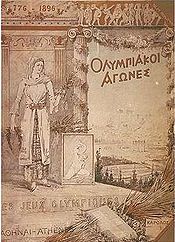
At the 1896 Summer Olympics
1896 Summer Olympics
The 1896 Summer Olympics, officially known as the Games of the I Olympiad, was a multi-sport event celebrated in Athens, Greece, from April 6 to April 15, 1896. It was the first international Olympic Games held in the Modern era...
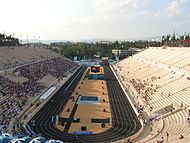
, twelve athletics events were contested. All of the events except the marathon were held in the Panathinaiko Stadium
Panathinaiko Stadium
The Panathinaiko or Panathenaic Stadium , also known as the Kallimarmaro , is an athletic stadium in Athens that hosted the first modern Olympic Games in 1896...
, which was also the finish for the marathon. Events were held on 6 April, 7 April, 9 April, and 10 April 1896 (all dates are according to the Gregorian calendar
Gregorian calendar
The Gregorian calendar, also known as the Western calendar, or Christian calendar, is the internationally accepted civil calendar. It was introduced by Pope Gregory XIII, after whom the calendar was named, by a decree signed on 24 February 1582, a papal bull known by its opening words Inter...
). 64 athletes, all men, from ten nations competed. This made athletics the most international of the nine sports at the 1896 Games.
The American team of 10, which featured only one national champion, was dominant, taking 9 of the 12 titles. No world record
World record
A world record is usually the best global performance ever recorded and verified in a specific skill or sport. The book Guinness World Records collates and publishes notable records of all types, from first and best to worst human achievements, to extremes in the natural world and beyond...
s were set, as few international top competitors had turned up. In addition, the curves of the track were very tight, making fast times in the running events virtually impossible.
The heats of the 100 metres were the first Olympic event to be conducted, and the winner of the first heat, Francis Lane
Francis Lane
Francis Adonijah Lane was an American athlete. He competed at the 1896 Summer Olympics in Greece....
, can thus be considered the first Olympic winner. The first Olympic champion was crowned in the triple jump
Triple jump
The triple jump is a track and field sport, similar to the long jump, but involving a “hop, bound and jump” routine, whereby the competitor runs down the track and performs a hop, a bound and then a jump into the sand pit.The triple jump has its origins in the Ancient Olympics and has been a...
, Harvard
Harvard University
Harvard University is a private Ivy League university located in Cambridge, Massachusetts, United States, established in 1636 by the Massachusetts legislature. Harvard is the oldest institution of higher learning in the United States and the first corporation chartered in the country...
student James Connolly. Connolly also did well in the other jumping events, placing second in the high jump
High jump
The high jump is a track and field athletics event in which competitors must jump over a horizontal bar placed at measured heights without the aid of certain devices in its modern most practiced format; auxiliary weights and mounds have been used for assistance; rules have changed over the years....
and third in the long jump
Long jump
The long jump is a track and field event in which athletes combine speed, strength, and agility in an attempt to leap as far as possible from a take off point...
.
Many other athletes were versatile as well. Thomas Burke won both the 100 metres and 400 metres, a feat not since repeated, while London-based Australia
Australia
Australia , officially the Commonwealth of Australia, is a country in the Southern Hemisphere comprising the mainland of the Australian continent, the island of Tasmania, and numerous smaller islands in the Indian and Pacific Oceans. It is the world's sixth-largest country by total area...
n Edwin Flack won the 800 and 1500 metres races. Robert Garrett
Robert Garrett
Robert Garrett was an American athlete. He was the first modern Olympic champion in discus throw and shot put.-Biography:...
, a Princeton
Princeton University
Princeton University is a private research university located in Princeton, New Jersey, United States. The school is one of the eight universities of the Ivy League, and is one of the nine Colonial Colleges founded before the American Revolution....
student, won two first and two second places. His first title was in the discus throw
Discus throw
The discus throw is an event in track and field athletics competition, in which an athlete throws a heavy disc—called a discus—in an attempt to mark a farther distance than his or her competitors. It is an ancient sport, as evidenced by the 5th century BC Myron statue, Discobolus...
, an event originating from the Ancient Olympics, but never before held at an international event. Garrett had attempted to train for the event with a 10 kilogram replica of a discus, but had given up as it was too heavy. When he learned the actual competition discus weighed only 2 kilograms, he entered the event after all, and won it, to the dismay of the Greek public, who considered their throwers "unbeatable".
A second event held for the first time in international competition was the marathon foot race. It was conceived by Michel Bréal
Michel Bréal
"Breal" redirects here. For the Rapper see B-RealMichel Jules Alfred Bréal , French philologist, was born at Landau in Rhenish Bavaria. He is often identified as a founder of modern semantics....
, a friend of Pierre de Coubertin
Pierre de Coubertin
Pierre de Frédy, Baron de Coubertin was a French educationalist and historian, founder of the International Olympic Committee, and is considered the father of the modern Olympic Games...
, based on the legend of Pheidippides
Pheidippides
Pheidippides , hero of Ancient Greece, is the central figure in a story which was the inspiration for a modern sporting event, the marathon.-The story:...
. This Athenian soldier first completed a two-day run to seek Spartan help against the invading Persians in the Battle of Marathon
Battle of Marathon
The Battle of Marathon took place in 490 BC, during the first Persian invasion of Greece. It was fought between the citizens of Athens, aided by Plataea, and a Persian force commanded by Datis and Artaphernes. It was the culmination of the first attempt by Persia, under King Darius I, to subjugate...
, and then ran from the town of Marathon
Marathon, Greece
Marathon is a town in Greece, the site of the battle of Marathon in 490 BC, in which the heavily outnumbered Athenian army defeated the Persians. The tumulus or burial mound for the 192 Athenian dead that was erected near the battlefield remains a feature of the coastal plain...
to Athens days later to announce the victory, dying as a result of his heroic efforts. The race started in Marathon, and ran for 40 kilometres over dusty roads to Athens. The Greek public, disappointed as there had not yet been a Greek victor in athletics, was overjoyed when it was announced during the race that a Greek runner had taken the lead. When Spiridon Louis
Spiridon Louis
Spyridon Louis was a Greek water-carrier who won the first modern-day Olympic marathon at the 1896 Summer Olympics, thereby becoming a national hero....
, a water carrier from Maroussi, arrived in the stadium he was accompanied by the Greek Crown Prince
Constantine I of Greece
Constantine I was King of Greece from 1913 to 1917 and from 1920 to 1922. He was commander-in-chief of the Hellenic Army during the unsuccessful Greco-Turkish War of 1897 and led the Greek forces during the successful Balkan Wars of 1912–1913, in which Greece won Thessaloniki and doubled in...
on his final lap. Louis would never again compete in a race, but his victory made him a national hero.
The exploits of Louis, Garrett, Connolly, and Flack would be chronicled in the 1984 NBC
NBC
The National Broadcasting Company is an American commercial broadcasting television network and former radio network headquartered in the GE Building in New York City's Rockefeller Center with additional major offices near Los Angeles and in Chicago...
miniseries
Miniseries
A miniseries , in a serial storytelling medium, is a television show production which tells a story in a limited number of episodes. The exact number is open to interpretation; however, they are usually limited to fewer than a whole season. The term "miniseries" is generally a North American term...
, The First Olympics: Athens, 1896.
Medal table
| 1 | 9 | 6 | 2 | 17 | |
| 2 | 2 | 0 | 0 | 2 | |
| 3 | 1 | 3 | 6 | 10 | |
| 4 | 0 | 1 | 2 | 3 | |
| 5 | 0 | 1 | 1 | 2 | |
| 0 | 1 | 1 | 2 | ||
| 7 | 0 | 1 | 0 | 1 |
Chile
Chile at the 1896 Summer Olympics
Chile claims one athlete, Luis Subercaseaux, competed for the nation at the 1896 Summer Olympics. This makes Chile one of the 14 nations to appear at the inaugural Summer Olympic Games. Subercaseaux's results are not listed in the Official Report, though that Report typically includes only...
, Denmark
Denmark at the 1896 Summer Olympics
Three athletes from Denmark competed in five sports at the 1896 Summer Olympics in Athens. Two of the three combined to win a gold medal, two silvers, and three bronzes, while Eugen Schmidt earned no medals. Viggo Jensen contributed one of each color, while Holger Nielsen earned the second silver...
and Sweden
Sweden at the 1896 Summer Olympics
One competitor from Sweden was present at the 1896 Summer Olympics. He competed in athletics and gymnastics, with 5 entries in as many events. Sweden was one of four nations present that won no medals; Italy, Chile and Bulgaria were the others....
had athletes compete, but won no medals.
Medal summary
These medals were retroactively assigned by the International Olympic CommitteeInternational Olympic Committee
The International Olympic Committee is an international corporation based in Lausanne, Switzerland, created by Pierre de Coubertin on 23 June 1894 with Demetrios Vikelas as its first president...
; at the time, winners were given a silver medal and runners-up bronze medals. Athletes coming third received no award.
| 100 metres |
|||
| 400 metres |
|||
| 800 metres |
|||
| 1500 metres |
|||
| 110 metre hurdles |
none awarded | ||
| Marathon |
|||
| High jump |
none awarded | ||
| Pole vault |
|||
| Long jump |
|||
| Triple jump |
|||
| Shot put |
|||
| Discus throw |
See also
- List of Olympic medalists in athletics (men)
- List of Olympic medalists in athletics (women)