

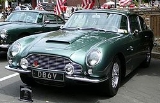
Aston Martin DB6

Encyclopedia
The Aston Martin DB6 is a grand tourer made by British car manufacturer Aston Martin
. Produced from September 1965 to January 1971, the DB6 had the longest production run up to that date of any Aston Martin model. The DB6 succeeded the popular Aston Martin DB5
and featured improved aerodynamics and specification over its predecessor.
, the decision was made to focus on their own development car, registered 4 YMC. Wind tunnel
testing, begun in February 1965, showed development was necessary to counteract a tendency toward aerodynamic lift [a result of the fastback styling] causing reduced rear-wheel traction at high speed. Final development phases relied upon DB5 chassis, suitably lengthened and titled MP 219, with rear lip-spoiler and abbreviated Kammback
tail Aston Martin previously incorporated in sports-racing prototypes. The decision was made to produce MP 219 as the Aston Martin DB6 although the prototype de Dion
rear axle was rejected, Aston's soldiering on with its well-located live-axle configuration reducing time to market, cost and complexity.
Introduced at the 1965 London Motor Show, the DB6 was already a dated design notable as the first model engineered following a factory relocate from Feltham
to Newport Pagnell
. The DB6 shares a large resemblance to its predecessor, the DB5; with the most noticeable differences being its wheelbase, side profile, split front and rear bumpers and rear panels incorporating the Kammback tail rear end. The tail, combined with the relocated rear-axle and the 3.75 inches (95.3 mm) lengthened wheelbase, provide more stability at high speed. Though fashionable-the rear-end Kamm-styled design was similar to the Ferrari 250
-it did not prove popular with conservative, tradition oriented Aston clientele when the DB6 was introduced. Performance was satisfactory: road-tests of the day observed top speed of the Vantage model between 145 mph to 148 mph, with intrepid and fearless John Bolster aboard a Vantage spec DB6 reaching a two-way average of 152 mph.
The DB6 continued with then high-tech Armstrong Selectaride cockpit-adjustable rear shock absorbers as available on the DB5. Other highlights include adopting front-door quarter windows, an oil-cooler air scoop low on the front valance, quarter-bumpers at each corner, revised tail-lamp clusters; additionally the spoiler with the luggage capacity affected overall proportions of the DB6, to an increased length approximately two inches.
Other notable changes:
Another major change from the DB5 to DB6 was abandonment of the full superleggera
construction technique patented by coachbuilders/stylist Touring of Milan. For later DB6's construction, the more common body-on-platform technique was used; this was primarily due to the extended rear requiring a stronger and more rigid design using folding sheet metal frames. Surprisingly the modifications combined to add only seventeen pounds weight compared to the DB5.
. The engine, continued with its triple SU
carb setup producing 282 bhp at 5,500 rpm; the Vantage engine option is quoted at 325 bhp against the 314 bhp of the DB5. Although the weight of the DB6 was approximately 17 lb (7.7 kg) heavier than its predecessor, the stability at high speed, added luggage capacity and comforts for passengers in this grand tourer more than offset any imperceptible loss in performance caused by additional weight.
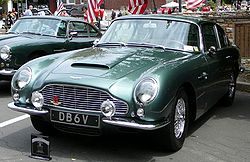 The DB6 Mark II was announced on 21 August 1969, identified by distinct flares on front and rear wheel arches and wider tyres on 1/2" wider wheels. Available as an optional extra for the Mark II was AE Brico electronic fuel-injection combined with the higher compression ratio cylinder head. The Mark II edition shared many parts with the then-new DBS
.
As with previous Aston Martin models, a high-power DB6 Vantage was offered. It was equipped with three Weber carburetors and higher compression ratio cylinder head.
A convertible
body style was also offered, as per Aston tradition, called the DB6 Volante, this was first introduced at the 1966 London Motor Show. The DB6 Volante preceded the earlier (1965–1966) Volantes which were built on the last of the DB5 chassis' and were known as "short chassis
" Volantes. Of the later DB6 Volantes just 140 were built, including 29 high-output Vantage Volante versions, highly prized by collectors.
Charles, Prince of Wales
, owns a DB6 Volante MkII that has been converted to run on bioethanol
. The car was given to him by his mother on his 21st birthday.
s were produced by British coachbuilder Harold Radford
. The engine options (282 and 325 hp) were the same as for the DB6 Saloon.
Aston Martin
Aston Martin Lagonda Limited is a British manufacturer of luxury sports cars, based in Gaydon, Warwickshire. The company name is derived from the name of one of the company's founders, Lionel Martin, and from the Aston Hill speed hillclimb near Aston Clinton in Buckinghamshire...
. Produced from September 1965 to January 1971, the DB6 had the longest production run up to that date of any Aston Martin model. The DB6 succeeded the popular Aston Martin DB5
Aston Martin DB5
The Aston Martin DB5 is a luxury grand tourer that was made by Aston Martin. Released in 1963, it was an evolution of the final series of DB4. The DB series was named honouring David Brown ....
and featured improved aerodynamics and specification over its predecessor.
History and design
After Aston Martin rejected proposals for a replacement for its DB5 from Touring of MilanCarrozzeria Touring
Carrozzeria Touring is an automobile coachbuilder established on March 25, 1926 in Milan, Italy by Felice Bianchi Anderloni and Gaetano Ponzoni...
, the decision was made to focus on their own development car, registered 4 YMC. Wind tunnel
Wind tunnel
A wind tunnel is a research tool used in aerodynamic research to study the effects of air moving past solid objects.-Theory of operation:Wind tunnels were first proposed as a means of studying vehicles in free flight...
testing, begun in February 1965, showed development was necessary to counteract a tendency toward aerodynamic lift [a result of the fastback styling] causing reduced rear-wheel traction at high speed. Final development phases relied upon DB5 chassis, suitably lengthened and titled MP 219, with rear lip-spoiler and abbreviated Kammback
Kammback
A Kammback is a car body style that derives from the research of the German aerodynamicist Wunibald Kamm in the 1930s. The design calls for a body with smooth contours that continues to a tail that is abruptly cut off. This shape reduces the drag of the vehicle."Kammback" is an American term...
tail Aston Martin previously incorporated in sports-racing prototypes. The decision was made to produce MP 219 as the Aston Martin DB6 although the prototype de Dion
De Dion tube
A de Dion tube is an automobile suspension technology. It is a sophisticated form of non-independent suspension and is a considerable improvement over the alternative swing axle and Hotchkiss drive types. A de Dion suspension uses universal joints at both the wheel hubs and differential, and uses a...
rear axle was rejected, Aston's soldiering on with its well-located live-axle configuration reducing time to market, cost and complexity.
Introduced at the 1965 London Motor Show, the DB6 was already a dated design notable as the first model engineered following a factory relocate from Feltham
Feltham
Feltham is a town in the London Borough of Hounslow, west London. It is located about west south west of central London at Charing Cross and from Heathrow Airport Central...
to Newport Pagnell
Newport Pagnell
Newport Pagnell is a town in the Borough of Milton Keynes , England. It is separated by the M1 motorway from Milton Keynes itself, though part of the same urban area...
. The DB6 shares a large resemblance to its predecessor, the DB5; with the most noticeable differences being its wheelbase, side profile, split front and rear bumpers and rear panels incorporating the Kammback tail rear end. The tail, combined with the relocated rear-axle and the 3.75 inches (95.3 mm) lengthened wheelbase, provide more stability at high speed. Though fashionable-the rear-end Kamm-styled design was similar to the Ferrari 250
Ferrari 250
The Ferrari 250 is a sports car built by Ferrari from 1953 to 1964. The company's most successful early line, the 250 series included several variants. It was replaced by the 275 and the 330.-Similarities:...
-it did not prove popular with conservative, tradition oriented Aston clientele when the DB6 was introduced. Performance was satisfactory: road-tests of the day observed top speed of the Vantage model between 145 mph to 148 mph, with intrepid and fearless John Bolster aboard a Vantage spec DB6 reaching a two-way average of 152 mph.
The DB6 continued with then high-tech Armstrong Selectaride cockpit-adjustable rear shock absorbers as available on the DB5. Other highlights include adopting front-door quarter windows, an oil-cooler air scoop low on the front valance, quarter-bumpers at each corner, revised tail-lamp clusters; additionally the spoiler with the luggage capacity affected overall proportions of the DB6, to an increased length approximately two inches.
Other notable changes:
- Roof line raised by two inches improving headroom especially for rear seat passengers
- Genuinely useful leg room for rear passengers
- More steeply raked albeit taller windscreen
- Split front and rear bumpers
- Standard chrome wire wheels on bias-ply whitewall tyres [in USA market]
- Optional power steering
- Optional air conditioning
- Standard ZFZF FriedrichshafenZF Friedrichshafen AG, also known as ZF Group, and commonly abbreviated to ZF, is a German public company headquartered in Friedrichshafen, in the south-west German region of Baden-Württemberg....
five-speed manual unit and a BorgWarnerBorgWarnerBorgWarner Inc. is a United States-based worldwide automotive industry components and parts supplier. It is primarily known for its powertrain products, which include manual and automatic transmissions and transmission components, , turbochargers, engine valve timing system...
or optional three speed automatic gearbox available at no extra cost - Optional Vantage specification retaining triple side-draft WeberWeberWeber is a surname of German origin, derived from the noun meaning "weaver". In some cases, following migration to English-speaking countries, it has been anglicised to the English surname 'Webber' or even 'Weaver'.Notable people with the surname include:...
45DCOE carburetors with other minor revisions raising quoted output to 325 hp
Another major change from the DB5 to DB6 was abandonment of the full superleggera
Superleggera
Superleggera is an automobile chassis construction technology developed by Felice Bianchi Anderloni of Italian coachbuilder Carrozzeria Touring. The company was located just north of Milan, near Alfa Romeo, Italian Citroen, and the former Isotta-Fraschini plant...
construction technique patented by coachbuilders/stylist Touring of Milan. For later DB6's construction, the more common body-on-platform technique was used; this was primarily due to the extended rear requiring a stronger and more rigid design using folding sheet metal frames. Surprisingly the modifications combined to add only seventeen pounds weight compared to the DB5.
Specifications
The DB6 is powered by the 3,995 cc twin-overhead camshaft (DOHC), in-line six-cylinder Aston Martin engine designed by the legendary Tadek MarekTadek Marek
Tadeusz "Tadek" Marek was a Polish automobile engineer, known for his Aston Martin engines.Marek was from Krakow.He raced and won with a Chevrolet Master sedan in the XII Rally Poland before moving to Great Britain...
. The engine, continued with its triple SU
SU Carburetter
SU Carburetters were a brand of carburetter usually of the sidedraught type but downdraught variants were used on some pre-war cars....
carb setup producing 282 bhp at 5,500 rpm; the Vantage engine option is quoted at 325 bhp against the 314 bhp of the DB5. Although the weight of the DB6 was approximately 17 lb (7.7 kg) heavier than its predecessor, the stability at high speed, added luggage capacity and comforts for passengers in this grand tourer more than offset any imperceptible loss in performance caused by additional weight.
- Kerb weight: 1474 kg (3,250 lb)
- Engine: 4.0 L (3995 cc/244 in³) straight-6
- Compression ratio: standard=8.9:1 ; Vantage=9.4:1
- Power: 282 hp at 5500 rpm (standard engine)
- Power: 325 hp at 5750 rpm (optional Vantage engine)
- Torque: 400 N·m (295 ft·lbf) at 4500 rpm
- Top Speed: 241 kilometre per hour
- 0–60 mph (97 km/h) Acceleration: 8.4 s
- Steering: rack and pinion with optional power assist
- Fuel tank capacity: 19 imp gal (86 l; 23 US gal) (standard)
16 imp gal (73 l; 19 US gal) (with optional air conditioningAir conditioningAn air conditioner is a home appliance, system, or mechanism designed to dehumidify and extract heat from an area. The cooling is done using a simple refrigeration cycle...
)
Later models and variants
Aston Martin DBS
The Aston Martin DBS is a GT car produced by the British manufacturer Aston Martin Lagonda Limited. Originally produced from 1967–72, it featured in the 1969 James Bond film On Her Majesty's Secret Service...
.
As with previous Aston Martin models, a high-power DB6 Vantage was offered. It was equipped with three Weber carburetors and higher compression ratio cylinder head.
A convertible
Convertible
A convertible is a type of automobile in which the roof can retract and fold away having windows which wind-down inside the doors, converting it from an enclosed to an open-air vehicle...
body style was also offered, as per Aston tradition, called the DB6 Volante, this was first introduced at the 1966 London Motor Show. The DB6 Volante preceded the earlier (1965–1966) Volantes which were built on the last of the DB5 chassis' and were known as "short chassis
Aston Martin Short Chassis Volante
The Short Chassis Volante was the first Aston Martin to be called an Aston Martin Volante, 'Volante' meaning 'Flying' in Italian...
" Volantes. Of the later DB6 Volantes just 140 were built, including 29 high-output Vantage Volante versions, highly prized by collectors.
Charles, Prince of Wales
Charles, Prince of Wales
Prince Charles, Prince of Wales is the heir apparent and eldest son of Queen Elizabeth II and Prince Philip, Duke of Edinburgh. Since 1958 his major title has been His Royal Highness The Prince of Wales. In Scotland he is additionally known as The Duke of Rothesay...
, owns a DB6 Volante MkII that has been converted to run on bioethanol
Biofuel
Biofuel is a type of fuel whose energy is derived from biological carbon fixation. Biofuels include fuels derived from biomass conversion, as well as solid biomass, liquid fuels and various biogases...
. The car was given to him by his mother on his 21st birthday.
Shooting Brake
A total of six-seven DB6 Shooting-brakeShooting-brake
Shooting-brake, shooting brake or shooting break is a term for a car body style that has evolved through several distinct meanings over its history....
s were produced by British coachbuilder Harold Radford
Harold Radford
Harold Radford & Co Limited of Melton Court, South Kensington, London SW7, were bespoke coachbuilders. The business began in the late 1940s making relatively minor changes to bodywork for owners of new Bentleys, amendments to suit the rural lifestyle of the landed gentry...
. The engine options (282 and 325 hp) were the same as for the DB6 Saloon.
- Kerb weight: 1587 kg (3,499 lb)
- Overall length: 180 in (4,572 mm)
- Overall width: 66 in (1,676 mm)
- Height: 52 in (1,321 mm)
- Turning radius: 34 feet
- Wheelbase: 98 in (2,489 mm)
- Track: 54 in (1,372 mm)(f)
53.5 in (1,359 mm)(r) - Fuel tank capacity: 16 imp gal (73 l; 19 US gal)
External links
- Car profile at motorbase
- Aston Martin DB6 Mark I Shooting Brake by F.L.M. Panelcraft – information from AMGE Aston Martin German Enthusiasts on www.auto-welt.info
- Aston Restoration Website – A site devoted to information on restoring an Aston Martin, including DB6
- Original Aston Martin brochures – Original sales literature for Aston Martin viewable online, including the DB6 and DB6 MK2