
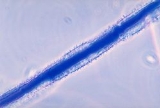
Aspergillus flavus is a
fungusA fungus is a member of a large group of eukaryotic organisms that includes microorganisms such as yeasts and molds , as well as the more familiar mushrooms. These organisms are classified as a kingdom, Fungi, which is separate from plants, animals, and bacteria...
. It is a common
moldMolds are fungi that grow in the form of multicellular filaments called hyphae. Molds are not considered to be microbes but microscopic fungi that grow as single cells called yeasts...
in the environment, and can cause storage problems in stored grains. It can also be a human
pathogenA pathogen gignomai "I give birth to") or infectious agent — colloquially, a germ — is a microbe or microorganism such as a virus, bacterium, prion, or fungus that causes disease in its animal or plant host...
, associated with
aspergillosisAspergillosis is the name given to a wide variety of diseases caused by fungi of the genus Aspergillus. The most common forms are allergic bronchopulmonary aspergillosis, pulmonary aspergilloma and invasive aspergillosis. Most humans inhale Aspergillus spores every day...
of the
lungThe lung is the essential respiration organ in many air-breathing animals, including most tetrapods, a few fish and a few snails. In mammals and the more complex life forms, the two lungs are located near the backbone on either side of the heart...
s and sometimes causing
corneaThe cornea is the transparent front part of the eye that covers the iris, pupil, and anterior chamber. Together with the lens, the cornea refracts light, with the cornea accounting for approximately two-thirds of the eye's total optical power. In humans, the refractive power of the cornea is...
l,
otomycoticOtomycosis is a fungal ear infection, a superficial mycotic infection of the outer ear canal. It is more common in the tropical countries. The infection may be either subacute or acute and is characterized by inflammation, pruritus, scaling, and severe discomfort...
, and nasoorbital infections. Many strains produce significant quantities of
aflatoxinAflatoxins are naturally occurring mycotoxins that are produced by many species of Aspergillus, a fungus, the most notable ones being Aspergillus flavus and Aspergillus parasiticus. Aflatoxins are toxic and among the most carcinogenic substances known...
, a carcinogenic and acutely toxic compound.
A. flavus spores are
allergenAn allergen is any substance that can cause an allergy. In technical terms, an allergen is a non-parasitic antigen capable of stimulating a type-I hypersensitivity reaction in atopic individuals....
ic.
A. flavus sometimes causes losses in silkworm hatcheries.
Disease in humans
A. flavus is the second most common agent of
aspergillosisAspergillosis is the name given to a wide variety of diseases caused by fungi of the genus Aspergillus. The most common forms are allergic bronchopulmonary aspergillosis, pulmonary aspergilloma and invasive aspergillosis. Most humans inhale Aspergillus spores every day...
, the first being
Aspergillus fumigatusAspergillus fumigatus is a fungus of the genus Aspergillus, and is one of the most common Aspergillus species to cause disease in individuals with an immunodeficiency....
.
A. flavus may invade arteries of the lung or brain and cause
infarctionIn medicine, infarction refers to tissue death that is caused by a local lack of oxygen due to obstruction of the tissue's blood supply. The resulting lesion is referred to as an infarct.-Causes:...
.
NeutropeniaNeutropenia, from Latin prefix neutro- and Greek suffix -πενία , is a granulocyte disorder characterized by an abnormally low number of neutrophils, the most important type of white blood cell...
predisposes to aspergillus infection.
Aspergillus flavus also produces a toxin,
aflatoxinAflatoxins are naturally occurring mycotoxins that are produced by many species of Aspergillus, a fungus, the most notable ones being Aspergillus flavus and Aspergillus parasiticus. Aflatoxins are toxic and among the most carcinogenic substances known...
, which is one of the aetiological agents for
hepatocellular carcinomaHepatocellular carcinoma is the most common type of liver cancer. Most cases of HCC are secondary to either a viral hepatitide infection or cirrhosis .Compared to other cancers, HCC is quite a rare tumor in the United States...
.
Appearance in culture
A. flavus grows as a yellow-green mold in culture. Like other
Aspergillus species, it produces a distinctive conidiophore composed of a long stalk supporting an inflated vesicle. Conidiogenous cells on the vesicle produce the conidia. Many strains of
A. flavus exhibit a greenish fluorescence under UV light that is correlated with levels of
aflatoxinAflatoxins are naturally occurring mycotoxins that are produced by many species of Aspergillus, a fungus, the most notable ones being Aspergillus flavus and Aspergillus parasiticus. Aflatoxins are toxic and among the most carcinogenic substances known...
production.
Mold damage
A. flavus is particularly common on
cornMaize known in many English-speaking countries as corn or mielie/mealie, is a grain domesticated by indigenous peoples in Mesoamerica in prehistoric times. The leafy stalk produces ears which contain seeds called kernels. Though technically a grain, maize kernels are used in cooking as a vegetable...
and
peanutThe peanut, or groundnut , is a species in the legume or "bean" family , so it is not a nut. The peanut was probably first cultivated in the valleys of Peru. It is an annual herbaceous plant growing tall...
s, as well as
water damageWater damage describes a large number of possible losses caused by water intruding where it will enable attack of a material or system by destructive processes such as rotting of wood, growth, rusting of steel, de-laminating of materials such as plywood , and many, many others.The damage may be...
d
carpetA carpet is a textile floor covering consisting of an upper layer of "pile" attached to a backing. The pile is generally either made from wool or a manmade fibre such as polypropylene,nylon or polyester and usually consists of twisted tufts which are often heat-treated to maintain their...
s, and is one of several species of mold known to produce
aflatoxinAflatoxins are naturally occurring mycotoxins that are produced by many species of Aspergillus, a fungus, the most notable ones being Aspergillus flavus and Aspergillus parasiticus. Aflatoxins are toxic and among the most carcinogenic substances known...
, which can cause acute hepatitis, immunosuppression, and
hepatocellular carcinomaHepatocellular carcinoma is the most common type of liver cancer. Most cases of HCC are secondary to either a viral hepatitide infection or cirrhosis .Compared to other cancers, HCC is quite a rare tumor in the United States...
. The absence of any regulation of screening for the fungus in countries that also have a high prevalence of viral
hepatitisHepatitis is a medical condition defined by the inflammation of the liver and characterized by the presence of inflammatory cells in the tissue of the organ. The name is from the Greek hepar , the root being hepat- , meaning liver, and suffix -itis, meaning "inflammation"...
highly increases the risk of
hepatocellular carcinomaHepatocellular carcinoma is the most common type of liver cancer. Most cases of HCC are secondary to either a viral hepatitide infection or cirrhosis .Compared to other cancers, HCC is quite a rare tumor in the United States...
.
To protect tree nuts and corn plants that are affected by
A. flavus scientists of the
Agricultural Research ServiceThe Agricultural Research Service is the principal in-house research agency of the United States Department of Agriculture . ARS is one of four agencies in USDA's Research, Education and Economics mission area...
found that treating these plants with the yeast
Pichia anomala reduced the growth of
A. flavus. The study showed that treating
pistachioThe pistachio, Pistacia vera in the Anacardiaceae family, is a small tree originally from Persia , which now can also be found in regions of Syria, Lebanon, Turkey, Greece, Kyrgyzstan, Turkmenistan, India, Pakistan, Egypt, Sicily and possibly Afghanistan , as well as in the United States,...
trees with
P. anomala inhibited the growth of
A. flavus up to 97% when compared to untreated trees.
http://www.ars.usda.gov/is/pr/2010/100127.htm The yeast successfully competes with
A. flavus for space and nutrients, ultimately limiting the growth of
A. flavus.
External links