

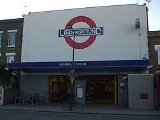
Arsenal tube station

Encyclopedia
Arsenal tube station is a London Underground
station located in Highbury
, London
. It is on the Piccadilly Line
, in Travelcard Zone 2
, between Holloway Road
and Finsbury Park
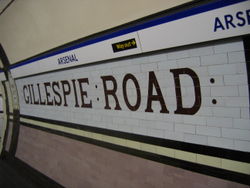
. Originally known as Gillespie Road, it was renamed in 1932 after Arsenal Football Club
, who at the time played at the nearby Arsenal Stadium
. It is the only Tube station named directly after a football club. Although Arsenal's Highbury Stadium closed in 2006, the station retains its name and is still used by spectators attending matches at Arsenal's new Emirates Stadium
, but it is otherwise quieter than other stations on the same stretch of line.
 Arsenal tube station was opened by the Great Northern, Piccadilly and Brompton Railway
(GNP&BR) as Gillespie Road
on 15 December 1906. The GNP&BR later renamed the Piccadilly line
after the consolidation & nationalisation of the Tube network as London Underground
. The original station building and ticket hall were red terracotta-clad buildings designed by Leslie Green
, similar to neighbouring Holloway Road
and Caledonian Road
stations.
At the time of Gillespie Road's construction, it served a residential area and a local divinity college. In 1913, Arsenal Football Club
moved to Highbury
on the site of the college's playing fields, and the club's presence there eventually led to a campaign for a change of name. Arsenal manager Herbert Chapman
was a particularly keen advocate, and on 5 November 1932 it was renamed Arsenal (Highbury Hill). The station was expanded in the 1930s, with the original station building demolished and being replaced with a wider building of a more modern design.
The (Highbury Hill) suffix was dropped from the station's name some time around 1960, giving the current name of Arsenal. The original tiled walls of the platforms still bear the Gillespie Road name, spelt out in large letters. In 2007, the station underwent a major upgrade; as part of this the wall tiling was completely restored, the floor resurfaced and an electronic Tannoy
system introduced.
 The station is in a narrow Victorian
residential street: when built, the station building was squeezed incongruously between residential properties on each side, occupying the width of just two terraced houses. Even after the surface building was rebuilt in the early 1930s and widened, with a further house being demolished, it has one of the narrowest frontages of any underground station. It is also unusual in not having any bus
routes pass its entrance, though routes 4
, 19
, 106
and 236
serve nearby Blackstock Road
.
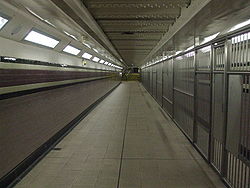
Unusually for a "deep level" tube station, Arsenal possesses neither escalators nor lifts
. Instead, a sloping passageway leads down to the platforms. This is due to the combination of the tunnels being both relatively shallow at this point and being some distance from the station entrance (being underneath the East Coast Main Line
). Due to short flights of stairs
at both ends of the passageway the station is not wheelchair accessible. When the station was rebuilt in the early 1930s an extra tunnel was dug to platform level from the main access passage in anticipation of increased traffic, which is now used to handle the large crowds on match days. The station has a "tidal" system unique on the Underground network, with a narrow section on one side divided from the main passageway by a full-height fence. The narrow section is used on match days for the lighter flow, according to time of day - for passengers catching trains before matches, or leaving the station afterwards.
 The station is located in a residential area, away from any main roads, and is considerably less busy than other stations on the same stretch of line. In 2007 only 2.735 million entries and exits were recorded, compared with Holloway Road
's 7.487m and Caledonian Road
's 5.333m. It is largely deserted outside rush hours except on Arsenal match days.
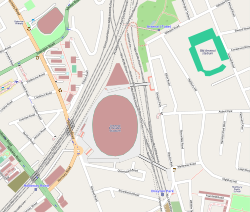
In 2006 Arsenal FC moved to a new stadium, the Emirates Stadium
. The stadium is on the site of Ashburton Grove, a former industrial estate approximately 500 yards from Highbury, and closer to Drayton Park and Holloway Road stations. However, Drayton Park (along with the rest of the Northern City Line
) is closed on weekends and weekday evenings, and trains do not stop at Holloway Road before and after matches to prevent overcrowding. Arsenal station meanwhile is still within easy walking distance of the new stadium and is recommended by the club for use on matchdays. The station thus still retains the "Arsenal" name and, along with Finsbury Park and Highbury & Islington, is still used by many Arsenal supporters to get to matches.
As part of the commemoration of Arsenal's move, a temporary mural
was placed along the walls of the station passageways as part of London Underground's Art on the Underground scheme. It was unveiled in February and removed in September 2006.
London Underground
The London Underground is a rapid transit system serving a large part of Greater London and some parts of Buckinghamshire, Hertfordshire and Essex in England...
station located in Highbury
Highbury
- Early Highbury :The area now known as Islington was part of the larger manor of Tolentone, which is mentioned in the Domesday Book. Tolentone was owned by Ranulf brother of Ilger and included all the areas north and east of Canonbury and Holloway Road. The manor house was situated by what is now...
, London
London
London is the capital city of :England and the :United Kingdom, the largest metropolitan area in the United Kingdom, and the largest urban zone in the European Union by most measures. Located on the River Thames, London has been a major settlement for two millennia, its history going back to its...
. It is on the Piccadilly Line
Piccadilly Line
The Piccadilly line is a line of the London Underground, coloured dark blue on the Tube map. It is the fifth busiest line on the Underground network judged by the number of passengers transported per year. It is mainly a deep-level line, running from the north to the west of London via Zone 1, with...
, in Travelcard Zone 2
Travelcard Zone 2
Fare zone 2 is an inner zone of Transport for London's zonal fare system used for calculating the price of tickets for travel on the London Underground, London Overground, Docklands Light Railway and, since 2007, on National Rail services.-Background:...
, between Holloway Road
Holloway Road tube station
Holloway Road is a station on the London Underground. It is on the Piccadilly Line between Caledonian Road and Arsenal stations, and in Travelcard Zone 2. The station opened on 15 December 1906....
and Finsbury Park
Finsbury Park station
Finsbury Park Station is a busy transport interchange in North London. The interchange consists of an interconnected National Rail station, London Underground station and two bus stations. The main entrances are by the eastern bus station on Station Place...
. Originally known as Gillespie Road, it was renamed in 1932 after Arsenal Football Club
Arsenal F.C.
Arsenal Football Club is a professional English Premier League football club based in North London. One of the most successful clubs in English football, it has won 13 First Division and Premier League titles and 10 FA Cups...
, who at the time played at the nearby Arsenal Stadium
Arsenal Stadium
Arsenal Stadium was a football stadium in Highbury, North London, which was the home ground of Arsenal Football Club between 6 September 1913 and 7 May 2006...
. It is the only Tube station named directly after a football club. Although Arsenal's Highbury Stadium closed in 2006, the station retains its name and is still used by spectators attending matches at Arsenal's new Emirates Stadium
Emirates Stadium
Ashburton Grove, currently known as the Emirates Stadium, is a UEFA elite football stadium which is home to Arsenal FC, where they moved from Highbury in 2006. It has an current capacity of 60,361, and there have been rumours of an expansion...
, but it is otherwise quieter than other stations on the same stretch of line.
History
Great Northern, Piccadilly and Brompton Railway
The Great Northern, Piccadilly and Brompton Railway , also known as the Piccadilly tube, was a railway company established in 1902 that constructed a deep-level underground "tube" railway in London. The GNP&BR was formed through a merger of two older companies, the Brompton and Piccadilly Circus...
(GNP&BR) as Gillespie Road
Gillespie Road
Gillespie Road is a road in Highbury, North London, running east-west along the north side of the Arsenal Stadium, previously home of Arsenal Football Club. Arsenal tube station was originally named Gillespie Road, before being given its current name in 1932 following pressure from the club...
on 15 December 1906. The GNP&BR later renamed the Piccadilly line
Piccadilly Line
The Piccadilly line is a line of the London Underground, coloured dark blue on the Tube map. It is the fifth busiest line on the Underground network judged by the number of passengers transported per year. It is mainly a deep-level line, running from the north to the west of London via Zone 1, with...
after the consolidation & nationalisation of the Tube network as London Underground
London Underground
The London Underground is a rapid transit system serving a large part of Greater London and some parts of Buckinghamshire, Hertfordshire and Essex in England...
. The original station building and ticket hall were red terracotta-clad buildings designed by Leslie Green
Leslie Green
Leslie William Green was an English architect known especially for his design of iconic stations constructed on the London Underground railway system in central London during the first decade of the 20th century....
, similar to neighbouring Holloway Road
Holloway Road tube station
Holloway Road is a station on the London Underground. It is on the Piccadilly Line between Caledonian Road and Arsenal stations, and in Travelcard Zone 2. The station opened on 15 December 1906....
and Caledonian Road
Caledonian Road tube station
Caledonian Road is a station on the Piccadilly Line of the London Underground, between King's Cross St. Pancras and Holloway Road, and in Travelcard Zone 2. It was opened on 15 December 1906 by the Great Northern, Piccadilly and Brompton Railway....
stations.
At the time of Gillespie Road's construction, it served a residential area and a local divinity college. In 1913, Arsenal Football Club
Arsenal F.C.
Arsenal Football Club is a professional English Premier League football club based in North London. One of the most successful clubs in English football, it has won 13 First Division and Premier League titles and 10 FA Cups...
moved to Highbury
Arsenal Stadium
Arsenal Stadium was a football stadium in Highbury, North London, which was the home ground of Arsenal Football Club between 6 September 1913 and 7 May 2006...
on the site of the college's playing fields, and the club's presence there eventually led to a campaign for a change of name. Arsenal manager Herbert Chapman
Herbert Chapman
Herbert Chapman was an English association football player and manager. Though he had an undistinguished playing career, he went on to become one of the most successful and influential managers in early 20th century English football, before his sudden death in 1934.As a player, Chapman played for...
was a particularly keen advocate, and on 5 November 1932 it was renamed Arsenal (Highbury Hill). The station was expanded in the 1930s, with the original station building demolished and being replaced with a wider building of a more modern design.
The (Highbury Hill) suffix was dropped from the station's name some time around 1960, giving the current name of Arsenal. The original tiled walls of the platforms still bear the Gillespie Road name, spelt out in large letters. In 2007, the station underwent a major upgrade; as part of this the wall tiling was completely restored, the floor resurfaced and an electronic Tannoy
Tannoy
Tannoy Ltd is a Scottish-based manufacturer of loudspeakers and public-address systems. The company was founded in London, England as Tulsemere Manufacturing Company in 1926, but has been based in Coatbridge, Scotland, since the 1970s...
system introduced.
Structure
Victorian architecture
The term Victorian architecture refers collectively to several architectural styles employed predominantly during the middle and late 19th century. The period that it indicates may slightly overlap the actual reign, 20 June 1837 – 22 January 1901, of Queen Victoria. This represents the British and...
residential street: when built, the station building was squeezed incongruously between residential properties on each side, occupying the width of just two terraced houses. Even after the surface building was rebuilt in the early 1930s and widened, with a further house being demolished, it has one of the narrowest frontages of any underground station. It is also unusual in not having any bus
Bus
A bus is a road vehicle designed to carry passengers. Buses can have a capacity as high as 300 passengers. The most common type of bus is the single-decker bus, with larger loads carried by double-decker buses and articulated buses, and smaller loads carried by midibuses and minibuses; coaches are...
routes pass its entrance, though routes 4
London Buses route 4
London Buses route 4 is a Transport for London contracted bus route in London, England, United Kingdom. The service is currently contracted to Metroline.-History:...
, 19
London Buses route 19
London Buses route 19 is a Transport for London contracted bus route in London, England, United Kingdom. The service is currently contracted to Arriva London.-History:...
, 106
London Buses route 106
London Buses route 106 is a Transport for London contracted bus route in London, United Kingdom. The service is currently contracted to Stagecoach London.-History:...
and 236
London Buses route 236
London Buses route 236 is a Transport for London contracted bus route in London, England. The service is currently contracted to First Capital.-History:...
serve nearby Blackstock Road
Blackstock Road
Blackstock Road is a major road in north London, England, running from Seven Sisters Road south westerly to Highbury. It runs along the border between the London Borough of Hackney and the London Borough of Islington...
.
Unusually for a "deep level" tube station, Arsenal possesses neither escalators nor lifts
Elevator
An elevator is a type of vertical transport equipment that efficiently moves people or goods between floors of a building, vessel or other structures...
. Instead, a sloping passageway leads down to the platforms. This is due to the combination of the tunnels being both relatively shallow at this point and being some distance from the station entrance (being underneath the East Coast Main Line
East Coast Main Line
The East Coast Main Line is a long electrified high-speed railway link between London, Peterborough, Doncaster, Wakefield, Leeds, York, Darlington, Newcastle and Edinburgh...
). Due to short flights of stairs
Stairs
-People:* Scott Kannberg , guitarist of Pavement* A. Edison Stairs , New Brunswick politician* Denis Stairs , engineer, Montreal businessman* Ernest W. Stairs , New Brunswick politician...
at both ends of the passageway the station is not wheelchair accessible. When the station was rebuilt in the early 1930s an extra tunnel was dug to platform level from the main access passage in anticipation of increased traffic, which is now used to handle the large crowds on match days. The station has a "tidal" system unique on the Underground network, with a narrow section on one side divided from the main passageway by a full-height fence. The narrow section is used on match days for the lighter flow, according to time of day - for passengers catching trains before matches, or leaving the station afterwards.
Usage
Holloway Road tube station
Holloway Road is a station on the London Underground. It is on the Piccadilly Line between Caledonian Road and Arsenal stations, and in Travelcard Zone 2. The station opened on 15 December 1906....
's 7.487m and Caledonian Road
Caledonian Road tube station
Caledonian Road is a station on the Piccadilly Line of the London Underground, between King's Cross St. Pancras and Holloway Road, and in Travelcard Zone 2. It was opened on 15 December 1906 by the Great Northern, Piccadilly and Brompton Railway....
's 5.333m. It is largely deserted outside rush hours except on Arsenal match days.
In 2006 Arsenal FC moved to a new stadium, the Emirates Stadium
Emirates Stadium
Ashburton Grove, currently known as the Emirates Stadium, is a UEFA elite football stadium which is home to Arsenal FC, where they moved from Highbury in 2006. It has an current capacity of 60,361, and there have been rumours of an expansion...
. The stadium is on the site of Ashburton Grove, a former industrial estate approximately 500 yards from Highbury, and closer to Drayton Park and Holloway Road stations. However, Drayton Park (along with the rest of the Northern City Line
Northern City Line
The Northern City Line is a railway line from Moorgate to Finsbury Park in London, once part of the Great Northern Electrics line. It should not be confused with the City branch of the Northern line, nor with the North London Line...
) is closed on weekends and weekday evenings, and trains do not stop at Holloway Road before and after matches to prevent overcrowding. Arsenal station meanwhile is still within easy walking distance of the new stadium and is recommended by the club for use on matchdays. The station thus still retains the "Arsenal" name and, along with Finsbury Park and Highbury & Islington, is still used by many Arsenal supporters to get to matches.
As part of the commemoration of Arsenal's move, a temporary mural
Mural
A mural is any piece of artwork painted or applied directly on a wall, ceiling or other large permanent surface. A particularly distinguishing characteristic of mural painting is that the architectural elements of the given space are harmoniously incorporated into the picture.-History:Murals of...
was placed along the walls of the station passageways as part of London Underground's Art on the Underground scheme. It was unveiled in February and removed in September 2006.