
All Topics  
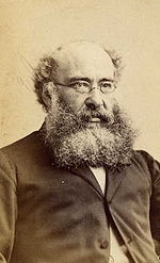
Anthony Trollope

 
Anthony Trollope

   Email Print
   Bookmark   Link


Anthony Trollope


Anthony Trollope ( 24 April 1815 – 6 December 1882 ) became one of the most successful, prolific and respected English
English language

English is a West Germanic language that originated in Anglo-Saxon England and has lingua franca status in many parts of the world as a result of the military, economic, scientific, political and cultural influence of the British Empire in the 18th, 19th and early 20th centuries and that of the United States from the mid 20th century onwa...
 novelists of the Victorian era
Victorian era

The Victorian Era of the United Kingdom of Great Britain and Ireland was the period of Victoria of the United Kingdom reign from June 1837 to January 1901....
. Some of Trollope's best-loved works, known as the Chronicles of Barsetshire
Chronicles of Barsetshire

The "Chronicles of Barsetshire" is a series of six novels by the English author Anthony Trollope, set in the fictitious cathedral town of Barchester....
, revolve around the imaginary county of Barsetshire
Barsetshire

Barsetshire is a fictional county created by Anthony Trollope, which is featured in the series of novels known as the "Chronicles of Barsetshire"....
; he also wrote penetrating novels on political
Politics

Politics is the process by which groups of people make decisions. The term is generally applied to behaviour within civil governments, but politics has been observed in all human group interactions, including corporation, academia, and religion institutions....
, social, gender issues and conflicts of his day.

Trollope has always been a popular novelist. Noted fans have included Sir Alec Guinness
Alec Guinness

Sir Alec Guinness, Order of the Companions of Honour, Order of the British Empire was an Academy Award for Best Actor winning English actor....
 (who never travelled without a Trollope novel), former British Prime Ministers
Prime Minister of the United Kingdom

The Prime Minister of the United Kingdom of Great Britain and Northern Ireland is the political leader of the United Kingdom and the head of government Her Majesty's Government....
 Harold Macmillan
Harold Macmillan

Harold Macmillan, 1st Earl of Stockton, Order of Merit, Her Majesty's Most Honourable Privy Council was a British Conservative Party politician and Prime Minister of the United Kingdom from 10 January 1957 to 18 October 1963....
 and Sir John Major
John Major

Sir John Major, Order of the Garter, Order of the Companions of Honour, Chartered Institute of Bankers , was Prime Minister of the United Kingdom of the United Kingdom and Leaders of the Conservative and Unionist Party of the Conservative Party during 1990 to 1997....
, economist John Kenneth Galbraith
John Kenneth Galbraith

John Kenneth "Ken" Galbraith, Order of Canada was a Canadian-American economics. He was a Keynesian economics and an institutional economics, a leading proponent of 20th-century American liberalism and Progressivism in the United States....
, American novelists Sue Grafton
Sue Grafton

Sue Taylor Grafton is a contemporary United States author of detective novels....
 and Dominick Dunne
Dominick Dunne

Dominick Dunne is an American writer and investigative journalist whose subjects frequently hinge on the ways high society interacts with the judicial system....
 and soap opera
Soap opera

A soap opera is an ongoing, episodic work of dramatic fiction presented in Serial format on television or radio. Programs described as soap operas have existed as an entertainment long enough for audiences to recognize them simply by the term soap....
 writer Harding Lemay.


Discussion
Ask a question about 'Anthony Trollope'
Start a new discussion about 'Anthony Trollope'
Answer questions from other users
Full Discussion Forum


Quotations


I can never bring myself to believe it, John, said Mary Walker, the pretty daughter of Mr. George Walker, attorney, of Silverbridge.

First lines

A small task, if it be really daily, will beat the labors of a spasmodic Hercules.

Ch. 7

Always remember, Mr. Robarts, that when you go into an attorney's office door, you will have to pay for it, first or last.

Vol. I, ch. 20

Barchester Towers has become one of those novels which do not die quite at once, which live and are read for perhaps a quarter of a century.

Ch. 6

I cannot hold with those who wish to put down the insignificant chatter of the world.

Framley Parsonage

It has been the great fault of our politicians that they have all wanted to do something.


Encyclopedia


Anthony Trollope ( 24 April 1815 – 6 December 1882 ) became one of the most successful, prolific and respected English
English language

English is a West Germanic language that originated in Anglo-Saxon England and has lingua franca status in many parts of the world as a result of the military, economic, scientific, political and cultural influence of the British Empire in the 18th, 19th and early 20th centuries and that of the United States from the mid 20th century onwa...
 novelists of the Victorian era
Victorian era

The Victorian Era of the United Kingdom of Great Britain and Ireland was the period of Victoria of the United Kingdom reign from June 1837 to January 1901....
. Some of Trollope's best-loved works, known as the Chronicles of Barsetshire
Chronicles of Barsetshire

The "Chronicles of Barsetshire" is a series of six novels by the English author Anthony Trollope, set in the fictitious cathedral town of Barchester....
, revolve around the imaginary county of Barsetshire
Barsetshire

Barsetshire is a fictional county created by Anthony Trollope, which is featured in the series of novels known as the "Chronicles of Barsetshire"....
; he also wrote penetrating novels on political
Politics

Politics is the process by which groups of people make decisions. The term is generally applied to behaviour within civil governments, but politics has been observed in all human group interactions, including corporation, academia, and religion institutions....
, social, gender issues and conflicts of his day.

Trollope has always been a popular novelist. Noted fans have included Sir Alec Guinness
Alec Guinness

Sir Alec Guinness, Order of the Companions of Honour, Order of the British Empire was an Academy Award for Best Actor winning English actor....
 (who never travelled without a Trollope novel), former British Prime Ministers
Prime Minister of the United Kingdom

The Prime Minister of the United Kingdom of Great Britain and Northern Ireland is the political leader of the United Kingdom and the head of government Her Majesty's Government....
 Harold Macmillan
Harold Macmillan

Harold Macmillan, 1st Earl of Stockton, Order of Merit, Her Majesty's Most Honourable Privy Council was a British Conservative Party politician and Prime Minister of the United Kingdom from 10 January 1957 to 18 October 1963....
 and Sir John Major
John Major

Sir John Major, Order of the Garter, Order of the Companions of Honour, Chartered Institute of Bankers , was Prime Minister of the United Kingdom of the United Kingdom and Leaders of the Conservative and Unionist Party of the Conservative Party during 1990 to 1997....
, economist John Kenneth Galbraith
John Kenneth Galbraith

John Kenneth "Ken" Galbraith, Order of Canada was a Canadian-American economics. He was a Keynesian economics and an institutional economics, a leading proponent of 20th-century American liberalism and Progressivism in the United States....
, American novelists Sue Grafton
Sue Grafton

Sue Taylor Grafton is a contemporary United States author of detective novels....
 and Dominick Dunne
Dominick Dunne

Dominick Dunne is an American writer and investigative journalist whose subjects frequently hinge on the ways high society interacts with the judicial system....
 and soap opera
Soap opera

A soap opera is an ongoing, episodic work of dramatic fiction presented in Serial format on television or radio. Programs described as soap operas have existed as an entertainment long enough for audiences to recognize them simply by the term soap....
 writer Harding Lemay. Trollope's literary reputation dipped somewhat during the last years of his life, but he regained the esteem of critics by the mid-twentieth century.

"Of all novelists in any country, Trollope best understands the role of money. Compared with him even Balzac
Honoré de Balzac

Honor? de Balzac was a French novelist and playwright. His magnum opus was a Novel sequence of almost 100 novels and plays collectively entitled La Com?die humaine, which presents a panorama of French life in the years after the fall of Napol?on Bonaparte in 1815....
 is a romantic." — W. H. Auden
W. H. Auden

Wystan Hugh Auden who signed his works W. H. Auden, was an Anglo-American poet, regarded by many as one of the greatest writers of the 20th century....


Biography

Anthony Trollope's father, Thomas Anthony Trollope, worked as a barrister
Barrister

A barrister is a lawyer found in many common law jurisdictions that employ a split profession in relation to legal representation. In split professions, the other type of lawyer is the solicitor....
. Thomas Trollope, though a clever and well-educated man and a Fellow of New College, Oxford
New College, Oxford

New College is one of the Colleges of the University of Oxfords of the University of Oxford in the United Kingdom. Its official name, College of St Mary, is the same as that of the older Oriel College, Oxford; hence, it has been referred to as the "New College of St Mary", and is now almost always called "New College"....
, failed at the bar due to his bad temper. In addition, his ventures into farming proved unprofitable and he lost an expected inheritance when an elderly uncle married and had children. Nonetheless, he came from a genteel background, with connections to the landed gentry
Landed gentry

Landed gentry is a term traditionally applied in United Kingdom to those people of a certain type and education who possess land in the form of country estates, often made up of tenanted farms....
, and so wished to educate his sons as gentlemen and for them to attend Oxford
University of Oxford

The University of Oxford , located in the city of Oxford, Oxfordshire, England, is the List of oldest universities in continuous operation in the English-speaking world....
 or Cambridge
University of Cambridge

The University of Cambridge , located in Cambridge, England, is the List of oldest universities in continuous operation university in the Anglosphere....
. The disparity between his family's social background and its poverty would be the cause of much misery to Anthony Trollope during his boyhood.

Born in London, Anthony attended Harrow School
Harrow School

Harrow School, commonly known as "Harrow", is a world-famous boys' independent school in United Kingdom. Harrow has educated boys since 1243 but was officially founded by John Lyon under a Royal Charter of Elizabeth I in 1572....
 as a day-boy
Day pupil

Day pupils are students who attend boarding school but who are not boarders and who travel between home and school every day. The majority of boarding schools allow this, although most of their students are boarders....
 for three years from the age of seven, as his father's farm lay in that neighbourhood. After a spell at a private school, he followed his father and two older brothers to Winchester College
Winchester College

Winchester College is a famous boys' independent school, set in the city of Winchester, Hampshire in Hampshire, England, once the ancient capital....
, where he remained for three years. He returned to Harrow as a day-boy to reduce the cost of his education. Trollope had some very miserable experiences at these two public schools. They ranked as two of the most élite schools in England, but Trollope had no money and no friends, and was bullied a great deal. At the age of twelve, he fantasized about suicide. However, he also daydreamed, constructing elaborate imaginary worlds.

In 1827, his mother Frances Trollope
Frances Trollope

Frances Trollope was an English novelist and miscellaneous writer who published as Mrs. Trollope or Mrs. Frances Trollope. Her detractors diminished her reputation by making the common name used for her the overly familiar and slightly vulgar diminutive Fanny Trollope....
 moved to America with Trollope's three younger siblings, where she opened a bazaar in Cincinnati, which proved unsuccessful. Thomas Trollope joined them for a short time before returning to the farm at Harrow, but Anthony stayed in England throughout. His mother returned in 1831 and rapidly made a name for herself as a writer, soon earning a good income. His father's affairs, however, went from bad to worse. He gave up his legal practice entirely and failed to make enough income from farming to pay rents to his landlord Lord Northwick
John Rushout, 2nd Baron Northwick

John Rushout, 2nd Baron Northwick was an English peer, landowner and collector of art works.Rushout was the son of John Rushout, 1st Baron Northwick and his wife Rebecca Bowles....
. In 1834 he fled to Belgium
Belgium

* A small German-speaking Community of Belgium exists in eastern Wallonia. Belgium's linguistic diversity and related political and cultural conflicts are reflected in the history of Belgium and a complex Communities and regions of Belgium....
 to avoid arrest for debt. The whole family moved to a house near Bruges
Bruges

Bruges is the capital and largest city of the Provinces of Belgium of West Flanders in the Flemish Region of Belgium. It is located in the northwest of the country....
, where they lived entirely on Frances's earnings. In 1835, Thomas Trollope died.

While living in Belgium, Anthony worked as a Classics
Classics

Classics is the branch of the Humanities comprising the languages, literature, philosophy, history, art, and other culture of the ancient Mediterranean World; especially Ancient Greece and Ancient Rome during Classical Antiquity ....
 usher (a junior or assistant teacher) in a school with a view to learning French
French language

French is a Romance language spoken around the world by around 80 million people as first language, by 190 million as second language, and by about another 200 million people as an acquired tongue, with significant speakers in 54 countries....
 and German
German language

German is a West Germanic languages, thus related to and classified alongside English language and Dutch language. It is one of the world's world language and the most widely spoken mother tongue in the European Union....
, so that he could take up a promised commission in an Austria
Austria

Austria , officially the Republic of Austria , is a landlocked country in Central Europe. It borders both Germany and the Czech Republic to the north, Slovakia and Hungary to the east, Slovenia and Italy to the south, and Switzerland and Liechtenstein to the west....
n cavalry regiment, which had to be cut short at six weeks. He then obtained a position as a civil servant in the British Post Office
Post office

A post office is a facility authorized by a postal system for the posting, receipt, sorting, handling, transmission or delivery of mail. Post offices offer mail-related services such as post office boxes, postage and packaging supplies....
 through one of his mother's family connections, and returned to London on his own. This provided a respectable, gentlemanly occupation, but not a well-paid one.

Time in Ireland

Trollope lived in boarding house
Boarding house

A boarding house, also known as a "rooming house" or a "lodging house", is a house in which people on vacation or lodging renting one or more rooms for one or more nights, and sometimes for extended periods of weeks, months and years....
s and remained socially awkward; he referred to this as his "hobbledehoyhood". He made little progress in his career until the Post Office sent him to Ireland
Ireland

Ireland is the List of islands by area in Europe, and the twentieth-largest island in the world. It lies to the north-west of continental Europe and is surrounded by hundreds of islands and islet....
 in 1841. He married an Englishwoman named Rose Heseltine in 1844. They lived in Ireland until 1859, when they moved back to England.

Despite the calamity of the Great Famine in Ireland, Trollope wrote of his time in Ireland in his own autobiography:
"It was altogether a very jolly life that I led in Ireland. The Irish people did not murder me, nor did they even break my head. I soon found them to be good-humoured, clever - the working classes very much more intelligent than those of England - economical and hospitable."


His professional role as a post-office surveyor brought him into contact with Irish people. Trollope began writing on the numerous long train trips around Ireland he had to take to carry out his postal duties. Setting very firm goals about how much he would write each day, he eventually became one of the most prolific writers of all time. He wrote his earliest novel
Novel

File:2009 stapelweise Neuerscheinungen im Buchladen.JPGA novel is today a long narrative in literary prose. The genre has historical roots both in the fields of the medieval and early modern Romance and in the tradition of the novella....
s while working as a Post Office inspector, occasionally dipping into the "lost-letter
Dead letter mail

Dead letter mail or undeliverable mail is mail that cannot be delivered to the addressee or returned to the sender. This is usually due to lack of compliance with postal regulations, an incomplete address and return address, or the inability to mail forwarding when both correspondents move before the letter can be delivered....
" box for ideas.

Significantly, many of his earliest novels have Ireland as their setting — natural enough given his background, but unlikely to enjoy warm critical reception, given the contemporary English attitudes towards Ireland. It has been pointed out by critics that Trollope's view of Ireland separates him from many of the other Victorian novelists. Some critics claim that Ireland did not influence Trollope as much as his experience in England, and that the society in Ireland harmed him as a writer, especially since Ireland was experiencing the famine during his time there. Such critics were dismissed as holding bigoted opinions against Ireland and did not reflect Trollope's true attachment to the country.

Trollope wrote four novels about Ireland. Two were written during the famine, while the third deals with the famine as a theme (The Macdermots of Ballycloran, The Landleaguers and Castle Richmond respectively). The Macdermots of Ballycloran was written while he was staying in the village of Drumsna
Drumsna

Drumsna is a village in County Leitrim, Republic of Ireland. It is situated 6km east of Carrick-on-Shannon on the River Shannon and is located on the N4 road Roads in Ireland which links Dublin and Sligo.Droim ar sn?mh, the ridge of the swimming place has always been associated with activity on the water....
, County Leitrim
County Leitrim

County Leitrim is one of the Irish county of Republic of Ireland and is part of the province of Connacht. Its name derives from the Irish , meaning "grey ridge."...
. A fourth, The Kellys and the O'Kellys (1848) is a humorous comparison of the romantic pursuits of the landed gentry (Francis O'Kelly, Lord Ballindine) and his Catholic tenant (Martin Kelly). Two short stories deal with Ireland ("The O'Conors of Castle Conor, County Mayo" and "Father Giles of Ballymoy" ). It has been argued by some critics that these works seek to unify an Irish and British identity, instead of viewing the two as distinct. Even as an Englishman in Ireland, Trollope was still able to attain what he saw as essential to being an "Irish writer": possessed, obsessed, and "mauled" by Ireland.

The reception of the Irish works left much to be desired. Henry Colburn wrote to Trollope, "It is evident that readers do not like novels on Irish subjects as well as on others". In particular, magazines such as New Monthly Magazine, which wrote reviews that attacked the Irish for their actions during the famine, were representative of the dismissal by English readers to any work written about the Irish.

Trollope himself wrote, about Phineas Finn's identity as an Irishman:
"There was nothing to be gained by the peculiarity, and there was an added difficulty in obtaining sympathy and affection for a politician belonging to a nationality whose politics are not respected in England. But in spite of this Phineas succeeded."


Return to England

By the mid-1860s, Trollope had reached a fairly senior position within the Post Office hierarchy. Postal history credits him with introducing the pillar box
Pillar box

A pillar box is a free-standing post box, in the United Kingdom and Republic of Ireland, where mail is deposited to be collected by the Royal Mail or An Post and forwarded to the addressee....
 (the ubiquitous bright red mail
Mail

Mail, or post, is a method for transmitting information and tangible objects, wherein written documents, typically enclosed in envelopes, and also small packages, are delivered to destinations around the world....
-box) in the United Kingdom
United Kingdom of Great Britain and Ireland

The United Kingdom of Great Britain and Ireland was the formal name and the state form of the United Kingdom from 1 January 1801 until 12 April 1927....
. He had by this time also started to earn a substantial income from his novels. He had overcome the awkwardness of his youth, made good friends in literary circles, and hunted enthusiastically.

He left the Post Office in 1867 to run for Parliament
Parliament of the United Kingdom

The Parliament of the United Kingdom of Great Britain and Northern Ireland is the supreme legislature in the United Kingdom and British overseas territories....
 as a Liberal
Liberal Party (UK)

The Liberal Party was one of the two major British political parties from the early 19th century until the rise of the Labour Party in the 1920s, and a third party of varying strength and importance up to 1988, when it merged with the Social Democratic Party to form a new party which would become known as the Liberal Democrats....
 candidate in 1868. After he lost, he concentrated entirely on his literary career
Career

Career is a term defined by the Oxford English Dictionary as an individual's "course or progress through life ". It usually is considered to pertain to remunerative work ....
. While continuing to produce novels rapidly, he also edited the St Paul's Magazine, which published several of his novels in serial form.

His first major success came with The Warden
The Warden

The Warden is the first novel in Anthony Trollope's series known as the "Chronicles of Barsetshire", published in 1855. It was his fourth novel....
 (1855) — the first of six novels set in the fictional county
County

A county is a land area of Local government government within a larger state. A county may have city and towns within its area....
 of "Barsetshire" (often collectively referred to as the Chronicles of Barsetshire
Chronicles of Barsetshire

The "Chronicles of Barsetshire" is a series of six novels by the English author Anthony Trollope, set in the fictitious cathedral town of Barchester....
), usually dealing with the clergy. The comic masterpiece Barchester Towers
Barchester Towers

Barchester Towers, published in 1857, is the second novel in Anthony Trollope's series known as the "Chronicles of Barsetshire". It is possibly Trollope's best known work....
 (1857) has probably become the best-known of these. Trollope's other major series, the Palliser novels
Palliser novels

The "Palliser novels" are six novels by Anthony Trollope.The common thread is the wealthy aristocrat and politician Plantagenet Palliser and his wife Lady Glencora....
, concerned itself with politics, with the wealthy, industrious Plantagenet Palliser
Plantagenet Palliser

Plantagenet Palliser, Duke of Omnium and Gatherum, Earl of Silverbridge, is a main character in the Palliser novels series, of novels, also known as the "Parliamentary Novels," by Anthony Trollope....
 and his delightfully spontaneous, even richer wife Lady Glencora usually featuring prominently (although, as with the Barsetshire series, many other well-developed characters populated each novel). Trollope's popularity and critical success diminished in his later years, but he continued to write prolifically, and some of his later novels have acquired a good reputation. In particular, critics generally acknowledge the sweeping satire The Way We Live Now
The Way We Live Now

The Way We Live Now is a scathing satire novel published in London in 1875 by Anthony Trollope, after a popular Serial isation. It was regarded by many of Trollope's contemporaries as his finest work....
 (1875) as his masterpiece. In all, Trollope wrote forty-seven novels, as well as dozens of short stories and a few books on travel.

Anthony Trollope died in London in 1882. His grave stands in Kensal Green Cemetery
Kensal Green Cemetery

Kensal Green Cemetery is a burial ground located in Kensal Green, London, England. It was immortalised in the lines of GK Chesterton "For there is good news yet to hear and fine things to be seen; Before we go to Paradise by way of Kensal Green"....
, near that of his contemporary Wilkie Collins
Wilkie Collins

William Wilkie Collins was an English people novelist, playwright, and author of short stories. He was hugely popular in his time, and wrote 27 novels, more than 50 short stories, at least 15 plays, and over 100 pieces of non-fiction work....
. C. P. Snow
C. P. Snow

Charles Percy Snow, Baron Snow Order of the British Empire was an England physicist and novelist, who also served several important positions in the Government of the United Kingdom....
 wrote a biography of Trollope, published in 1975, called Trollope: His Life and Art.

Other travels

In 1871, Trollope made his first trip to Australia
Australia

Australia, officially the Commonwealth of Australia, is a country in the southern hemisphere comprising the Australia of the world's smallest continent, the major island of Tasmania, and numerous list of islands of Australia in the Indian Ocean and Pacific Oceans....
, arriving in Melbourne in July, with his wife and their cook. The trip was made to visit their younger son, Frederic, who was a sheep farmer near Grenfell, New South Wales
Grenfell, New South Wales

Grenfell is a country town in the Central West, New South Wales of New South Wales, Australia, in Weddin Shire. It is 370 kilometres west of Sydney and five hours' drive from the city....
. He wrote his novel Lady Anna during the voyage. He spent a year and two days "descending mines, mixing with shearers and rouseabouts, riding his horse into the loneliness of the bush, touring lunatic asylums, and exploring coast and plain by steamer and stagecoach". Despite this, the Australian press was uneasy, fearing he would misrepresent Australia in his writings. This fear was based on rather negative writings about America by his mother, Fanny, and by Charles Dickens
Charles Dickens

Charles John Huffam Dickens, Royal Society of Arts , pen-name "Boz", was the most popular English people novelist of the Victorian era, as well as a vigorous Reform movement....
. On his return Trollope published a book, Australia and New Zealand (1873). It contained both positive and negative comments. On the positive side included finding a comparative absence of class consciousness, and praising aspects of Perth, Melbourne, Hobart and Sydney. However, he was negative about Adelaide's river, the towns of Bendigo and Ballarat, and the Aboriginal people. What most angered the Australian papers, though, were his comments "accusing Australians of being braggarts".

When Trollope returned to Australia in 1875 to help his son close down his failed farming business, he found that the resentment created by his bragging accusations remained and, when he died in 1882, Australian papers still "smouldered". In their obituaries they referred yet again to his accusations, and refused to fully praise or recognise his achievements.

Reputation

After his death, Trollope's Autobiography appeared. Trollope's downfall in the eyes of the critics stemmed largely from this volume. Even during his writing career, reviewers tended increasingly to shake their heads over his prodigious output (the same complaint was targeted at Charles Dickens
Charles Dickens

Charles John Huffam Dickens, Royal Society of Arts , pen-name "Boz", was the most popular English people novelist of the Victorian era, as well as a vigorous Reform movement....
), but when Trollope revealed that he strictly adhered to a daily writing quota, he confirmed his critics' worst fears. The Muse
Muse

File:Muse reading Louvre CA2220.jpgThe Muses in Greek mythology, poetry, and literature are the goddesses or spirits who inspire the creation of literature and the arts....
, in their view, might prove immensely prolific, but she would never ever follow a schedule. (Interestingly, no-one decried Gustave Flaubert
Gustave Flaubert

Gustave Flaubert was a France writer who is counted among the greatest Western literature. He is known especially for his first published novel, Madame Bovary , and for his scrupulous devotion to his art and style....
 for diligence, though he too worked on a schedule-scheme similar to Trollope's.) Furthermore, Trollope admitted that he wrote for money; at the same time he called the disdain of money false and foolish. The Muse, claimed the critics, should not be aware of money.

Julian Hawthorne
Julian Hawthorne

Julian Hawthorne was an American writer and journalist, the son of novelist Nathaniel Hawthorne and Sophia Hawthorne. He wrote numerous poems, novels, short stories, mystery/detective fiction, essays, travel books, biographies and histories....
, an American writer, critic and friend of Trollope, while praising him as a man, calling him "a credit to England and to human nature, and ...[deserving] to be numbered among the darlings of mankind," at the same time says that "he has done great harm to English fictitious literature by his novels" ("The Maker of Many Books," Confessions and Criticisms).

Henry James
Henry James

Henry James, Order of Merit , son of theologian Henry James Sr., brother of the philosopher and psychologist William James and diarist Alice James, was an United States author....
 also expressed mixed opinions of Trollope. The young James wrote some scathing reviews of Trollope's novels (The Belton Estate, for instance, he called "a stupid book, without a single thought or idea in it ... a sort of mental pabulum"). He also made it clear that he disliked Trollope's narrative method; Trollope's cheerful interpolations into his novels about how his storylines could take any twist their author wanted did not appeal to James' sense of artistic integrity. However, James thoroughly appreciated Trollope's attention to realistic detail, as he wrote in an essay shortly after the novelist's death:
"His [Trollope's] great, his incontestable merit, was a complete appreciation of the usual...he felt all daily and immediate things as well as saw them; felt them in a simple, direct, salubrious way, with their sadness, their gladness, their charm, their comicality, all their obvious and measurable meanings...Trollope will remain one of the most trustworthy, though not one of the most eloquent of writers who have helped the heart of man to know itself...A race is fortunate when it has a good deal of the sort of imagination — of imaginative feeling — that had fallen to the share of Anthony Trollope; and in this possession our English race is not poor."
James disliked Trollope's breaking the fourth wall
Fourth wall

The fourth wall is an element of fiction. Originally, the term referred to the imaginary "wall" at the front of the stage in a proscenium theater, through which the audience sees the action in the world of the Play ....
 in addressing readers directly. However, Trollope may have had some influence on James's own work; the earlier novelist's treatment of family
Family

Family denotes a group of people affiliated by a common ancestry, affinity or co-residence. Although the concept of consanguinity originally referred to relations by "blood," some cultural anthropology have argued that one must understand the idea of "blood" metaphorically, and that many societies understand 'family' through other concepts r...
 tensions, especially between fathers and daughters, may resonate in some of James' novels. For instance, Alice Vavasor and her selfish father in the first of the so-called Palliser novels
Palliser novels

The "Palliser novels" are six novels by Anthony Trollope.The common thread is the wealthy aristocrat and politician Plantagenet Palliser and his wife Lady Glencora....
, Can You Forgive Her?
Can You Forgive Her?

Can You Forgive Her? is a novel by Anthony Trollope, first published in serial form in 1864 and 1865. It is the first of six novels in the "Palliser novels" series....
, may pre-figure Kate Croy and her own insufferable father, Lionel, in The Wings of the Dove
The Wings of the Dove

The Wings of the Dove is a 1902 novel by Henry James. One of the masterpieces of James' final period, this novel tells the story of Milly Theale, an United States inheritance stricken with a serious disease, and her impact on the people around her....
.

Writers such as Thackeray, Eliot
George Eliot

Mary Anne Evans , better known by her pen name George Eliot, was an England novelist. She was one of the leading writers of the Victorian era....
 and Collins
Wilkie Collins

William Wilkie Collins was an English people novelist, playwright, and author of short stories. He was hugely popular in his time, and wrote 27 novels, more than 50 short stories, at least 15 plays, and over 100 pieces of non-fiction work....
 admired and befriended Trollope, and George Eliot noted that she could not have embarked on so ambitious a project as Middlemarch without the precedent set by Trollope in his own novels of the fictional — yet thoroughly alive — county of Barsetshire.

As trends in the world of the novel moved increasingly towards subjectivity and artistic experimentation, Trollope's standing with critics suffered. In the 1940s, Trollopians made attempts to resurrect his reputation; he enjoyed a critical Renaissance in the 1960s, and again in the 1990s. Some critics today have a particular interest in Trollope's portrayal of women — he caused remark even in his own day for his remarkable insight and sensitivity to the inner conflicts caused by the position of women in Victorian
Victorian era

The Victorian Era of the United Kingdom of Great Britain and Ireland was the period of Victoria of the United Kingdom reign from June 1837 to January 1901....
 society. Less compelling however, is the anti-semitism which appears in some of his work (for instance, in The Eustace Diamonds
The Eustace Diamonds

The Eustace Diamonds is a novel by Anthony Trollope, first published in 1871 as a serial in the Fortnightly Review. It is the third of the "Palliser novels" series of novels....
, where he refers to the character of Mr Emilius as a "nasty, greasy, lying, squinting Jew preacher"), and which exceeds anything to be found, say, in either Dickens or James.

A Trollope Society flourishes in the United Kingdom
United Kingdom

The United Kingdom of Great Britain and Northern Ireland, commonly known as the United Kingdom , the UK or Britain,is a sovereign state located off the northwestern coast of continental Europe....
, as does its sister society in the United States.

Trollope's works on television

The British Broadcasting Corporation has made several television-drama serials based on the works of Anthony Trollope:

  • The Pallisers
    The Pallisers

    The Pallisers is a 1974 in television BBC television adaptation of Anthony Trollope's Palliser novels....
    , a twenty-six-episode adaptation of all six Palliser novels, first broadcast in 1974. Adapted by Simon Raven
    Simon Raven

    Simon Arthur No?l Raven was an England novelist, essayist, dramatist and raconteur who, in a writing career of forty years, caused controversy, amusement and offence....
    , it starred Philip Latham
    Philip Latham

    Philip Latham is a United Kingdom actor. He was educated at Felsted School.In the late 1960s/early 1970s he was well known to British TV viewers for his portrayal of chief accountant Willy Izard, the "conscience" to hard-nosed oil company industrialist Brian Stead in the BBC series The Troubleshooters ....
     as Plantagenet Palliser and Susan Hampshire
    Susan Hampshire

    Susan Hampshire, Lady Kulukundis, Order of the British Empire is an England Actor best known for her many television and film roles. Her appeal has always been that of an "English rose"....
     as Lady Glencora.


  • The Barchester Chronicles
    The Barchester Chronicles

    The Barchester Chronicles was a 1982 British television mini-series produced by the BBC. The serial was an adaptation of theChronicles of Barsetshire: The Warden and Barchester Towers written by Anthony Trollope and was directed by David Giles....
    , a seven-episode adaptation of the first two Barset novels, The Warden
    The Warden

    The Warden is the first novel in Anthony Trollope's series known as the "Chronicles of Barsetshire", published in 1855. It was his fourth novel....
     and Barchester Towers
    Barchester Towers

    Barchester Towers, published in 1857, is the second novel in Anthony Trollope's series known as the "Chronicles of Barsetshire". It is possibly Trollope's best known work....
    . Adapted by Alan Plater
    Alan Plater

    Alan Frederick Plater, CBE is an United Kingdom playwright and screenwriter, who has worked extensively in British television from the 1960s to the 2000s....
    , it starred Donald Pleasence
    Donald Pleasence

    Donald Henry Pleasence, Order of the British Empire, was an England actor. His high work rate in international cinema earned him the distinction of being the most prolific film actor at the time of his death with over 200 screen credits....
     as the Reverend Septimus Harding, Geraldine McEwan
    Geraldine McEwan

    Geraldine McEwan is a BAFTA Awards-winning England actor, with a diverse and successful history in theatre, film and television. From 2004-2009 she appeared as Miss Marple, the Agatha Christie sleuth, for the series Marple shown on PBS in the United States...
     as Mrs Proudie, Nigel Hawthorne
    Nigel Hawthorne

    Sir Nigel Barnard Hawthorne Order of the British Empire was an English actor, perhaps best remembered for his role as Sir Humphrey Appleby, the Permanent Secretary in the sitcom Yes Minister and the Cabinet Secretary in its sequel, Yes, Prime Minister....
     as Archdeacon Grantly, and Alan Rickman
    Alan Rickman

    Alan Sidney Patrick Rickman is an Emmy-, Golden Globe-, BAFTA- and Screen Actors Guild Award-winning England film, television and Theatre actor....
     as the Reverend Obadiah Slope.


  • The Way We Live Now
    The Way We Live Now

    The Way We Live Now is a scathing satire novel published in London in 1875 by Anthony Trollope, after a popular Serial isation. It was regarded by many of Trollope's contemporaries as his finest work....
    , a four-episode adaptation of the novel of the same name. Adapted by Andrew Davies
    Andrew Davies (writer)

    Andrew Wynford Davies is a United Kingdom author and screenwriter....
    , it starred David Suchet
    David Suchet

    David Suchet , Order of the British Empire is an England actor, known for his work on United Kingdom television. He is recognised for his Royal Television Society- and Broadcasting Press Guild Awards award-winning performance as Augustus Melmotte in the 2001 United Kingdom TV mini-drama The Way We Live Now , alongside Matthew Macfadyen a...
     as Auguste Melmotte and Matthew Macfadyen
    Matthew Macfadyen

    Matthew Macfadyen is a United Kingdom actor, known for his role as MI5 agent Tom Quinn in the BBC television drama series Spooks and for starring as Fitzwilliam Darcy in the 2005 film version of Pride and Prejudice ....
     as Sir Felix Carbury.


  • He Knew He Was Right
    He Knew He Was Right

    He Knew He Was Right is a 1869 in literature novel written by Anthony Trollope which describes the failure of a marriage caused by the unreasonable jealousy of a husband exacerbated by the stubbornness of a willful wife....
     transmitted April 18–May 9, 2004 on BBC One
    BBC One

    BBC One is the primary television channel of the BBC . It was launched on 2 November 1936 as the BBC Television Service, and was the world's first regular public television service with a high level of ....
    , in four sixty-minute episodes. Produced by BBC Wales
    BBC Wales

    BBC Cymru Wales is a division of the British Broadcasting Corporation for Wales. Based at Broadcasting House in the Llandaff area of Cardiff, it directly employs over 1200 people, and produces a broad range of television, radio and online services in both the Welsh and English languages....
    , and adapted again by Andrew Davies, it starred, amongst others, Oliver Dimsdale, Bill Nighy
    Bill Nighy

    'William Francis "Bill" Nighy' is a Golden Globe- and British Academy of Film and Television Arts-award winning English people actor. He started working in theatre and television, before his first film role in 1981, and is perhaps best known to international film audiences for his roles in Love Actually, Shaun of the Dead, Notes on a...
    , Laura Fraser
    Laura Fraser

    Laura Fraser is a Scotland actor....
    , David Tennant
    David Tennant

    David Tennant is a Scotland actor. Already a well-known theatre actor, Tennant achieved wider fame for his TV role as the Tenth Doctor in BBC's Doctor Who as well as in Casanova , and his film role as Death Eater#Barty Crouch, Jr in Harry Potter and the Goblet of Fire ....
    , and Geoffrey Palmer
    Geoffrey Palmer (actor)

    Geoffrey Dyson Palmer, Order of the British Empire is an England actor, best known for his roles in sitcoms such as Butterflies and As Time Goes By ....
    .


In the United States, PBS has broadcast all four series: The Pallisers in its own right, and The Barchester Chronicles, The Way We Live Now, and He Knew He Was Right as part of Masterpiece Theatre
Masterpiece Theatre

Masterpiece is a drama anthology television series produced by WGBH-TV. It premiered on Public Broadcasting Service on January 10, 1971, making it America's longest-running weekly primetime drama series....
.

Trollope's works on radio

  • The BBC commissioned a four-part radio adaptation of The Small House at Allington
    The Small House at Allington

    The Small House at Allington is the fifth novel in Anthony Trollope's series known as the "Chronicles of Barsetshire", first published in 1864....
    , the fifth novel of the Chronicles of Barsetshire
    Chronicles of Barsetshire

    The "Chronicles of Barsetshire" is a series of six novels by the English author Anthony Trollope, set in the fictitious cathedral town of Barchester....
    , which it broadcast in 1993. Listeners responded so positively that the BBC had the five remaining novels of the series adapted, and BBC Radio 4
    BBC Radio 4

    BBC Radio 4 is a domestic UK radio station that broadcasts a wide variety of spoken-word programmes, including news, drama, comedy, science and history....
     broadcast the complete series between December 1995 and March 1998. In this adaptation, Stephen Moore
    Stephen Moore (actor)

    Stephen Moore is an England actor, known for his work on United Kingdom television in the 80s and 2000s.He is best recognised for his appearances in "Rock Follies " and other TV series such as The Last Place on Earth, the chidren's series The Queen's Nose and Chief Constable Mike Bishop in the TV drama Merseybeat and as Danny Tyrrell...
     played the part of Archdeacon Grantley.


  • BBC Radio 4 broadcast a serialised radio adaptation of The Kellys and the O'Kellys, starring Derek Jacobi
    Derek Jacobi

    Sir Derek George Jacobi Order of the British Empire is an England actor and film director. Like Laurence Olivier, he bears the distinction of holding two knighthoods, Danish and British....
    , between 21 November 1982 and 2 January 1983.


  • Radio 4 broadcast The Pallisers, a new twelve-part adaptation of the Palliser novels, from January to April 2004 in the weekend Classic Serial slot.


Works

Novels unless otherwise noted:

  • The Macdermots of Ballycloran
    The Macdermots of Ballycloran

    The Macdermots of Ballycloran is a novel by Anthony Trollope. It was Trollope's first published novel, which he began in September 1843 and completed by June 1845....
     (1847)
  • The Kellys and the O'Kellys (1848)
  • La Vendée:An Historical Romance (1850)
  • The Warden
    The Warden

    The Warden is the first novel in Anthony Trollope's series known as the "Chronicles of Barsetshire", published in 1855. It was his fourth novel....
     (1855) Chronicles of Barsetshire #1
  • Barchester Towers
    Barchester Towers

    Barchester Towers, published in 1857, is the second novel in Anthony Trollope's series known as the "Chronicles of Barsetshire". It is possibly Trollope's best known work....
     (1857) Chronicles of Barsetshire #2
  • The Three Clerks (1858)
  • Doctor Thorne
    Doctor Thorne

    Doctor Thorne is the third novel in Anthony Trollope's series known as the "Chronicles of Barsetshire". It is preceded by Barchester Towers and followed by Framley Parsonage ....
     (1858) Chronicles of Barsetshire #3
  • The West Indies and the Spanish Main (travel) (1859)
  • The Bertrams (1859)
  • Castle Richmond (1860)
  • Framley Parsonage
    Framley Parsonage

    Framley Parsonage is the fourth novel in Anthony Trollope's series known as the "Chronicles of Barsetshire", first published in serial form in the Cornhill Magazine in 1860....
     (1861) Chronicles of Barsetshire #4
  • Tales of All Countries--1st Series (stories) (1861)
  • Tales of All Countries--2nd Series (stories) (1863)
  • Tales of All Countries--3rd Series (stories) (1870)
  • Orley Farm
    Orley Farm

    Orley Farm can refer to:*The book Orley Farm by Anthony Trollope.*A Orley Farm School of the same name, in Harrow, London, in London....
     (1862)
  • North America (travel) (1862)
  • The Struggles of Brown, Jones & Robinson (1862)
  • Rachel Ray (1863)
  • The Small House at Allington
    The Small House at Allington

    The Small House at Allington is the fifth novel in Anthony Trollope's series known as the "Chronicles of Barsetshire", first published in 1864....
     (1864) Chronicles of Barsetshire #5
  • Can You Forgive Her?
    Can You Forgive Her?

    Can You Forgive Her? is a novel by Anthony Trollope, first published in serial form in 1864 and 1865. It is the first of six novels in the "Palliser novels" series....
     (1865) Palliser Novel #1
  • Miss Mackenzie (1865)
  • Hunting Sketches (sketches) (1865)
  • Travelling Sketches (sketches) (1866)
  • Clergymen of the Church of England (sketches) (1866)
  • The Belton Estate (1866)
  • The Claverings (1867)
  • Nina Balatka (1867)
  • Last Chronicle of Barset (1867) Chronicles of Barsetshire #6
  • Lotta Schmidt & Other Stories (1867)
  • Linda Tressel (1868)
  • Phineas Finn
    Phineas Finn

    Phineas Finn is a novel by Anthony Trollope and the name of its leading character. The novel was first published in 1867 as a serial in St Paul's Magazine....
     (1869) Palliser Novel #2
  • He Knew He Was Right
    He Knew He Was Right

    He Knew He Was Right is a 1869 in literature novel written by Anthony Trollope which describes the failure of a marriage caused by the unreasonable jealousy of a husband exacerbated by the stubbornness of a willful wife....
     (1869)
  • Did He Steal It? (play) (1869)
  • The Vicar of Bullhampton (1870)
  • An Editor's Tales (stories) (1870)
  • The Commentaries of Caesar (school textbook) (1870)
  • Sir Harry Hotspur of Humblethwaite
    Sir Harry Hotspur of Humblethwaite

    Anthony Trollope's novel Sir Harry Hotspur of Humblethwaite, appeared in 1871.The novel offers psychological dissection of the issues of inheritance, filial duty, noblesse oblige, gentlemanly behaviour, repentance and love, all hung upon the story of the wooing and losing of Sir Harry Hotspur's daughter , Emily, by their "scamp" of...
     (1871)
  • Ralph the Heir (1871)
  • The Golden Lion of Granpère (1872)
  • Australia and New Zealand (travel) (1873)
  • The Eustace Diamonds
    The Eustace Diamonds

    The Eustace Diamonds is a novel by Anthony Trollope, first published in 1871 as a serial in the Fortnightly Review. It is the third of the "Palliser novels" series of novels....
     (1873) Palliser Novel #3
  • Harry Heathcote of Gangoil (1874)
  • Lady Anna (1874)
  • Phineas Redux
    Phineas Redux

    Phineas Redux is a novel by Anthony Trollope, first published in 1873 as a serial in the Graphic. It is the fourth of the "Palliser novels" series of novels and the sequel to the second book of the series, Phineas Finn....
     (1874) Palliser Novel #4
  • The Way We Live Now
    The Way We Live Now

    The Way We Live Now is a scathing satire novel published in London in 1875 by Anthony Trollope, after a popular Serial isation. It was regarded by many of Trollope's contemporaries as his finest work....
     (1875)
  • The Prime Minister
    The Prime Minister

    The Prime Minister is a novel by Anthony Trollope, first published in 1876. It is the fifth of the "Palliser novels" series of novels....
     (1876) Palliser Novel #5
  • The American Senator (1877)
  • Is He Popenjoy? (1878)
  • South Africa (travel) (1878)
  • How the 'Mastiffs' Went to Iceland (travel) (1878)
  • John Caldigate (1879)
  • An Eye for an Eye
    An eye for an eye

    The phrase "an eye for an eye", ; , is a quotation from in which a person who has taken the eye of another in a fight is instructed to give his own eye in compensation....
     (1879)
  • Cousin Henry
    Cousin Henry

    Cousin Henry is a novel by Anthony Trollope first published in 1879 in literature. The story deals with the trouble arising from the indecision of a squire, Indefer Jones, in choosing an heir to his estate....
     (1879)
  • Thackeray (criticism) (1879) English Men of Letters Series #11
  • The Duke's Children
    The Duke's Children

    The Duke's Children is a novel by Anthony Trollope, first published in 1879 as a serial in All the Year Round. It is the sixth and last novel of the "Palliser novels" series....
     (1880) Palliser Novel #6
  • Life of Cicero (biography) (1880)
  • Ayala's Angel
    Ayala's Angel

    Ayala's Angel is a novel written by England author Anthony Trollope, written between April 25,1878, and September 24 of the same year, although it was not published for two years....
     (1881)
  • Doctor Wortle's School
    Doctor Wortle's School

    Doctor Wortle's School, alternatively Dr. Wortle's School or Dr Wortle's School, published in 1881, is a novel by Anthony Trollope, his fortieth book....
     (1881)
  • Why Frau Frohmann Raised Her Prices and other Stories (stories) (1882)
  • Lord Palmerston (biography) (1882)
  • The Fixed Period
    The Fixed Period

    The Fixed Period is a satire Utopian and dystopian fiction by Anthony Trollope....
     (1882)
  • Kept in the Dark
    Kept in the Dark

    Kept in the Dark is a novel by the 19th century English novelist Anthony Trollope. One of his lesser and later works, it nonetheless has interest....
     (1882)
  • Marion Fay (1882)
  • Mr. Scarborough's Family (1883)
  • An Autobiography (autobiography) (1883)
  • The Landleaguers (unfinished novel) (1883)
  • An Old Man's Love (1884)
  • The Noble Jilt (play) (1923)
  • London Tradesmen (sketches) (1927)
  • The New Zealander (essay) (1972)


External links

  • in the Barsetshire series of novels, researched by students from Hendrix College
    Hendrix College

    Hendrix College is a private liberal arts college located in Conway, Arkansas, Arkansas. The student body averages around 1,100 attendees and currently represents thirty-five states and ten foreign countries....
    .
  • - Comprehensive summaries of all of Trollope's plots and characters as well as information on all things Trollopian
  • - Anthony Trollope works.
  • at Babblebooks.com