

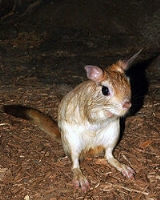
Anomaluromorpha

Encyclopedia
Anomaluromorpha is the name given to a clade
that unites the anomalure
s with the springhare
. It has alternately been designated as either a suborder or infraorder. Most recently, recognized it as one of five suborders of rodents.
restricted to sub-Saharan Africa
. Many authors have suggested that the two extant families may be only distantly related, and that they belong to separate suborders or infraorders. For example, the Pedetidae are the only family of rodents with multiserial enamel except for the Hystricognathi
. This character, the hystricomorphous zygomatic region, and a common distribution in southern continents has led many researchers to suggest that the springhare (but not anomalures) may be allied with hystricognaths. generated some support for Anomaluromorpha in a molecular phylogeny
using 12S rRNA and cytochrome b
.
family probably belongs to this group.
Clade
A clade is a group consisting of a species and all its descendants. In the terms of biological systematics, a clade is a single "branch" on the "tree of life". The idea that such a "natural group" of organisms should be grouped together and given a taxonomic name is central to biological...
that unites the anomalure
Anomalure
Anomaluridae is a family of rodents found in central Africa. They are known as anomalures or scaly-tailed squirrels. There are seven extant species, classified into three genera...
s with the springhare
Springhare
The springhare , or springhaas, is not actually a hare, but a member of the order Rodentia. It is one of a number of species in the genus Pedetes, and is native to southern Africa. Synonyms are P. caffer or P...
. It has alternately been designated as either a suborder or infraorder. Most recently, recognized it as one of five suborders of rodents.
Characteristics
The suborder Anomaluromorpha was erected to unite sciurognathous rodents with a hystricomorphous zygomasseteric systemZygomasseteric system
The zygomasseteric system in rodents is the anatomical arrangement of the masseter muscle of the jaw and the zygomatic arch of the skull...
restricted to sub-Saharan Africa
Sub-Saharan Africa
Sub-Saharan Africa as a geographical term refers to the area of the African continent which lies south of the Sahara. A political definition of Sub-Saharan Africa, instead, covers all African countries which are fully or partially located south of the Sahara...
. Many authors have suggested that the two extant families may be only distantly related, and that they belong to separate suborders or infraorders. For example, the Pedetidae are the only family of rodents with multiserial enamel except for the Hystricognathi
Hystricognathi
Hystricognathi is an infraorder of rodents. Hystricognaths are distinguished from other rodents by the bone structure of their skulls. The masseter medialis passes partially through the infraorbital foramen and connects to the bone on the opposite side...
. This character, the hystricomorphous zygomatic region, and a common distribution in southern continents has led many researchers to suggest that the springhare (but not anomalures) may be allied with hystricognaths. generated some support for Anomaluromorpha in a molecular phylogeny
Molecular phylogeny
Molecular phylogenetics is the analysis of hereditary molecular differences, mainly in DNA sequences, to gain information on an organism's evolutionary relationships. The result of a molecular phylogenetic analysis is expressed in a phylogenetic tree...
using 12S rRNA and cytochrome b
Cytochrome b
Cytochrome b/b6 is the main subunit of transmembrane cytochrome bc1 and b6f complexes. In addition, it commonly refers to a region of mtDNA used for population genetics and phylogenetics.- Function :...
.
Families
The suborder Anomaluromorpha contains 9 living species in 4 genera and two families. An additional fossilFossil
Fossils are the preserved remains or traces of animals , plants, and other organisms from the remote past...
family probably belongs to this group.
- †Parapedetidae
- PedetidaePedetidaePedetidae is a family of mammals from the rodent order. The two living species, the springhares, are distributed throughout much of southern Africa and also around Kenya, Tanzania and Uganda. Fossils have been found as far north as Turkey. Together with the anomalures, Pedetidae forms the suborder...
- springhare - Anomaluridae - scaly-tailed flying squirrels, flying mice
Potential relatives
The following fossil taxa are also sometimes placed in the Anomaluromorpha:- †DiatomysDiatomysDiatomys is a hystricomorphous sciurognathous rodent known from Miocene deposits in China, Japan, Pakistan, and Thailand. The fossil range is from the late Early Miocene to the Middle Miocene .- Specimens :...
- †Zegdoumyidae